


 by Tom Gurney
Tom Gurney BSc (Hons) is an art history expert with over 20 years experience
Published on June 19, 2020 / Updated on November 18, 2026
Email: tomgurney1@gmail.com / Phone: +44 7429 011000
Bust of Pope Paul V
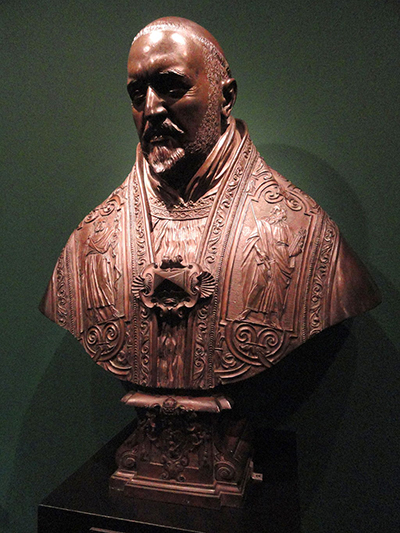
Pope Paul V looks out from above a heavy cope. Two saints appear in the bands of embroidery that run down the front, and a large clasp holds the garment across his chest. The bronze shown here is the portrait preserved at Statens Museum for Kunst in Copenhagen, where it is catalogued as DEP47 and dated 1621–22. Sebastiano Sebastiani cast the bronze after a design by Gian Lorenzo Bernini. The design is closely related to a full-sized marble at the Getty Museum. A smaller marble portrait at the Galleria Borghese is a separate work, and its date is still debated. [1][2][3]
At a Glance
- Date1621–22
- Location or statusStatens Museum for Kunst, Copenhagen
- WorkBronze cast by Sebastiano Sebastiani after Bernini
The work in Bernini’s career
The Rape of Proserpina
1621–22Bust of Pope Paul V
1621–22Apollo and Daphne
1622–25David
1623–24Reading the papal vestments
In the bronze, the head rises above a broad sweep of cloth. Much of the visual detail sits below the face. The embroidered saints stand within the separate decorative bands, so their silhouettes remain distinct from the larger folds of the mantle. The borders turn to follow the drape of the cloth, and the clasp creates a firm point where the front edges meet. These details orient the viewer before the expression becomes clear. The shoulders spread to both sides, while the face and the point of the beard concentrate attention in a smaller area. [1][2]
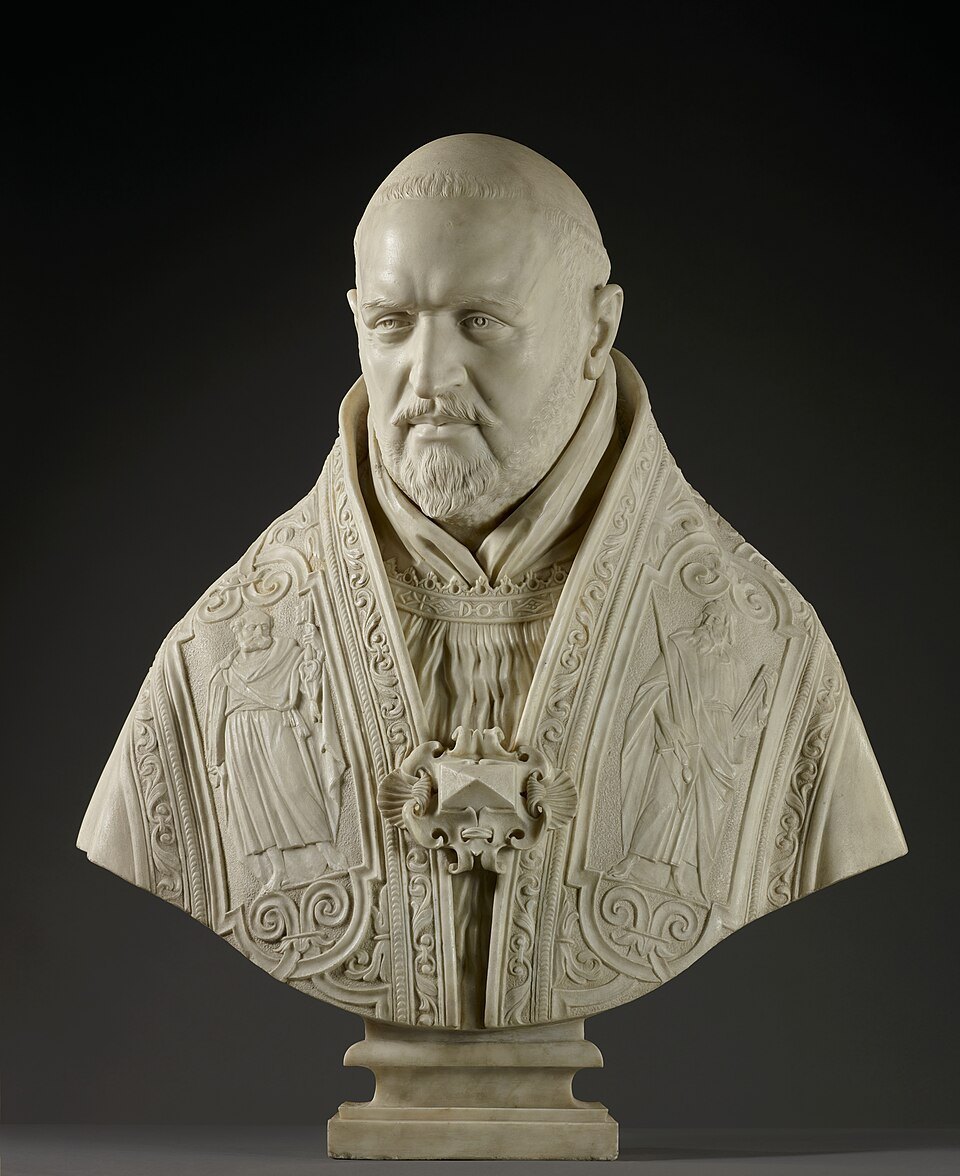
Peter and Paul are the apostles associated with Rome. In the Getty marble, Peter holds keys and Paul carries a sword and book. The corresponding panels on the bronze belong to the same design. Because they are presented as embroidery, the saints have to occupy the shallow surface of a garment as well as suggest standing figures with attributes of their own. The rise and fall of the folds brings parts of their images into shadow even though the design of each panel remains legible. The portrait therefore uses sculpture at two scales. The face and upper body describe the sitter, while the small figures on the cope identify the office and its associations. [1][2][4]
The treatment of the head is restrained by comparison with the decoration on the vestments. The hair is cut in a tonsure, leaving much of the head bare, and the beard gives the lower part of the face a different texture from the cheeks and forehead. Across the front of the bust one can move from the close, irregular marks describing hair to the ordered forms in the embroidery. Light can pick out those marks differently in bronze and marble. On dark metal the highest points of the design can take on a strong reflection, while on pale stone the depth of an incision becomes visible through the shadow within it. [1][2][4]
The commission and the bronze
Paul V was Camillo Borghese, uncle of Cardinal Scipione Borghese. He died in 1621. The Getty’s provenance records payments made to Bernini in June and September of that year, and the museum identifies the full-sized marble as a posthumous portrait commissioned by Scipione. That dating places the work among Bernini’s early commissions for the cardinal. It also explains why the commission was a form of family commemoration as well as a formal representation of a pope. The choice of vestments gave the likeness a public language even though the work was obtained by Paul’s nephew. [2][4]
The Copenhagen museum connects its bronze with the casting undertaken by Sebastiani in 1621–22. It proposes that he worked from Bernini’s model for the marble. Such a relationship accounts for the close agreement between the two finished works without requiring the bronze to have been moulded from the Getty’s marble itself. The payments connected with the portrait and with the casting are evidence for different stages in its production. The Copenhagen catalogue gives the bronze’s height as eighty-three centimetres. The width across the shoulders is nearly as great, giving the ornament on the cope considerable room in relation to the size of the head. [1][2][4]
Its catalogue also records that Scipione commissioned a comparable portrait of Paul’s successor, Gregory XV. The pairing is a reminder that a bust of a particular man could be considered alongside a likeness of another holder of the same office. The format leaves room for distinctive faces, while the presentation of the body and its vestments can make a connection visible between otherwise separate portraits. The design of the Paul V therefore had to communicate enough about one man to serve as a memorial and enough about the office to stand beside a successor. [1][2]
Sebastiani before the Bernini commission
Sebastiano Sebastiani had already worked on a bronze image of Paul V before casting the bust now in Copenhagen. The Louvre preserves Nicolas Cordier’s preparatory drawing for a public statue of the pope in Rimini. Its catalogue records the contract made with Sebastiani on 10 April 1611. He undertook to cast the larger-than-life figure according to Cordier’s directions. The Louvre traces the model to January 1612 and leaves open whether the casting took place in Rome, where Cordier worked, or in Recanati, where Sebastiani trained. The document gives a view of what it meant to commission a portrait in bronze. The artist who modelled the pope and the founder who brought that design into metal had identifiable responsibilities. [5]
The Rimini design shows Paul above a tall pedestal ornamented with heraldry. The Louvre notes that the executed monument used a simpler architectural base, with proposed bronze reliefs still unfinished when Sebastiani died. Comparing the drawing and commission reveals how much could change between the conception of a public monument and the object installed. In Copenhagen the portrait’s identity is concentrated within the bust, where the face, garment and clasp carry details that the Rimini project could distribute between the figure and a much larger structure below it. Sebastiani’s role connects the two commissions, while each sculpture had a different scale and setting. [5][6]
The study published by the Comune di Rimini follows the division of work further. Cordier’s part of the contract ended with a finished wax model. Sebastiani’s responsibilities extended past casting to cleaning up and finishing the metal surface. That distinction matters when a bronze is compared with the marble that shares its design. The folds and embroidered figures must survive the change of material, and the finish determines how they catch light. The Rimini contract documents those responsibilities for the public statue. It gives an example of the work Sebastiani could bring to a commission without identifying the person who finished particular passages of the Copenhagen bust. [11]
The papal likeness on a medal
Giacomo Antonio Moro represented Paul V in a much smaller format. The Klassik Stiftung Weimar catalogues an example in Goethe’s collection dated 1612, a copper-alloy cast after a struck medal. A different example in the Bargello was struck in gold during the thirteenth year of Paul’s pontificate, 1617–18. It carries the pope’s portrait on one face and a view of Carlo Maderno’s Confession Chapel at Saint Peter’s on the other. A portrait could thus associate Paul with a building project and be handled or passed from one owner to the next. The front of the bust concentrates attention on his presence, while the two sides of the medal connect the sitter and his patronage in a single object. [7][8]
The numismatist Giulia Daniele draws attention to the partly turned bust and the elaborate brooch on the Bargello medal, which he compares with the larger Bernini marble at the Getty. He considers whether the resemblance might point to an earlier portrait design or model. The Getty continues to identify its marble with the posthumous commission documented in 1621. The date on the medal supplies an early instance of a related treatment of robes and clasp. It leaves the route of any exchange between sculptor and medallist open. Nor does it settle the separate debate over the date of the small Borghese bust. [8][9][10]
The other records of casts and copies
The Copenhagen catalogue records a second bronze portrait of Paul in a 1633 Villa Ludovisi inventory. It describes that bronze as lost. The same catalogue discusses a plaster at Santa Maria Maggiore in Rome, proposing that it was cast from the Copenhagen example. The inventory and the plaster represent different kinds of evidence. The inventory places a bronze portrait of the pope in another collection without supplying an object for direct comparison. The plaster preserves a form that can be compared to the surviving bronze, although the exact circumstances of its making remain uncertain. The Rimini study notes disagreement over whether the painted plaster derives from the marble or from the bronze. [6][11]
These records also help explain why it matters to specify which likeness is under discussion. The Copenhagen bronze and Getty marble can be compared directly through their surviving details. The smaller portrait in Rome raises a different question about dates and payment. A lost bronze known through a written description can tell us about demand for the portrait, while its pose, finish and precise relation to the Copenhagen bust remain open. The distinct evidence for each object is what allows the history of the design to be followed across workshops and collections. [6][9][10]
The Getty marble and its rediscovery
The full-sized marble stayed in the Borghese family until it was sold in Rome in 1893. The Getty’s provenance records that the auction catalogue gave the work to Alessandro Algardi. For much of the time after the sale, students of Bernini relied on the photograph made for the auction and on the bronze as a record of the larger composition. The Getty announced its acquisition of the marble in 2015 after its reappearance in a private collection. The auction photograph supplies evidence of which object left the collection. The bronze supplies a surviving version of the design in three dimensions. Those records serve different purposes when the ownership and the authorship of the marble are considered together. [1][2][4]
A comparison of the two larger portraits can begin with the turn of the head, the position of the clasp and the disposition of the cope. Agreement in these larger features makes it possible to look more closely at how the materials describe the figure. In a photograph a reflection on a bronze surface may pull attention to a different part of the design from a shadow on the marble. Recognising the correspondence of the forms allows the viewer to distinguish a difference introduced by the material or display from a difference in how the portrait was composed. [1][2]
The smaller Borghese bust
The marble at the Galleria Borghese measures thirty-five centimetres in height and is catalogued as CCXLVIII. The museum identifies a portrait by Nicolas Cordier as a model and describes the small bust’s uncut pupils, which leave its gaze comparatively indeterminate. Paul still wears official vestments, including the embroidered apostles and the clasp. At this scale the details of the face and the treatment of the stone can be taken in at much closer range. The object demonstrates how the elements of a formal portrait could be carried into a bust intended for a more private setting. [3]
The Borghese catalogue preserves two proposals for its date. The earlier one places it in 1617–18, while Paul was alive, and has been supported by Domenico Bernini’s account of the pope keeping the bust on his desk. A rereading of payment evidence led to the proposed posthumous date of 1622–23. The museum leaves the question open. The secure evidence for the larger Getty commission and the Copenhagen bronze makes it possible to consider that debate on its own terms. It concerns a different piece of marble and a different scale of viewing. [1][2][3]
Discussion
The bronze portrait preserves small details in the pope’s cope.
Reader Insights
Which cast details are most legible in the fold of the garment?
What changes when you compare the bronze with the related marble design?
How does Sebastiano Sebastiani’s role affect the way you would credit the bust?
Join the Conversation
Share a detail, comparison or question about Bust of Pope Paul V by Gian Lorenzo Bernini below.
References
- Statens Museum for Kunst. Bust of Pope Paul V Borghese. Inventory DEP47, casting, date and relationship to the marble and the Gregory XV portrait. View source
- J. Paul Getty Museum. Bust of Pope Paul V. Original payments, commission and provenance of the Getty marble. View source
- Felici, Sonja. Bust of Pope Paul V. Galleria Borghese, January 2023, inventory CCXLVIII, dating and discussion of the separate small marble. View source
- J. Paul Getty Museum. Recently Rediscovered Bernini Acquired by Getty Museum. Acquisition announcement, June 2015. View source
- Musée du Louvre. Projet pour une statue du pape Paul V Borghese. Nicolas Cordier, French catalogue and account of the Rimini commission.
- Statens Museum for Kunst. Buste af Pave Paul V Borghese. Danish notes on Sebastiani, the lost bronze and the proposed plaster cast.
- Klassik Stiftung Weimar. Medaille auf Papst Paul V.. German catalogue, GMM-372.
- Daniele, Giulia. Cataloguing the gold and silver papal medals at the Bargello Museum. Médailles, FIDEM Congress proceedings, pp. 59–60, figs. 12, 14 and 15.
- J. Paul Getty Museum. Bust of Pope Paul V. Collection catalogue and 1621 provenance notes.
- Felici, Sonja. Busto di Paolo V. Italian collection catalogue, CCXLVIII.
- Comune di Rimini. Paolo V in Rimini, pp. 35–37, on the founder’s work and the Santa Maria Maggiore plaster.








