


 by Tom Gurney
Tom Gurney BSc (Hons) is an art history expert with over 20 years experience
Published on June 19, 2020 / Updated on November 18, 2026
Email: tomgurney1@gmail.com / Phone: +44 7429 011000
Bust of Costanza Bonarelli
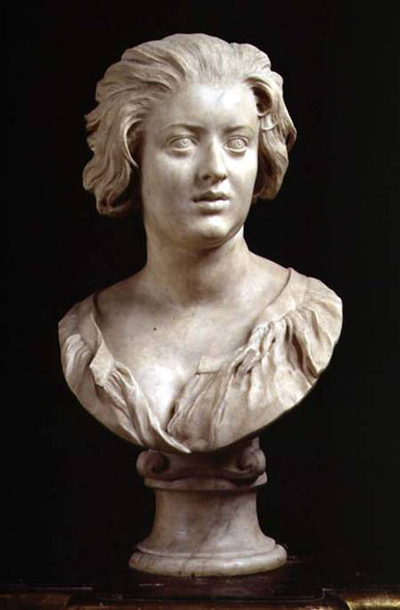
Costanza Piccolomini turns her head with her lips slightly parted. A few locks escape from her gathered hair, and her shirt opens at the throat. Gian Lorenzo Bernini carved this portrait in white marble around 1637–38. The figure seems to have turned towards a person whose presence we have to supply. Now held by the Museo Nazionale del Bargello in Florence, the bust is often called Costanza Bonarelli. That familiar title reflects one form of her married name. Archival research gives a fuller account of Costanza as a woman who built a collection and continued a sculpture business in Rome. [1][2][3]
At a Glance
- Datec. 1637–38
- Location or statusMuseo Nazionale del Bargello, Florence
- WorkWhite marble portrait of Costanza Piccolomini
The work in Bernini’s career
Bust of Costanza Bonarelli
c. 1637–38Ecstasy of Saint Teresa
1647–52Fountain of the Four Rivers
1648–51A face in the middle of turning
Bernini makes the movement legible at the scale of the entire bust. The shoulders establish a broad lower shape, and the neckline carries attention from that base towards the face. The turn makes the line of the mouth and the direction of the eyes more apparent. If you shift to one side, the angle of the face changes and the features come into view in a different order. The effect of an encounter depends partly on where you stand in relation to the marble. [1]
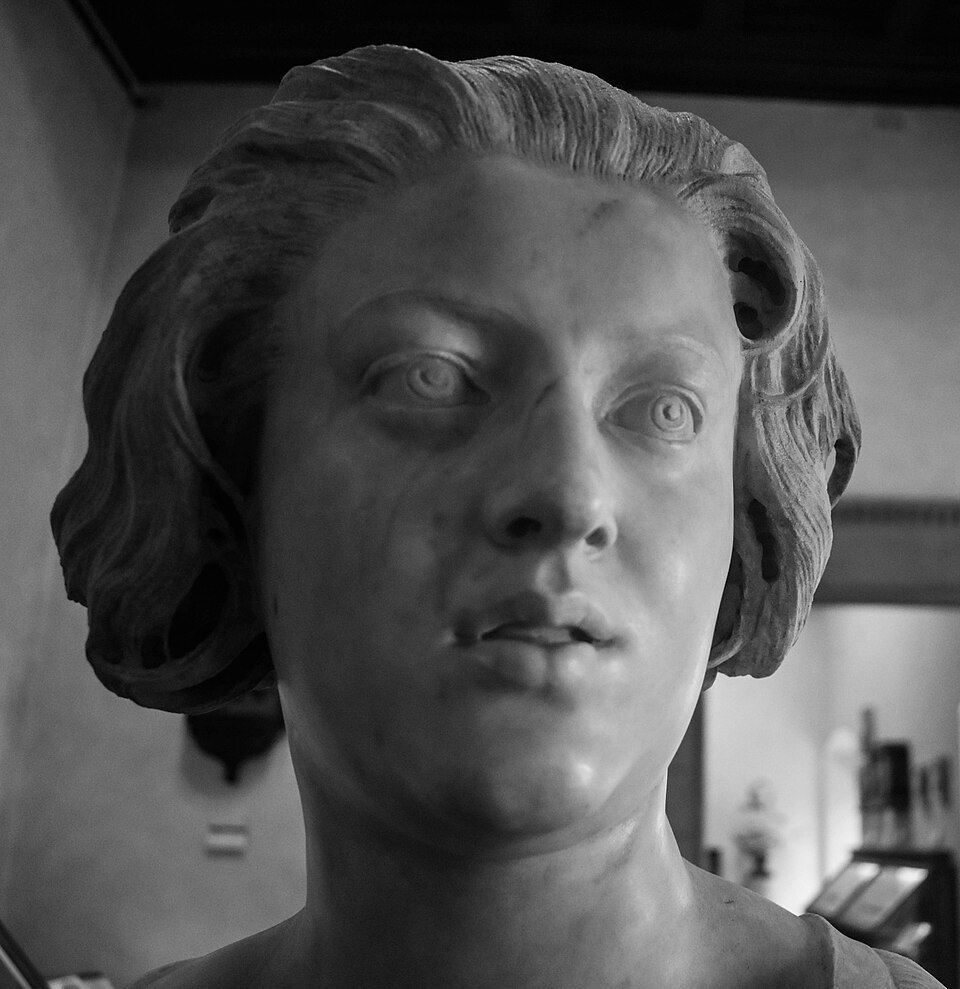
The clothing contributes to that movement. The loose opening of the shirt leaves a stretch of the neck visible, with sharper folds in the cloth beside it. The hair has its own direction, drawn away from the face and broken at the edges by smaller locks. These passages divide the reflected light into areas of different size. The broad surfaces of the face carry gradual shifts of tone. The edges of the shirt and the strands of hair produce narrower shadows. The open lips can register with a much smaller change in depth because the surrounding face is so carefully modelled. [1]
Bernini had already explored a similarly fleeting expression in his busts of Scipione Borghese, dated 1632. The cardinal’s cape, buttons and headgear define his rank even as his parted lips suggest interrupted talk. Costanza’s shirt and hair give Bernini another way to set a head and shoulders in motion. Here the dress reads as something worn in everyday life. It brings the pose closer to an informal exchange, even though the dimensions and finish of the marble give the likeness a presence that can command a room. [1][4]
Costanza in the archives
The national catalogue describes the portrait as a private work and dates it to about 1637–38. It depicts Costanza Piccolomini, who was married to Matteo, a sculptor who worked with Bernini. Matteo’s surname appears as Bonarelli and Bonucelli in published records. Sarah McPhee uses Costanza’s family name, Piccolomini, in her study of the sitter. Reading across those names helps connect a portrait usually encountered under a single title with the records of the woman it represents. [1][3]
Costanza and Bernini had a relationship. Bernini subsequently ordered a servant to slash her face. The museum and national catalogue discuss the assault, and the latter traces its consequences through documentary research. The servant was exiled. Costanza was confined for several months at Casa Pia, an institution near the Pantheon, while Bernini continued to work for the pope. A letter she wrote to the governor of Rome sought her release into the care of her husband. The letter gives Costanza’s actions a place in the account and records one of the means available to her for getting out of confinement. [1][2][3]
McPhee’s research follows Costanza through the years after the assault and after Matteo’s death. Costanza continued to operate the sculpture business and held a collection that included paintings and ancient sculpture. Her will and the inventory drawn up after her death in 1662 provide evidence for that later life. The inventory is important because it accounts for objects in her possession at a specific date. It helps establish the scale and variety of the collection without assigning each acquisition to a particular moment in the marriage or her widowhood. Her activity in the Roman market gives the portrait a context beyond the circle of artists who made and first knew it. [1][3]
These documents also help establish where the likeness can and cannot answer a question. The sculpture gives an observer the arrangement of Costanza’s features and the action of turning. The letter, the will and the inventory give evidence of decisions she made under different circumstances and of a household in which works of art had practical and financial significance. The immediate expression in the marble is consistent with several ordinary moments. The documents establish events that the face alone cannot locate in time. [1][3]
What two travellers tell us about the Uffizi display
The date of the bust’s arrival in Florence depends on how two travel accounts are read. John Evelyn’s diary places his description under 23 May 1645. He lists a head by Bernini alongside works by Michelangelo and Bandinelli and a Cupid. The edition identifies the head in a note. Balthasar de Monconys’s French account of 2 November 1646 describes much the same group and identifies Bernini’s contribution as a female head. Piera Bocci Pacini and Vera Laura Verona reproduce the accounts and compare them as evidence for the arrangement of sculpture in the Uffizi. The two authors even describe the Cupid’s stone differently. Their accounts show what can happen when a traveller’s list becomes the evidence for reconstructing an interior. [7][8]
The Italian national catalogue cites Tomaso Montanari’s observation that Evelyn’s wording overlaps with Monconys’s. For that reason Montanari takes November 1646 as the secure date by which the marble was in the gallery. The proposal that Bernini gave it to Giovan Carlo de’ Medici during the cardinal’s studio visit on 2 May 1645 remains plausible. An older account places the bust with the duke of Modena first, but the catalogue reports that its presence in the Este collection lacks documentary confirmation. There is firmer visual evidence for its later location. Bocci Pacini and Verona identify Costanza in Tommaso Arrighetti’s drawing for the illustrated Uffizi inventory of 1759. The drawing and the travellers’ lists mark separate moments in the marble’s life in the gallery. [8][9]
Two marble versions and what they retain
Ursula Schlegel studied two marble works that borrow from the Bargello portrait. The female bust she records in the Contini-Bonacossi collection extends the figure to the beginnings of the arms and broadens the lower shape with a mantle. A fold runs across it, and the opening at the neck falls differently on the shoulders. Its pupils are unmarked. Schlegel places the work in eighteenth-century Florence and suggests that the borrowing may have served to create a more general figure for an interior. That reading rests on changes a viewer can check, especially the altered proportions of the bust and the treatment of the eyes. [10]
A second version, in a private collection when Schlegel published it, repeats the original far more closely within a slightly smaller block. She proposed that Costanza’s husband Matteo carved it. Her reasoning starts with the closeness of the copy and asks who might have had access to the original while it was still in Rome. Access and resemblance make the attribution possible. They leave the maker’s identity open, and Schlegel’s reconstruction of the bust’s early whereabouts predates the provenance reassessment in the Italian catalogue. The two versions show different ways a sculptor could use the likeness, one retaining much of the original arrangement and the other reshaping it into a wider figure. [9][10]
The portrait in New York in 1940
The Bargello lent the original to the Museum of Modern Art for its 1940 exhibition of Italian masters. The catalogue highlighted the pupils, mouth and hair and reproduced the marble from two angles. In profile, the mouth and the sweep of hair can be studied against the dark background. The larger view brings the eyes and the folds at the shoulders into the same image. The catalogue gave the work an earlier date, about 1625. That date belongs to the history of the exhibition. The current Italian record dates the original to about 1637–38. The two publications also ask different questions of the sculpture. MoMA’s entry uses the personal character of the portrait to distinguish it among Bernini’s large public projects. The Italian catalogue follows the documents that identify the woman and the route by which her likeness became a gallery piece. [9][11]
From the studio to Florence
The Bargello says the bust remained in Bernini’s studio for a time. It dates its transfer to Cardinal Giovan Carlo de’ Medici to 1645 and describes Bernini himself as the probable donor. Once in the Florentine collections, the marble was displayed in the Uffizi sculpture gallery beside Michelangelo’s Brutus. The passage from studio to gallery changed the audience for a likeness that had been made privately. In that company, the head’s turn and the treatment of the stone could be assessed alongside a different sculptor’s handling of a bust. The Bargello now gives Costanza a prominent place in its display of Baroque sculpture. [1][2]
Other objects reproduce the same likeness. The Italian national catalogue identifies a nineteenth-century plaster taken from the Bargello marble and separately records a bronze cast after it. A reproduction can preserve the angle of the head and the outline of the shirt while presenting those details in a different material. The marble’s date and provenance belong to the original. Comparing the records matters in this case because the plaster entry gives an earlier date for the model than the more recent record for the carving itself. It is the record for the marble that supplies the dimensions and date used here. [1][5][6]
The marble stands 74.5 centimetres high. Its scale lets the face stand out at a distance while the marble still rewards looking from nearer by. Begin with the lighter stretch along the throat, then notice where the line of the chin leads into the parted lips. From the side, the turn of the head becomes clearer and the open shirt gives the shoulders a stronger direction. The old Florentine display put the portrait into a history of marble carving. The archives give it a second history, that of a sitter whose work with sculpture and collections continued for years beyond the making of her likeness. [1][2][3]
Discussion
Costanza turns with her mouth slightly open and her shirt loose at the throat.
Reader Insights
Which part of the carving makes her look as if she has just moved?
How does the treatment of clothing compare with the bust of Scipione Borghese?
What can the portrait itself tell you about the sitter, apart from the biographical record?
Join the Conversation
Share a detail, comparison or question about Bust of Costanza Bonarelli by Gian Lorenzo Bernini below.
References
- Catalogo Generale dei Beni Culturali. Ritratto di Costanza Bonarelli, national record 0900349873. View source
- Musei del Bargello. Il nuovo medagliere e la sala della scultura barocca. Display and provenance account. View source
- McPhee, Sarah. Interview on Costanza Piccolomini and the Roman archives, Getty, Art + Ideas. See also archive references in the national catalogue. View source
- Felici, Sonja. Bust of Scipione Borghese. Galleria Borghese, inv. CCLXV. View source
- Catalogo Generale dei Beni Culturali. Busto di Costanza Bonarelli, national record 0900425032, plaster after the Bargello original. View source
- Catalogo Generale dei Beni Culturali. Busto di Costanza Bonarelli, national record 0302137057, bronze after the Bargello original. View source
- Evelyn, John. The Diary of John Evelyn, vol. II. Edited by E. S. de Beer. Florence, 23 May 1645.
- Bocci Pacini, Piera, and Vera Laura Verona. Lo sviluppo della Galleria degli Uffizi. Comparison and transcriptions of the travel accounts, including Monconys’s French text, and note 204 on the illustrated inventory.
- Ministero della Cultura. Ritratto di Costanza Bonarelli, linked open data record. Provenance discussion citing Tomaso Montanari.
- Schlegel, Ursula. Berninis Büste der Costanza Bonarelli: Die Kopien. Comparative descriptions and attribution proposal.
- Museum of Modern Art. Italian Masters Lent by the Royal Italian Government. 1940, pp. 58–59, no. 26.








