


 by Tom Gurney
Tom Gurney BSc (Hons) is an art history expert with over 20 years experience
Published on June 19, 2020 / Updated on November 18, 2026
Email: tomgurney1@gmail.com / Phone: +44 7429 011000
Ares Ludovisi
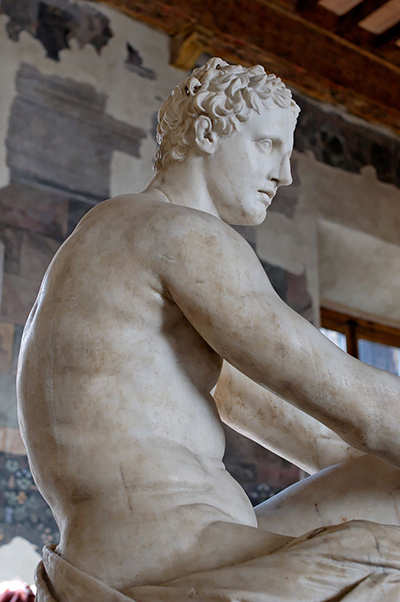
The seated warrior known as the Ares Ludovisi rests his hands near a raised knee. A sword and shield identify him with warfare, while a small figure of Cupid appears near his feet. The marble belongs to the Boncompagni Ludovisi collection at Palazzo Altemps in Rome. Gian Lorenzo Bernini worked on it in 1622, restoring an ancient statue at a time when collectors wanted excavated sculpture to be ready for display among other marbles. The result has a history as an ancient figure and as a seventeenth-century restoration. An account book, successive inventories and later reproductions help distinguish what each period contributed to the sculpture we see. [1][2][3][4]
At a Glance
- DateRestored in 1622
- Location or statusPalazzo Altemps, Rome
- WorkAncient marble restored by Bernini
The work in Bernini’s career
The Rape of Proserpina
1621–22Ares Ludovisi
Restored in 1622Apollo and Daphne
1622–25David
1623–24A warrior seated at rest
The figure is usually called Ares, the Greek god of war, or Mars, his Roman counterpart. The pose gives the body a compact outline. One knee is raised, and the arms return towards it, drawing several parts of the figure together. The lower leg leads the eye out from that compact arrangement. The seated body takes up relatively little room in comparison with the standing figure a warrior’s subject might lead us to expect. There is time to take in the weapons as objects at rest and then to notice the smaller presence at the god’s feet. [1][3]
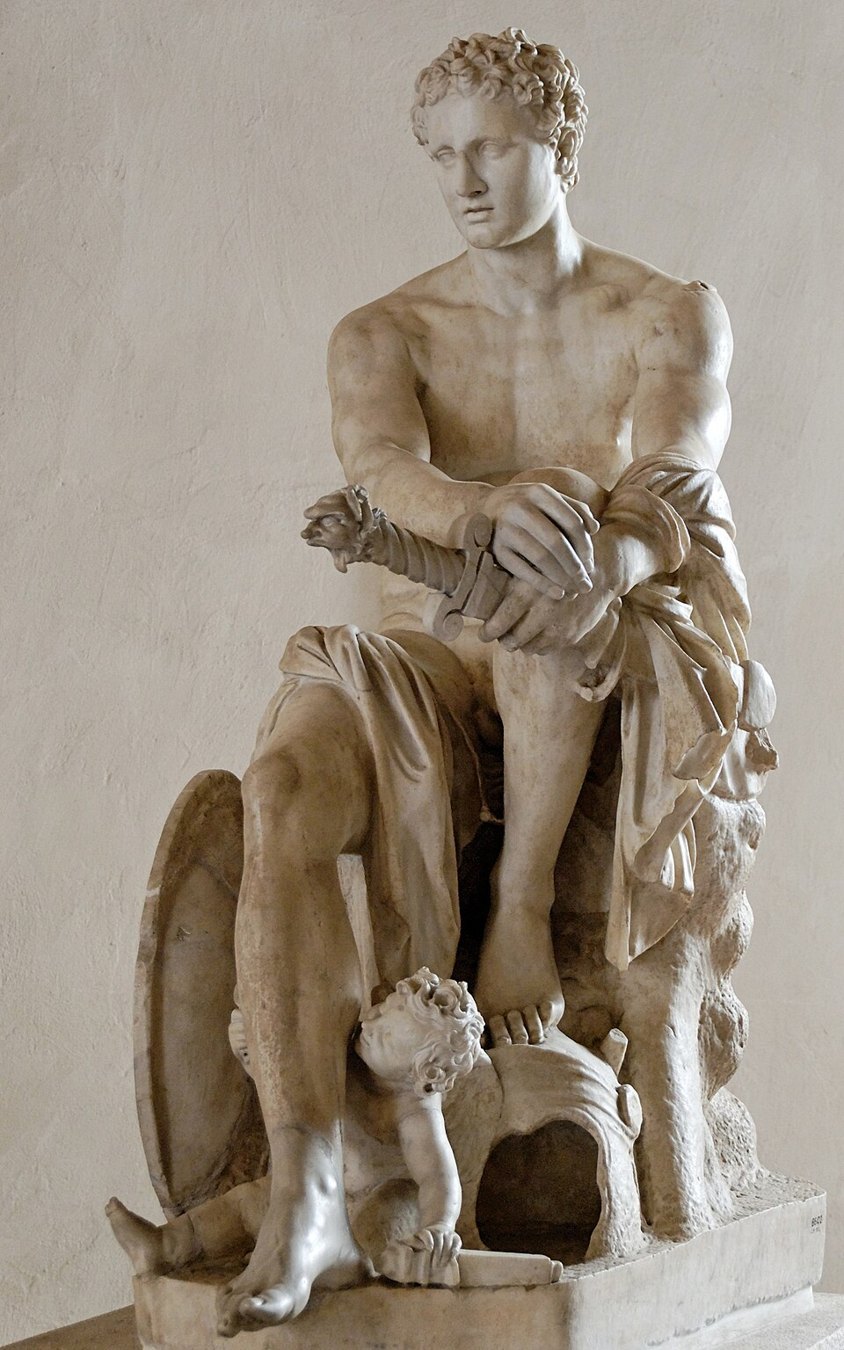
Cupid introduces a second scale and another subject. The small figure can be hard to pick out when the main body dominates the view. Once seen, it changes the significance of the empty ground around the feet, which becomes a place for a second figure to act. A combination of Mars and Cupid can make rest seem associated with love. The history of the carving matters to that reading because the small figure has been particularly closely associated with the early modern restoration. The main body gives the group its structure, while a comparatively small passage can influence the way its subject is understood. [1][3]
Bernini in the Ludovisi accounts
A payment dated 20 June 1622 names Bernini and refers to the restoration of an ancient statue described as Adonis. The transcribed account also covers other work at the Ludovisi property, so the sixty scudi recorded there cannot be treated as a separately itemised price for this one intervention. Sapienza’s Mirror LAB assembles the document with later inventories of the seated figure. The change of name matters. An account made to record an expense could use an identification that differed from the one a later inventory gave the very same object. [1][2]
The written record establishes that Bernini was engaged as a restorer. For the details of his work the evidence is more varied. Cambridge’s Museum of Classical Archaeology describes Cupid as probably an invention of the seventeenth-century restorer. The question of who devised the small figure is distinct from the question of which parts of its surviving marble were recut or supplied. The bill gives no list of the joins or replacements. Looking closely at Cupid and at the sword’s decorative hilt helps show the sorts of small passages through which a restoration can affect the whole figure. Individual claims about the carving require evidence beyond the fact that Bernini received a payment. [1][2][3]
How the statue acquired its names
The inventory of October 1623 describes a seated gladiator with a curved sword and a Cupid beside him. It also records a gilded wooden pedestal bearing the cardinal’s arms. By January 1633 the inventory identifies the seated figure as Mars and notes a sword, shield, helmet and an accompanying Cupid. Later records return to the designation of gladiator, and an inventory of 1819 calls it a seated Mars. The titles show how different observers weighed the same evidence. Armour and the seated pose could suggest a mortal combatant. The little figure beside him allowed a mythological reading. [2]
The pedestals mentioned in the inventories also tell us how the marble presented itself in the villa. A wooden support could be coloured to resemble stone and framed with gilding, and the family arms were part of what a visitor saw below the figure. These descriptions place the acquisition among objects displayed as possessions of the cardinal. They also help us imagine the angle at which a spectator would see the small figure. Elevating the warrior changes the view of the knees and feet, where much of the modern discussion about the subject is concentrated. [2]
The inventories also show that a single detail could support more than one name. The 1665 account calls the figure a gladiator and still describes a Cupid with his bow and quiver. The presence of Cupid therefore did not settle the question for every observer. A reader looking only for the word Mars would miss records with recognisable descriptions of the hands, the raised knee and the weapon. Following the object across these entries requires comparing the arrangement of the figures and their accessories alongside the changing titles. [2]
Ares or Achilles
The Italian national catalogue places the Roman statue in the Antonine period. The identity of the warrior and the composition from which he may have come have been debated separately. Filippo Coarelli proposed that he is Achilles and that a seated female marble found nearby represents his mother Thetis. As the Mainz catalogue explains, this would put the figure within a wider group associated with a temple of Neptune. The proposal shifts attention from the surviving weapons and Cupid to the original relationship between several figures. It depends on reconstructing an ancient setting from pieces found apart. The Roman catalogue retains the name Ares. [10][11]
What Bernini supplied to the old marble
Yves Bruand compared the Ludovisi accounts and inventories with the restored statues themselves. In a discussion of the collection, he singled out the freedom Bernini took with the small Eros. Other sculptors working for the family also had to decide how closely an addition should follow the antique. Bruand contrasts Bernini’s handling of Eros with Alessandro Algardi’s effort to approach the ancient style when completing the Hermes Loghios. The comparison helps explain why a detail at the foot of the Ares became so conspicuous in the history of its reception. It is a place where the figure restored in 1622 gives room to a sculptor working in a different period. [6][7]
Cristiano Giometti discusses the head of Cupid and the sword hilt among Bernini’s additions. The hilt ends in a distorted little face with its tongue protruding. Set near the composed torso of the warrior, the open mouth gives that small accessory an expression of its own. Giometti also notes a coarser finish on marble used for the restorations and reads the difference as deliberate. The bill for restoring the statue records a transaction. Comparison of textures and details gives a further basis for judging how conspicuous Bernini’s contribution was meant to be. The precise extent of the new carving in Cupid remains a separate question from the effects of the smiling head or the face on the sword. [6][7]
What vanished when Mars was engraved
Claude Randon engraved a front and a side view for the Raccolta di statue antiche e moderne, first published in 1704. In the inscription to the front view, the figure is Mars, shown nude with his weapons at his feet and located in the Ludovisi gardens. The side view gave a reader access to the shape of the seated figure from another angle. Together the plates offered a closer look at the work than one image could supply, yet the printed presentation could also shape what a reader understood to be part of the antique. [7][8][9]
Giometti points out that the print omits the laughing Cupid and Bernini’s expressive hilt. He interprets the omissions as a decision about the image made for the publication. A reader of the book could therefore encounter a Mars from which two of the restoration’s distinctive features had disappeared on paper. That choice brings the caption’s identification of the figure into sharper focus, since a viewer no longer has to account for the playful expression of the small companion. The engraving establishes the features its makers chose to show. Giometti’s reading of the purpose behind that choice draws on Maffei’s attitude toward antique sculpture and remains an interpretation. [7][8][9]
A plaster with a history of its own
A plaster cast acquired for Mainz in March 1881 preserves a different stage of the sculpture’s reception. The university’s catalogue traces the purchase to the firm of Antonio Vanni in Frankfurt. A photograph from the 1930s shows that the cast then included the sword pommel and the figure of Eros. The catalogue attributes the loss of those parts, wholly or in part, to damage around the time of the Second World War. Here the comparison between the cast’s present state and a dated photograph helps reconstruct what was originally copied. That history belongs to the plaster in Mainz, while the Roman marble has its own record of joins and additions. [10]
A conservation team in Mainz also found layers of paint on the cast’s right lower leg. The university account connects them with attempts to restore the plaster by repainting it. These layers record successive treatments of the copy after its arrival in Mainz. The cast began as a record that included Bernini’s additions. Its losses and coatings now show how a teaching collection could acquire a material history of its own, long after a publisher had chosen to send a different version of the figure into circulation. [7][10]
From the villa to a museum
Francesco Piranesi’s print of the sculpture, now in the Metropolitan Museum of Art, belongs to a series of classical statues in Rome. By placing the figure among those statues, the publication made its antique identity a central part of how it travelled on paper. A photograph issued by Edizioni Brogi and held by the Rijksmuseum documents the marble in the Villa Boncompagni Ludovisi. The picture preserves a later point in the history of the sculpture and its setting. These reproductions are also views selected by their makers. Each lets us compare what is visible of the sword and the small figure at the feet with what the inventories chose to describe. [4][5]
The cast held in Cambridge is another kind of record. A cast preserves three-dimensional relationships that a print or a photograph reduces to one view. It can show how far the knee projects and where the small figure is placed in relation to it. The Roman marble remains the source for a question about stone or joins. The different records have their value in combination, particularly where a description of the subject might lead someone to imagine a statue of a different shape. [1][3][4][5]
The Ares is now kept at Palazzo Altemps in the Museo Nazionale Romano. When looking at the group, begin with the position of the hands and the way the raised knee supports the pose. Then look lower down to see how the weapons and Cupid extend the subject beyond the seated body. The main figure gives the statue its broad outline. The surrounding attributes have repeatedly altered what people have called it. The record of restoration and the early inventories let us follow those changes through specific documents as well as through the finished marble. [1][2][3]
Discussion
An early modern restoration shaped how later viewers encountered the ancient warrior.
Reader Insights
How do the sword and shield affect your reading of the seated pose?
What evidence could distinguish an ancient detail from a replacement?
How does Cupid change the mood of the group?
Join the Conversation
Share a detail, comparison or question about Ares Ludovisi and Bernini’s Restoration below.
References
- Sapienza Università di Roma, Mirror LAB. Il catalogo, entry for Ares Ludovisi. View source
- Sapienza Università di Roma, Mirror LAB. Fonti Ares Ludovisi, transcriptions of the Ludovisi accounts and inventories. View source
- University of Cambridge, Museum of Classical Archaeology. Ludovisi Ares, cast catalogue. View source
- Metropolitan Museum of Art. The Ludovisi Ares [Mars], Francesco Piranesi. View source
- Rijksmuseum. Sculptuur van de Ares Ludovisi in de Villa Boncompagni Ludovisi te Rome, photograph issued by Edizioni Brogi. View source
- Bruand, Yves. Quelques sculptures antiques de la collection Ludovisi au début du XVIIe siècle. French proceedings, pp. 193–95.
- Giometti, Cristiano. Paolo Alessandro Maffei derestaura Bernini. In Progettare le arti, 2013, pp. 123–28.
- National Gallery of Art. Nude Statue of Mars Seated, plate LXVI. Claude Randon.
- National Gallery of Art. Nude Statue of Mars Seated, Seen from the Side, plate LXVII. Claude Randon.
- Johannes Gutenberg-Universität Mainz. Museum aus Gips und Kleister, section on the Ares Ludovisi cast. German exhibition catalogue.
- Ministero della Cultura. Statua Ares. Italian national archaeological catalogue.








