


 by Tom Gurney
Tom Gurney BSc (Hons) is an art history expert with over 20 years experience
Published on June 19, 2020 / Updated on November 18, 2026
Email: tomgurney1@gmail.com / Phone: +44 7429 011000
Martyrdom of Saint Lawrence
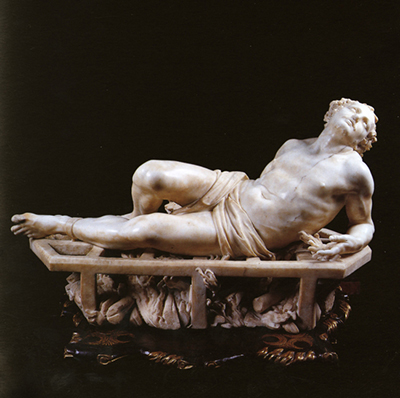
Saint Lawrence lies over a gridiron, his head turned upward and his torso twisting above the fire. Gian Lorenzo Bernini carved the white marble early in his career. The Uffizi dates the work to 1617 and holds it in the Contini Bonacossi Collection. A carved wooden support continues the subject below the stone with a tree wrapped in flames. The difference between the lowered body and the upward face gives the sculpture its expression. Bernini’s son Domenico later described his father making studies of his own reaction to heat as he prepared the figure. That story belongs to the biography of the sculptor, while the marble itself shows how selectively he represented the effects of pain. [1][2]
At a Glance
- Date1617
- Location or statusUffizi, Contini Bonacossi Collection, Florence
- WorkWhite marble with a carved wooden support
The work in Bernini’s career
Martyrdom of Saint Lawrence
1617The Rape of Proserpina
1621–22Apollo and Daphne
1622–25David
1623–24A figure held above the fire
The gridiron identifies the punishment in the traditional account of Lawrence’s martyrdom. Its regular structure provides a measure for the movement of the body. Look first along the direction of the support and then along the figure. Lawrence extends over the bars, but the turn of his chest and the change of direction at the neck prevent the two lines from coinciding. The body’s weight is apparent where it is lowered towards the grid. The upper part of the figure gives a different impression as he lifts his face. Those two tendencies allow the figure to seem at once subject to its circumstances and capable of answering them. [1]
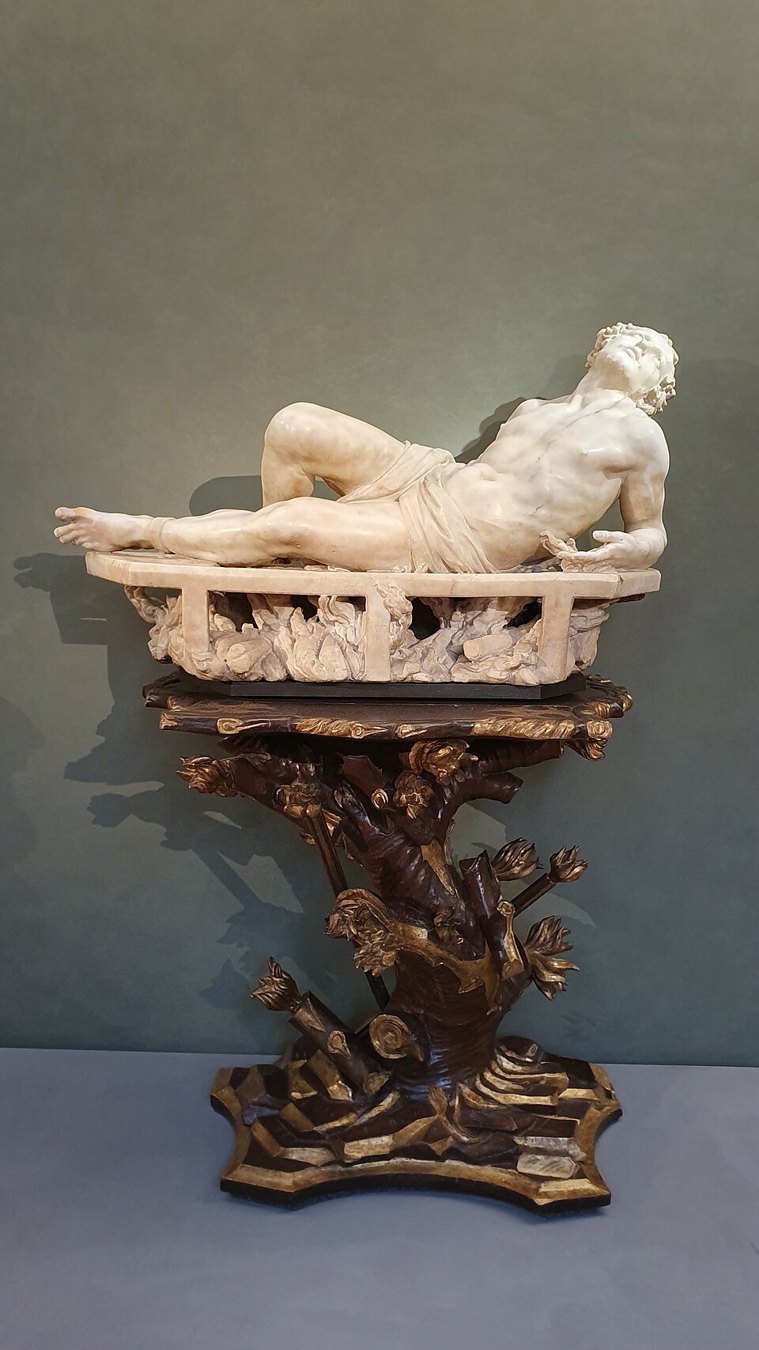
The face is an important departure from what the apparatus of the punishment might lead a viewer to expect. The Uffizi describes it as relaxed and looking upward. The expression can be understood in relation to the belief that Lawrence’s contact with God sustains him through the ordeal. His direction of attention also changes how the body is seen. The eye travels from the bars to the limbs, then follows the twist to a face directed out of the immediate scene. Bernini gives the viewer two places to concentrate. The fire and gridiron explain what is happening on the ground, while the saint’s gaze gives the action a direction beyond it. [1]
The proportions make the long axis of the sculpture consequential. The Uffizi records dimensions of 66 by 108 centimetres for the marble. From the broad side it is possible to compare the position of the head, trunk and legs in one view. From nearer either end, parts of the body overlap and more of the weight is read through foreshortening. The bars and the base remain comparatively regular in both views, providing a stable point of reference for the changing outline of Lawrence. The subject is recognisable from the equipment beneath him, but the angle of approach affects how fully the viewer can read his response. [1]
Marble and the carved wooden support
Fire appears both within the sculptural composition and in the support designed to be seen beneath it. The Uffizi describes the carved table as a tree surrounded by flames and considers it probably made after a design by Bernini. Its material gives the viewer a clear division between the pale body above and the furnishing below. Its imagery brings the continuation of the flames across that division. The furniture was therefore capable of changing the way a figure of this scale occupied a room. It raised the sculpture to view while giving the violence of the event a visible extension below the gridiron. The museum qualifies the connection with Bernini’s design, leaving room for a distinction between the conception and execution of the support. [1]
Michelangelo and the study of expression
The Uffizi identifies Michelangelo’s example in the body of Christ in the Vatican Pietà, the River God in Casa Buonarroti and Adam on the Sistine Chapel ceiling. These comparisons concern different parts of the design. The Pietà offers a way to think about the weight of a lowered figure. The River God supplies an example of the torsion possible in a reclining body. The image of Adam helps place the broad disposition of a naked figure in a composition that still has a clear direction of attention. Lawrence brings those possibilities together within a narrow scene in which the apparatus limits where the body can go. [1]
Domenico Bernini’s biography, published in 1713, gives a different account of the preparation. He says his father stood with a bare leg near hot ashes and used a mirror and a pencil to study changes in his face and flesh. The Uffizi reproduces the account. It was written many decades after the sculpture and presents the artist as someone willing to examine a sensation directly. Its interest for a viewer lies partly in the difference between the method it describes and the appearance of the finished face. The artist could gather evidence of physical discomfort and still make a religious figure whose head appears composed. The displacement of strain into the torso and limbs helps reconcile those different demands. [1][2]
Leone Strozzi and the early sculptures
The Uffizi’s presentation records that Leone Strozzi saw the work in Bernini’s workshop and acquired it. Irving Lavin distinguishes this version, associated with Domenico’s account of the sculpture, from the formulation that it was made for Strozzi. Domenico also connects the subject with the artist’s own name, Lorenzo. Lavin notes that the Strozzi family chapel in Sant’Andrea della Valle, where bronze copies after Michelangelo were installed, was being prepared in the same period. The circumstances make a study of the connection worthwhile. The Uffizi account establishes Strozzi’s place in the work’s early history, while the precise purpose for which Bernini began it remains open. [2][3]
The roughly contemporary Saint Sebastian provides another way of placing the sculpture. Both figures depend on a support and have much of their meaning invested in the direction and weight of a limb. Sebastian’s tree stands behind him as the body threatens to slip. Lawrence’s gridiron lies underneath him, where he turns his face upward during the ordeal. In each work the support belongs to the saint’s story and also determines how the figure can move. The marble of Lawrence gives the fire a material counterpart in the carved base, helping the subject extend below the level at which the viewer first meets the figure. [1][4]
The date in the biographies and the Strozzi inventory
Filippo Baldinucci and Domenico Bernini both say that Bernini carved the figure in his fifteenth year. Irving Lavin interprets that as 1614 and argues for taking the testimony seriously, in part because he sees independent grounds for placing Saint Sebastian slightly later. The Uffizi dates Saint Lawrence to 1617. The difference matters when the sculpture is placed alongside works associated with the Bernini workshop. A date of 1614 would make the sustained turn of the body and the integration of figure and setting achievements of an even younger artist. The two biographical accounts are also part of a tradition that stressed his precocity, which gives their dating particular weight in the story they tell. [6][11]
Lavin transcribes a Strozzi estate inventory of 8 July 1632 that describes a modern figure of Saint Lawrence on a gridiron. The gridiron made the figure recognisable enough for a brief entry. The document anchors it in the collection and gives a date by which the sculpture had entered it. It leaves room for the different accounts of how Strozzi came to own it. The dates of the sculptures and fittings in the family chapel show that Strozzi had reason to be interested in work that followed Michelangelo. As Lavin points out, the bronze copies on the altar wall are dated 1616. The estate entry documents ownership without settling the purpose for which Bernini carved the marble. [6][7]
The river figure and the tombs in Florence
The River God at Casa Buonarroti was a large model for a figure planned to sit low beneath the Medici tombs in San Lorenzo. The museum records a mixture of unfired clay, river sand, fibres and animal hair, with wood and metal in the model’s construction. It places the proposed figure at the foot of the tomb of Lorenzo de’ Medici. Frank Zöllner discusses the river figures as part of a possible early scheme about the passage of time, alongside the sculpted times of day. They remained at the project stage while the marble figures over the tombs became the visible part of the scheme. [8][9]
The Uffizi has also compared Lawrence’s pose to the completed reclining figures above those tombs. In the River God and the Medici figures, the turn of a reclining body is part of how the figure occupies a low architectural position. Bernini uses a comparable disposition of weight in a narrative whose turning point is carried by a single figure. The bars give a line against which the angle of Lawrence’s shoulders can be judged. The effect can recall the reach and turn of a Michelangelo figure while serving an episode where the support is itself an instrument of punishment. [7][8][9]
Lawrence in a chapel painting and in a collection
A drawing in the Louvre shows how the same subject could be composed for a painting. The museum relates the sheet to the altarpiece commissioned by Cardinal Lorenzo Magalotti, now in Ferrara Cathedral. Its record keeps the traditional association with Guercino while noting Catherine Loisel’s attribution of the drawing to Pietro Desani. On the sheet, figures around the saint give the execution a social space and a scale. The sculpture gives the viewer a nearer encounter with the instrument itself and with the turn of the body over it. The Louvre work offers a comparison for how much of the episode can be carried by a single body, regardless of which hand drew the sheet. [10]
The fourth-century account by Ambrose gives Lawrence a voice at the moment of his death. In On the Duties of the Clergy, the deacon tells his executioners to turn him over and eat. Ambrose recounts this taunt as an example of courage in a work addressed to the clergy. The sculpture can be read with that tradition in mind. The face is turned up and away from any executioner, and its composure gives the viewer a way of understanding the saint’s resolve. Ambrose stages that resolve in a confrontation through speech. Bernini conveys it in the direction and bearing of a figure seen alone. [11][12]
The later history of Bernini’s marble also changed the kind of encounter it offered. The Uffizi records that the Contini Bonacossi donation first went on view in the Meridiana rooms at Palazzo Pitti in 1974. In 1998 it moved to premises in Via Lambertesca, where access remained largely by appointment even after the rooms were connected to the main museum route in 2011. The 2018 installation made the gift accessible as a group of works in the regular gallery circuit. That arrangement brought Bernini’s marble and its support into the same sequence as other sculptures, paintings and furnishings assembled by the collectors. [7]
The sculpture in the Uffizi
The modern collection provides another setting in which to see the marble alongside its carved support. The Contini Bonacossi bequest entered the Uffizi in 1969 and was given a new suite of eight rooms in 2018. One room was devoted to Bernini. The gallery’s account of the installation describes the role of natural and artificial light in displaying the works. For the Lawrence, the distribution of light matters across both levels of the object. Large changes of surface are visible in the marble body and the wood carries smaller, darker forms which describe the spread of fire. Examining them together gives a fuller impression of the extent of the design than a detail of Lawrence’s face can convey. [1][5]
Discussion
The carved support continues the fire below the white marble.
Reader Insights
At what point do the flames and gridiron become clear?
What does the upward turn of Lawrence’s face add to the twisting pose?
How does the wooden support change the boundary between sculpture and display?
Join the Conversation
Share a detail, comparison or question about Martyrdom of Saint Lawrence by Gian Lorenzo Bernini below.
References
- Uffizi Galleries. Saint Lawrence. Inventory B8, catalogue entry, description and quotation from Domenico Bernini’s biography. View source
- Uffizi Galleries. The Martyrdom of St. Lawrence by Bernini. Presentation by Paola D’Agostino, including the work’s acquisition by Leone Strozzi. View source
- Lavin, Irving. “Five New Youthful Sculptures by Gianlorenzo Bernini and a Revised Chronology of His Early Works”. Discussion of Saint Lawrence and the Strozzi chapel. View source
- Museo Nacional Thyssen-Bornemisza. San Sebastian. Object record K35 and discussion of the early chronology. View source
- Uffizi Galleries. The Contini Bonacossi bequest in newly inaugurated rooms. History of the bequest and 2018 installation. View source
- Lavin, Irving. Five New Youthful Sculptures by Gianlorenzo Bernini and a Revised Chronology of His Early Works. In Visible Spirit, pp. 229–30 and n. 69, including the 1632 estate inventory.
- Gallerie degli Uffizi. Inaugurate agli Uffizi le sale della Collezione Contini Bonacossi. Italian installation account and comparison with the Medici tombs.
- Casa Buonarroti. Dio fluviale. Italian catalogue for the model and its intended position.
- Zöllner, Frank. Vorbilder und Nachbilder. Michelangelos Maus in der Medicikapelle als hermeneutischer Testfall. In Antworten auf Michelangelo, 2020, pp. 141–46. German study of the chapel’s design.
- Musée du Louvre. Le martyre de saint Laurent. INV 6875. French drawings catalogue.
- Gallerie degli Uffizi. San Lorenzo. Italian collection catalogue, B8.
- Ambrose of Milan. On the Duties of the Clergy, book I, chapter 41, especially section 207.








