


 by Tom Gurney
Tom Gurney BSc (Hons) is an art history expert with over 20 years experience
Published on June 19, 2020 / Updated on October 14, 2023
Email: tomgurney1@gmail.com / Phone: +44 7429 011000
William Hogarth: Introduction
A little dog noses a cap in a man's pocket. The man has sunk so far into his chair that the broken sword at his feet seems to have fallen there with him. Across from him his wife stretches, and a steward leaves with a bundle of unpaid bills. William Hogarth painted this room around 1743 for The Tête à Tête, the second of six episodes in Marriage A-la-Mode. The husband and wife share a room, yet almost everything in it suggests they spent the night apart. The dog has found something the man would have done well to put away. The steward's exit tells us who has to deal with the household they are running together. [1]
Follow the steward past the edge of the canvas in your imagination, then look through the opening into the next room. A servant moves among the remnants of the night, and a curtain across one of the pictures on the wall leaves a bare foot showing. Hogarth gives the person looking something like the dog's advantage. We can attend to a piece of clothing or a sliver of a painting while those entitled to occupy this grand room are too tired or preoccupied to notice them. The details differ in what they can establish. The steward's bills attest to debts in the story. The concealed picture, like the cap, invites us to imagine conduct we have arrived too late to see. [1] [2]
The foot in that half-hidden picture was an afterthought. Infrared examination revealed an earlier image of the Virgin and Child with a kneeling figure. The pose of that figure suggests an Adoration. In the earlier arrangement it would have sat comfortably alongside pictures of saints. Hogarth painted the curtain and the exposed foot over it, giving the figures below an entirely different room to inhabit. Where a devotional picture might have reassured a visitor of the owners' piety, the partly screened painting makes any such assurance harder to sustain. [2] [3]
Hogarth (1697–1764) was a London painter and engraver whose art moves readily between the public street and the private room. His six-part marriage story shows how much he could make us infer about an invented household. A family portrait could put the same alertness to a gesture at the service of affection. A street print could make the busiest shop tell the viewer who stood to gain from a whole neighbourhood's troubles. Getting to know his work means looking at what each picture withholds as well as at the often extraordinary amount it puts in front of us. [1] [4] [5]
At a Glance
- ArtistWilliam Hogarth
- Life1697–1764
- Worked chiefly inLondon
- MediaOil painting, drawing, etching and engraving
Hogarth’s artistic and public connections
Explore the trades, people and institutions that shaped Hogarth’s work and its reception.
- London’s engraving trade: Hogarth learned engraving in the metal trades before working for the London print and book market. [5]
- Hubert-François Gravelot: Gravelot worked in a London milieu where artists shared drawing practices and brought French ornamental designs into print. [6]
- Thomas Coram: Hogarth painted Coram and gave the picture to the Foundling Hospital, the institution the sitter had worked to found. [7]
- Henry Fielding: Fielding made distilled spirits a public concern in his Enquiry. Hogarth’s companion prints addressed the same question through contrasts between businesses and customers. [8]
- Sir John Soane: Soane acquired the Rake and Election paintings at different sales and made both cycles part of the Picture Room collection. [9]
William Hogarth in context
Early Georgian London
1714–1760Rococo in Britain
about 1730–1760 [6]James Thornhill
1675/76–1734William Hogarth
1697–1764 [5]Hubert-François Gravelot
1699–1773 [6]Francis Hayman
1708–1776Assembly at Wanstead House
1728–31The Heir
1734The Marriage Settlement
about 1743Gin Lane
1751Canvassing for Votes
1754–55Essential William Hogarth works
Assembly at Wanstead House
1728–31 · A family group in an Essex ballroom.
The Heir
1734 · Tom Rakewell receives a tailor and turns away Sarah Young.
Captain Thomas Coram
1740 · Hogarth’s large portrait for the Foundling Hospital.

The Graham Children
1742 · A family portrait that rewards looking closely at its objects.

The Marriage Settlement
about 1743 · The first of six Marriage A-la-Mode scenes.

The Painter and his Pug
1745 · Hogarth gives his likeness a frame and sets Trump beside it.

Gin Lane
1751 · The companion print to Beer Street.

Canvassing for Votes
1754–55 · The second scene in the Election series.
Contents
- From the print shop to the painted room
- How Hogarth paints a portrait
- Reading Hogarth’s picture stories
- Two streets that belong side by side
- How the pictures reached their readers
- Hogarth's London and the people who kept his work
- The line of beauty
From the print shop to the painted room
Hogarth learned to engrave metal in the silver trade and set up on his own as a copperplate engraver in 1720. One early subject had already produced a flood of printed satire. Speculation in South Sea Company shares culminated in the crash of 1720, and Hogarth developed his own account of the disaster. A preparatory drawing discussed by the Morgan Library & Museum belongs to this early venture. The Museum of Fine Arts Ghent dates its Emblematical Print on the South Sea Scheme to 1721. In the print, people of several walks of life ride a merry-go-round together. Trade sleeps nearby, while personifications of Honour and Honesty suffer at the hands of Self-Interest and Villainy. [4] [5] [10] [11]
The street in the South Sea Scheme looks recognisable enough to invite a Londoner's attention. Hogarth draws the Monument to the Great Fire into an invented gathering of landmarks and changes its inscription to commemorate the ruin inflicted by the South Sea scheme. The real Monument asked passers-by to remember a catastrophe. Hogarth makes its fictional counterpart ask what the city ought to remember about itself. The wheel gives the vice he is attacking a specific motion. People keep going round, in view of everyone, and each has a chance to occupy the same conspicuous position for a moment. The print could be read by someone who knew the crash from news and conversation as well as by someone who knew its cost firsthand. [10] [11]
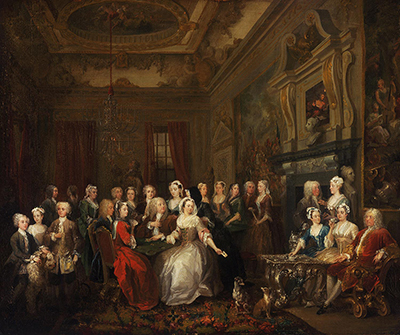
A different kind of social observation earned Hogarth work as a painter. In the Assembly at Wanstead House, dated 1728–31 by the Philadelphia Museum of Art, members of the Child family take tea and play cards in a vast ballroom. Lady Castlemaine holds up the ace of spades towards her husband, who sits in red velvet at the far right. The museum suggests that the painting may mark their twenty-fifth wedding anniversary and that her winning card alludes to their partnership. The gesture creates a relation across a distance that the painter has taken pains to make visible. A visitor to Wanstead could admire the great room. A viewer of the painting also gets to know who directs the small activity at its centre. [12]
There was another use for a roomful of figures in Hogarth's paintings of John Gay's The Beggar's Opera. Gay's work became a theatrical sensation in 1728. By 1731 Hogarth had painted several versions of the scene in which Macheath, in chains and facing execution, stands between Lucy Lockit and Polly Peachum as they plead for him. In the Yale Center for British Art's 1729 painting, the women's appeals are part of a recognisable dramatic situation, with spectators at either side of it. A theatre audience has heard the words leading up to the scene. A painted scene has to make the predicament available through the placement of bodies and the direction of an appeal. That economy of gesture carries over into Hogarth's invented stories. [13]
The serial pictures brought painting and the print trade together. A Harlot's Progress, published in six prints in 1732, and A Rake's Progress, published in eight in 1735, followed people through changes of fortune. The six canvases Hogarth prepared for Marriage A-la-Mode around 1743 belonged to another such enterprise. For this project he worked with French-trained engravers in London, part of a milieu in which design, book illustration, teaching and the engraving trade brought artists from Britain and continental Europe together. The French engraver Hubert-François Gravelot and the artists around St Martin's Lane belong to that history of Rococo in Britain. Hogarth could enlist the urban trade in fashionable images to make his satire on the pursuit of fashion. [2] [5] [6]
Late in his career he was still finding out what an existing image could do in a different setting. In the print The Bruiser, dated 1763, the poet Charles Churchill appears as a bear. The animal takes the place Hogarth had occupied in an engraved version of his own portrait. The dog from that earlier composition stays in the scene, where the substitution turns a familiar arrangement into an insult. The joke depends on the survival of some of the original design in the altered plate. It also gives a direct answer to anyone who expects Hogarth's targets to be anonymous social types. The biography follows the friendships and quarrels behind such work. The pictures show how long he remained willing to change what viewers thought they already knew. [14] [15]
Four stages of William Hogarth’s career
These periods group related developments; painting, travel and local work overlap across their boundaries.
From apprenticeship to independent work
Training in the metal trades gave Hogarth experience of engraved lines and commercial design. He drew and engraved for London’s print and book trades before finding a broader market for his own subjects. [5]
Painting for rooms and printing for readers
Group portraits and theatre subjects expanded the range of his work. Hogarth used different forms of subscription and publication to take the Harlot and Rake sequences from painting to print. [5]
Pictures for institutions and buyers
Hogarth gave the Foundling Hospital a portrait of its founder and helped bring other artists into the institution’s work. At the same time he developed Marriage A-la-Mode for sale as six plates. [16] [2]
Explaining beauty and picturing elections
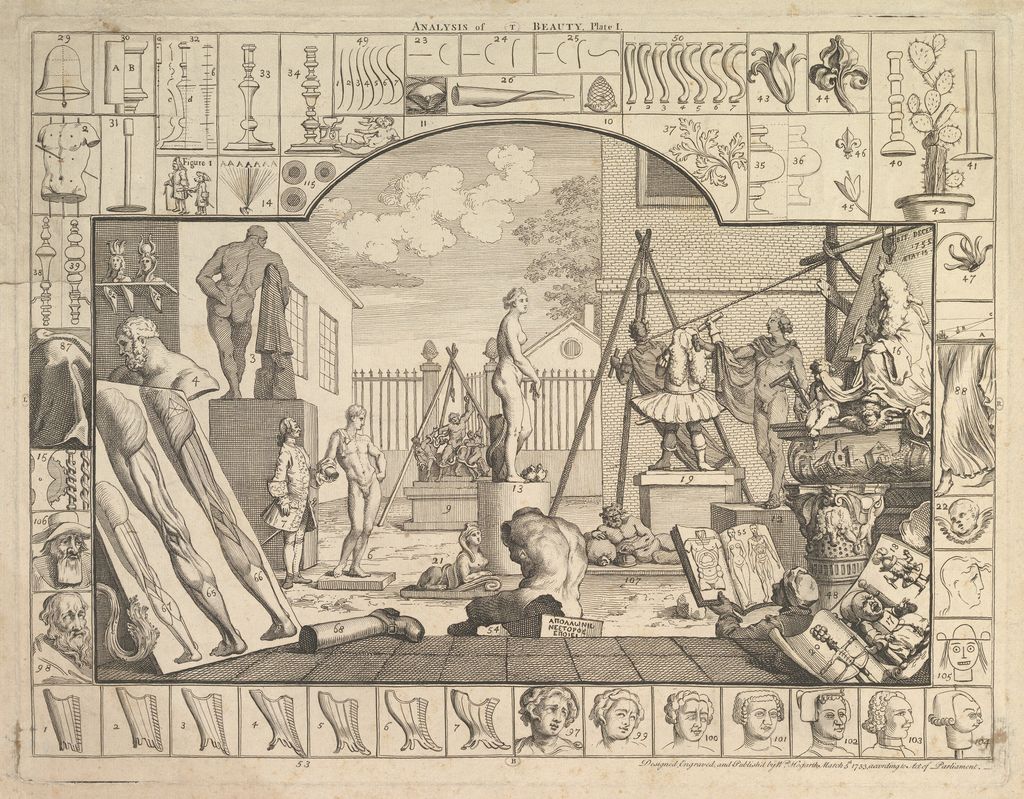
Hogarth published The Analysis of Beauty in 1753. His examples range from sculpture and painting to chairs, everyday movements and dancing. [17]
How Hogarth paints a portrait
At Wanstead, keeping the family together on the canvas requires a long view. People seated at opposite ends of the room have to read as members of the same gathering. The ace of spades gives the eye a reason to cross the floor. Hogarth has room for the building and its splendour because the card does so much with a relatively slight gesture. Think of the small dog and the cap in The Tête à Tête. Another object light enough to lift between two fingers has become an involuntary disclosure. In both cases we learn something about a couple by following an object across the space they share. [1] [12]
In The Graham Children, of 1742, the figures are life-size. The youngest child, Thomas, reaches from an elaborate carriage towards the cherries held by his sister. At the other end of the group Richard Robert works a bird-organ while a cat climbs towards the caged bird. Two actions are on the verge of happening. The baby might grasp the fruit, and the cat might get closer to the cage. This sense of time passing gives the portrait some of its tenderness. Thomas died before the painting was finished. The clock in the shadows, topped with a winged figure carrying an hourglass and scythe, belongs to a picture that keeps the boy visibly intent on the next moment. His death may have been the reason for the commission, a possibility the National Gallery leaves open. [18]
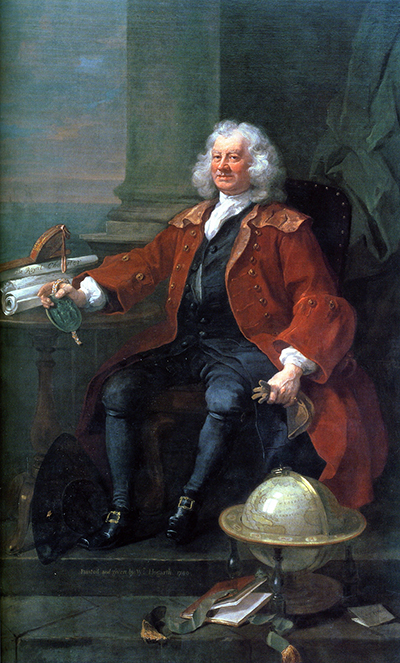
The portrait of Captain Thomas Coram takes the question of scale in a public direction. Hogarth painted it in 1740 and gave it to the Foundling Hospital, for which Coram had campaigned. A column, drapery and an elevated seat convey the standing of the figure. The Hospital's charter seal in Coram's hand and a globe showing England and New England refer to the sitter's actual work and interests. With his coat open, his face turned out and his legs planted well apart, Coram looks settled in his chair. Portraiture on this scale makes the terms of a public achievement visible. It also has room for the individual at the centre of the project to occupy the chair in his own way. [7]
The woman in The Shrimp Girl brings that question of presence close to the surface of the painting. Her name is unknown, and the National Gallery dates the oil sketch to about 1740–45. The loaded basket on her head contains a measure for selling the shellfish. Her head seems to tip very slightly as she meets our gaze, while the rapid strokes of her clothing leave parts of the ground exposed. The painted balance of the basket is especially striking against the freedom of the edges lower down. Look at the space where one brushstroke meets another in the cloak, then return to the face. So little finishing is needed to give us the impression that the expression could change the next instant. Hogarth kept the picture in his studio, and it remained with Jane Hogarth after his death. [19]
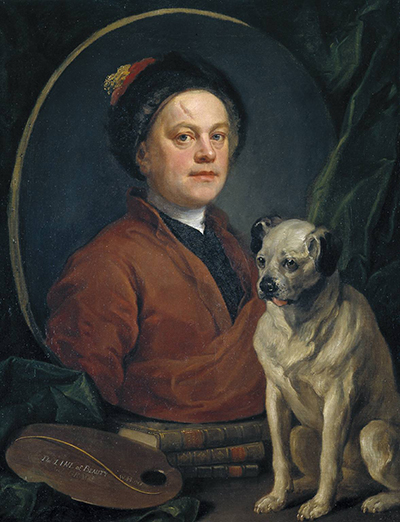
In Tate's The Painter and his Pug, dated 1745, Hogarth shows a picture of himself propped on books by Shakespeare, Swift and Milton. Trump, the pug, sits in front of the oval portrait. Hogarth puts the dog's paws on the same plane as his palette, whose conspicuous curve he calls the line of beauty and grace. The oval places the painter a step farther away from us than his dog. It takes very little before that distinction begins to feel like a joke at the portraitist's expense. X-rays have shown that Hogarth originally gave himself a wig and more formal clothes. His choice of a cap and simpler clothing was a change he made to the painting, much as the substitution of Churchill's bear was a change he later made to the engraved portrait. Each alteration belongs to its own object. [15] [20]
Look across these paintings by asking what each person has been given to handle, carry or command. Lady Castlemaine can direct the family gathering with a card. Thomas Graham stretches for fruit. Coram holds a charter seal and the shellfish seller keeps her basket balanced. Only a few inches of space around a hand or a head may carry the character of an encounter. The paintings range from the relatively intimate conversation piece to work made to meet an audience in a public building. Their scale changes how much room Hogarth gives each gesture and how far away we can stand before it disappears. [12] [18] [7] [19]
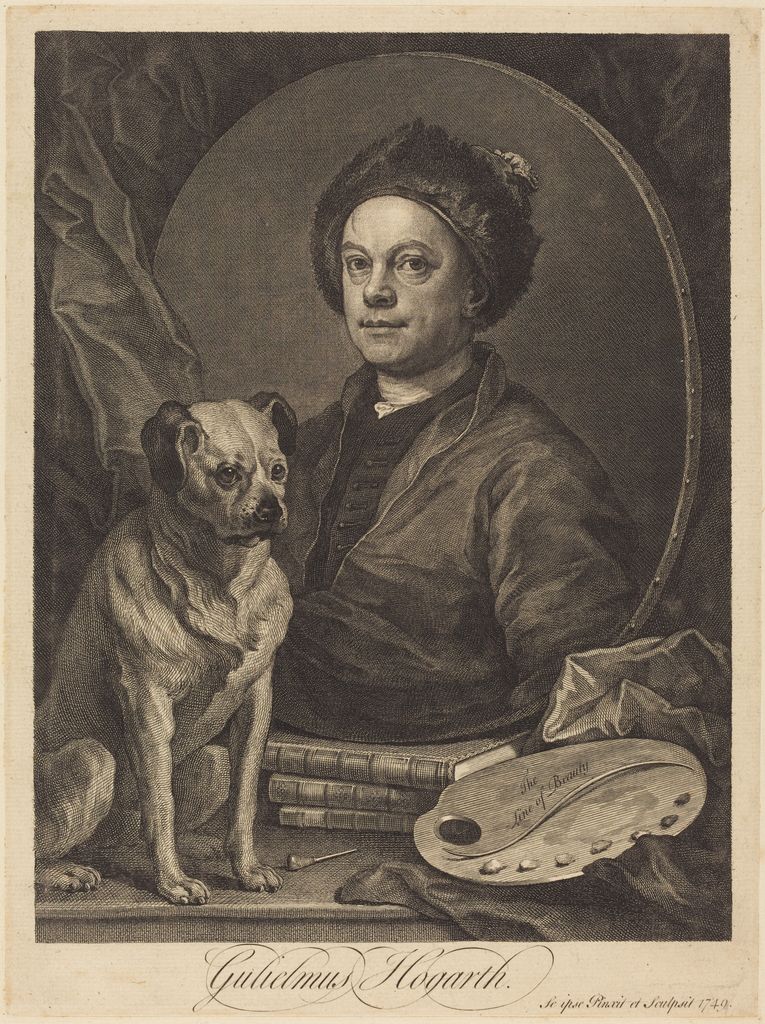
Gulielmus Hogarth, William Hogarth, 1748–49. Etching and engraving. 1944.5.9. Rosenwald Collection, National Gallery of Art, Washington. Image source. CC0 / Public domain.
Reading Hogarth’s picture stories
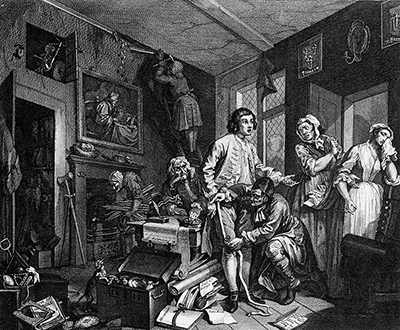
One way into A Rake's Progress is to keep your eye on Tom Rakewell as the people around him change. At the beginning he is being measured for a suit in the house of the father whose money he has inherited. While his tailor attends to his new clothes, Tom has a decision to make about Sarah Young, whom he has promised to marry. The canvases follow him out of that room and into quite different relations with the people who dress, entertain, lend to or restrain him. The first room makes wealth look like the beginning of freedom. By the last, the story has done away with the rich clothes, the easy access to money and the pretence that Tom can conduct his life alone. [5] [9] [21]
Sarah gives the eight paintings a second point of continuity. In the last canvas, The Madhouse, she bends down beside Tom while two well-dressed visitors remain upright farther back. Sarah is close enough to bring him something to eat. The visitors give him the scrutiny of strangers who can leave again. Hogarth puts these two kinds of attention within sight of each other. For someone reading the sequence straight through, Sarah's proximity brings the beginning of the story back into the room. She has a reason to be there that no visit to see the inmates could supply. [9] [21]
Even here the choice of object affects the story we see. Sir John Soane's Museum notes a patch on Tom's body in the first state of the engraving, absent from the painted Madhouse. A contemporary explanation of the prints links the mark to a wound Tom inflicted on himself. A separately catalogued impression in the National Museum of Western Art in Tokyo also allows the engraved composition to be read with its verse below the picture. The canvas builds its account of the encounter through the figures and space. On the page of a print there is room for words that tell us how to judge what we see, and a physical detail that can carry a further episode of the story. [21] [22]
In the twelve prints of Industry and Idleness, published in 1747, the opening offers two people to follow. Hogarth puts Francis Goodchild and Thomas Idle at their looms in the same workshop. One works while the other dozes. Tools, uprights and hanging threads give the sheet a common setting for the two figures, inviting the eye to measure one part of the room against the other. The effect would be weaker if each man were introduced in his own picture. We can see them both from the outset and watch two possible careers grow out of the same trade. [23]
Apprenticeship gives this comparison a particular social force. An indenture could bind a young person to a master or mistress for years in return for vocational training and maintenance. It put work, housing and authority into one relationship. The printed workshop makes that relationship look like an opportunity for the diligent Goodchild, who ends up Lord Mayor. Idle goes to Tyburn. The last two prints give their respective journeys a public audience, with a crowd around an execution in one and around a civic procession in the other. Read them after the shared workshop and both crowds become part of the comparison. Where the Rake's changing rooms track money and attachments slipping away from one person, Industry and Idleness asks us to compare the standing that two people acquire or lose in the same city. [23] [24] [25] [26]
Watch Hogarth’s paintings and prints
Five films on Hogarth’s painted stories, prints, drawing methods and work for the Foundling Hospital.
William Hogarth and the Foundling Hospital | HENI Talks
Caro Howell discusses Thomas Coram, Hogarth’s portrait of him and the artist’s work for the Foundling Hospital.
Watch on YouTubeMarriage A-la-Mode works through the continuing consequences of a bargain. In The Marriage Settlement the Earl's rank and the Alderman's money meet in a transaction negotiated around a table. In the drawing room of The Tête à Tête the steward has to reckon with what the new household spends. By the final scene the story has returned to the Alderman's household, where money and family ties still shape the actions of the people around his dying daughter. Notice how often those with the greatest stake in a room have their attention fixed on different things. The initial bargain has brought them into one another's company without supplying a common interest beyond the terms of the bargain itself. [1] [2]
Egerton's National Gallery catalogue cites a comparison between the interiors in Marriage A-la-Mode and the stock settings of a theatre. In that reading, the house of the Earl in the first scene and the Alderman's in the last share a background structure. Putting the openings in the wall and the main groups of people side by side makes this easier to see. The homes belong to different people and can echo one another across the entire run of paintings. There is a similar echo between the two domestic gatherings in the fashionable rooms of The Tête à Tête and The Toilette. The latter room is full of visitors while the wife is being attended to. The former has just emptied, leaving the tired couple and the bills. Space can signal continuity in the marriage even when the company and mood change. [2]
A Harlot's Progress brings another kind of scrutiny to the first appearance of its protagonist. In the first print, a young arrival in London is approached by an older woman while two men look on from the doorway of an inn. The sewing tools at her waist hint at the sort of work she might have come to London to find. As in the opening scene of the Rake, people are taking the measure of a newcomer to their circle, but here it is the newcomer who has least to bargain with. The premise prepares us to follow an individual through transactions in which other people have an interest. [2] [27] [28]
When the shape of the story becomes clear, try laying two of its scenes side by side. The series guide brings together the sequences and their individual episodes, so a detail that first looks incidental can be traced across several pictures.
Two streets that belong side by side
The pawnbroker in Beer Street has the most dilapidated premises around. Elsewhere builders work on a roof and a barrel is hauled up to a higher storey. With their tankards to hand, Hogarth's tradespeople look capable of keeping both themselves and the neighbourhood going. In Gin Lane the pawnbroker can sit behind his opening and accept the tools and household goods brought to him. The built fabric gives way around him, and one of the great shocks of the foreground is a child slipping from a woman's arms. Compare the two pawnshops first. Their businesses tell us where goods and money are going, and they show how deliberately Hogarth has assigned each street a different sort of prosperity. [29] [30]
The two prints were published as companions in 1751. A reader could move straight from one street to the other, and back. The pawnbroker and the different kinds of work give the eye familiar points of comparison. In Beer Street the activity of carrying, lifting and repairing gives the scene its upward pull. In Gin Lane the eye can trace a fall from the woman's lap in the foreground to the ruin being played out across buildings and bodies. Reading the sheets together makes a distinction that a catalogue of the occupants of either street would miss. Work and drink are deliberately linked in each street. [29] [30] [31]
A change to Beer Street shifts the balance of the argument. Jennifer Tonkovich's study traces a figure of a Frenchman held up by a blacksmith in early impressions and his removal in later work on the plate. In the British Museum's revised impression, a butcher raises a joint of meat. What began as a show of strength at a stranger's expense became an indication of how well the street could feed itself. Part of the Frenchman's arm supplied the contour of the joint in one stage of reworking. The Metropolitan Museum of Art holds the engraved copperplate, a separate object that gives material evidence of the revision. The comparison in Beer Street and Gin Lane follows these changes from paper studies to specific impressions. [29] [31] [32]
The prints appeared amid a debate over regulating gin. In An Enquiry into the Causes of the Late Increase of Robbers, published in 1751, the magistrate Henry Fielding linked spirits to theft and robbery, drawing on the cases he said he had heard. In the same section he imagines the harm that gin might do to an infant. Hogarth gives the fear for the child's welfare immediate visual form, with the child tipped headlong above the steps. [30] [31] [8] The two prints make their appeal by picturing two streets as though a viewer could take in the fortunes of a district at a glance. That comparison shows something about how reformers invited the public to think. The economic and political history of drinking has to account for actual prices, production, enforcement and behaviour over time. Studies of the different measures aimed at controlling gin make clear how much of that history lies outside a pair of pictures. [30] [31] [8] [33]
The drink prints and the Four Stages of Cruelty were taking shape at about the same time. Tonkovich found that the Morgan drawings for the two streets have a watermark that matches the one in the drawing for the second Cruelty design. The shared paper makes the difference between the projects especially telling. In the first Cruelty print, Hogarth gives one boy the name Tom Nero and sets him among several other boys in a scene of abuse. Giving the central figure a name helps the reader follow him to the next sheet. The child who tumbles in Gin Lane belongs to a picture in which several outcomes crowd in at once. Its companion street renews the argument by changing the whole setting. [30] [31] [34]
A later political series, The Humours of an Election, divides an electoral contest into successive public occasions. Hogarth took the 1754 Oxfordshire contest as a starting point and placed its first scene in an inn in the fictional town of Guzzledown. Between the two opposing streets and the election's succession of gatherings, we can see the choices he made about how much of a collective story to give us at one time. [30] [35]
How the pictures reached their readers
Subscribers to A Harlot's Progress were asked for a guinea for the set, with half due when they ordered and half when they received the prints. The antiquary and engraver George Vertue recorded considerable interest from people coming to see the pictures, as well as interest from subscribers. These were two different encounters with the work. Someone who came to look at the paintings could tell others what they had seen. Someone who bought the prints could keep six paper sheets to look at again, hand one around for inspection, or set two together to explain a connection between them. Subscription let Hogarth take some of the payment before he supplied an edition. It gave buyers a reason to keep track of a work still in progress. [2] [5]
The surviving objects can tell us how far a comparison between a painting and its print can go. The National Gallery's Tête à Tête is Hogarth's oil on canvas. The Metropolitan Museum of Art's Marriage A-la-Mode, Plate II is an impression of Bernard Baron's etching and engraving after Hogarth's design. Open the two records and follow the chairs, the steward and the dog. Their positions are reversed across the compositions. In colour the objects inside the room help separate the figures from their surroundings. On the printed sheet the engraver has to pick out comparable edges, shadows and surfaces with marks printed in ink. The room packed with clues survives the change of medium because the engraver has kept those details intelligible within it. [1] [2] [36]
The prints bear the date 1 April 1745 and were issued in June. Hogarth had advertised a sale of paintings that February and had even included a sketch of The Tête à Tête on his engraved bidding ticket. The marriage paintings were still needed by the engravers and did not go into that sale. They were eventually sold together to John Lane for 120 guineas in 1751. Another set of prints after the canvases followed decades later, made in mezzotint by Richard Earlom and published by John Boydell. A print called The Tête à Tête could belong to either undertaking. The engraver's name and the date can settle which one it is. [2] [36]
Prices and terms varied with the project. The advertisement examined by Tonkovich shows Hogarth offering the drink prints at a shilling apiece in 1751, a different proposition from the guinea charged for six Harlot prints. The figures establish the sums asked and leave open the question of who could pay them, who bought copies and who saw a picture only through another person's purchase. Prints gave Hogarth more than one thing to sell from an image. Their reproducibility also gave other people a way to profit from his designs. He and fellow artists helped secure the 1735 Act granting a term of exclusive rights over qualifying engraved designs. Its subject was the work of inventing and producing prints, an activity on which Hogarth had already built much of his business. The engravings trace that business through particular sheets, inscriptions and surviving plates. [5] [31] [37]
Hogarth's London and the people who kept his work
Hogarth gave his portrait of Captain Coram to the Foundling Hospital in 1740. It was the first painting given to the institution. As one of the Hospital's governors, Hogarth also brought artists together to make pictures for the room where the governors met. The paintings gave the charity a further means of introducing itself to visitors. The March of the Guards to Finchley came in by a different route. In 1750 Hogarth organised a lottery for this painting and gave the Hospital his 167 remaining tickets. The winning ticket went to the Hospital. The two pictures make complementary points about the place of art in the institution. One asserts the identity of its founder in the formal language of public portraiture. The other carried the uncertainty and publicity of a draw into the beginnings of its collection. [7] [16] [38]
Leicester Fields gave Hogarth a central London address and, from 1749, Chiswick gave him a country home. At Chiswick he worked in a studio over the coach house at the bottom of the garden. The family's involvement with his art continued after he died in 1764. Jane Hogarth and her cousin Mary Lewis sold his prints, and Jane remained at the house. The print trade that the young copperplate engraver had entered depended on more people and places than the inventor named on the sheets. In the case of Hogarth's household it outlasted the engraver himself. [10] [38]
The architect Sir John Soane acquired the eight Rake canvases in 1802 for 570 guineas. His wife Eliza was the bidder, according to the diary of the painter Joseph Farington. He later bought the four Election canvases in 1823 from the sale of the effects of Mrs Garrick. The 1814 British Institution exhibition catalogue records a point in between those purchases. Soane could lend the Rake pictures, and Mrs Garrick was still lending the Election pictures herself. Follow those names through the successive sales and exhibition and the two sets emerge as different groups, each kept together while changing hands. Their histories intersect in the collection that Soane built at Lincoln's Inn Fields. [35] [39] [40]
Soane put the Rake paintings behind movable panels in his Picture Room. That arrangement made the uncovering of one picture behind another part of what it was like to visit his collection. It is an especially apt setting for Hogarth's art, where a picture that seems at first to give the whole situation away often rewards a second look behind the foreground events. The Rake and Election canvases belong to Sir John Soane's Museum, and the marriage series entered the National Gallery with the Angerstein collection in 1824. A collection record tells us where an object belongs. For a visit, consult the institution's current display information for the particular work. [2] [9] [21] [35]
The line of beauty
A cup, a coat or a shop sign can point outside the scene that Hogarth built for it. The Lewis Walpole Library's exhibition William Hogarth's Topographies opens with the story of his arrest while sketching at Calais, as told by the early biographer John Nichols. In Hogarth's design a spear comes down onto the shoulder of a small figure who is still drawing. The pose makes something of the painter's attention to the things directly in front of him, at the very moment someone is taking an interest in what he is doing. The London map and print seller John Smith later adopted this profile for his own trade card and shop sign. An artist's appearance at the edge of a narrative became an image that people could recognise in the street. [41]
Hogarth's own treatise, The Analysis of Beauty, appeared in London in 1753. Hogarth assigns a particular importance to the waving line and to the serpentine line, which also winds in depth. Figure 26 in the margin of the first plate shows a line coiling around a cone. The diagram can be read against the sculptures in the crowded central scene, where a related turn may be harder to isolate from the whole figure. The exercise asks the eye to do some of the work that the written description alone leaves open. [17] [42] [43] A viewer who laughed at the dog, the books and the palette in the painted self-portrait can go back to the curve on the palette and compare it with the variations demonstrated in the treatise. A curve gives the eye a course to follow. A composition can keep that motion alive, leading our attention onwards even when we have already recognised the person or object in front of us. [20] [17] [42]
An edition translated by Christlob Mylius appeared the following year, published in London and Hanover. The copy held by Zentralbibliothek Zürich contains two folding plates. A reader of the German edition could stop over an illustration, open it out, then return to the written argument. That physical act offers a final way to think about how Hogarth expected his audience to use pictures. The self-portrait, the book and the painted story each give something to the person willing to look twice. A drawing room we first saw through a dog's discovery becomes a room that we know how to enter again, this time with an eye on the departing steward or the half-concealed painting. [1] [20] [17] [42] [44]
Browse Hogarth’s artworks
All 54 individual artworks and series stages in the approved English cluster
Frequently Asked Questions
Hogarth painted portraits and scenes of London life. He also told stories through sequences of pictures, including the six scenes of Marriage A-la-Mode. [1]
Discussion
Look again at the images and ideas explored in William Hogarth. These editorial prompts invite your observations.
Reader Insights
Which detail in Tête à Tête makes you look differently at the people in the room?
Where does a version in print change what you notice about an original painting?
Join the Conversation
Share a detail, comparison or question about William Hogarth below.
References
- The National Gallery, Marriage A-la-Mode: 2, The Tête à Tête, NG114. View source.
- Judy Egerton, Marriage A-la-Mode, in National Gallery Catalogues: The British Paintings (2000), NG113–NG118, technical notes, provenance, and catalogue text. View source.
- David Bomford and Ashok Roy, Hogarth's “Marriage à la Mode”, National Gallery Technical Bulletin 6 (1982), pp. 44–67, figs. 6–10 on NG114. View source.
- The National Gallery, William Hogarth, artist entry and collection. View source.
- Sir John Soane's Museum, Hogarth: 101, sections on Hogarth's training, the painted series and subscription. View source.
- Victoria and Albert Museum, Rococo: Art and Design in Hogarth's England (1984), exhibition catalogue, sections on Gravelot and printmaking and Hogarth and St Martin's Lane, Rijksmuseum Research Library record. View source.
- Foundling Museum, Captain Thomas Coram & Duchess of Somerset, entry for Hogarth's 1740 portrait of Captain Thomas Coram. View source.
- Henry Fielding, An Enquiry into the Causes of the Late Increase of Robbers, 2nd ed., London, Andrew Millar, 1751, section II, “Of Drunkenness”. View source.
- Sir John Soane's Museum, The Picture Room, the picture planes and Soane's Hogarths. View source.
- Laurel O. Peterson, The Morgan Library & Museum, The South Sea Bubble, curatorial commentary for Hogarth: Cruelty and Humor. View source.
- Museum of Fine Arts Ghent, Emblematical Print on the South Sea Scheme, 1958-V-13. View source.
- Philadelphia Museum of Art, Assembly at Wanstead House, collection record 103800. View source.
- Yale Center for British Art, “Among the Whores and Thieves”: William Hogarth and The Beggar's Opera, exhibition and 1729 painting. View source.
- The Metropolitan Museum of Art, The Bruiser, 91.1.57. View source.
- John Kerslake, Early Georgian Portraits (1977), catalogue entry on Charles Churchill, note 5, National Portrait Gallery. View source.
- Foundling Museum, Hogarth & Company, account of the Court Room and the Finchley lottery. View source.
- William Hogarth, The Analysis of Beauty, London, J. Reeves for the author, 1753, chapters VII and IX, ETH-Bibliothek Zürich, Rar 265. View source.
- The National Gallery, The Graham Children, NG4756. View source.
- The National Gallery, The Shrimp Girl, NG1162. View source.
- Tate, The Painter and his Pug, N00112, Tate collection commentary on Google Arts & Culture. View source.
- Sir John Soane's Museum, A Rake's Progress VIII: The Madhouse, P47. View source.
- The National Museum of Western Art, Tokyo, A Rake's Progress (8), G.1994-0011 (Japanese and English). View source.
- The Metropolitan Museum of Art, The Fellow 'Prentices at their Looms (Industry and Idleness, plate 1), 91.1.9. View source.
- London Lives, Apprenticeship Indentures and Disciplinary Cases (IA), introduction to the archival records. View source.
- The Metropolitan Museum of Art, The Idle 'Prentice Executed at Tyburn (Industry and Idleness, plate 11), 91.1.19. View source.
- The Metropolitan Museum of Art, The Industrious 'Prentice Lord Mayor of London (Industry and Idleness, plate 12), 91.1.20. View source.
- The Metropolitan Museum of Art, A Harlot's Progress, Plate 1, 32.35(2). View source.
- Colonial Williamsburg Foundation, A Harlot's Progress, Plate 1, 1972-409,3, later impression with commentary on the scene. View source.
- The British Museum, Beer Street, 1880,1113.4473. View source.
- National Galleries of Scotland, Gin Lane, P 6858. View source.
- Jennifer Tonkovich, Hogarth and the Making of Beer Street and Gin Lane, Master Drawings 60, no. 2 (2022), especially pp. 201–203 and 206–212. View source.
- The Metropolitan Museum of Art, Beer Street, engraved copperplate, 21.55.2. View source.
- Jessica Warner, M. Her, Gerhard Gmel and Jürgen Rehm, Can legislation prevent debauchery? Mother gin and public health in 18th-century England, American Journal of Public Health 91, no. 3 (2001), pp. 375–384. View source.
- The Metropolitan Museum of Art, The First Stage of Cruelty (The Four Stages of Cruelty), 91.1.136. View source.
- Sir John Soane's Museum, The Humours of an Election I: An Election Entertainment, P53. View source.
- The Metropolitan Museum of Art, Bernard Baron after William Hogarth, Marriage A-la-Mode, Plate II, 91.1.108. View source.
- Parliament of Great Britain, Engravers' Act, London, 1735, 8 Geo. II c. 13, facsimile and commentary in Primary Sources on Copyright (1450–1900). View source.
- Hogarth's House, William Hogarth, Chiswick house, studio and print-selling business. View source.
- Sir John Soane's Museum, A Rake's Progress I: The Heir, P40, provenance and Eliza Soane's role. View source.
- British Institution, Catalogue of Pictures by the Late William Hogarth, Richard Wilson, Thomas Gainsborough, and J. Zoffani, London, 1814, Sir John Soane's Museum, ref. 4954, bound item 9. View source.
- Pierre Von-Ow, Lewis Walpole Library, William Hogarth's Topographies, introduction, Yale University Library (2022). View source.
- The Metropolitan Museum of Art, The Analysis of Beauty, Plate 1, 32.35(22). View source.
- Wellcome Collection, Analysis of Beauty, Plate I, 38383i, collection commentary on fig. 26. View source.
- William Hogarth, Zergliederung der Schönheit, die schwankenden Begriffe von dem Geschmack festzusetzen, translated by Christlob Mylius, London and Hanover, 1754, Zentralbibliothek Zürich, NM 211 (in German). View source.


