


 by Tom Gurney
Tom Gurney BSc (Hons) is an art history expert with over 20 years experience
Published on June 19, 2020 / Updated on October 14, 2023
Email: tomgurney1@gmail.com / Phone: +44 7429 011000
Sigismunda Mourning over the Heart of Guiscardo: Introduction
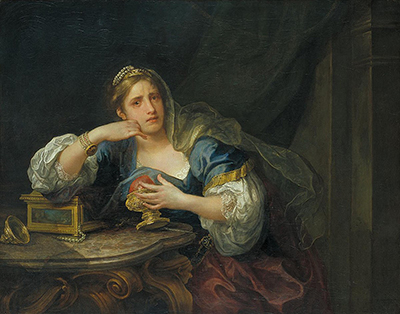
Sigismunda holds a gold cup close to her breast. A red shape rises above its rim, partly covered by her fingers. It is the heart of Guiscardo, the man her father has had killed. William Hogarth painted her alone, with her cheek resting on one hand and her eyes turned away from the cup. The oil on canvas is dated 1759. The canvas measures 100.4 by 126.5 centimetres, large enough for the figure to have something of the scale of a person seated across a table. The painting is in Tate’s collection, accession N01046, and was bequeathed by J. H. Anderdon in 1879. [1]
At a Glance
- Artist and dateWilliam Hogarth, 1759
- Medium and sizeOil on canvas, 100.4 × 126.5 cm
- CollectionTate, N01046
- ExhibitionSociety of Artists, Spring Gardens, 1761, no. 43
- Dunkarton printMezzotint, third state, 1 February 1793, Metropolitan Museum of Art, 32.35(148)
This work across William Hogarth’s career
Assembly at Wanstead House
1728–31The Heir
1734The Marriage Settlement
about 1743Gin Lane
1751Canvassing for Votes
1754–55Contents
- The moment between the cup and the poison
- What Sir Richard Grosvenor agreed to buy
- A picture for Spring Gardens
- From subscription ticket to reproductive print
The moment between the cup and the poison
The story is the first tale of the fourth day of Giovanni Boccaccio’s Decameron. Ghismonda, as Boccaccio names her, is the widowed daughter of Tancred, Prince of Salerno. She chooses Guiscardo, a man of humble birth in her father’s household, and shows him how to reach her chamber through a concealed passage. Tancred discovers them and has Guiscardo killed. When he confronts his daughter about the affair, she defends her choice on the grounds that a man’s worth comes from his conduct rather than his birth. The cup containing Guiscardo’s heart arrives after this exchange. She weeps over it, pours poison into it and drinks. The gift meant to punish her becomes the means by which she decides her own fate. [2]
John Dryden retold the story in verse as Sigismonda and Guiscardo in Fables Ancient and Modern (1700). He introduces a priest who marries the lovers in secret, which explains the word husband in the title under which Hogarth exhibited the painting. Both writers give the heroine words to speak over the heart. Hogarth had to make the change from defiance in her father’s presence to grief in solitude legible without that speech. The painting places the cup in her hands and leaves the fatal drink to the story the audience brings to it. [2] [3] [4]
The bend of Sigismunda’s body brings her near the table, where her elbow is supported by a casket. Its straight edge gives the pose a firm base. Her opposite arm folds in towards the cup, and the pale lace at both wrists draws attention to what each hand is doing. One bears the weight of her head. The other curves around the vessel and partly screens what it contains. The wide space of dark curtain and architecture beyond her leaves the eye free to return to that small area between cheek and cup. At this scale a viewer can notice the slackness of her mouth and the redness about her eyes even as the sweep of the drapery makes the figure visible across a room. [1] [5]
The art historian Marcia Pointon draws attention to the veins marked on the heart and to those visible in Sigismunda’s forehead. The first detail gives the gift a disturbing physical specificity. The second makes the living woman’s distress register in her skin. Her fingers are close enough to the organ to make the encounter uncomfortable for the viewer, yet the care with which she holds the vessel allows the gesture to be read as tender. Jane Hogarth has been suggested as the model. The identification remains a tradition, while the effect of the face depends on details anyone can examine, particularly the swollen-looking lower lids and the slightly parted lips. [5]
What Sir Richard Grosvenor agreed to buy
In the account preserved by John Ireland, Hogarth recalled that Sir Richard Grosvenor had seen the picture he made for Lord Charlemont and asked him for a painting on the same terms. Hogarth described his choice of Sigismunda as an experiment in making a spectator feel what a tragedy in the theatre could produce. He also recalled setting his price at £400 after a painting of the same subject had attracted a bid of about that amount under the name of Correggio. The older composition was subsequently associated with Francesco Furini. For Hogarth the comparison offered a way to put a price on the labour of a living painter alongside the price a collector would pay for an admired older work. [6] [7]
The terms described in Hogarth’s letter left Grosvenor free to decline the finished picture. Grosvenor’s reply, as transcribed by Ireland, allowed Hogarth to offer it elsewhere and said that living with it would repeatedly bring on melancholy thoughts. He added that a curtain would do little to lessen the effect. His letter leaves room for courtesy, but the objection he chose to make concerns what it would be like to pass the painting day after day. Hogarth’s account treats tears as a measure of what a painter could achieve. Grosvenor’s reply makes much the same power a reason to keep the canvas out of his house. The picture remained with Hogarth. Tate’s gallery label reads the work as a test of whether a living English artist could treat a heroic subject as convincingly as the Italian painters collectors admired. The exchange with Grosvenor shows how much that test depended on who would have to live with the result. [6] [1]
Watch Hogarth’s paintings and prints
Five films on Hogarth’s painted stories, prints, drawing methods and work for the Foundling Hospital.
William Hogarth and the Foundling Hospital | HENI Talks
Caro Howell discusses Thomas Coram, Hogarth’s portrait of him and the artist’s work for the Foundling Hospital.
Watch on YouTubeThe Charlemont painting, The Lady’s Last Stake, is dated 1759 by the Buffalo AKG Art Museum, which holds it as 1945:2.1. Its social drama depends on an exchange between two figures. An officer offers a woman a last game after she has lost heavily at cards. The painting leaves her considering his terms, and the small dog partly tucked below the table gives the viewer a place to look while waiting for her answer. In Sigismunda, the table serves a different purpose. It supports her weight, while the cup makes a deed committed elsewhere physically present in the room. In each work Hogarth chooses a moment in which a woman must decide what to do, but the scene for Charlemont invites spectators to weigh a proposal and its consequences, while the Tate canvas asks them to stay with the aftermath of an act they cannot undo. The two pictures show the range of dramatic situations in Hogarth’s paintings. [8] [1] [3]
A picture for Spring Gardens
The Society of Artists catalogue for the exhibition that opened at Spring Gardens on 9 May 1761 listed the work as no. 43, Sigismunda mourning over the heart of Guiscardo, her murther’d husband, with a direction to consult Dryden’s Fables. Two numbers later came the Charlemont picture as Picquet, or virtue in danger. The catalogue set the tragic figure alongside the gambling scene and gave each title enough information to frame the decision suspended in the paint. [4]
Horace Walpole’s letter to George Montagu of 5 May 1761 describes a visit to Hogarth’s studio shortly before the exhibition. He took the gesture for a woman angrily pulling off jewellery and likened the heart to offal bought at St James’s Market. The comparison makes clear how differently an observer could read the same details. The expensive cup and dress might establish a princess’s rank, but Walpole’s description makes the costume and the exposed heart grounds for denying the figure dignity. His letter describes an encounter in the studio. The exhibition catalogue establishes the public showing. [9] [4]
There is also a material reason to be careful when comparing that letter with the painting today. Pointon reproduces a Tate X-ray and identifies more extensive jewellery beneath the visible paint. That finding gives Walpole’s emphasis on ornaments a basis in the work’s earlier appearance. The Yale editors of his correspondence also document a disagreement between Walpole and the early Hogarth biographer John Nichols over the blood Walpole said he saw on the fingers. The X-ray evidence for jewellery and the written disagreement over the fingers answer different questions. The painting changed, and the studio letter alone cannot tell us when each revision was made. [5] [9]
From subscription ticket to reproductive print
Hogarth chose a different picture for the subscription ticket to the proposed engraving. In Time Smoking a Picture, a winged figure blows smoke from a pipe at a landscape and pierces it with a scythe. Hogarth gives the supposed improvement of paintings with age the appearance of deliberate damage. The London Archives identifies the design as a subscription ticket for an engraving of Sigismunda. The Metropolitan Museum of Art dates its own impression, 32.35(76), to March 1761 and catalogues it as an etching and mezzotint in the second of three states. In the account transcribed by Ireland, the proposed engraver Simon François Ravenet was committed to working for Boydell, so the subscription was stopped and subscribers were repaid. [10] [11] [12] [6]
The British Museum holds a black chalk and wash drawing by Edward Edwards after Hogarth, dated 1764 and thought to be the study used by James Basire for another attempt to reproduce the painting. The Met holds Basire’s unfinished etching, 32.35(142), with a publication date of 5 May 1790. In 1785 Nichols recorded an oil sketch alongside a drawing from the finished picture in the collection of Samuel Ireland. The early oil sketch’s present whereabouts are uncertain. [13] [14] [15]
Robert Dunkarton’s Sigismunda is another object. The Met’s third-state mezzotint, 32.35(148), is dated 1 February 1793 and was published by Tristam Bampfylde Freeman. The lettering credits an Edwards drawing as the immediate source for this reproduction and connects that design with Basire’s unfinished plate. In the mezzotint the light on the cheek, fingers and cuffs picks out the same connected gestures that guide the eye in the painted composition. The dark ground does the work of several colours, and the heart is harder to distinguish at first glance from the hand over it. John and Josiah Boydell’s separate print was engraved by Benjamin Smith and is represented at the Met by an impression dated 4 June 1795. The Boydells advertised Smith’s engraving as taken from the original picture then in their Shakespeare Gallery. The 1761 ticket had made a joke about the value attached to older paintings. By the 1790s the painting itself had become the object publishers invoked to sell a print. [16] [17] [18]
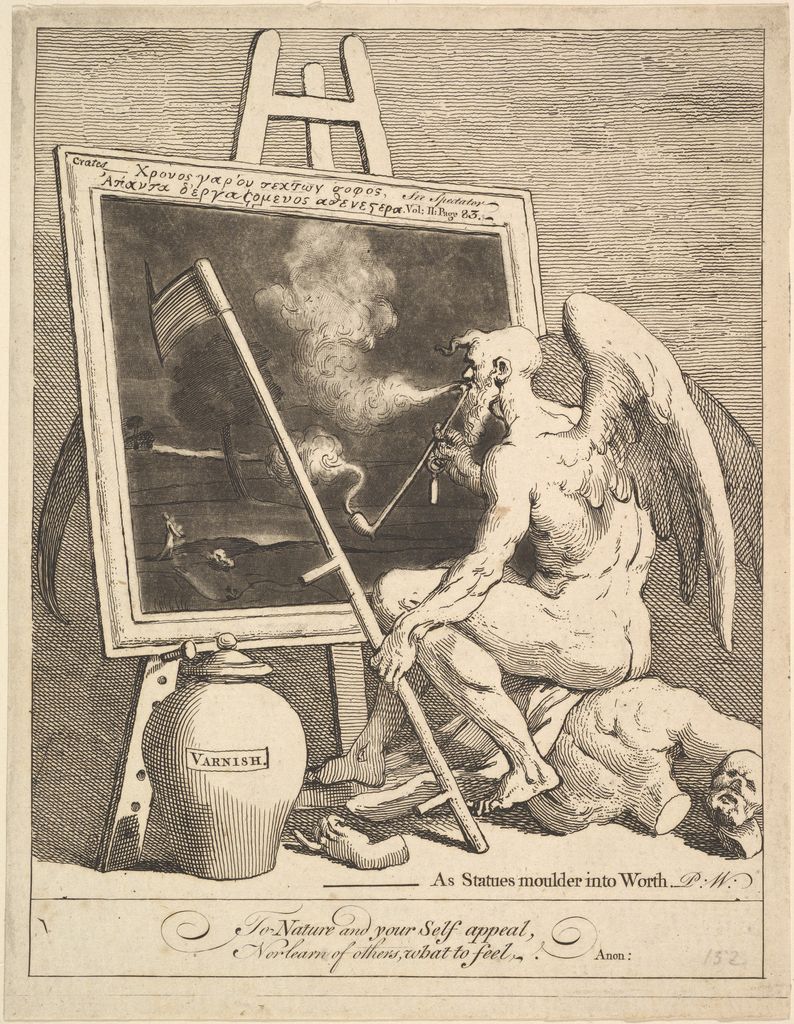
Time Smoking a Picture, William Hogarth, March 1761. Etching and mezzotint; second state of three. 32.35(76). Harris Brisbane Dick Fund, 1932. Image source. CC0 / Public domain.
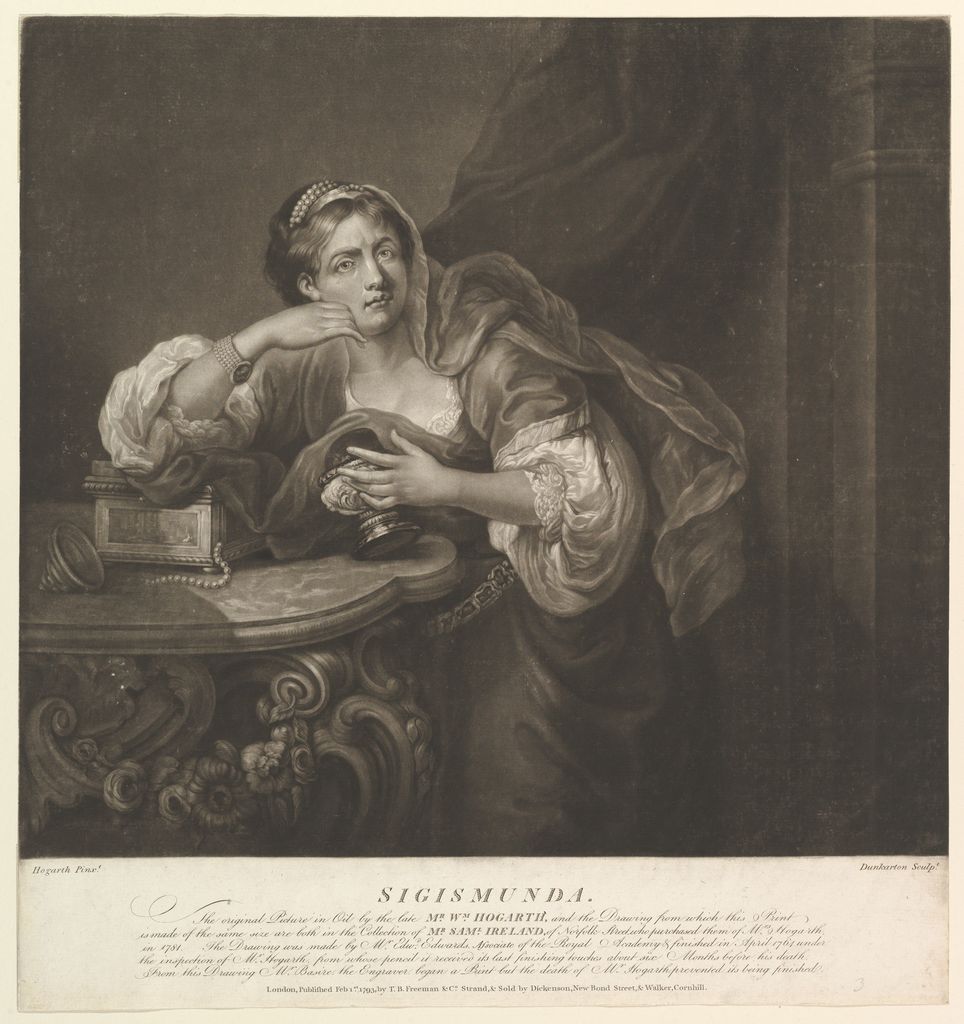
Sigismunda, Robert Dunkarton after William Hogarth, published by Tristam Bampfylde Freeman, February 1, 1793. Mezzotint; third state. 32.35(148). Harris Brisbane Dick Fund, 1932. Image source. CC0 / Public domain.
Browse Hogarth’s artworks
All 54 individual artworks and series stages in the approved English cluster
Frequently Asked Questions
Discussion
Look again at the images and ideas explored in Sigismunda Mourning over the Heart of Guiscardo. These editorial prompts invite your observations.
Reader Insights
How does Sigismunda’s grip on the cup change what you notice about the heart?
What does the hidden jewellery revealed by the X-ray help explain about Walpole’s account of the painting?
Join the Conversation
Share a detail, comparison or question about Sigismunda Mourning over the Heart of Guiscardo below.
References
- Tate, William Hogarth, Sigismunda Mourning over the Heart of Guiscardo, 1759, N01046, collection record and May 2007 gallery label. View source.
- Giovanni Boccaccio, The Decameron, Day IV, tale 1, translated by J. M. Rigg. View source.
- John Dryden, “Sigismonda and Guiscardo,” Fables Ancient and Modern, 1700. View source.
- Society of Artists of Great Britain, A Catalogue of the Pictures, Sculptures, Models, Drawings, Prints, &c., Spring Gardens, 1761, p. 6, nos. 43 and 45, Getty Research Institute copy. View source.
- Marcia Pointon, “A Woman Weeps: Hogarth’s Sigismunda (1759) and the Aesthetics of Excess,” in Penelope Gouk and Helen Hills, eds., Representing Emotions, 2005, pp. 155–172, especially pp. 157–158 and 165–166, fig. 9.5. View source.
- John Ireland, Hogarth’s Works, with Life and Anecdotal Descriptions of His Pictures, vol. III, ch. V, Hogarth’s account, his correspondence with Grosvenor, and the subscription. View source.
- National Trust, Michael Henry Spang after Francesco Furini, Sigismunda with the Heart of Guiscardo, NT 108920, catalogue note on the earlier composition. View source.
- Buffalo AKG Art Museum, William Hogarth, The Lady’s Last Stake, 1759, 1945:2.1. View source.
- Horace Walpole, letter to George Montagu, 5 May 1761, The Yale Edition of Horace Walpole’s Correspondence, vol. 9, p. 365 and n. 7. View source.
- The London Archives, William Hogarth, Time Smoking a Picture, 1761, subscription-ticket note, record 25272. View source.
- The Metropolitan Museum of Art, William Hogarth, Time Smoking a Picture, March 1761, 32.35(76). View source.
- Rijksmuseum, William Hogarth, Time Smoking a Picture, 1761, RP-P-OB-18.728, explanatory note (in Dutch). View source.
- British Museum, Edward Edwards after William Hogarth, Sigismunda, drawing and print study, 1910,1013.16. View source.
- The Metropolitan Museum of Art, James Basire the elder after William Hogarth, Sigismunda, unfinished etching, 5 May 1790, 32.35(142). View source.
- John Nichols, Biographical Anecdotes of William Hogarth, 1785, note 57 on the oil sketch and the drawing. View source.
- The Metropolitan Museum of Art, Robert Dunkarton after William Hogarth, Sigismunda, published by Tristam Bampfylde Freeman, 1 February 1793, 32.35(148). View source.
- The Metropolitan Museum of Art, Benjamin Smith, Sigismonda (Sigismunda), published by John and Josiah Boydell, 4 June 1795, 91.1.113. View source.
- John and Josiah Boydell, Shakspeare Gallery, 1 January 1797, notice for Benjamin Smith’s Sigismunda, item 4, Princeton University Library copy. View source.







