


, and taken in a Night-Cellar with his Accomplice William Hogarth.jpg)
 by Tom Gurney
Tom Gurney BSc (Hons) is an art history expert with over 20 years experience
Published on June 19, 2020 / Updated on October 14, 2023
Email: tomgurney1@gmail.com / Phone: +44 7429 011000
The Idle Apprentice Betrayed in a Night Cellar: Introduction
A woman on the stairs points towards Tom Idle while he and an accomplice sort through stolen goods. Two lanterns announce the arrival of the officers, but the men are still intent on what they have acquired. On the other side of the room, a man lowers a body through a trapdoor. William Hogarth brings these actions together in the ninth of the twelve plates of Industry and Idleness. The engraved publication date is 30 September 1747. The Metropolitan Museum of Art’s impression, 91.1.17, is an etching and engraving catalogued in the third of four states. [1]
At a Glance
- SeriesIndustry and Idleness, plate 9 of 12
- Inscribed publication date30 September 1747
- MediumEtching and engraving
- Metropolitan Museum of Art91.1.17, third of four states
- Later copyThomas Cook after William Hogarth, 1 October 1795, Wellcome Collection 38375i
This work across William Hogarth’s career
Assembly at Wanstead House
1728–31The Heir
1734The Marriage Settlement
about 1743Gin Lane
1751Canvassing for Votes
1754–55Contents
- Two ways into the cellar
- The woman on the stairs
- From the garret to the hearing
- What the lettering tells us about an impression
Two ways into the cellar
The stairs and the trapdoor give the room two openings with opposite purposes. At the left, the stairs bring witnesses down into the room. At the right, the opening in the floor is being used to put a possible victim beyond sight. Hogarth places the two men and the stolen goods between these actions. The raised hatch leaves the reader a glimpse of the body even as it is being concealed. The title says that Idle is taken, but the image stops just before anyone lays a hand on him. We have time to see what the officers are about to discover. [1] [2]
The fireplace at the rear and the lanterns on the stairs allow for patches of visibility in an otherwise heavily worked interior. The overhead beams make the low room recede sharply behind the central pair. A chair is held aloft in a scuffle, a vessel sits on the mantel, and a man in a tall cap smokes beside the hearth. Playing cards have fallen near the foot of the stairs. Colonial Williamsburg describes a night cellar as a tavern-like establishment below ground that opened at night. Hogarth gives it the recognisable equipment of a drinking room, then puts ordinary pastimes and extraordinary violence within a few steps of each other. The raised chair draws the eye away from the trapdoor, much as a brawl might distract the people in the room. [1] [2]
A thin length of rope drops from a beam. It takes longer to notice than the pistol on the floor or the woman’s bright skirt. John Trusler, in Hogarth Moralized, read the rope over a sleeper as a warning about the danger that the occupants fail to recognise. It can also recall the noose worked into the ornamental border. The border makes the threat of punishment visible outside the room while the hanging rope lets it intrude into the room itself. Trusler put the cellar in the Blood Bowl House in Chick Lane, Smithfield. Another tradition, recorded in John Ireland’s commentary, placed the house near Water Lane off Fleet Street. The print gives a kind of establishment and leaves its address open. [1] [3] [4]
The small scale of the loot makes the body on the right more disturbing. Trusler identifies watches and a snuffbox among the goods, and Ireland describes the watches as lying in a hat. The accomplice holds that makeshift receptacle near his knees while Idle bends to inspect what is inside. Both men can take stock of the haul in a glance. The reader, who can also see the stairs and the trapdoor, has a much wider view of what their possessions may cost them. [1] [3] [4]
The woman on the stairs
The woman looks up at the man on the stair. One hand meets his while the other points behind her towards Idle. Their faces are close enough for a private exchange, yet the extended finger makes its subject plain to the reader. The National Library of New Zealand identifies the man as a high constable accompanied by the watch and reads the contact as a cash payment. Colonial Williamsburg likewise reads a fee, although it calls the man a magistrate. The action establishes an informant bringing officers to the suspects. Their exchange suggests payment, while the terms of any arrangement remain outside the picture. [1] [2] [5]
Watch Hogarth’s paintings and prints
Five films on Hogarth’s painted stories, prints, drawing methods and work for the Foundling Hospital.
In 60 seconds: Hogarth's 'Gin Lane' & 'Beer Street'
A short introduction to the contrasting streets, the shops and the people in Hogarth’s paired prints.
Watch on YouTubeThat suggestion would have been intelligible in a city where information about crime could have a price. The London Lives research project documents rewards for convictions for specified offences, as well as private payments for help recovering property. Some people made a living by bringing suspects to justice or brokering the return of stolen goods. A reward payable after conviction and a possible payment as officers arrive are different events. The history gives the gesture a plausible context while leaving the woman’s motive and the source of any money open. [6]
Hogarth’s title calls the act betrayal. The cartouche below couples it with Proverbs 6:26, “The Adulteress will hunt for the precious life.” The word “hunt” fits the pursuit down the stairs, with the pointed finger directing it. The verse assigns the woman a threatening role even as her action makes possible the discovery of an apparent killing. That strain between wording and picture matters. The people closest to Idle have their own interests, and the image gives the woman a clear purpose in a room where he has scarcely looked up from the spoils. [1] [7]
From the garret to the hearing
In plate seven, Idle starts up on a bed while a woman examines a trinket. A cat tumbles into the hearth. In the cellar, an actual threat descends the stairs while he studies valuables. Colonial Williamsburg identifies the informant with the woman in the garret, as Ireland had done earlier. Read that way, her attention to the goods in the earlier scene takes on greater significance. The two rooms also reverse the value of company. Few people can see into the garret, where the danger seems to come from an unexpected noise. In the cellar, Idle has several companions and his safety depends on what they choose to tell. [8] [1] [2] [4]
The sheriff’s feast in plate eight comes directly before this scene. There too, diners have their own business to attend to while people at an entrance seek a hearing. The men at the cellar’s centre have their share of goods within reach, but the decisive transaction is on the stairs. At the hearing before the alderman in plate ten, an accomplice gives evidence and Goodchild occupies the place of authority. Plate nine joins the two episodes by making the act of pointing consequential. Someone with access to Idle puts the authorities in a position to act, and the next plate shows how far his former fellow apprentice has risen when the suspect is brought before him. [9] [1] [10]
What the lettering tells us about an impression
Vicki Principi’s inventory of Princeton University Library’s Hogarth collection lists plate nine among the twelve engravings dated 30 September 1747. That date is legible at the lower right of the Met sheet and is transcribed in the National Gallery of Victoria’s record for 1278.460-3, which identifies its impression as Paulson 176, state III of IV. A second Melbourne sheet, 1995.358.9, retains the same publication date in its lettering and carries the same state classification, while the museum names John Boydell as its publisher. A state identifies a stage in the working of the printing plate, and multiple sheets can be pulled in that state. The date in the margin is part of the engraved design. It can survive a change in publisher and gives no exact printing date for either sheet. [11] [1] [7] [12]
A separately engraved version gives firmer evidence for changed lettering. The Wellcome Collection’s impression 38375i, published on 1 October 1795, credits Hogarth with the design and Thomas Cook with the engraving. In the museum’s transcription the biblical word appears as “adultress”, while Melbourne transcribes “Adultereſs” on Hogarth’s plate, with the long s before the final s. The Lewis Walpole Library, whose finding aid follows the third revised edition of Ronald Paulson’s Hogarth’s Graphic Works (1989), also documents a version drawn by G. Murray for the Comick Magazine in 1796. Its title calls the woman “a prostitute”. The different credits and wording identify ways the scene was passed on through fresh production. They also make a case for reading the lettering of the particular sheet in front of you, from the title over the stairs to the names and date along the bottom. [13] [7] [14]
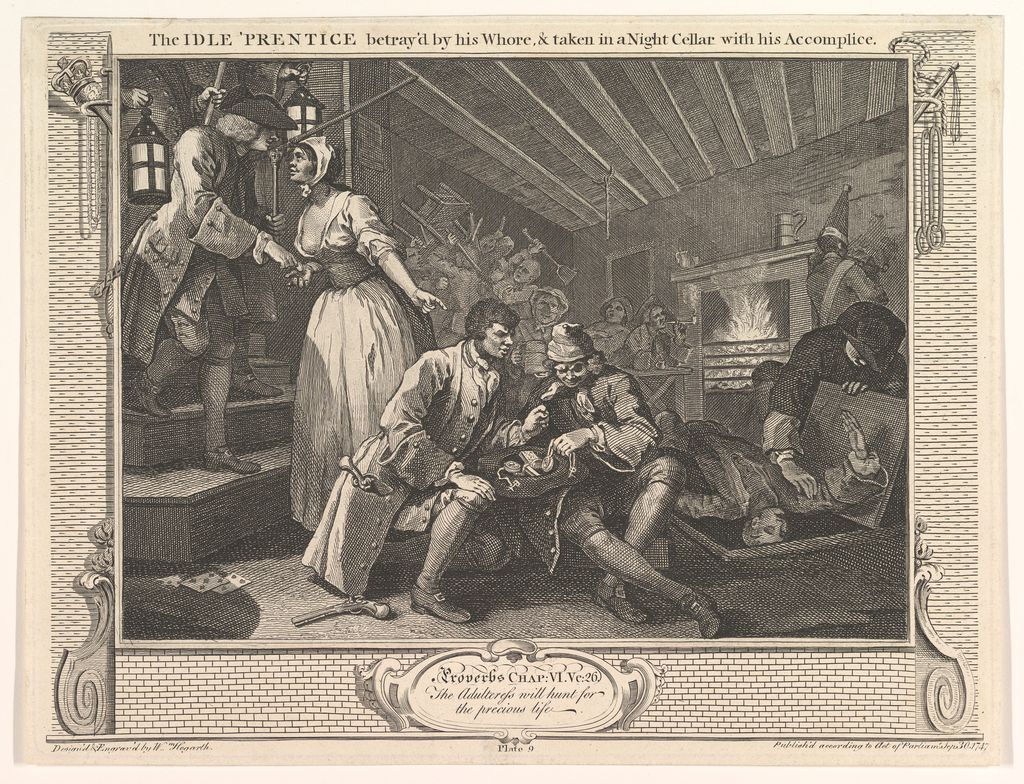
The Idle 'Prentice Betrayed by his Whore and Taken in a Night Cellar with his Accomplice (Industry and Idleness, plate 9), William Hogarth, September 30, 1747. Etching and engraving; third state of four. 91.1.17. Gift of Sarah Lazarus, 1891. Image source. CC0 / Public domain.
Browse Hogarth’s artworks
All 54 individual artworks and series stages in the approved English cluster
Frequently Asked Questions
A woman on the stairs points him out to the party arriving with lanterns. Idle and his companion are still occupied with the goods in front of them. [1]
It is plate 9 of 12 in Industry and Idleness. Following the plate numbers keeps Goodchild’s and Idle’s episodes in the intended order. [1]
Discussion
Look again at the images and ideas explored in The Idle Apprentice Betrayed in a Night Cellar. These editorial prompts invite your observations.
Reader Insights
How do the staircase and the trapdoor control what the officers and the reader can see?
How does the verse from Proverbs shape your reading of the woman’s pointing gesture?
Join the Conversation
Share a detail, comparison or question about The Idle Apprentice Betrayed in a Night Cellar below.
References
- The Metropolitan Museum of Art, William Hogarth, The Idle ’Prentice Betrayed by his Whore and Taken in a Night Cellar with his Accomplice (Industry and Idleness, plate 9), 91.1.17. View source.
- Colonial Williamsburg Foundation, William Hogarth, Industry and Idleness – The Idle ’Prentice betray’d by his Whore & taken in a Night Cellar with his Accomplice, 1947-486,A. View source.
- John Trusler, Hogarth Moralized, plate IX, pp. 102–104, John Major edition, digitised by Universitätsbibliothek Paderborn. View source.
- John Ireland and John Nichols, Hogarth’s Works, with Life and Anecdotal Descriptions of His Pictures, vol. 1, plates IX–X and note 164, Chatto and Windus collected edition. View source.
- National Library of New Zealand, William Hogarth, Industry and Idleness, plate 9, Alexander Turnbull Library, D-020-064. View source.
- London Lives 1690–1800, Prosecutors and Litigants, “Thief-Takers”. View source.
- National Gallery of Victoria, William Hogarth, The idle ’prentice betray’d by his whore, and taken in a night cellar with his accomplice, 1278.460-3. View source.
- The Metropolitan Museum of Art, William Hogarth, The Idle ’Prentice Returned from Sea and in a Garret with a Common Prostitute (Industry and Idleness, plate 7), 91.1.15. View source.
- The Metropolitan Museum of Art, William Hogarth, The Industrious ’Prentice Grown Rich and Sheriff of London (Industry and Idleness, plate 8), 91.1.16. View source.
- The Metropolitan Museum of Art, William Hogarth, The Industrious ’Prentice Alderman of London, The Idle One Brought Before Him and Impeached by his Accomplices (Industry and Idleness, plate 10), 91.1.18. View source.
- Vicki Principi, Princeton University Library, William Hogarth Collection, GC113, “Drawer 2 contents”, plates 1–12. View source.
- National Gallery of Victoria, William Hogarth, The idle ’prentice betray’d by his whore, and taken in a night cellar with his accomplice, John Boydell as publisher, 1995.358.9. View source.
- Wellcome Collection, Thomas Cook after William Hogarth, plate IX of Industry and Idleness, 1 October 1795, 38375i. View source.
- Lewis Walpole Library, Yale University, Lewis Walpole Library Collection of Prints after William Hogarth, LWL MSS 42, processing note and box 3, folder 69. View source.







