


 by Tom Gurney
Tom Gurney BSc (Hons) is an art history expert with over 20 years experience
Published on June 19, 2020 / Updated on October 14, 2023
Email: tomgurney1@gmail.com / Phone: +44 7429 011000
The First Stage of Cruelty: Introduction
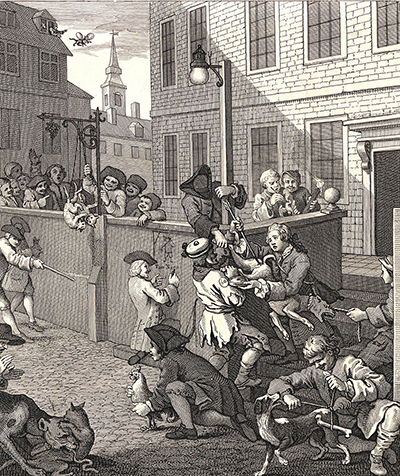
A boy holds out a tart to the child who is hurting a dog. Other boys restrain the animal, and the offer fails. William Hogarth puts that small act of compassion in the middle of The First Stage of Cruelty, the opening print of The Four Stages of Cruelty. The child tormenting the dog is the fictional Tom Nero. The impression at The Metropolitan Museum of Art, 91.1.136, is an etching and engraving in the first of two states. Its plate mark measures 38.8 × 32.3 cm, large enough for Hogarth to set the central encounter among a host of smaller incidents. [1] [2]
At a Glance
- ArtistWilliam Hogarth
- Date engraved on the print1 February 1751
- Medium and stateEtching and engraving, first state of two
- Print collectionThe Metropolitan Museum of Art, 91.1.136
- Preparatory drawingRed chalk, about 1750, The Morgan Library & Museum, III, 32b
This work across William Hogarth’s career
Assembly at Wanstead House
1728–31The Heir
1734The Marriage Settlement
about 1743Gin Lane
1751Canvassing for Votes
1754–55Contents
- A street full of witnesses
- The boy with the tart
- How the drawing became a print
- What the margin tells us
A street full of witnesses
The low wall gives the picture much of its order. It recedes across the street, closes off the space behind Tom and provides an edge for the boys leaning over it. Some of their faces line up along the coping. The lamp and the tall post rise above the central group, while the tower in the distance and the windows at the right extend the scene beyond the children. From a distance, the post and the overlapping bodies pick out the dog’s predicament. At closer range, the faces and gestures begin to show how many people are involved. One boy peers over the edge of the wall with his chin almost level with it. Others lean forward for a better view. By making looking so conspicuous, Hogarth places the boys who watch within the action. [1]
The abuse takes different forms across the sheet. Near the wall, a boy holds a cock while others take part in the game of throwing at it. In the lower right, a crouching figure ties a bone to a dog’s tail. At the far left, a dog attacks a cat as hands clap just inside the edge of the picture. Up by the roofline, a cat is already in the air outside a dormer window. The scattered episodes pull the eye from the paving to the roof. Each occupies a different patch of the street, and each has enough space for its own action to be read. What first appears to be a crowd gathered around one disturbance turns out to contain several groups making their own entertainment. [1] [2] [3]
Hogarth gives this fictional street a local association through a detail that is easy to miss. The letters SG appear inside the badge on Tom’s sleeve. The scholars Jennifer Tonkovich and Laurel O. Peterson read the initials as St Giles-in-the-Fields, the parish whose care the badge indicates and the district Hogarth represents in Gin Lane. The badge ties Nero to a recognisable London parish. The precise street and the identity of the tower remain uncertain. The drawing on the wall supplies a different kind of identification. A child has put Tom’s name beside the image of a hanging man. Nero’s fate is already imaginable within the opening scene, even as the boys around him are busy with their games. [1] [2] [3]
The boy with the tart
The boy offering food is so close to Tom that the two figures almost touch. His face is uncovered and turned towards Nero, and the pale oval of the tart stands out between them. Another boy braces himself against the post. Still another pulls from the right. Their gestures converge on the dog, while the offered tart creates a line of attention from one child to another. No figure in the central group visibly takes up the appeal. With the boy’s face and hands so clearly set out, however, the reader can follow what he is trying to do even before reading the words below. [1] [2]
The Morgan credits the verses to the Reverend James Townley, a friend of Hogarth’s. They are laid out under the scene in three columns. The first finds “The Tyrant in the Boy,” giving the idea of children’s sport a sinister turn. The second gives the boy with the tart a voice and sums up his failure in “But Tears and Tart are vain.” In the third, the verse turns outward and addresses people who take pleasure in cruel sports. The reader is asked to learn from a gesture the other children ignore. Pity is presented as a pleasure to the eye. That invitation puts the appearance of the boy and the way he carries himself to work alongside the words. His good clothes help to distinguish him in the crush, but his offer is the detail singled out by the verse. [1] [4]
Watch Hogarth’s paintings and prints
Five films on Hogarth’s painted stories, prints, drawing methods and work for the Foundling Hospital.
Crafting Cruelty: Hogarth’s Innovative Drawing Methods
The Morgan examines Hogarth’s drawings for The Four Stages of Cruelty and the methods he used to work out his designs.
Watch on YouTubeWellcome Collection records a suggestion that the boy represents George William Frederick, the future George III. The picture and verse establish his role as an intercessor, and the verse leaves him unnamed. The royal identification remains conjectural. His place in the picture is more securely understood through an action as ordinary as giving up his own food. He uses the resource available to him, with no evident authority over the other boys. [1] [2]
How the drawing became a print
A red-chalk design of about 1750 at the Morgan Library & Museum, III, 32b, preserves much of the street already worked out. The sheet is incised, and its back was rubbed with red chalk so that pressure from a stylus could carry selected lines onto another surface. At the Yale Center for British Art, a separate sheet of about 1750, B1975.4.1543, shows the same subject in graphite and red chalk. Its architectural guides and redrawn outlines reveal the work of giving the groups positions in a street with convincing depth. The sheets make it possible to follow changes that are almost invisible once the image has been printed. [3] [5] [6]
The clapping boy at the left edge of the print offers a particularly small test. In the Yale drawing his head and hat are visible. On the Morgan sheet the hands survive and the face is at most lightly indicated. In the print there is room for a dark, broad-brimmed hat, with the clapping figure placed closer to the dog attacking the cat. The change preserves the gesture without crowding the legs of the boys in the cock-throwing scene above. Tonkovich and Peterson also compared the position of the receding wall in the two drawings. Its change in height affects how the incidents fit together. The wall works as both a piece of street architecture and a line Hogarth could move to make the actions easier to read. [1] [3]
The rougher Yale sheet may have served more than once. As Tonkovich and Peterson explain, David Bindman proposed that it came after the Morgan drawing and could have been used to transfer the composition to copper. They see signs of early development in Yale’s changes to perspective and placement, alongside signs of later work. One is the incised detail of the cat falling from the dormer, which the Morgan sheet describes more fully. They suggest that Hogarth used the Yale sheet to develop the initial scene and returned to it as he refined the design. The transfer marks are evidence of handling and revision, while the precise order of those uses remains open. Two details that the print adds to the Morgan design are the boys blinding a bird at the right and the parish badge. One fills a space with another incident. The other uses a few strokes of lettering to give the main figure a social identity. [3]
What the margin tells us
The Met dates its impression 1 February 1751, the date engraved in the publication line. From a notice in the London Evening Post, Tonkovich and Peterson place the series’ appearance on 21 February 1751, presumably New Style. The notice announced the prints as inexpensive and described them as intended to reform vices it associated with poorer people. The shilling price survives at the lower right of the Met sheet. The advertisement tells us whom the sales pitch invoked and how the publisher represented the price. It leaves open who actually bought or saw a copy. [1] [2] [3]
Small details in the margin also tell impressions apart. Wellcome’s example, 38379i, retains the one-shilling price and is catalogued as state I under no. 187 in Ronald Paulson’s third edition of Hogarth’s Graphic Works (1989). Tokyo’s National Museum of Western Art likewise identifies its impression, G.1994-0012, as the first of two states under that number. The Museum of Fine Arts, Houston, calls its own price-bearing impression the version before the price was removed. A state describes a form of the printing plate, so the date in the lettering alone cannot tell us when any particular sheet was pulled. [2] [7] [8]
In The Second Stage of Cruelty, Tom has become a hackney coach driver and the animal he beats is the horse that carries his fares. The move from a dog in a group’s hands to a collapsed horse under the shafts connects the opening pastime with adult work. It also changes what a witness can do. Where the boy offers his tart, a man in the next print takes down the cab number, a detail that makes it possible to hold the driver to account. The first plate gives this small intervention its force by showing how thoroughly Nero’s companions have accepted the violence as part of their play. [1] [3] [9]
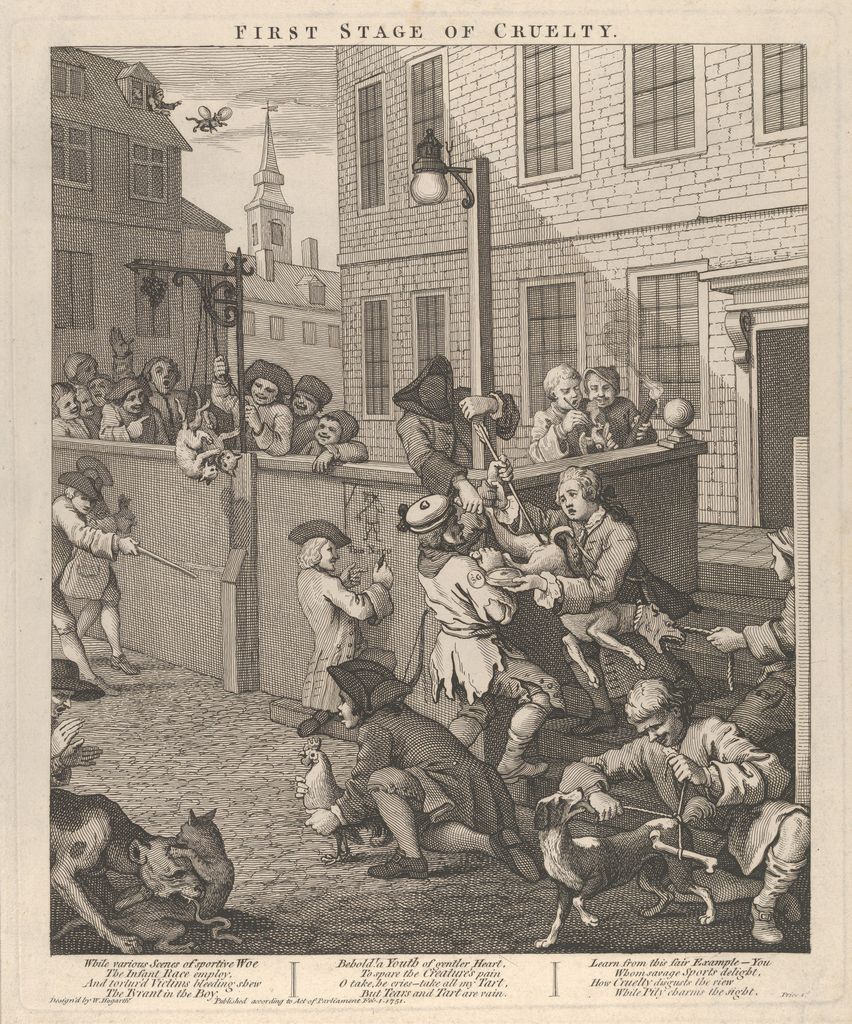
The First Stage of Cruelty (The Four Stages of Cruelty), William Hogarth, February 1, 1751. Etching and engraving; first state of two. 91.1.136. Gift of Sarah Lazarus, 1891. Image source. CC0 / Public domain.
Browse Hogarth’s artworks
All 54 individual artworks and series stages in the approved English cluster
Frequently Asked Questions
It is print 1 of 4 in The Four Stages of Cruelty. Use that position to follow the change in setting from one episode to the next. [1]
Discussion
Look again at the images and ideas explored in The First Stage of Cruelty. These editorial prompts invite your observations.
Reader Insights
How do the pale tart and the boy’s turned face draw your eye away from the boys restraining the dog?
What does the drawing of a hanging man on the wall add to your first impression of Tom Nero?
Join the Conversation
Share a detail, comparison or question about The First Stage of Cruelty below.
References
- The Metropolitan Museum of Art, The First Stage of Cruelty (The Four Stages of Cruelty), 91.1.136. View source.
- Wellcome Collection, A street scene in which a dog is maltreated; a young man intervenes by offering his food to the miscreants, 38379i. View source.
- Jennifer Tonkovich and Laurel O. Peterson, “Hogarth and the Making of the Four Stages of Cruelty,” Master Drawings 62, no. 1 (2024), especially pp. 21, 33–36 and figs. 1, 5 and 21–23. View source.
- The Morgan Library & Museum, First Stage of Cruelty [print], exhibition entry for The Metropolitan Museum of Art impression 91.1.136. View source.
- The Morgan Library & Museum, First Stage of Cruelty, III, 32b. View source.
- Yale Center for British Art, The First Stage of Cruelty, B1975.4.1543. View source.
- National Museum of Western Art, Tokyo, The Four Stages of Cruelty: First Stage of Cruelty, G.1994-0012. View source.
- The Museum of Fine Arts, Houston, The First Stage of Cruelty, 2022.319. View source.
- The Metropolitan Museum of Art, The Second Stage of Cruelty (The Four Stages of Cruelty), 91.1.137. View source.







