


 by Tom Gurney
Tom Gurney BSc (Hons) is an art history expert with over 20 years experience
Published on June 19, 2020 / Updated on October 14, 2023
Email: tomgurney1@gmail.com / Phone: +44 7429 011000
The Gaming House: Introduction
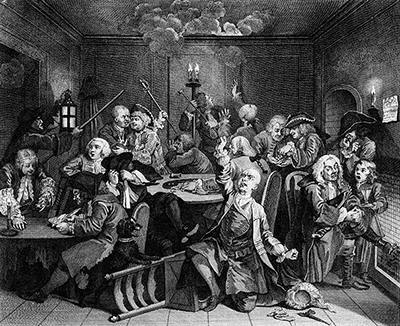
Tom Rakewell drops to one knee with his fist in the air. His chair has gone over, and his wig and empty purse lie on the floor. Behind him, people still have their eyes on the money as smoke gathers near the ceiling. This is the sixth of eight scenes in William Hogarth’s A Rake’s Progress. Sir John Soane’s Museum catalogues the oil on canvas as a work of 1734. The canvas, museum number P45, measures 62.5 by 75.5 centimetres. [1] [2]
The money Tom has just lost came through his marriage. In the preceding scene, The Marriage, Hogarth makes it possible to see the wealth of the bride in the clothes and jewellery she wears to church. She is absent from the gaming house. What she brought to the marriage is now among the stakes, and Tom can think only of what he has lost. Hogarth gives us the result of the wager in the position of Tom’s body and in the belongings scattered around it. [3] [1]
At a Glance
- SeriesScene 6 of 8 in A Rake’s Progress
- Painting1734, oil on canvas, Sir John Soane’s Museum, P45
- Plate publication25 June 1735, sold at the Golden Head in Leicester Fields
- Second-state impressionEtching and engraving, Bibliothèque nationale de France, FRBNF40262629
- Third-state impressionEtching and engraving, The Metropolitan Museum of Art, 91.1.88
This work across William Hogarth’s career
Assembly at Wanstead House
1728–31The Heir
1734The Marriage Settlement
about 1743Gin Lane
1751Canvassing for Votes
1754–55Contents
- What the players stand to lose
- Who sees the smoke?
- How the print directs the eye
- Looking into the dark
What the players stand to lose
The blue coat with silver braid and the coral lining of the waistcoat still distinguish Tom in the oil. His clothes have kept their shape and sheen while the figure inside them has lost his composure. The upended chair drops the line of the furniture sharply towards the floor, where the purse and wig are in reach. Tom’s eyes and raised hand take us in the opposite direction. The dog has raised its paws onto the chair and appears to bark at him. It is one of the few creatures in the room whose attention he commands. [1]
The Soane catalogue suggests the players may have been throwing dice at Hazard, a game played with two dice. The absence of cards on the table supports the reading of a dice game. The man gathering the stakes and the wigless man brandishing a sword tell us more about the mood than about the rules. A companion tries to hold the armed man back. The threat makes sense as an accusation of cheating, as the museum suggests, but the picture leaves the throw and the fairness of the dice to inference. Tom has made a spectacle of losing while another man is ready to contest the result. [1]
At a separate table, a finely dressed borrower waits while a lender writes down a sum. The Soane catalogue reads the entry as a loan of £500 to a Lord Cogg, a name within the picture. The small written record gives a different measure of the stakes from the pile of coins. One can be swept away with a rake in the time it takes to settle a bet. The other is an obligation that will remain after the money is spent. Nearby, two men count gold by hand. Their absorbed calculation is a quieter form of concentration than the quarrel over the stakes, and just as effective at keeping their attention below the ceiling. [1]
The seated man by the hearth offers a further possibility for what can happen to the winnings. The Soane catalogue reads his mask and pistols as signs that he is a highwayman, and suggests that his sidelong look may be directed at the man collecting the money. His posture allows him to watch without joining the crush around the table. The boy bringing a drink and the guard in front of the hearth belong to the ordinary business of keeping the room in use. There is time to sit and warm oneself while, higher up, the building is beginning to burn. [1]
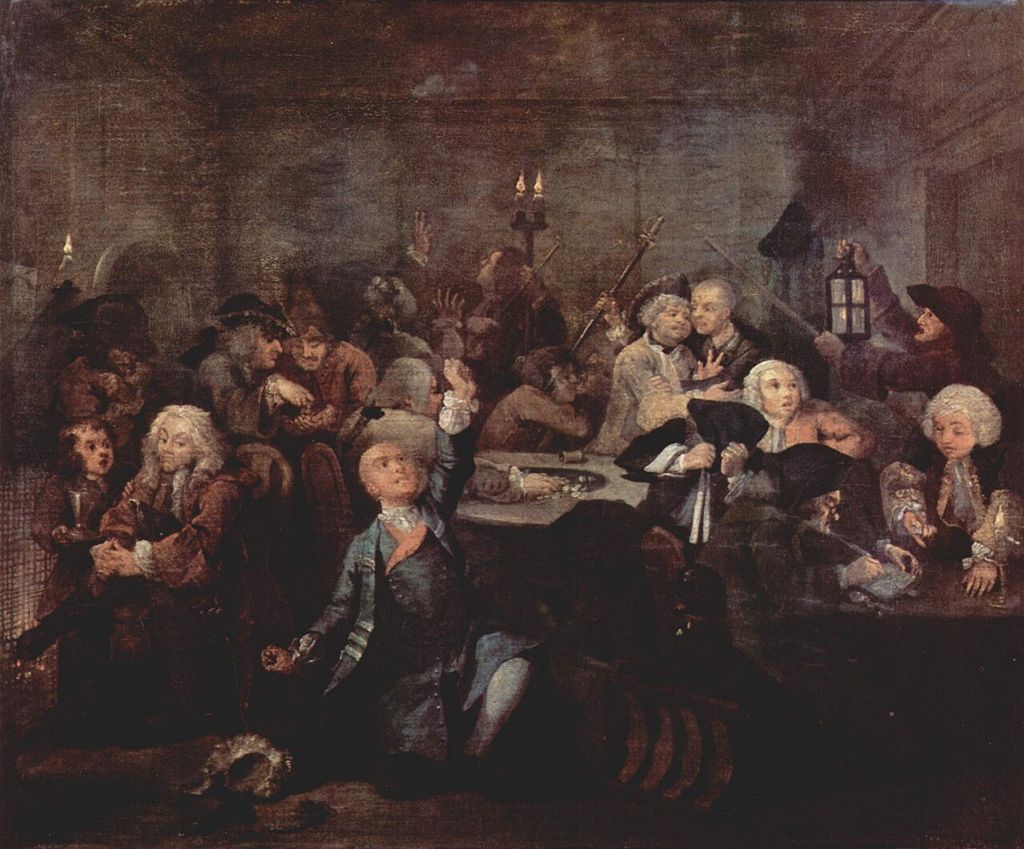
The Gaming House, William Hogarth, 1734. Oil on canvas. SM P45. The Yorck Project via Wikimedia Commons. Image source. Public domain.
Who sees the smoke?
The night watchman is already through the doorway. His lantern and staff give him a clear purpose and recall the similar equipment lying by Tom in the earlier tavern scene. There the Soane catalogue reads the objects as the spoils of a prank on the watch. Here the man carrying them has brought news the gamblers need. A red-coated figure turns at the interruption, and two men deeper in the scene look towards the danger overhead. One has both a torch and a money rake. Hogarth can register successive moments of recognition in a single room, from the watchman’s entrance to the upward looks and the people still absorbed in their transactions. [1] [4]
Watch Hogarth’s paintings and prints
Five films on Hogarth’s painted stories, prints, drawing methods and work for the Foundling Hospital.
The Sequel: Hogarth’s "A Rake’s Progress" (1734–5)
The Paul Mellon Centre revisits the eight-scene story of Tom Rakewell and its place in Hogarth’s work.
Watch on YouTubeThe dog supplies the best clue to the depicted address. The Soane catalogue reads the partial lettering on its collar as pointing to Covent Garden. The fire may recall a documented blaze in a different district. On 28 April 1733 a fire at White’s Chocolate House in St James’s Street began, according to the account cited by the Soane, in a gaming room known as Hell. Te Papa’s commentary places the printed scene at White’s, while the collar supports the Soane’s Covent Garden reading of the painting. The historical fire gives Hogarth’s audience a possible association, and the collar locates the invented room only as far as the district. [1] [5] [6]
How the print directs the eye
Hogarth reversed the room in plate six. In the Metropolitan Museum of Art’s third-state impression, 91.1.88, the watchman enters at the left and the hearth is on the right. Tom’s fist rises just to the right of centre. The black dog and the back of the overturned chair sit to his left, and the wig and purse mark the floor to his right. The print makes the weave of his clothes and the pale oval of his bare head stand out among darker hats and coats. Farther up, the watchman’s staff cuts diagonally into the room. The viewer can follow that line past the crowded table to the faces looking up, then pick out the overlapping masses of smoke against the engraved ceiling. [1] [7]
On a lettered impression, there is another way out of the crowd. The Bibliothèque nationale de France describes four columns of verse below the image. The poem begins by praising gold for what it enables people to do for one another. It turns to the misuse of money, to friends preying on friends, and finally to imprisonment. That last idea directs the reader beyond the picture. The engraved publication line also gives the date, 25 June 1735, and a sales address, the Golden Head in Leicester Fields. A sheet that shows money passing so quickly from hand to hand tells its reader where it was offered for sale. [8] [9]
Those details belong to identifiable impressions. The French library’s record FRBNF40262629 describes an etching and engraving in the second state, Paulson 137.2 in the 1965 edition. It measures the printed element at 35.5 by 40.7 centimetres and the sheet at 39 by 43.8. Te Papa’s separate impression, 1965-0001-1/6-8, is catalogued as a 1735 engraving, with an image measuring 35.8 by 41.2 centimetres. These records measure different parts of their objects. The date engraved on the plate could also outlast its original publication. Colonial Williamsburg identifies its third-state impression as a Boydell printing made after 1790, although the 1735 date remains in the lettering. [8] [6] [9]
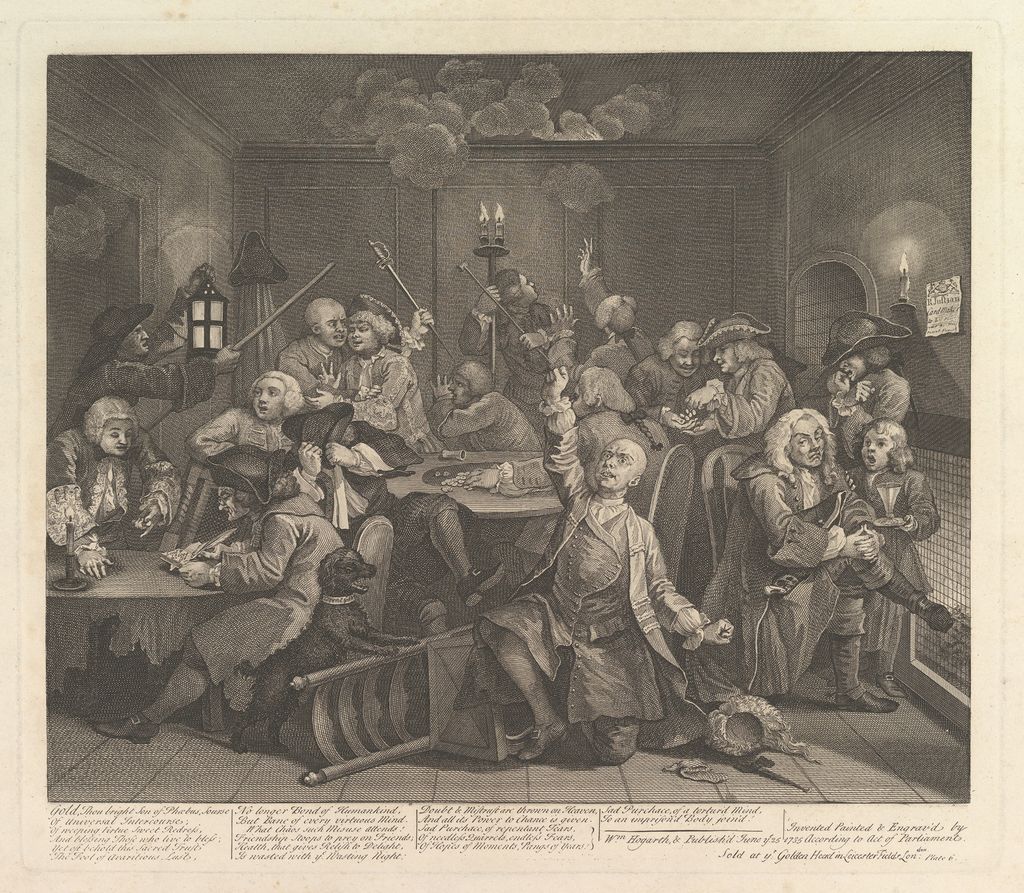
A Rake's Progress, Plate 6, William Hogarth, June 25, 1735. Etching and engraving; third state of three. 91.1.88. Gift of Sarah Lazarus, 1891. Image source. CC0 / Public domain.
Looking into the dark
The appearance of the painted shadows also has a material history. A microscopic examination reported by the Soane in 2021 found a darker paint over a pale underlayer in the face of the woman leaning towards a man at the table, both beneath later discoloured varnish. The museum included The Gaming House in the first group when it began conserving the series in April 2024. Its report describes the reduction of old varnish and the stabilisation of vulnerable paint and canvas edges. The examination explains how a figure Hogarth painted so sketchily can become harder to make out as a coating darkens. That obscurity differs from the smoke Hogarth deliberately set above the crowd. [1] [10]
In The Prison, the demands for payment continue inside the Fleet. There the blue coat is torn and Tom’s wife raises her own clenched fist. The Soane catalogue notes the echo of his gesture from the gaming house. His loss is now hers to reckon with. The moneylender in The Gaming House still has someone eager to borrow. The keeper in the next scene has a captive customer. Hogarth makes the change visible in the different faces around Tom, and in how little room he has left to move. [11] [1]
Browse Hogarth’s artworks
All 54 individual artworks and series stages in the approved English cluster
Frequently Asked Questions
It is scene 6 of 8 in A Rake’s Progress. Sir John Soane’s Museum uses the scene number for the original oil painting. [1]
Discussion
Look again at the images and ideas explored in The Gaming House. These editorial prompts invite your observations.
Reader Insights
How does the watchman’s staff lead your eye from the doorway to the smoke in the print?
What do Tom’s empty purse and the lender’s written entry tell you about what happens to money in the room?
Join the Conversation
Share a detail, comparison or question about The Gaming House below.
References
- Sir John Soane’s Museum, Joanna Tinworth, William Hogarth, A Rake’s Progress VI: The Gaming House, P45, including curatorial note and note 7 on paint examination. View source.
- Sir John Soane’s Museum, The Picture Room, sections on A Rake’s Progress and conservation. View source.
- Sir John Soane’s Museum, William Hogarth, A Rake’s Progress V: The Marriage, P44. View source.
- Sir John Soane’s Museum, Joanna Tinworth, William Hogarth, A Rake’s Progress III: The Orgy, P42. View source.
- Sir John Soane’s Museum, Anna McAlaney, White’s Chocolate House, 37–8 St James’s Street, London, 1787, unexecuted (9), ARC10977, historical notes on the 1733 fire. View source.
- Museum of New Zealand Te Papa Tongarewa, William Hogarth, A rake’s progress. Plate 6. Scene in a gaming house, 1965-0001-1/6-8, including commentary by Mark Stocker. View source.
- The Metropolitan Museum of Art, William Hogarth, A Rake’s Progress, Plate 6, 91.1.88, third state of three. View source.
- Bibliothèque nationale de France, William Hogarth, [A rake’s progress : the Gaming House] : Plate 6, FRBNF40262629, second state, Paulson 137.2 (1965). View source.
- The Colonial Williamsburg Foundation, William Hogarth, A Rake’s Progress, Plate 6, 1967-566,6, third state, Boydell impression, lower-margin transcription. View source.
- Sir John Soane’s Museum, Report and Accounts for the Year Ended 31 March 2025, HC 1547, pp. 13–14. View source.
- Sir John Soane’s Museum, William Hogarth, A Rake’s Progress VII: The Prison, P46. View source.







