


 by Tom Gurney
Tom Gurney BSc (Hons) is an art history expert with over 20 years experience
Published on June 19, 2020 / Updated on October 14, 2023
Email: tomgurney1@gmail.com / Phone: +44 7429 011000
The Industrious Apprentice, Alderman of London: Introduction
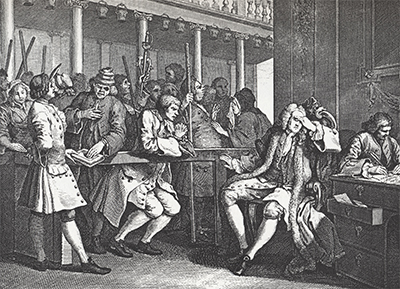
Thomas Idle clasps his hands at a railing while Francis Goodchild, seated on the other side, raises a hand to his forehead. The two men began William Hogarth’s Industry and Idleness as fellow apprentices. In plate 10, Goodchild is a City of London alderman hearing an accusation against Idle. Hogarth puts the plea for mercy, the accomplice’s oath and the clerk’s writing within a few feet of one another. In this room, a gesture or a piece of paper can have consequences beyond anything the two men faced in the workshop. [1]
The Metropolitan Museum of Art’s impression, 91.1.18, is an etching and engraving catalogued as the second state of two and dated 30 September 1747. The upper inscription describes Idle as impeached by his accomplice. Here the word means accused or informed against. The title tells us who has turned against Idle, while the image shows how the accusation is made and who has the authority to act on it. [1] [2]
At a Glance
- ArtistWilliam Hogarth
- SeriesIndustry and Idleness, plate 10 of 12
- Inscribed publication date30 September 1747
- MediumEtching and engraving
- ImpressionThe Metropolitan Museum of Art, 91.1.18, second state of two
This work across William Hogarth’s career
Assembly at Wanstead House
1728–31The Heir
1734The Marriage Settlement
about 1743Gin Lane
1751Canvassing for Votes
1754–55Contents
- Two former apprentices at the bar
- How the accusation reaches Goodchild
- What a City alderman could decide
- Two verses beneath one hearing
- The two states and the 1747 date
Two former apprentices at the bar
In the first plate the two men sit at similar looms, with Idle on the left and Goodchild on the right. Hogarth keeps that order in their reunion but positions them on opposite sides of the bar. Idle’s knees are bent and his elbows have reached the rail. Goodchild can sit back in a carved chair. There are people pressed close behind the prisoner, while the alderman has room to extend one hand towards him. The space around Goodchild makes the difference in rank as palpable as his fur-trimmed robe. Even without the title, a viewer could tell which man is asking for something and which has the power to answer. [1] [3]
One of Goodchild’s hands cuts across his brow while the other opens towards Idle. In the 1833 edition of his commentary, John Trusler reads the pose as a struggle between pity and duty. Colonial Williamsburg’s label sees an allusion to blind justice in Goodchild’s averted gaze. The interpretations meet at an awkward detail. Hogarth gives the viewer a view of what the alderman, with his attention on the man he once knew and his hand across his face, might easily miss at the other end of the bar. [1] [2] [4]
How the accusation reaches Goodchild
The man with the covered eye lays a hand on a book held by an official at the left. His cap and covered eye recall the man at Idle’s side in the night cellar. In that scene they lean towards the same heap of valuables while a woman points them out to an officer. Here the accomplice has a chance to speak for himself by speaking against Idle. Behind the prisoner, a man raises weapons in one hand for inspection. Hogarth puts the objects above the crowd so the eye can pick them out, giving the accusation a material focus without establishing who used the weapons. [1] [2] [5]
Look below the book and towards the left edge. A woman reaches towards the free hand of the man administering the oath. Trusler takes the exchange to be a payment and observes that the witness is allowed to lay his left hand on the book. Colonial Williamsburg also reads the exchange as a bribe and identifies the woman with Idle’s earlier companion. The identity and purpose of the payment are matters of interpretation. What Hogarth makes conspicuous, once the viewer notices it, is that the official can attend to a private transaction with one hand while the other supports the book on which a public oath depends. [1] [2] [4]
The writer at the far right is a separate figure. He bends to his paper as the alderman listens, with more papers in the open drawer below him. Trusler interprets the document as a warrant of commitment, or mittimus. In that reading the paper would authorise detention. Toward the centre, a woman with raised hands attempts to reach an official behind the bar. Trusler identifies her as Idle’s mother. Her gesture has no visible counterpart on paper. [1] [4]
Watch Hogarth’s paintings and prints
Five films on Hogarth’s painted stories, prints, drawing methods and work for the Foundling Hospital.
In 60 seconds: Hogarth's 'Gin Lane' & 'Beer Street'
A short introduction to the contrasting streets, the shops and the people in Hogarth’s paired prints.
Watch on YouTubeWhat a City alderman could decide
The City began regular daily sittings by aldermen at Guildhall in December 1737, about a decade before Hogarth’s print. One alderman at a time dealt with business that included examining felony suspects before trial. John H. Langbein’s study of City records locates the hearings in a partitioned part of the Matted Gallery. The surviving architectural drawings he cites indicate a ceiling too low to accommodate Hogarth’s double gallery. The print’s columns and balustrade make a grand public setting for a recognisable civic function. The London Archives lists the Guildhall Justice Room records under CLA/005, separately from the repertories that record the governing business of the Court of Aldermen. [6] [7]
Langbein reads the clerk’s task differently from Trusler. He takes the clerk to be writing down the accomplice’s confession. A magistrate could secure testimony for the prosecution by allowing a participant to give evidence for the Crown in the expectation that he would escape prosecution himself. The oath at the left of the print fits that arrangement. The possibility gives the witness a reason to cooperate and the viewer a reason to scrutinise his story. Hogarth leaves the terms of any bargain outside the scene. [1] [4] [6]
The surviving Guildhall minute book for May and June 1752 supplies a comparison. On 29 May, a watchman and a constable brought William Robinson before Alderman Thomas Rawlinson on suspicion of stealing shoemaking tools and old shoes. Rawlinson ordered detention while inquiries were made about the goods. At a further hearing on 1 June, with Thomas Chitty sitting, the owner and his son identified the property and the watchman gave his account again. Chitty placed them under an obligation to prosecute at the ensuing Old Bailey sessions. Robinson was convicted and transported following that later trial. The minute book and the printed trial account give Langbein different parts of the same case. [6]
That sequence shows how much work could intervene between a suspect’s first appearance and a verdict. The presiding official could change, the objects could acquire a documented owner, and statements could have to be given again. In plate 10, Hogarth brings the charge, the display of objects and the clerk’s writing into a single encounter. The next plate jumps ahead to Idle’s execution at Tyburn, leaving the trial and sentence between the sheets. The sudden transition makes the encounter feel decisive, although the authority Goodchild exercises is best understood as that of an examining magistrate. [1] [6] [8]
Two verses beneath one hearing
Below Idle’s side, Psalm 9:16 says that the wicked man is caught in the work of his own hands. Below the alderman’s side, Leviticus 19:15 forbids unrighteous judgement. The first verse asks readers to look back at how Idle came to be there. The second sets a standard for what the people in office do next. In the workshop, Goodchild’s diligence had chiefly affected his prospects with his master. Here his conduct matters to somebody whose interests are opposed to his own. The suspected payment beside the oath gives the verse on judging honestly a point beyond Goodchild’s personal dilemma. [1] [2] [9]
The two states and the 1747 date
The Met dates its first-state impression, 32.35(47), to the same day as the second-state sheet. In Melbourne, the National Gallery of Victoria also catalogues its impression, 1278.461-3, as the second of two states. Its transcription records the publication date of 30 September 1747 in the lower margin, alongside the credit to Hogarth and the plate number. The Met’s second-state sheet ends at the base of the ornamental border, so Melbourne’s fuller margin supplies lettering absent from that sheet. The shared date identifies the publication named on the plate. The precise day on which either Met sheet was pulled remains uncertain. [1] [9] [10]
The Lewis Walpole Library files later copies of this design under no. 177 in the third edition of Ronald Paulson’s catalogue. One copy, engraved by G. Murray, appeared as the frontispiece to no. X of the Comick Magazine on 2 January 1797. Princeton University Library’s finding aid lists its Hogarth impression of plate 10 among the twelve numbered subjects and dates the entry to 30 September 1747. The two holdings show different ways a reader could encounter the design, as one of the consecutive Hogarth plates or as a frontispiece engraved by another hand half a century later. [11] [12]
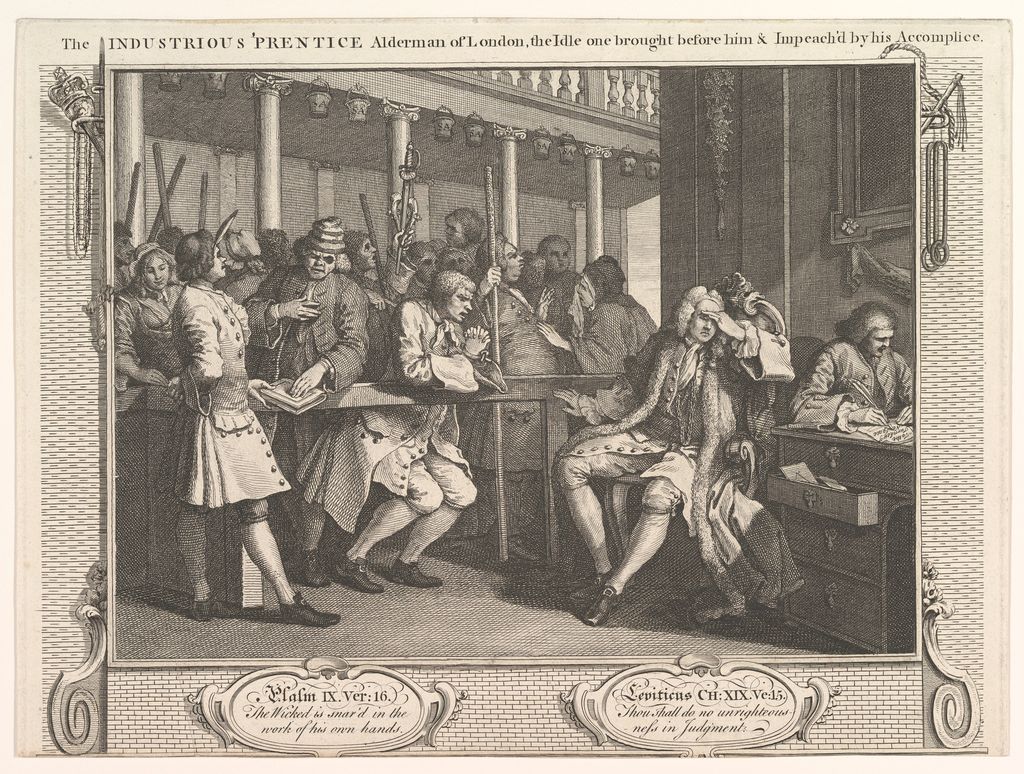
The Industrious 'Prentice Alderman of London, The Idle One Brought Before Him and Impeached by his Accomplices (Industry and Idleness, plate 10), William Hogarth, September 30, 1747. Etching and engraving; second state of two. 91.1.18. Gift of Sarah Lazarus, 1891. Image source. CC0 / Public domain.
Browse Hogarth’s artworks
All 54 individual artworks and series stages in the approved English cluster
Frequently Asked Questions
Goodchild is now an alderman hearing an accusation against Idle. An accomplice gives evidence while a clerk writes. [1]
It is plate 10 of 12 in Industry and Idleness. Following the plate numbers keeps Goodchild’s and Idle’s episodes in the intended order. [1]
Discussion
Look again at the images and ideas explored in The Industrious Apprentice, Alderman of London. These editorial prompts invite your observations.
Reader Insights
How do the railing and Goodchild’s chair show what has changed since the two men worked at their looms?
How does the exchange beside the oath book change the way you read the verse about judging honestly?
Join the Conversation
Share a detail, comparison or question about The Industrious Apprentice, Alderman of London below.
References
- The Metropolitan Museum of Art, William Hogarth, The Industrious ’Prentice Alderman of London, The Idle One Brought Before Him and Impeached by his Accomplices (Industry and Idleness, plate 10), 91.1.18, second state of two. View source.
- The Colonial Williamsburg Foundation, William Hogarth, Industry and Idleness – The Industrious ’Prentice Alderman of London, the Idle one brought before him & Impeach’d by his Accomplice, 1947-487,A, inscriptions and collection label. View source.
- The Metropolitan Museum of Art, William Hogarth, The Fellow ’Prentices at their Looms (Industry and Idleness, plate 1), 91.1.9. View source.
- John Trusler, The Works of William Hogarth, in a Series of Engravings, London, Jones and Co., 1833, “Industry and Idleness, Plate X”. View source.
- The Metropolitan Museum of Art, William Hogarth, The Idle ’Prentice Betrayed by his Whore and Taken in a Night Cellar with his Accomplice (Industry and Idleness, plate 9), 91.1.17. View source.
- John H. Langbein, “Shaping the Eighteenth-Century Criminal Trial: A View from the Ryder Sources,” University of Chicago Law Review 50, no. 1 (1983), pp. 77–81, 84–85 and 91–92, including the Guildhall Justice Room minute book, former City of London Record Office reference 204B, and the June 1752 Old Bailey record, case no. 394. View source.
- The London Archives, City of London Corporation: Administrative Records, sections 3.1 and 4, Court of Aldermen repertories COL/CA/01/01 and Guildhall Justice Room CLA/005. View source.
- London Museum, William Hogarth, The Idle ’Prentice Executed at Tyburn, collection object 93353. View source.
- National Gallery of Victoria, William Hogarth, The industrious ’prentice alderman of London, the idle one brought before him and impeach’d by his accomplice, 1278.461-3, inscriptions and state. View source.
- The Metropolitan Museum of Art, William Hogarth, The Industrious ’Prentice Alderman of London, the Idle One Brought Before Him & Impeached by his Accomplice: Industry and Idleness, plate 10, 32.35(47), first state of two. View source.
- Lewis Walpole Library, Yale University, Collection of Prints after William Hogarth, LWL MSS 42, pp. 6 and 32, box 3, folder 73, with numbering from Ronald Paulson, Hogarth’s Graphic Works, third edition, 1989. View source.
- Princeton University Library, Vicki Principi, William Hogarth Collection, GC113, drawer 2, plate 10. View source.







