


 by Tom Gurney
Tom Gurney BSc (Hons) is an art history expert with over 20 years experience
Published on June 19, 2020 / Updated on October 14, 2023
Email: tomgurney1@gmail.com / Phone: +44 7429 011000
The Prison: Introduction
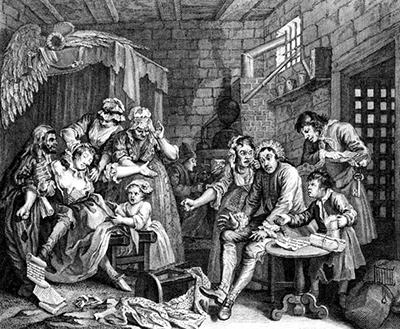
A boy brings Tom Rakewell a tankard of beer and holds out an empty hand. Behind him, a gaoler points to a book. The two expect payment, and Tom, who has written a play in the hope of earning enough to get out of prison, has just had it turned down. This is the seventh of eight scenes in William Hogarth’s A Rake’s Progress. Hogarth sets it in London’s Fleet Prison, where a man confined for debt can still run up bills. Sir John Soane’s Museum dates its oil on canvas, P46, to 1734. The print reverses the composition, placing Tom and the table on the right. [1] [2] [3]
At a Glance
- Series positionScene 7 of 8 in A Rake’s Progress
- Painting1734, oil on canvas, Sir John Soane’s Museum, P46
- Plate 7 publication25 June 1735, etching and engraving
- Met impressionFourth state of four, The Metropolitan Museum of Art, 91.1.89
- BnF impressionCatalogued fourth state, Bibliothèque nationale de France, FRBNF40262630
This work across William Hogarth’s career
Assembly at Wanstead House
1728–31The Heir
1734The Marriage Settlement
about 1743Gin Lane
1751Canvassing for Votes
1754–55Contents
- The book, the manuscript and the letter
- What it cost to be held at the Fleet
- Tom’s wife and Sarah Young
- Other ways out
- The painting and plate seven
The book, the manuscript and the letter
In the painting, the tear in Tom’s blue coat and the gold embroidery at the ankles of his red stockings tell different parts of his story. The embroidered ankle panels, known as clocks, were a mark of expensive hosiery. Enough of Tom’s old wardrobe survives to show the care he once took over how he appeared. The prison’s trades have their own accessories. The gaoler carries a key and a book marked “Garnish Money.” In the Metropolitan Museum of Art’s impression, the key hangs between his hand and the barred door. The boy brings the demand nearer, putting his open palm almost over the table. His other hand stays on the tankard. Tom’s own fingers spread over his knee, with nothing in them to complete the exchange. [1] [2] [3]
Hogarth puts the rolled manuscript beside the answer it has received. The rolled sheets conceal what Tom has written. The refusal lies open and can be read in a few seconds. Joanna Tinworth, writing for the Soane Museum, reads the abbreviated signature as a reference to John Rich. The historical Rich managed the theatre at Lincoln’s Inn Fields where John Gay’s The Beggar’s Opera proved a success in 1728. He opened the first Theatre Royal at Covent Garden in 1732. An audience familiar with that career could appreciate the choice of a manager who had already made money from a play that set scenes in Newgate Prison. In Hogarth’s fiction Tom needs a decision about whether his play can be put on, and the answer comes back just as the people standing over him want cash. [1] [3] [4] [5]
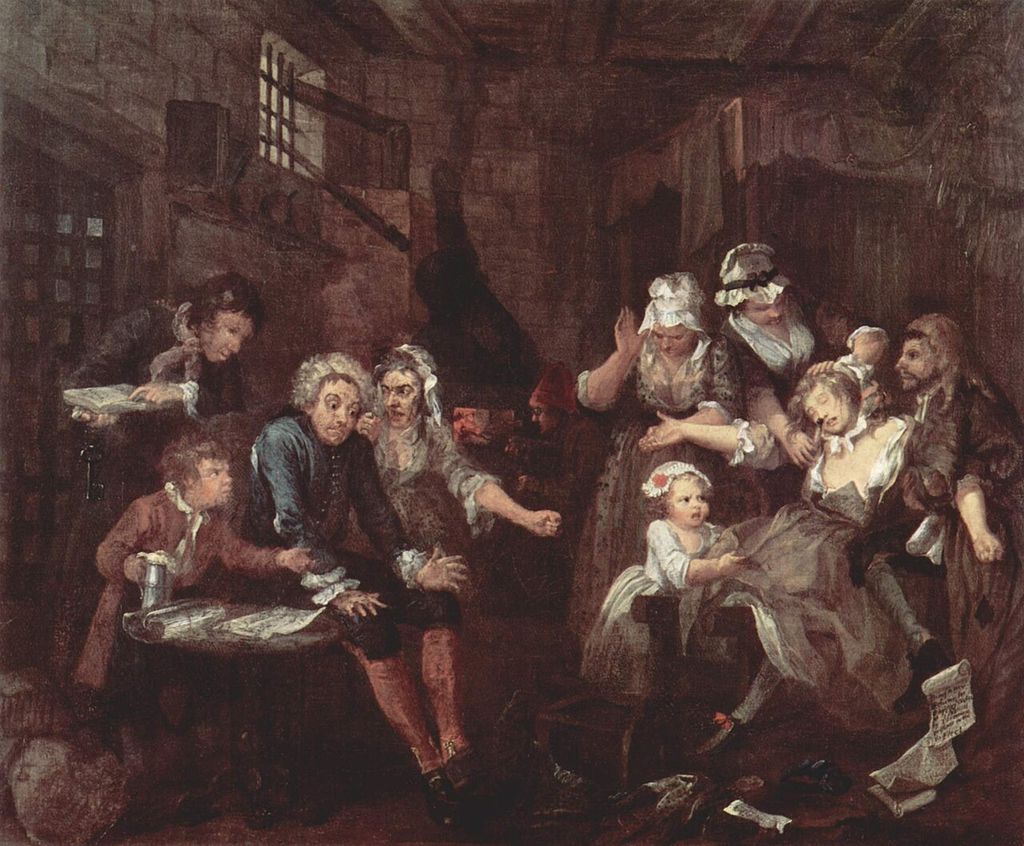
The Prison, William Hogarth, 1734. Oil on canvas. SM P46. The Yorck Project via Wikimedia Commons. Image source. Public domain.
What it cost to be held at the Fleet
The Fleet’s charges had been the subject of a House of Commons inquiry in 1729. Its report distinguished fees for committal and discharge from room rents and payments to particular officers. The committee alleged that the warden, Thomas Bambridge, had presented a total incorporating several charges as though the whole sum were due to him for committal. The other officers’ charges were then levied in addition. The report also describes the case of Captain John Mackpheadris, who was made to pay a second committal fee. When he disputed the rent demanded for a room he had furnished, the committee reported that Bambridge had him locked out and made to sleep in the yard. [6]
The distinctions matter when looking at the picture. In his study of the Fleet in the 1720s, Kazunori Kurita distinguishes the garnish paid to fellow prisoners on arrival from the fees paid to the warden and other officers. He also describes how some prisoners who could pay and provide security were allowed to live in a designated area outside the walls, under what was called the liberty of the Rules. Hogarth puts the label for garnish on a gaoler’s book and gives the beer its own collector. The scene makes the demands simultaneous. The historical records show why the ability to pay could affect a prisoner’s immediate surroundings long before the original debt was settled. [1] [6] [7]
Hogarth had already used the Fleet as a setting for The Gaols Committee of the House of Commons, dated about 1729 by the National Portrait Gallery. In that painting a man wearing irons kneels before assembled MPs. The gallery’s extended catalogue explains that Hogarth moved the inquiry from a panelled room in his oil sketch to a prison interior in the finished work. In The Prison, the gaoler keeps his authority and the debtor has no committee to hear him. The two pictures give different work to the setting. In the committee picture confinement becomes a matter for people with the power to investigate it. At Tom’s table, the immediate decision is whether he can have the beer. [8] [1] [2]
Watch Hogarth’s paintings and prints
Five films on Hogarth’s painted stories, prints, drawing methods and work for the Foundling Hospital.
The Sequel: Hogarth’s "A Rake’s Progress" (1734–5)
The Paul Mellon Centre revisits the eight-scene story of Tom Rakewell and its place in Hogarth’s work.
Watch on YouTubeTom’s wife and Sarah Young
At the wedding, Tom’s bride wears expensive fabric and jewellery. At the Fleet her clothes are plain, her hair disordered, and her arm shoots out with a clenched fist. Tinworth compares it to Tom’s fist in the preceding scene, The Gaming House, when he has just lost his second fortune. She has reason to be angry about what has become of the money. The echo gives the gesture a new object. At the gaming table Tom rages at his luck. Here his wife can direct her anger at the person whose decisions have brought her into the room. [9] [10] [1]
The fainting woman across the room is generally identified as Sarah Young. That reading has been disputed, in part because the exposure of her breast seemed out of character to some writers. Tinworth makes the case from the painted clothes, particularly the ribbons of Sarah’s cap and the pattern on the dress of the woman she identifies as Sarah’s mother. In the print a child pulls at the fainting woman’s skirts while adults support her and try to revive her. When Tom was arrested in the street, Sarah could interrupt the officer by offering her purse. Here it takes several people to attend to her, and the child can only pull at a garment. Tom sits close enough to see the group, with his face turned away from it. [1] [2] [3] [11]
Other ways out
The bearded man supporting the fainting woman has let a paper drop. It proposes a way to pay the national debt. The rolls of paper at opposite sides of the print make two ambitions visible at once. Tom wants to turn a play into the price of his release. Another debtor has put his mind to the balance sheet of the country. The Soane catalogue notes a possible family resonance. William Hogarth’s father Richard was himself a Fleet debtor and sent Robert Harley proposals to raise public revenue in 1710. That proposal offers a precedent for the joke about scale, in which a man who needs to find money for himself considers the finances of the entire nation. [1] [2] [3]
At the back an alchemist works at a furnace, and a telescope points through the barred window. In the painting the book on the philosopher’s stone helps explain what the furnace might yield. Te Papa reads the telescope as a possible reference to the rewards on offer for finding longitude. The window makes that reading apt even without settling the allusion. The instrument can be aimed out of the room, while the people around it remain inside. The props extend a question raised by the letter on Tom’s table. Each scheme might promise a large return some day, while the boy expects payment for one tankard now. [1] [2] [12]
The painting and plate seven
The Soane canvas measures 63 by 75.5 cm. Hogarth’s seventh plate bears the publication date 25 June 1735. The Met describes its impression, 91.1.89, as an etching and engraving in the fourth state of four, with a plate measurement of 35.2 by 40.9 cm and a sheet of 39.7 by 47.7 cm. The Bibliothèque nationale de France records a separate fourth-state impression, FRBNF40262630, whose plate impression measures 35.5 by 40.7 cm on a sheet of 39 by 43.8 cm. Te Papa’s record for 1965-0001-1/7-8 gives an image of 35.3 by 40.5 cm on a paper support of 36 by 41.5 cm. The extent of the margins varies from sheet to sheet. The publication line belongs to the design, so its date alone cannot tell us when any particular impression was pulled. [1] [2] [12] [13]
The Met sheet also shows what happens beneath the scene. The lines of verse run below the image and shift from the consolation that a person might draw from remembering honourable actions to the despair of someone whose memories offer no such comfort. The prison room supplies a more immediate account of that despair, through the silence at Tom’s table and the work going on around him. In the final scene, The Madhouse, the Soane Museum identifies Sarah beside Tom again, this time with a bowl of broth she has brought. The drink held back by the boy and the food left beside Tom belong to rooms where he depends on other people. In the Fleet the boy waits for a return. At Bethlem Sarah stays with him even as the broth goes untouched. [2] [14]
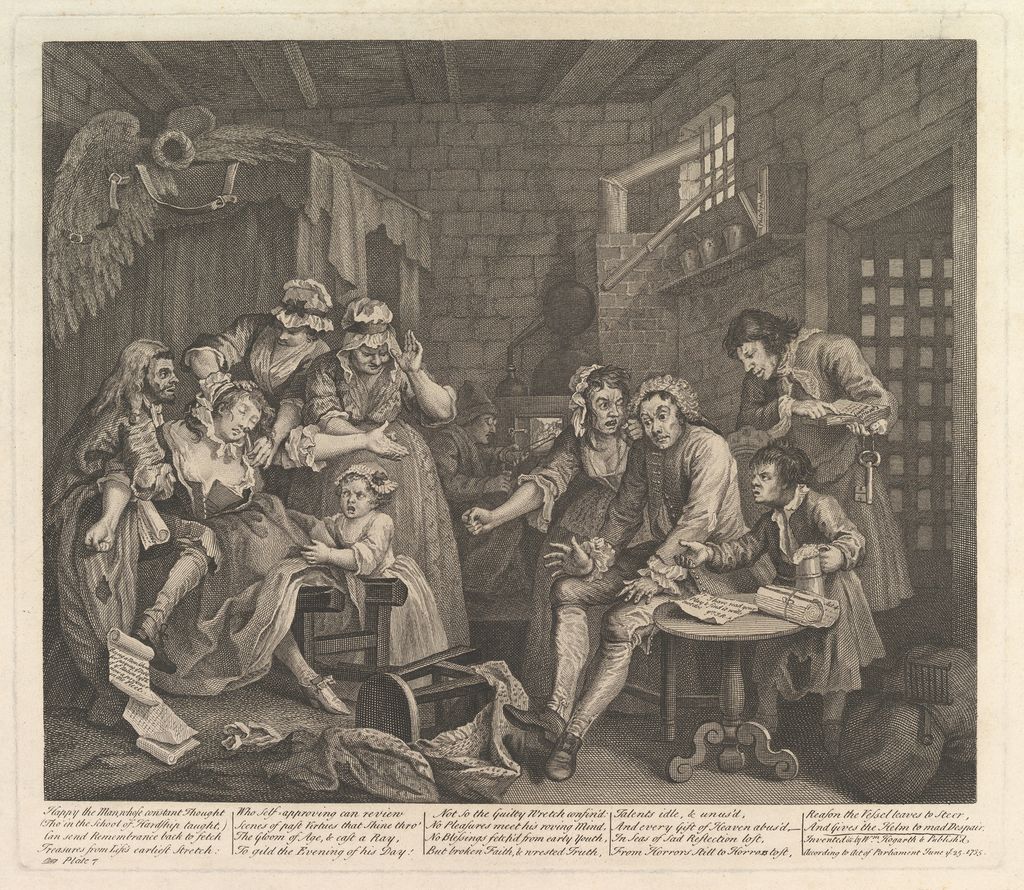
A Rake's Progress, Plate 7, William Hogarth, June 25, 1735. Etching and engraving; fourth state of four. 91.1.89. Gift of Sarah Lazarus, 1891. Image source. CC0 / Public domain.
Browse Hogarth’s artworks
All 54 individual artworks and series stages in the approved English cluster
Frequently Asked Questions
It is scene 7 of 8 in A Rake’s Progress. Sir John Soane’s Museum uses the scene number for the original oil painting. [1]
Discussion
Look again at the images and ideas explored in The Prison. These editorial prompts invite your observations.
Reader Insights
How do the boy’s open hand and the gaoler’s pointing finger draw attention to two different demands for payment?
What does the placement of the national debt proposal across the room from Tom’s rejected play suggest about the two prisoners’ hopes?
Join the Conversation
Share a detail, comparison or question about The Prison below.
References
- Joanna Tinworth, Sir John Soane’s Museum, William Hogarth, A Rake’s Progress VII: The Prison, P46, including notes 4–5 and 7–8 on clothing, the letter, Sarah’s identification and Richard Hogarth. View source.
- The Metropolitan Museum of Art, William Hogarth, A Rake’s Progress, Plate 7, 91.1.89, collection entry and illustrated impression. View source.
- British Museum, William Hogarth, A Rake’s Progress, Plate 7, S,2.47, collection entry and identification of the scene and its objects. View source.
- Royal Opera House Collections, “The History of the Royal Opera House,” section on the opening of the Theatre Royal in 1732. View source.
- John Gay, The Beggar’s Opera, 1728, Newgate scenes in acts II–III, 1921 Heinemann edition of the 1765 text. View source.
- House of Commons Committee on the State of the Gaols, A Report from the Committee appointed to Enquire into the State of the Goals of this Kingdom: Relating to the Fleet Prison, 1729, in The Publications of James Edward Oglethorpe, edited by Rodney M. Baine, University of Georgia Press. View source.
- Kazunori Kurita, “‘Ungovernable’ Prisoners: Fleet Prison during the 1720s,” sections 1–2 on the Rules, prison fees and room allocation. View source.
- National Portrait Gallery, William Hogarth, The Gaols Committee of the House of Commons, NPG 926, Early Georgian Portraits Catalogue, sections on historical background and composition. View source.
- Joanna Tinworth, Sir John Soane’s Museum, William Hogarth, A Rake’s Progress V: The Marriage, P44. View source.
- Joanna Tinworth, Sir John Soane’s Museum, William Hogarth, A Rake’s Progress VI: The Gaming House, P45. View source.
- Joanna Tinworth, Sir John Soane’s Museum, William Hogarth, A Rake’s Progress IV: The Arrest, P43. View source.
- Museum of New Zealand Te Papa Tongarewa, William Hogarth, A Rake’s Progress. Plate 7. The Prison, 1965-0001-1/7-8. View source.
- Bibliothèque nationale de France, William Hogarth, A Rake’s Progress: The Prison, plate 7, FRBNF40262630, fourth-state catalogue entry. View source.
- Sir John Soane’s Museum, William Hogarth, A Rake’s Progress VIII: The Madhouse, P47. View source.







