


 by Tom Gurney
Tom Gurney BSc (Hons) is an art history expert with over 20 years experience
Published on June 19, 2020 / Updated on October 14, 2023
Email: tomgurney1@gmail.com / Phone: +44 7429 011000
William Hogarth Biography: Introduction
William Hogarth began his working life engraving silver and ended it holding the office of Serjeant Painter to the King. In his last years he fought a political quarrel in images and verse. His widow Jane kept the print business running for another twenty-five years. In between he painted two enormous biblical scenes for a London hospital, helped establish a school for artists, and persuaded buyers to pay in advance for stories told in pictures. Selling his own prints gave him the means to invent his own subjects and a reason to care about who could copy them, how they reached buyers and what happened to the copperplates after the first printing. [1] [2] [3] [4] [5]
At a Glance
- BornLondon, 1697
- DiedLondon, 1764
- Early trainingEngraving in the metal trades
- PublishedThe Analysis of Beauty, 1753
William Hogarth in context
Early Georgian London
1714–1760Rococo in Britain
about 1730–1760 [6]James Thornhill
1675/76–1734William Hogarth
1697–1764 [2]Hubert-François Gravelot
1699–1773 [6]Francis Hayman
1708–1776Assembly at Wanstead House
1728–31The Heir
1734The Marriage Settlement
about 1743Gin Lane
1751Canvassing for Votes
1754–55Contents
- Childhood in Smithfield and apprenticeship
- Early satire and the book trade
- Jane Thornhill, the theatre and group portraiture
- A Harlot’s Progress and the subscription business
- A Rake’s Progress and the Engravers’ Act
- The St Martin’s Lane Academy and the hospital staircase
- Thomas Coram and the Foundling Hospital
- Private patrons and Marriage A-la-Mode
- Apprentices, soldiers and two London addresses
- Beer Street, Gin Lane and the campaign against cruelty
Childhood in Smithfield and apprenticeship
Hogarth was born on 10 November 1697 in Bartholomew Close, Smithfield. David Bindman’s account in the Oxford Dictionary of National Biography records his baptism on 28 November at St Bartholomew-the-Great, with the birth and baptism entered in a nonconformist register. His father, Richard Hogarth, was a schoolmaster and author who had come to London from Westmorland. His mother, Anne, was born Anne Gibbons. Smithfield was the family’s neighbourhood and the place where Hogarth would later return to paint the staircase at St Bartholomew’s Hospital. [1] [7]
Richard’s ventures included a coffeehouse with an unusual rule. Customers were to converse in Latin. The scheme failed, and Richard was confined for debt under the jurisdiction of the Fleet. The family lived within the prison’s jurisdiction for a period in Hogarth’s childhood. Hogarth returned to the subject of the Fleet as an adult when he painted a parliamentary investigation of its abuses in 1729. [1] [8] [9]
The details of Hogarth’s own education are sparse. The recollections John Ireland published from Hogarth’s papers late in the century describe a boy with a keen interest in drawing and a young workman who set about improving his observation. Hogarth recalled training himself to retain something he had seen so that he could draw it later. He represented this as an alternative to depending on copies for his visual education. The account tells us what the established artist valued about his beginnings. Its retrospective argument for independent observation belongs to the later career, when he had a reputation and a theory of art to defend. John Nichols’s Biographical Anecdotes, first published in 1781, is another early source, compiled after Hogarth’s death and assembled from recollection, documents and anecdotes of different kinds. [10] [11]
In his mid-teens Hogarth was apprenticed to Ellis Gamble, an engraver of silver plate. The apprenticeship is generally placed around 1713–14. Engraving on a spoon, a cup or a piece of silver destined for somebody’s table required a steady hand and a design that could be recognised at the scale of a household object. Coats of arms, crests and ornamental figures needed clean outlines. Commissioned work also meant cutting somebody else’s emblem to somebody else’s requirements. There was an obvious advantage in carrying those skills into a trade where the signature, lettered address and invention might be the engraver’s own. [1] [8] [12]
Hogarth was working independently as a copperplate engraver by 1720. His own engraved shop card, made that year, is a better guide to the start of the business than his later fame. Its lettering offers an engraver’s services and its ornament demonstrates the kind of work a customer could buy. The Metropolitan Museum holds a later etching after the design by Samuel Ireland, made in the 1790s, when the card was already a piece of Hogarth’s early history. [13] A small printed advertisement could travel with a customer or be passed on as a recommendation. Its engraver needed to know how much detail the sheet would bear and how to make names readable after transferring them from the plate. Hogarth was already applying the expertise he had acquired on silver to a medium in which one engraved surface could reach many people. [2] [12]
Four stages of William Hogarth’s career
These periods group related developments; painting, travel and local work overlap across their boundaries.
From apprenticeship to independent work
Training in the metal trades gave Hogarth experience of engraved lines and commercial design. He drew and engraved for London’s print and book trades before finding a broader market for his own subjects. [2]
Painting for rooms and printing for readers
Group portraits and theatre subjects expanded the range of his work. Hogarth used different forms of subscription and publication to take the Harlot and Rake sequences from painting to print. [2]
Pictures for institutions and buyers
Hogarth gave the Foundling Hospital a portrait of its founder and helped bring other artists into the institution’s work. At the same time he developed Marriage A-la-Mode for sale as six plates. [14] [15]


Explaining beauty and picturing elections
Hogarth published The Analysis of Beauty in 1753. His examples range from sculpture and painting to chairs, everyday movements and dancing. [16]
Early satire and the book trade
A young engraver could take an order for a small job, supply an illustration to a bookseller, or find a topical subject and offer purchasers an opinion they could hang on a wall. Hogarth tried all three. The South Sea Scheme, generally associated with 1721, takes up the collapse of speculation in South Sea Company shares in 1720. In the Morgan’s example, the Monument to the Great Fire becomes part of a satirical London landscape. The device works because readers know both the real landmark and the crisis it is being made to commemorate. The print could circulate while arguments over loss, greed and responsibility were still fresh. It was among several early works in which Hogarth discovered how much a reader could infer from an apparently familiar street remade for a picture. [1] [17]
In Masquerades and Operas, dated 1724 by the Metropolitan Museum of Art, the conspicuous attractions are theatrical and fashionable. Crowds move towards entertainments and a figure wheels away the works of English writers. Hogarth made the city’s cultural priorities look like the results of competing businesses courting crowds. The sheet can be read as a claim on the public’s attention by somebody whose own work depended on attracting it. Its disagreements about taste also had an immediate professional setting. A painter, printmaker or theatre manager had a livelihood at stake in debates over which performances and artists deserved notice. The early print thus brings in the subject Hogarth would later approach through an academy, a book about beauty and arguments over public support for living artists. [18]
Work after Samuel Butler’s Hudibras brought a different set of conditions. The large series belongs to 1726, and Princeton’s holdings give some indication of the variety of surviving plates and their relation to the text. Butler’s mock-heroic poem had precedents, named incidents and an audience that could compare words with images. An engraver could choose which person in the episode made the best centre of attention or supply a visual joke that the text merely suggested. For Hogarth, this offered experience in building a sequence out of recognisable characters, expressions and recurring situations years before he invented the six scenes of Moll Hackabout’s life. [19] [12]
The illustrations for Don Quixote show the limits a publishing commission could put on such invention. In the 1720s the publisher Jacob Tonson was preparing a lavish Spanish-language edition under the patronage of Lord Carteret. Hogarth drew and engraved six subjects for it. The Royal Collection holds a preparatory drawing for the episode in which Don Quixote releases the galley slaves. The drawing records the work of selecting and arranging a particular moment from the book. The actual four-volume edition, issued in London in 1738, used other illustrations. The Prado’s acquisition account distinguishes proofs pulled before the plates were lettered from finished impressions with English scene descriptions and a page reference to Tonson’s 1756 edition. Impressions were also issued commercially around 1767. The Prado’s three sheets belong to an edition released in 2012 and printed from the surviving copperplates. A drawing intended for the 1738 book, a proof of Hogarth’s copperplate and a page in Tonson’s published edition are three different kinds of evidence. [20] [21]
These experiences help explain the attractions of publishing on his own account. A bookseller could order the drawing, the engraver could make a finished plate, and a final decision about the edition could still send the design elsewhere. By making a sequence in his own name and finding subscribers for it directly, Hogarth would have much more say over which subjects reached the public. The buyer could see the same independence in the address on the prints and in the receipt through which the order was recorded. [2] [20] [21]
Jane Thornhill, the theatre and group portraiture
When Hogarth began to learn the formal aspects of drawing and painting, London already had several attempts at providing training through the study of a model. Around 1720 he attended the academy associated with John Vanderbank and Louis Chéron. He was also connected to Sir James Thornhill’s private academy in the later 1720s. For an engraver accustomed to working on small forms, the chance to work directly from a model was valuable. It gave him practice in making figures carry their weight convincingly and placing several bodies in relation to one another. These were problems a young painter could encounter in a family portrait as readily as in a biblical composition. [12] [22] [23]
Thornhill, whose immense decorative schemes included the Painted Hall at Greenwich and the dome of St Paul’s Cathedral, also held Crown appointments and sat in Parliament. On 23 March 1729 Hogarth married Thornhill’s daughter Jane, as Cristina S. Martinez records from the Paddington parish register. The London Evening Post reported the marriage on 1 April. Their marriage is usually described as an elopement. Stories about Sir James’s reaction and eventual approval accumulated around it, and should be read as part of the marriage’s later retelling. The documented family connection continued to matter well beyond the wedding. Jane had grown up in a household where painting could involve professional education, well-placed patrons and the management of a large undertaking. Her later work as a publisher is extensively documented in her own right. [22] [23] [3]
In the same period Hogarth was making his name with the conversation piece, a group portrait in which people appear together in the course of an activity. In Assembly at Wanstead House, dated 1728–31 by the Philadelphia Museum of Art, members and guests of the Child family gather amid the splendour of a country house. The museum considers the couple’s twenty-fifth wedding anniversary a likely occasion. A commission on this scale asked the painter to make a large group intelligible in a comparatively small space. Sitters required individual likenesses and legible places in a social arrangement. The room needed enough substance to express the family’s wealth and to give its activities a plausible setting. It is early evidence that patrons trusted Hogarth with more than a likeness of a single sitter. [24]
The commission also demonstrates a practical overlap with theatre. A conversation piece may show several exchanges occurring at once, some directed towards the principal figures and others that reward a viewer who looks past them. A stage arrangement can employ a similar distribution of attention. John Gay’s The Beggar’s Opera, first performed in 1728, gave Hogarth a popular subject with several characters known by their roles and performers. In the composition in Tate’s collection, he brings the audience inside the frame around the playing area. The actress playing Polly and Macheath at the centre belong to Gay’s fiction, while identifiable spectators make the occasion a piece of London social life. The existence of several painted versions suggests demand for a picture that could commemorate the production and offer its own view of the room in which it played. [25]
Hogarth also used a gathering of recognisable people to address an event in public life. The Committee of the House of Commons Examining Bambridge concerns the 1729 parliamentary investigation of the Fleet Prison. It shows the warden Thomas Bambridge before the committee. In this case the crowded arrangement and the prominence of speakers recall problems of group portraiture, but the subject is the exercise of power and the public examination of its abuse. A viewer’s attention moves between the men authorised to hear evidence and the man called to account. Here a familiar institutional encounter was already supplying Hogarth with the sort of distinct roles he would assign to invented people in the serial narratives. [9]
A Harlot’s Progress and the subscription business
The decisive step in Hogarth’s independent publishing was the six-plate A Harlot’s Progress, issued in 1732. Its beginnings are known partly through George Vertue, the engraver and antiquary who observed the London art world while Hogarth was working. As Sir John Soane’s Museum explains from Vertue’s account, the project appears to have grown out of a single painting of a woman at her toilet. Hogarth developed the premise into a sequence that followed Moll Hackabout from her arrival in London to her funeral. A potential buyer could see that the story had more to offer than one satirical encounter or a single arresting figure. [2] [26]
Hogarth asked a guinea for the printed set, half when a buyer subscribed and half on delivery. The method spread costs over the time it took to prepare the plates and gave him an indication of demand before he had put the finished sequence on sale. The subscription receipt was itself a picture, Boys Peeping at Nature. The subscriber took away an example of his work as well as an acknowledgement of payment. Vertue reports substantial weekly receipts and frequent visitors to see the pictures while the subscription was open. His testimony is good evidence of attention among artists and fashionable people. It is harder to convert his reports, or later estimates of the total, into a complete account of Hogarth’s earnings. Receipts had to cover the making and distribution of the prints. [2] [26] [27]
The six sheets were a way of selling time as well as images. A buyer acquired a beginning, several changes in the character’s circumstances and an ending. Each picture had to carry enough incident to sustain separate inspection. It also needed to make sense in relation to a scene the buyer might look at before or after it. That left Hogarth considerable scope to move the story forward through a change of clothing, address or company. The order gave ordinary objects and repeated visual habits a narrative use. By following the subscription for a new set, a buyer was putting money down for the chance to discover these relations as a whole. [2] [26]
The enterprise was vulnerable to copies. Competing engravers could make plates from designs for which Hogarth had already paid in time and materials. A dealer who could sell a copy was able to benefit from the interest stirred by the original. This was a familiar feature of the print business. The scale of the Harlot venture made the problem especially immediate because the sale of many individual impressions was what justified the expense of preparing six designs. The documents behind the subsequent change in the law show the engravers’ concern with the market for invented designs and the cost of defending that market. [27] [28]
A Rake’s Progress and the Engravers’ Act
The subscription for A Rake’s Progress specified a different bargain. The advertisement in December 1733 offered nine prints, eight for the Rake’s story and a ninth for Southwark Fair. Subscribers paid half a guinea for a receipt and a further guinea when the prints were ready. In the picture used for the receipt, The Laughing Audience, the spectators supply the entertainment. There is a natural connection between the expressions available for inspection on the little sheet and the elaborate company a subscriber would encounter in the larger plates. The Soane holds an impression from a version without the original receipt wording, a reminder that the same printed design could later have a life in a different group of prints. [29] [30]
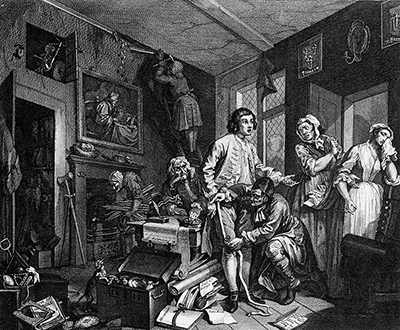
The eight paintings, made around 1734, follow Tom Rakewell after his father’s death. He starts with money and rooms full of possessions, a position very different from that of Moll Hackabout on her arrival. The scope of his choices and the places he can enter form part of this second venture. The terminal picture in Bethlem Hospital also shows the need to distinguish a canvas from an impression. The Soane’s record of the painting and the National Museum of Western Art’s record of a later state of the final plate document different objects. The series was designed for continuity, while a design could still change when Hogarth made a new version of it for another medium. [31] [32]
Hogarth and other designers and engravers took their case to Parliament. Their printed statement described the cost of inventing and producing original prints and the advantage enjoyed by competitors who could copy the work that proved popular. The resulting act, 8 Geo. II c. 13, granted a fourteen-year exclusive right to print and reprint qualifying designs. It applied to people who made prints from their own invention and those who had such designs engraved for them. The term ran from first publication, and the statute called for the proprietor’s name and publication date to appear on the plate and be printed on the sheets. The right thereby travelled with information visible to anyone who handled a properly lettered impression. [28] [33]
The statute uses the wording “from and after” 24 June 1735. The Rake plates bear the date 25 June 1735, which the Bibliothèque nationale de France records across its set. The start of the statutory regime and Hogarth’s publication are best read at that level of precision. A sheet catalogued as a later state can still carry that first publication date. The date identifies the design’s declared entry into the market, while the state describes a version of the plate at some stage in its working life. Hogarth’s campaign had secured a kind of control that mattered to him as designer, publisher and owner of the means of production. It took the form of a defined statutory privilege for these kinds of prints, with a time limit and procedures for redress. [34] [33]
Enforcement became part of the business almost at once. Isabella Alexander and Cristina S. Martinez trace the proceedings in Blackwell v. Harper, which arose from competing versions of plates of medicinal plants designed and engraved by Elizabeth Blackwell for A Curious Herbal. The case concerned another artist and another class of subject. Its importance for Hogarth’s career is what it shows about the law he had helped secure. A buyer and publisher could now find themselves in an argument over the rights in a reproducible image, even when the artist intended the design to circulate in a book instead of as a freestanding satire. [35]
The St Martin’s Lane Academy and the hospital staircase
In 1735, after the death of Sir James Thornhill the previous year, Hogarth helped organise the life-drawing academy commonly associated with St Martin’s Lane. This was a distinct undertaking from the earlier school he attended when he was young. The later academy gave working artists access to a model through a shared arrangement and lasted into the 1760s. Its membership and circle connected painters, engravers and makers in other trades. The opportunity to learn from peers mattered in a city where a private painting collection might be accessible to its owner’s guests and a young designer’s training usually depended on a single master. [22] [36]
The French draughtsman and engraver Hubert-François Gravelot was part of that artistic milieu. His work in book illustration and ornamental design helps explain a particular connection between London’s drawing circles and the British Rococo. Artists accustomed to seeing Gravelot’s lively figures, curls and asymmetrical ornaments encountered a design vocabulary that could be adapted to a book, a furnishing or a painted interior. The V&A’s exhibition catalogue treated Hogarth’s London as a place where painting and design developed in contact with each other. Gravelot supplied booksellers with illustrations and helped spread the Rococo ornamental vocabulary in Britain. Hogarth’s later employment of French engravers shows how useful this exchange was to his own practice. [36] [6] [15] [37]
At St Bartholomew’s Hospital, Hogarth undertook a project on a scale that he had rarely attempted. He decorated the staircase of the new North Wing without charging the hospital for the work. The Pool of Bethesda was painted off site and installed in 1736, and The Good Samaritan was painted on site and completed in 1737. The first shows Christ healing a man beside the pool, and the second shows a traveller caring for a wounded stranger. Both made sense in a hospital entrance. Their figures, reaching up to seven feet in height, were made to be seen by someone climbing or crossing the stair. The project allowed Hogarth to demonstrate his aptitude for public history painting in circumstances very different from a print in a buyer’s portfolio. [7]
The rest of the stair also matters. Barts identifies smaller scenes from the life of the hospital’s founder, Rahere, by Hogarth’s assistant Mr Richards. The arrangement had a local history as well as two biblical histories, and it required more than the work of one painter. The large compositions belong to a planned route through the building. They prepared a visitor for entry into the Great Hall and represented the work of the place to the people coming to it. Hogarth had returned to his childhood district with a public claim to an art his father-in-law had practised at the highest level. [7] [22]
Thomas Coram and the Foundling Hospital
Thomas Coram spent years trying to secure support for a London institution that would take in abandoned infants. A royal charter was granted in October 1739, with Hogarth among the governors. The Hospital began receiving children in temporary accommodation in 1741. The institution needed money, public trust and an enduring group of supporters. It also gave Hogarth a place to show what contemporary painters could contribute to a public enterprise. [12] [38] [39]
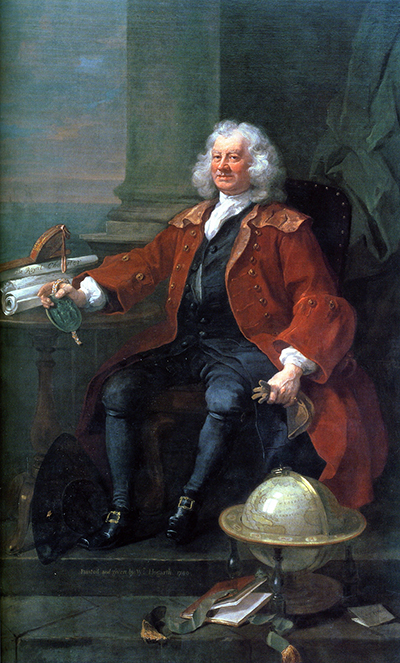
Hogarth painted Coram in 1740 and gave the portrait to the Hospital. The size and arrangement belong to the language of the grand public portrait. Coram sits on a raised platform, with a column and drapery behind him. But his face and body are presented with an informality his surroundings lead us to notice. He looks used to the clothes he wears and comfortable in the chair. One of the portrait’s effects is to make the apparatus of distinction seem to have gathered around this individual because he has earned it. The picture gives the founder a visible position in the institution’s story, and its documented donation meant that it could have that function from the beginning of the collection. [40]
The collaboration went beyond the portrait. Hogarth recruited artists to help furnish the governors’ Court Room. Thomas Gainsborough was among those he invited. William Hallett made frames for the room in 1746, and the decorated space was unveiled in 1747. Frames, architectural positions and the relationship between neighbouring works mattered because paintings given by separate people had to make a coherent impression in a room used for meetings. The enterprise offered living artists an audience of governors, supporters and visitors who could see examples of contemporary British work together. It also gave a charity a reason for people who could help it to visit again. [8] [14] [41]
In Moses Brought Before Pharaoh’s Daughter, Hogarth took a biblical subject that made particular sense in this building. A child who had been left exposed survived and was received into a powerful household. The moment Hogarth chose is one of presentation and reception, with adults arranging the child’s future. The relevance of the picture lay in that action and in where the painting was given. The same composition later reached people who might never enter the Court Room. An engraving made by Hogarth and Luke Sullivan, dated February 1752, names the Foundling Hospital as the location of the original painting. The institution benefited from the association, and the engraving made the association part of the work’s public identity. [42] [43]
Private patrons and Marriage A-la-Mode
Different patrons asked Hogarth to take different approaches to likeness and company. The four children of Daniel Graham appear at close to life size in The Graham Children, which the National Gallery dates to 1742. The youngest, Thomas, died while the painting was being made. A study of his features in chalk helped Hogarth complete the portrait. The practical demands were specific to a family whose members needed to recognise the children and remember one of them. The engaging activities of the surviving children are part of the same picture as the familiar likeness of the baby. [44]
In Captain Lord George Graham in his Cabin Hogarth returned to a smaller scale and placed a group amid the possessions and routines of life aboard ship. Royal Museums Greenwich dates the painting to about 1742–44 on the evidence of Graham’s January 1745 will, which leaves the already completed picture to his brother. Graham referred to it as his conversation piece. The will confirms that a sitter understood the work as a picture of a company and setting as well as a record of his own features. The shelf, table, music, food and animals help fill an interior in which something is happening between the likenesses. [45]
Hogarth had a different kind of ownership to negotiate in a series he conceived without a private patron. The paintings of Marriage A-la-Mode were made around 1743. The subject was a marriage between families with different things to bargain with, and the sequence had a plot complex enough to require the reader to keep track of the people, places and terms involved. Hogarth engaged Gérard Jean-Baptiste Scotin, Bernard Baron and Simon François Ravenet to turn the paintings into prints. Their names are evidence of expertise hired for a project Hogarth directed. Work by London-based engravers of French origin helped carry a highly specific account of English social ambition to print buyers. [15]
Advertising separated the publication of the prints from the proposed disposal of the paintings. Buyers ordered a printed set by subscription. The plates were lettered 1 April 1745, and Judy Egerton’s National Gallery catalogue documents that the prints were ready to collect in early June. The same catalogue records the eventual sale of the paintings on 6 June 1751. There was one advance bid for the set, of £120. John Lane called at Hogarth’s house and raised the offer to 120 guineas, or £126, which bought him the six paintings in their frames. The market that would buy an edition of a story in six prints and the market that could buy six canvases offered Hogarth very different prospects. A published image could make a series famous while the corresponding paintings still presented a difficulty of finding one buyer, one price and a place to put all six. [15]
Watch Hogarth’s paintings and prints
Five films on Hogarth’s painted stories, prints, drawing methods and work for the Foundling Hospital.
William Hogarth and the Foundling Hospital | HENI Talks
Caro Howell discusses Thomas Coram, Hogarth’s portrait of him and the artist’s work for the Foundling Hospital.
Watch on YouTubeHogarth had already tried to sell paintings through written bids in February 1745. The notice promised a sale of works including the Harlot and Rake paintings and advertised the Marriage canvases for sale after the engravings were finished. The Battle of the Pictures, the ticket that gave holders the option to bid, included a version of a Marriage scene even though the canvases were still needed by the engravers when the February sale went ahead. An auction print thus did double duty as an advertisement for what was available and a preview of work Hogarth was preparing for another sale. [15]
The different transactions show what ownership meant to a painter taking on projects of his own. Graham’s will puts his portrait inside the history of a family and its property. The Marriage canvases were Hogarth’s to exhibit, have engraved and offer for sale. That freedom also left him exposed to the outcome of the bidding. The Foundling paintings moved by yet another route, entering an institutional collection through gifts. The several markets help explain why he continued to paint conventional commissions, public histories and independent sequences in overlapping periods. [15] [40] [14] [45]
Apprentices, soldiers and two London addresses
In September 1747 Hogarth published the twelve scenes of Industry and Idleness. The narrative draws on the familiar arrangement of apprenticeship to send two young men in opposite directions through the world of London work. The first scene places them at adjacent looms. By beginning with two people doing the same job, Hogarth gives the series a basis for comparing the consequences of their actions and the rewards and penalties administered by the institutions around them. Scripture in the printed margins supplies further instruction. The British Museum’s surviving copperplate for the first scene and a paper impression in the Metropolitan Museum make the work of the printer tangible. An industrious fictional apprentice could be sold many times over from the same engraved surface. [15] [46] [47]
This series drew on a kind of relationship likely to be immediately legible to readers who knew how a workshop operated. An indenture joined a master and apprentice in an agreement lasting years. Placement, training and discipline could affect a child’s future and a household’s income. London’s institutional records preserve apprenticeships that can be followed independently of the two designs Hogarth chose to put side by side. The Augustan moral tale and the London workshop therefore overlap at a specific point in his life. The artist who knew the responsibilities of a workshop from his youth was now deciding how to represent a powerful master, a young worker and the routes from the loom to other places in the city. [8] [48]
Hogarth went to France in 1748, and the oil painting The Gate of Calais is dated to that year by Tate. He later connected its subject with being detained while sketching the gate. The anecdote comes from the artist’s retrospective account. In the painting he puts himself at the edge of the scene, where a hand reaches for his shoulder, and sets a great joint of English beef in motion through the gateway. A printed version credited to Hogarth and Charles Mosley is dated 1748–49 by the National Gallery of Art. A personal incident became useful material for an image because Hogarth could put the indignity he claimed to have suffered inside a much larger joke about the French and their English visitors. [49] [50] [51]
Hogarth also took up a subject from the recent Jacobite rising. The painting now known as The March of the Guards to Finchley was finished in 1750. It is a comic treatment of the mobilisation of troops in 1745, with soldiers and civilians making a crowd of a sort Hogarth had learned to organise in other settings. A single canvas could be sold by a method that combined subscriptions, the promise of a print and a chance at the original. The Foundling Museum records that Hogarth gave the Hospital his unsold chances and that it won the painting. The donation of a Coram portrait and the transfer of a Finchley painting through a lottery helped build the same collection by different means. [40] [52] [53]
The arrangement did more than put the painting within reach of a buyer who could never have paid for it outright. A subscriber could make sense of the offer in several ways, as the purchase of a print, a gamble on a valuable canvas or participation in an event on which Hogarth had focused public interest. The institution eventually held the work, and the engraved treatment kept it in circulation outside the Hospital. A buyer of an engraving after Hogarth by Luke Sullivan could see a version of the composition in another medium and at a scale suited to a domestic wall or portfolio. [52] [53]
The Hogarths acquired their house at Chiswick in 1749. [54] Leicester Fields, now Leicester Square, remained the family’s central London address and a place from which Hogarth made and sold prints. The sign of the Golden Head appears in the lettering of his work. Chiswick offered a garden and a painting room, with country lanes, earlier acquaintances and relatives nearby. Val Bott’s research identifies Jane’s widowed mother Judith Thornhill, Jane’s cousin Mary Lewis and William’s sister Anne among the people who lived with the couple. The rooms the family added to the house reflect the requirements of an extended household. [34] [55] [56]
Mary Lewis was Jane’s companion and worked in the printselling business. Her dual role helps make sense of the two addresses. Chiswick could be a summer refuge for the artist and a place where members of the working household spent time together. Leicester Fields offered direct access to buyers and other tradesmen and remained the public face of the business. The inscribed location on a print meant a person who encountered it elsewhere knew where to ask for other work. Household continuity mattered to that business, especially when an owner’s absence or illness made his material, clients and suppliers somebody else’s responsibility. [3] [55] [56]
Beer Street, Gin Lane and the campaign against cruelty
In 1751 Hogarth applied his skills as a publisher to several designs about the conduct of people in public. Beer Street and Gin Lane were conceived as a pair. One offers well-fed figures and productive work, and the other associates gin with neglect, hunger and social collapse. The buildings, signs and occupations allow the reader to compare the worlds systematically. They are arguments composed out of familiar things. A Londoner could recognise what a pawnbroker did and understand how Hogarth had arranged the shop and its customers to press a case. [57]
Jennifer Tonkovich’s study of the surviving designs and prints reconstructs how that case changed. Hogarth moved figures in the preliminary drawing for Beer Street by using pieces of paper to cover and replace parts of the original arrangement. He revised the design in copper as well. In the earlier version of the print, a prosperous English figure hoists a slight Frenchman. The Frenchman disappears in a later version, and the picture’s balance of work, nationality and sociability changes with him. The surviving copperplates for the two scenes are in the Metropolitan Museum. They make it possible to follow a piece of the publisher’s working capital as well as the alterations a buyer could see from one version to the next. [57] [58]
The February advertisements anchor their appearance in a debate about gin visible also in Henry Fielding’s Enquiry into the Causes of the Late Increase of Robbers and in a contemporary reply preserved at Wellcome. The 1751 Gin Act belongs to the same debate. Among its provisions were restrictions on spirits retailers taking pledges to secure payment for drink. That subject was close to the world of credit Hogarth drew on for his pawnbrokers. The advertisements establish the intervention he made in print, while the statute records the government’s response to the trade in spirits. A cheap image with several things to read could enter the conversation in its own way, whether the encounter took place in a shop, in someone’s room or through a copy. [57] [59] [60] [61]
The Four Stages of Cruelty also appeared in 1751. The prints follow the fictional Tom Nero from cruelty to animals to a killing, execution and the opening of his corpse by anatomists. The circumstances are individually invented and the progression is the point. The manufacture of the pictures was more complicated than their eventual numbering suggests. Tonkovich and Laurel O. Peterson examine red-chalk drawings and two woodcuts cut by John Bell after Hogarth’s designs for the later stages. In their reconstruction, the work may have begun with the last two subjects before Hogarth settled on the four engraved scenes. The woodcuts are evidence of an experiment with production and format. The published engraved sequence gives all four subjects a common visual scheme. [62]
The anatomy scene belongs to a city where the bodies of some executed people were already used for dissection. It appeared before the Murder Act of 1752 introduced a new statutory regime for the treatment of convicted murderers’ bodies. Its sequence of moral accusation and bodily punishment was Hogarth’s choice. The legislative history gives the image a context and a limit. Hogarth could dramatise the connection between a public hanging and what came after it, and legislators could set out when a particular sentence was to be carried out. Those actions left the historian two different kinds of evidence. [62] [63]
Hogarth took care over what these papers would cost. Tonkovich traces the advertising of the drink prints at a shilling for an ordinary impression and the possibility of more expensive impressions. That possibility may have been dropped. A price is useful evidence of an attempt to make a print accessible. The actual audience was shaped by where and how the work was sold, whether somebody lent it and whether a dealer copied it. After twenty years in business, Hogarth could match a current question to a size and price while continuing to alter what a purchaser found on the finished sheet. [57]
The Analysis of Beauty
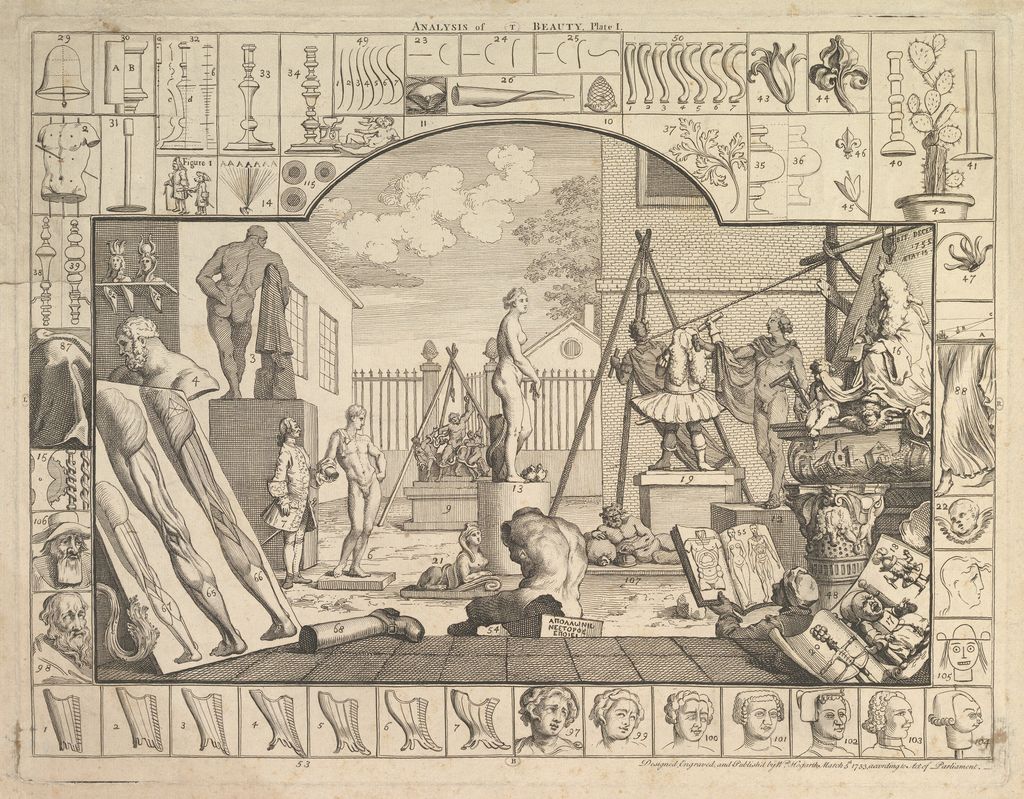
In 1753 Hogarth published The Analysis of Beauty. The London edition printed by J. Reeves offered a book and two large plates. In the text he examines fitness, variety, uniformity, simplicity, intricacy and quantity, approaches to judging shapes in relation to their use and the movement of the eye. His readers were asked to look at bodies, objects and familiar actions. Chapter IX introduces compositions with a waving line. Chapter X considers compositions with a serpentine line and introduces the idea of judging a complicated form by following a line that twists in space. Their argument is easier to grasp with an object or an illustration at hand because its subject is what the eye does when it pursues a shape. [16]
The first plate presents an assortment of sculptures and other forms in a yard, surrounded by numbered figures. The second includes dancers and diagrams of movement. The arrangement invites readers to pass back and forth between a real activity as the artist knew it, a pictured instance and an isolated form. Hogarth’s account of the minuet, for example, asks the reader to attend to the raising and lowering of the body as a person steps. An ordinary movement can be examined more closely through dance, where the changes in height and direction are enlarged. The book carried to a new readership the sustained attention to gesture Hogarth had required of his theatre and conversation pieces. [16] [64]
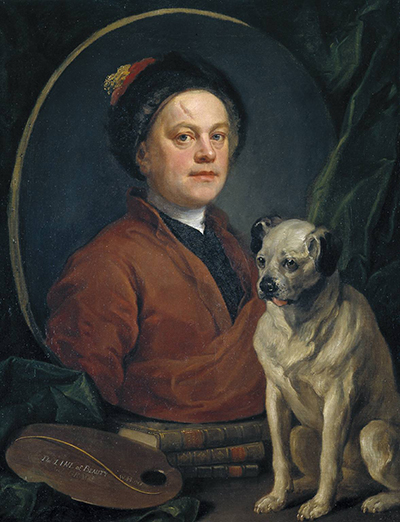
He had already attached a version of the argument to his public image. In The Painter and his Pug, dated 1745, the framed likeness is supported by books and accompanied by the dog Trump. The palette carries a sinuous line associated in its inscription with beauty and grace. The painted palette places a claim about how to see next to a claim about who is entitled to make it. Hogarth had signed pictures, plates and receipts for years. Here he also associated a formal proposition with his likeness and the objects in his possession. [65]
The treatise crossed languages quickly. Christlob Mylius’s German translation, Zergliederung der Schönheit, was issued in 1754 with a London and Hanover imprint. The copy at Zentralbibliothek Zürich records a German text with its own preliminaries and pagination, and two plates. A London work about the judgement of form could now be read and debated by people who had no need to follow Hogarth’s English sentence by sentence. The translation establishes circulation of his argument in his lifetime. The identity and printing history of the plates in particular copies is a separate bibliographical question. [16] [66]
The Oxfordshire election and the Crown
The Oxfordshire election of 1754 furnished Hogarth with material for another series. Newcastle University’s parliamentary election project describes a fiercely disputed contest between rival interests in a county with two seats. Hogarth devised an election in an invented town for his four painted scenes of Humours of an Election, dated about 1754–55 by Sir John Soane’s Museum. The canvases follow the gathering and entertainment of supporters, solicitation, polling and the public celebration of the result. The historical contest supplied occasions and a political atmosphere. Hogarth’s people, rooms and crowds permitted a broader account of how much work it took to produce a public demonstration of political support. [67] [68]
The prints entered circulation over several years. The first carries a date of February 1755, the second of February 1757. The Paris impressions record an inscription of 1 January 1758 on the fourth plate and 20 February 1758 on the third. At this stage of Hogarth’s career the numerical order of the story and the sequence of dates in the publication lines were distinct. There were different engravers and dedicatees, including Henry Fox for the first plate and Sir Charles Hanbury Williams for the second. The material history of the series gives a way to see how differently four designs for a common project could be finished and presented. [68] [69]
Meanwhile, a document dated 6 June 1757 appointed Hogarth Serjeant Painter to George II. He succeeded John Thornhill, Jane’s brother. The letters patent concern work connected with the King’s household and property. They gave access to business in painting and gilding royal possessions such as vehicles and furnishings alongside a nominal salary. The post links Hogarth with the Thornhill family’s long connection to official work. It also shows what a royal painting appointment could mean in practice. When the painter became the subject of political caricature, the title gave an opponent an immediate way to suggest that Hogarth had an interest in defending the court. [22] [4] [70]
Hogarth also continued to seek serious painting commissions. By 1756 he had completed a large biblical triptych for St Mary Redcliffe in Bristol. A church could give a work of ambitious scale a specific architectural and ritual setting, as the hospitals had given his earlier public paintings. The Bristol work and the Oxfordshire series overlapped in the last decade of his life. The career that looks from a distance like a steady advance towards satirical prints involved a sustained effort to make history painting and large public works pay or earn esteem. [8]
Sigismunda and the quarrel with Wilkes and Churchill
Sigismunda Mourning over the Heart of Guiscardo, which Tate dates to 1759, makes the ambition behind Hogarth’s later history painting particularly plain. The story comes from Boccaccio’s Decameron. Sigismunda’s father has had her lover killed and sends her his heart in a cup. Hogarth chose to put the woman’s response at the centre of the picture. Its concentrated action differs from the scenes he built for a reader to follow across a wall or a portfolio. The subject demands sympathy for a person in extremity, expressed through the relationship between her face, her hands and a vessel the viewer must imagine approaching. [8] [71]
Sir Richard Grosvenor had been prepared to commission another picture from Hogarth but declined to buy this one. The correspondence preserved in Ireland’s edition shows Hogarth arguing for the work and its price. Much of the difficulty lay in what a patron was willing to pay for a living painter’s treatment of a subject associated with admired older pictures. The effort to publish an engraving generated a subscription ticket, Time Smoking a Picture. Its figure of Time applies the smoke of his pipe to a canvas, a joke about the value attributed to the appearance of age. A defence of the contemporary painter thus supplied an image with an independent satirical life, even as the projected engraving of Sigismunda languished. [8] [71] [51]
In 1762 Hogarth stepped directly into the dispute over the conduct of the Seven Years’ War. The first plate of The Times is dated 7 September. A fire is being fought and fanned, with the Earl of Bute represented on the side of those trying to put it out. The Colonial Williamsburg Foundation’s impression shows Henry VIII working the bellows. Hogarth soon altered the plate so that William Pitt took the place of the king. Pitt’s opposition to the peace policy gave the changed picture a more immediate target. A man holding a royal appointment had placed his business and reputation behind an argument about the conduct of government. [72]
John Wilkes answered in his newspaper, The North Briton. Issue 17 took aim at Hogarth and at his support for government policy. In 1763, when Wilkes faced proceedings over another issue of the paper, Hogarth drew him and published the etched portrait John Wilkes, Esq. The sitter holds a staff with a cap of liberty. A deliberately unflattering handling of the face works against the heroic claim of the emblem. Wilkes’s readers could also recognise the papers in the design. The portrait used an opponent’s own printed identity as material for a competing image. An anonymous print called Tit for Tat promptly returned the treatment, giving Hogarth a fool’s cap and placing him and his art under hostile scrutiny. [70] [73] [5]
Charles Churchill, a poet and Wilkes’s ally, attacked Hogarth in An Epistle to William Hogarth. Hogarth’s answer was The Bruiser, with Churchill figured as a bear. The relation between this print and the artist’s painted self-portrait passes through another object. An earlier engraved self-portrait with Trump had used the arrangement familiar from The Painter and his Pug. Hogarth worked on the copperplate of that print, replacing his likeness with the bear and turning the surviving dog into a participant in the attack on Churchill. The oil painting remained a separate work. Reusing the metal brought his opponents into a composition that previously presented his own identity to the public. [65] [5] [74] [75]
The Metropolitan Museum’s impression of The Bruiser, 91.1.57, is an etching and engraving catalogued as the seventh state of seven and dated 1 August 1763 in the museum record. Its details belong to the version of the design the museum records. In it Churchill’s role as a former clergyman and his printed attack are available for a reader to recognise. Here the state matters because the occasion for issuing the design and the accumulated work on the plate tell different parts of the story. The dog, the bear and the printed words gave buyers a way of following a quarrel that also included newspaper issues, an epistle and other people’s caricatures. [74] [75]
Hogarth’s death and Jane’s print business
In 1764 Hogarth published Tailpiece, or The Bathos. The figure of Time has collapsed among the broken instruments and spent objects around him. The word “tailpiece” belongs to bookmaking and to the close of a sequence. Hogarth, who had supplied book illustrations when he was young, used a form associated with the end of a text to make an elaborate joke about endings, exhausted materials and the pretensions of painting. An impression preserved by the Fitzwilliam Museum gives this conception a firmer footing than the later stories that make every object a prophecy of the artist’s own death. [76]
In October the ailing Hogarth returned from Chiswick to Leicester Fields. The William Hogarth Trust records that he travelled on the 25th and died in the early hours of 26 October 1764. Some accounts give the 25th. The return to town and the death are best placed on the night spanning those dates. Hogarth was buried in St Nicholas’s churchyard, Chiswick. The family tomb eventually included Jane and other relatives from the household. David Garrick, his friend and an actor whose profession had supplied him with a subject and a way of thinking about gesture, wrote the epitaph. A letter from Horace Walpole to the Earl of Hertford on 1 November gives the terser contemporary notice, “Hogarth is dead”. It is news passed between correspondents, with a different purpose from the epitaph or the posthumous portrait of the artist assembled by biographers. [3] [55] [77] [78]
The plates passed into a business Jane Hogarth understood. She was executrix and principal beneficiary under William’s will, which included conditions on disposal of the plates and provision for the other members of the household. She took over selling the prints with the help of Mary Lewis and William’s sister Ann. She kept Leicester Fields as a selling address and retained Chiswick as a family home. A January 1765 advertisement announced the continued sale of William’s work. Buyers were to be able to obtain authorised impressions from a business that had kept the tools, premises and experience to supply them. [3] [55] [56]
Cristina S. Martinez’s study of Jane as a printseller follows how she dealt with several separate markets. Existing copperplates made further impressions possible, so a buyer of fine prints could order an authorised set. Hogarth Moralized, a commercial venture with the clergyman John Trusler, offered another way into the work at a lower price. It paired images with explanations and could be sold through booksellers. Jane took control of that enterprise after difficulties with Trusler. Maintaining more than one kind of product gave her a way to meet different demand without surrendering the special position of the dealer who controlled William’s plates. [3]
Copyright posed a different problem. A physical plate could remain in her possession even if the right to prevent competitors from copying its design had expired. Some of the most familiar works, first sold decades earlier, faced just that difficulty under the fourteen-year term. Jane petitioned Parliament while the Society of Artists pursued an amendment to the engraving law. She argued that the sale of copies damaged the income she depended on. The new act, 7 Geo. III c. 38, received royal assent on 29 June 1767. Section 3 gave Jane a twenty-year exclusive right for the prints, etchings and engravings of William’s design concerned by the act, with the term counted from 1 January 1767. Section 7 separately enlarged the general copyright term to twenty-eight years. Jane’s special provision brought protection back to works for which it had lapsed. [3] [79]
Jane’s authority over the impressions could be disputed in print as well as in Parliament. When John Nichols questioned the condition of one of the plates in his account of Hogarth, she responded to the specific claim and secured the public testimony of three engravers, Francesco Bartolozzi, William Woollett and William Wynne Ryland. Their names provided readers with a basis for judging whether the plates had been retouched and the impressions well made. Their testimony also shows that somebody who saw herself as the custodian of a reputation had to answer questions about physical wear, printing and professional judgement. [3] [11]
The business remained active until Jane’s death in 1789. Evidence from the 1780s includes an account connecting her with the publisher John Boydell and naming prices for sets such as Marriage A-la-Mode and A Rake’s Progress. Stock and copper could be valuable again with each authorised issue. Mary Lewis, already experienced in the business, inherited Jane’s property and sold the plates to Boydell. Their movement from the artist to a family-run enterprise and then to a publisher goes some way towards explaining how Hogarth’s work remained commercially available long after its subjects had ceased to be news. [3] [23] [55]
Even during Hogarth’s lifetime, prints and paintings prompted sustained explanation. In 1746 the enamel painter André Rouquet, a neighbour, published a French commentary on the engravings of Marriage A-la-Mode with Hogarth’s approval. A French-language account of a particular series and Mylius’s German version of the book on beauty are distinct signs of interest abroad. Later readers worked at a greater distance from the original London audience. Georg Christoph Lichtenberg’s explanations of Hogarth’s engravings, published in Germany in the 1790s, brought an extended reading of the pictures and their social references to a new generation. Such readings became part of the prints’ history because a new proprietor could issue an old design and a new writer could give its details another audience. [15] [66] [80]
Hogarth’s career survived in different forms as a result. The Foundling Hospital kept the public portrait and the prize picture it had won. Sir John Soane acquired the painted sets of the Rake and the Election in 1802 and 1823 respectively. Buyers elsewhere could continue to acquire printed versions and read books about them. These are the consequences of a working life that joined different kinds of artistic property to particular institutions and audiences. A canvas in a hospital, a set of designs owned by a collector and the paper produced from a working plate could all carry a different part of what William and Jane Hogarth had made possible. [2] [3] [14] [52]
Browse Hogarth’s artworks
All 54 individual artworks and series stages in the approved English cluster
Frequently Asked Questions
He painted The Good Samaritan and The Pool of Bethesda on the staircase at St Bartholomew’s Hospital in London. Both subjects make the care of the sick or injured central to a scene visitors encountered on their way upstairs. [7]
Discussion
Look again at the images and ideas explored in William Hogarth Biography. These editorial prompts invite your observations.
Reader Insights
How did Hogarth’s training in the engraving trade shape a decision he made as an independent artist?
What can the portrait of Thomas Coram tell you about the kind of public role Hogarth sought?
Join the Conversation
Share a detail, comparison or question about William Hogarth Biography below.
References
- David Bindman, “Hogarth, William (1697–1764), painter and engraver,” Oxford Dictionary of National Biography, birth, baptism and early career. View source.
- Sir John Soane’s Museum, Hogarth: 101, early training, subscription terms, George Vertue’s testimony and Soane acquisitions. View source.
- Cristina S. Martinez, “Jane Hogarth: A Printseller’s Imprint on Copyright Law,” in Female Printmakers, Printsellers, and Print Publishers in the Eighteenth Century, chapter 12, Cambridge University Press, 2024. View source.
- William Hogarth Trust, Sergeant Painter to the King, the letters patent of George II dated 6 June 1757. View source.
- Colonial Williamsburg Foundation, The Feud: William Hogarth’s Portrait of John Wilkes, exhibition account of Wilkes, Churchill and the opposing prints. View source.
- Victoria and Albert Museum, Rococo: Art and Design in Hogarth’s England, 1984 exhibition catalogue, Rijksmuseum library record. View source.
- Barts North Wing, History and Restoration, “The Hogarth Stair,” staircase, work on site and completion dates. View source.
- National Gallery of Art, British Paintings of the Sixteenth through Nineteenth Centuries, William Hogarth biographical entry. View source.
- National Portrait Gallery, The Gaols Committee of the House of Commons, NPG 926, and its extended catalogue. View source.
- William Hogarth, autobiographical passages reproduced in John Ireland and John Nichols, Hogarth’s Works, vol. I, chapter I, Project Gutenberg edition. View source.
- John Nichols, Biographical Anecdotes of William Hogarth, With a Catalogue of His Works, later expanded edition, digitised by Project Gutenberg. View source.
- John Kerslake, “William Hogarth,” Early Georgian Portraits, National Portrait Gallery, 1977 catalogue entry. View source.
- Metropolitan Museum of Art, Hogarth’s Shop Card, Samuel Ireland after William Hogarth, 1790s, 17.3.1474. View source.
- Foundling Museum, Hogarth & Company, Court Room paintings and the Finchley lottery. View source.
- Judy Egerton, “Marriage A-la-Mode,” National Gallery Catalogues: The British Paintings, NG113–118, particularly “Provenance,” “Engraved” and “Discussion.”. View source.
- William Hogarth, The Analysis of Beauty, London, J. Reeves for the author, 1753, especially chapters I–VI, IX–X and XVII, ETH-Bibliothek Rar 265. View source.
- Morgan Library & Museum, The South Sea Scheme, exhibition object entry. View source.
- Metropolitan Museum of Art, Masquerades and Operas, 1724, collection object. View source.
- Princeton University Library, William Hogarth Collection, GC113, Hudibras records. View source.
- Museo Nacional del Prado, Memoria de actividades 2012, “Tres estampas para el Quijote,” pp. 72–73. View source.
- Royal Collection Trust, A design for Don Quixote: Don Quixote releases the Galley-Slaves, RCIN 913471. View source.
- National Portrait Gallery, Sir James Thornhill, artist and sitter record. View source.
- Cristina S. Martinez, “Hogarth [née Thornhill], Jane (bap. 1710, d. 1789), printseller and businesswoman,” Oxford Dictionary of National Biography. View source.
- Philadelphia Museum of Art, Assembly at Wanstead House, 1728–31, M1928-1-13. View source.
- University of California, Santa Barbara, Early Modern British Theater: Access, A Scene from ‘The Beggar’s Opera’ VI, Tate N02437. View source.
- Metropolitan Museum of Art, A Harlot’s Progress, plate 1, first-state impression, 1732. View source.
- Ronan Deazley, commentary on the Engravers’ Copyright Act, Primary Sources on Copyright (1450–1900), Harlot subscription and copyright campaign. View source.
- Designers, engravers and etchers petitioning Parliament, The Case of Designers, Engravers, Etchers, &c., London, 1735, facsimile in Primary Sources on Copyright (1450–1900). View source.
- Sir John Soane’s Museum, The Laughing Audience, P21, subscription use and subsequent issue. View source.
- Mark McNally, The Marketing Techniques of William Hogarth (1697–1764), Artist and Engraver, Durham University, 2014, reproduction of the London Journal advertisement dated 22 December 1733. View source.
- Sir John Soane’s Museum, A Rake’s Progress VIII: The Madhouse, P47, painting and differences from the printed subject. View source.
- National Museum of Western Art, Tokyo, A Rake’s Progress, plate VIII, G.1994-0011, Paulson 139 (2/3). View source.
- Parliament of Great Britain, Engravers’ Copyright Act, 8 Geo. II c. 13, especially section 1, facsimile in Primary Sources on Copyright (1450–1900). View source.
- Bibliothèque nationale de France, A Rake’s Progress: The Gaming House, plate 6, FRBNF40262629, second state, with its Leicester Fields address and date of first publication. View source.
- Isabella Alexander and Cristina S. Martinez, “The First Copyright Case under the 1735 Engravings Act: The Germination of Visual Copyright?”, in Circulation and Control, Open Book Publishers, 2021, pp. 39–76. View source.
- Oxford Dictionary of National Biography, “St Martin’s Lane Academy (act. 1735–1767),” academy and artistic training. View source.
- Gainsborough’s House, Gravelot: Designing Georgian Britain, curator’s account of Gravelot’s contribution to British Rococo. View source.
- Coram, The History of Coram, Thomas Coram’s campaign and the charter of 17 October 1739. View source.
- Foundling Museum, History, establishment and the admission of children. View source.
- Foundling Museum, Captain Thomas Coram & Duchess of Somerset, Hogarth’s portrait of Coram and its donation in 1740. View source.
- National Portrait Gallery, Picture Frames at the Foundling Museum, London, William Hallett and the Court Room frames. View source.
- Foundling Museum, Moses Brought Before Pharaoh’s Daughter, painting and place in the Court Room. View source.
- National Library of New Zealand, Moses Brought Before Pharaoh’s Daughter, engraving by William Hogarth and Luke Sullivan, lettered 5 February 1752. View source.
- National Gallery, London, The Graham Children, 1742, NG4756, object and catalogue entries. View source.
- Royal Museums Greenwich, Captain Lord George Graham, 1715–47, in his Cabin, BHC2720, catalogue and the 1745 will. View source.
- Metropolitan Museum of Art, The Fellow ’Prentices at their Looms, Industry and Idleness, plate 1, printed impression. View source.
- British Museum, The Fellow ’Prentices at their Looms, copperplate, 1990,1215.10. View source.
- London Lives 1690–1800, Apprenticeship Indentures, documentary collection and its historical context. View source.
- Tate, O the Roast Beef of Old England (‘The Gate of Calais’), 1748, N01464. View source.
- National Gallery of Art, The Gate of Calais, or The Roast Beef of Old England, William Hogarth and Charles Mosley. View source.
- John Ireland and John Nichols, Hogarth’s Works, vol. III, chapter V, correspondence with Sir Richard Grosvenor and the proposed engraving of Sigismunda, and pp. 301–02, Hogarth’s account of Calais. View source.
- Foundling Museum, The March of the Guards to Finchley, painting, Jacobite setting and lottery. View source.
- Queen Mary University of London Archives, Engraved Subscription Ticket for A March to Finchley, historical subscription and chance of winning the painting. View source.
- Hogarth’s House, William Hogarth, institutional history of the artist’s household, studio and home. View source.
- William Hogarth Trust, Hogarth and Chiswick, the houses, household and burial. View source.
- Val Bott, “Who Lived at Hogarth’s House,” Brentford & Chiswick Local History Society Journal 21, 2013. View source.
- Jennifer Tonkovich, “Hogarth and the Making of Beer Street and Gin Lane,” Master Drawings 60, no. 2, 2022, pp. 201–18. View source.
- Metropolitan Museum of Art, Beer Street and Gin Lane, engraved copperplates 21.55.2 and 21.55.3. Beer Street. Gin Lane. View source 1. View source 2.
- Henry Fielding, An Enquiry into the Causes of the Late Increase of Robbers, London, 1751, first edition, Eton College Library B16874. View source.
- Wellcome Collection, A Letter to Henry Fielding, Esq., Occasioned by His Enquiry into the Causes of the Late Increase of Robbers, &c., 1751. View source.
- Parliament of Great Britain, Gin Act, 24 Geo. II c. 40, in Owen Ruffhead, The Statutes at Large, vol. VII, p. 367 and following, especially section XII. View source.
- Jennifer Tonkovich and Laurel O. Peterson, “Hogarth and the Making of the Four Stages of Cruelty,” Master Drawings 62, no. 1, 2024. View source.
- Elizabeth T. Hurren, Dissecting the Criminal Corpse, 2016, chapter 4, London anatomy and the 1752 Murder Act. View source.
- Princeton University Art Museum, Analysis of Beauty, plate 1, illustration of the treatise and the serpentine line. View source.
- National Gallery, London, The Painter and his Pug, 1745, Tate N00112, National Gallery loan record L1356. View source.
- William Hogarth and Christlob Mylius, Zergliederung der Schönheit, London and Hannover, 1754, Zentralbibliothek Zürich NM 211 | G. View source.
- Eighteenth-Century Political Participation and Electoral Culture, Oxfordshire Election, April 1754, Newcastle University project. View source.
- Sir John Soane’s Museum, Humours of an Election, An Election Entertainment, P53, and Chairing the Member, P78, with supporting references on the prints. View Chairing the Member. View source 1. View source 2.
- Petit Palais, Paris Musées, An Election Entertainment, PPG6040, Canvassing for Votes, PPG6041, The Polling, PPG6042, and Chairing the Members, PPG6043, print inscriptions. View plate I. View plate II. View plate III. View plate IV. View source 1. View source 2. View source 3. View source 4.
- Museum of Fine Arts, Houston, Tit for Tat or Wm. Hogarth Esqr. Principal Pannel Painter to his Majesty, print and the dispute over The North Briton. View source.
- Tate, Sigismunda Mourning over the Heart of Guiscardo, N01046, 1759, collection data. View source.
- Colonial Williamsburg Foundation, The Times, plate I, 1959-435, first design and revision. View source.
- Metropolitan Museum of Art, John Wilkes, Esq., 1763, printed portrait. View source.
- Metropolitan Museum of Art, The Bruiser, 91.1.57, seventh state of seven, dated 1 August 1763. View source.
- National Gallery of Victoria, The Bruiser, print with an account of the use of the graphic self-portrait and Trump. View source.
- Fitzwilliam Museum, Tailpiece, or The Bathos, 1764, 22.K.3-123. View source.
- William Hogarth Trust, Hogarth’s 250th: 1764–2014, account of his last journey and burial. View source.
- Horace Walpole, letter to the Earl of Hertford, 1 November 1764, The Yale Edition of Horace Walpole’s Correspondence, vol. 38, p. 459. View source.
- Parliament of Great Britain, 7 Geo. III c. 38, especially sections 3 and 7, royal assent 29 June 1767, statute facsimile catalogued as the Engravers’ Copyright Act, London (1766). View source.
- Klassik Stiftung Weimar, Ausführliche Erklärung der Hogarthischen Kupferstiche, Goethe’s collection and the publication of Georg Christoph Lichtenberg’s commentaries. View source.





