


 by Tom Gurney
Tom Gurney BSc (Hons) is an art history expert with over 20 years experience
Published on June 19, 2020 / Updated on October 14, 2023
Email: tomgurney1@gmail.com / Phone: +44 7429 011000
The Heir: Introduction
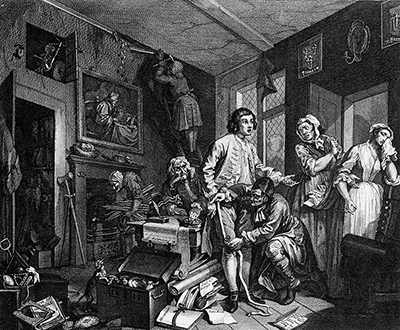
A tailor kneels to measure Tom Rakewell for a new suit while Tom holds out a handful of coins to Sarah Young. She has come with the ring he gave her and with her mother, who has brought his letters. Behind Tom, the man drawing up the inventory of his late father’s estate reaches into a bag of money. William Hogarth brings all three transactions together around a young man intent on dismissing Sarah while someone else helps himself to the inheritance. Sir John Soane’s Museum holds the painting, an oil on canvas dated 1734 and catalogued as P40. It opens the eight scenes of A Rake’s Progress, the fictional story of what Tom does with his inheritance. [1] [2]
At a Glance
- Painting1734, oil on canvas, Sir John Soane’s Museum, P40
- Plate I publication25 June 1735, etching and engraving
- First-state impressionNational Gallery of Art, 1944.5.27
- Third-state impressionThe Metropolitan Museum of Art, 91.1.83
- Authorised copyJuly 1735 imprint, Thomas Bakewell, The Colonial Williamsburg Foundation, 1986-21,A
This work across William Hogarth’s career
Assembly at Wanstead House
1728–31The Marriage Settlement
about 1743Gin Lane
1751Canvassing for Votes
1754–55Contents
- What the tailor measures
- What the house yields
- Sarah’s ring and her mother’s letters
- Plate I and the next scene
What the tailor measures
The tailor can go on working while the quarrel unfolds. He is down at Tom’s legs, taking the measure of a customer whose upper body is turned towards the two women. Tom scarcely has to interrupt the fitting to extend his hand. The new suit might be for mourning, as the black cloth going up in the room suggests, or it might be a first indulgence in finer dress. The fitting itself leaves the finished garment to the imagination. What Hogarth gives us is the transformation already under way, with someone at work on the figure Tom will present to the world as soon as he leaves this house. [1]
Look up from the tailor to the portrait over the fireplace. The dead man is shown weighing money, and the fur cap in his portrait has its counterpart on the mantelpiece below. The repetition lets a small piece of clothing establish whose likeness we are seeing. Above the door are two versions of a coat of arms that the museum says the elder Rakewell acquired. He evidently cared about how the family appeared, even as he economised on heat and light. The portrait dignifies the activity that made his fortune. His son, in turn, has chosen to have himself measured in the very room where that fortune is being counted out. [1]
A memorandum in the foreground gives the father a voice. As the Soane catalogue reads it, the entry for 3 May 1720 records Tom’s return from Oxford. The father also notes a meal at a French ordinary, an inexpensive eating house, and his success in passing off a bad shilling. The catalogue suggests Tom may have been expelled for misbehaviour. The entry establishes his return within the fiction and leaves the reason open. Its comedy comes from the father writing down news about his son in much the same manner as a minor saving. The portrait shows how he chose to be seen. The notebook shows what he thought worth remembering. [1]
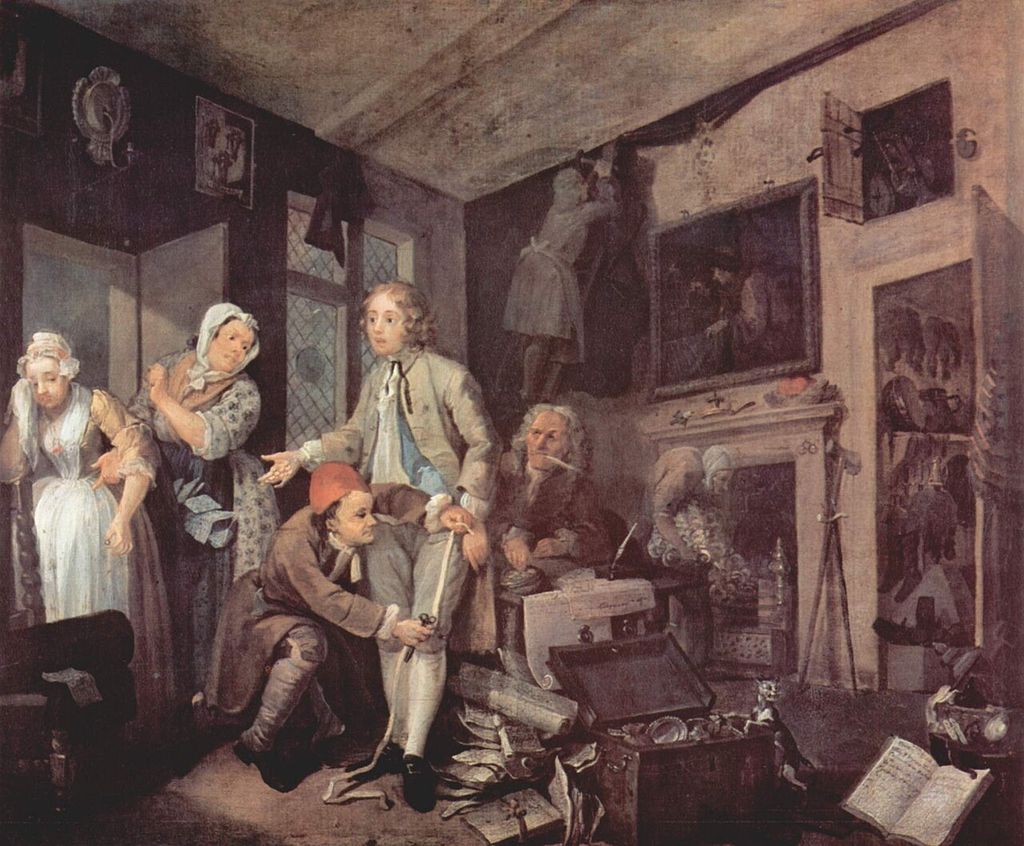
The Heir, William Hogarth, 1734. Oil on canvas. SM P40. The Yorck Project via Wikimedia Commons. Image source. Public domain.
What the house yields
The open chest makes the size of the fortune easier to grasp than the room would suggest. Silver plate shares the space with bags marked in thousands. On the floor, bundles labelled as mortgages, bonds and India funds point to money lent or invested beyond the household. A small fireplace, a scrawny cat and a device on the mantel for using up candle ends show how little of that wealth went into daily comfort. An older woman bends to lay the fire even as the household has money to spend draping the walls. In the cupboard, old footwear and a broken jug have been kept along with things that might still fetch a price. Hogarth puts the habits of a man reluctant to discard anything alongside evidence of what he could readily have afforded to replace. [1]
The man up by the cornice has come to hang mourning cloth. In the course of preparing the room for a public mark of respect, he loosens the hiding place and coins start to fall. The money in the chest can be counted into the estate and the papers on the floor can be sorted. This part of the inheritance turns up because someone pulls at the fabric of the house. At the table, the inventory taker creates a different problem for anyone trying to reckon what Tom will receive. His access to the bag comes from a position of trust. Hogarth lets the viewer see both what the worker accidentally adds to the reckoning and what the man charged with making it quietly takes away. [1]
Watch Hogarth’s paintings and prints
Five films on Hogarth’s painted stories, prints, drawing methods and work for the Foundling Hospital.
The Sequel: Hogarth’s "A Rake’s Progress" (1734–5)
The Paul Mellon Centre revisits the eight-scene story of Tom Rakewell and its place in Hogarth’s work.
Watch on YouTubeSarah’s ring and her mother’s letters
In the painting, Sarah stands at the far left with a handkerchief to her face and the ring in her other hand. Her mother turns more squarely upon Tom. The letters falling from her hands contain an Oxford address and traces of his promise to marry Sarah, according to the museum’s transcription. Sarah is presented as pregnant. Each woman brings something to the encounter. The ring is small enough to need looking for, while the mother’s gesture draws attention to a set of papers with words that can be read back to their author. Tom tries to end the conversation by assigning a price to a commitment whose terms he had once set down himself. [1]
In the Metropolitan Museum of Art’s third-state impression, accession 91.1.83, the room is reversed and the women are on the right. The mother is nearest Tom’s outstretched palm, with the folded letters spreading across her apron. Sarah leans away near the doorway. In the painting, the papers spill down as her mother confronts him. In this print, their angular edges stand out against the folds of her clothing. Both versions let the viewer move from the coins to the letters to the ring. The floor is already strewn with documents that count towards Tom’s wealth, so the letters introduce another kind of written obligation into a room full of people deciding what he owes and what belongs to him. [1] [3]
The verse under Hogarth’s print, associated by the Met with the poet John Hoadley, addresses the father. It asks what kind of companionship or instruction a son can expect when paternal care is shut away with the savings. A separate, smaller print issued with Hogarth’s consent by Thomas Bakewell in July 1735 gives the women a more explicit role in its own verse. The pregnancy and the broken marriage promise become part of the accusation, and the ring and letters are named as evidence. Bakewell’s verse also treats the fitting as preparation for mourning. Where Hogarth’s verse sends the eye back to the portrait and the chests, Bakewell’s directs it to the family dispute and supplies a particular reading of the tailor’s work. [3] [4]
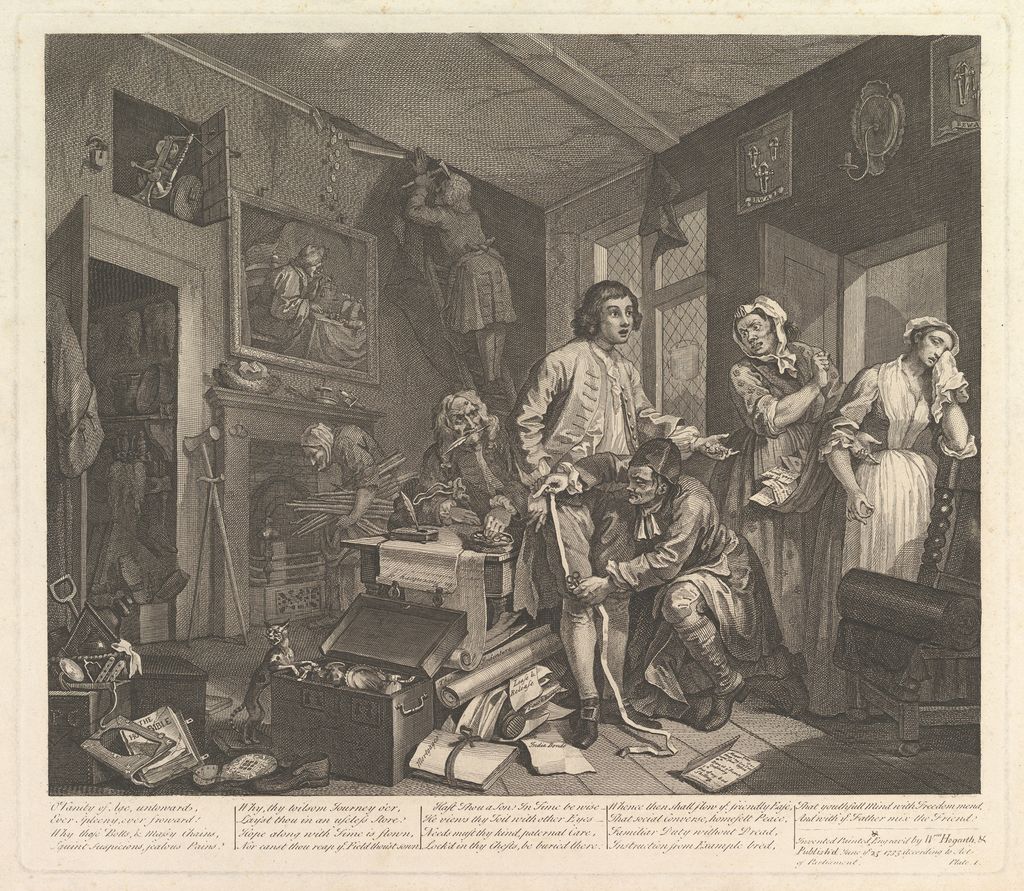
A Rake's Progress, Plate 1, William Hogarth, June 25, 1735. Etching and engraving; third state of three. 91.1.83. Gift of Sarah Lazarus, 1891. Image source. CC0 / Public domain.
Plate I and the next scene
Hogarth first published Plate I on 25 June 1735, the date printed beneath the scene. The Bibliothèque nationale de France catalogues its etching and engraving, FRBNF40262624, as a third state in its reference to Ronald Paulson’s 1965 catalogue. Under the same catalogue numbering, the National Gallery of Art records its impression, 1944.5.27, as the first of three states and gives a sheet size of 35.9 × 41.2 cm. Princeton University Art Museum records a plate measurement of 35 × 40.5 cm for its impression, x1954-42. The plate mark records the size of the copperplate’s impression on the paper. It is a little over half the height and width of the 62.2 × 75 cm canvas. The smaller format brings the image and the five columns of verse into a space where a reader can look back and forth between them. [5] [6] [7] [1]
In the next scene, The Levee, Tom is receiving callers in a bigger, more fashionable room. A tailor with a coat over his arm is among the waiting company, and a dancing master and a fencing master can offer further lessons in how to carry himself. The first room is still recognisably his father’s, though Tom can give orders in it. By the time he has a room fitted to his own ambitions, he can make an occasion of getting dressed. The fitting in The Heir has already shown how easily he can give someone access to his person or his property while thinking about something else. [8] [1]
Browse Hogarth’s artworks
All 54 individual artworks and series stages in the approved English cluster
Frequently Asked Questions
Sarah Young and her mother arrive with Sarah’s letters and ring. Tom offers money while the tailor measures him for new clothes. [1]
It is scene 1 of 8 in A Rake’s Progress. Sir John Soane’s Museum uses the scene number for the original oil painting. [1]
Discussion
Look again at the images and ideas explored in The Heir. These editorial prompts invite your observations.
Reader Insights
How does the position of the kneeling tailor help you follow Tom’s attention while the inventory taker reaches for the money?
What do Sarah’s ring and her mother’s letters show about the promise that Tom’s handful of coins cannot settle?
Join the Conversation
Share a detail, comparison or question about The Heir below.
References
- Joanna Tinworth, Sir John Soane’s Museum, A Rake’s Progress I: The Heir, P40, curatorial entry, April 2021. View source.
- Sir John Soane’s Museum, The Picture Room, section on Hogarth’s modern moral subjects. View source.
- The Metropolitan Museum of Art, William Hogarth, A Rake’s Progress, Plate 1, 91.1.83, third state of three. View source.
- The Colonial Williamsburg Foundation, after William Hogarth, A Rake’s Progress, Plate 1: Taking Possession of His Father’s Effects, published by Thomas Bakewell, 1986-21,A, July 1735 imprint and verse. View source.
- Bibliothèque nationale de France, William Hogarth, A Rake’s Progress: The Heir, plate I, FRBNF40262624, third state, Paulson 132.3 (1965). View source.
- National Gallery of Art, William Hogarth, A Rake’s Progress: pl.1, 1944.5.27, Paulson 132, state i/iii (1965). View source.
- Princeton University Art Museum, William Hogarth, The Young Heir Taking Possession, plate 1 from A Rake’s Progress, x1954-42. View source.
- Sir John Soane’s Museum, William Hogarth, A Rake’s Progress II: The Levee, P41. View source.







