


 by Tom Gurney
Tom Gurney BSc (Hons) is an art history expert with over 20 years experience
Published on June 19, 2020 / Updated on October 14, 2023
Email: tomgurney1@gmail.com / Phone: +44 7429 011000
The Reward of Cruelty: Introduction
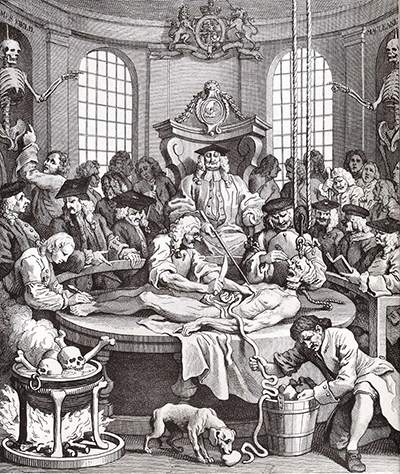
The hangman’s rope still lies beside Tom Nero’s head in William Hogarth’s The Reward of Cruelty. Nero has been executed for murder, and his body now occupies the centre of an anatomy theatre. A surgeon looks down into his opened abdomen. Behind the table a man in a high-backed chair directs attention to the body with a rod. The fourth and final print of The Four Stages of Cruelty gives as much room to the people who look as it does to the man they have come to see. The Metropolitan Museum of Art’s impression, 91.1.139, is an etching and engraving with a publication line dated 1 February 1751. [1]
At a Glance
- ArtistWilliam Hogarth
- SeriesPlate 4 of The Four Stages of Cruelty, issued in 1751
- Met impressionEtching and engraving, dated 1 February 1751, The Metropolitan Museum of Art, 91.1.139
- Morgan drawingRed chalk on paper, incised and squared in graphite, dated 1750 in the collection record, The Morgan Library & Museum, III, 32e
- Boydell impressionWoodcut by John Bell after William Hogarth, published in 1790, The Metropolitan Museum of Art, 21.72(1)
This work across William Hogarth’s career
Assembly at Wanstead House
1728–31The Heir
1734The Marriage Settlement
about 1743Gin Lane
1751Canvassing for Votes
1754–55Contents
- From the churchyard to the anatomy theatre
- The names above the skeletons
- What Londoners knew about public anatomy
- The chair, the drawing and the woodcut
From the churchyard to the anatomy theatre
In the previous stage, Cruelty in Perfection, people gather around the murdered Ann Gill and restrain Nero. A letter and the goods scattered beside her body help the reader piece together what brought her there. At the anatomy table, the noose is the most immediate clue to what happened between the two scenes. The trial and hanging occur outside the picture. The spectators in the churchyard arrived to find out what had happened to Ann. The people in the theatre have a place to stand and an authority to direct their attention. They have assembled to see what will be done to Nero. [1] [2]
Two arched windows flank the chair, which rises beneath the royal arms. The rail around the table separates those doing the work from the people leaning in for a view. Within that tidy arrangement, the onlookers have different interests. One man on the left reaches up towards a skeleton. A figure on the right has an open book in front of him. Others peer in from behind the ropes descending to Nero’s head. In front, the ring of spectators opens up. The reader has a clear view of the table, the bucket and the instruments, even as the people in the room peer over one another’s shoulders. [1]
Hogarth’s design takes the eye below the level of the demonstration. A dog bends to the organ on the floor that the Morgan Library & Museum identifies as Nero’s heart. At the beginning of the series other boys hold a dog down while Nero abuses it. Here the animal moves freely at the edge of the group and Nero lies exposed. To the left, steam rises from a cauldron containing skulls and bones. Nero’s dangling hand points towards it. Together with the skeletons in the niches, the cauldron gives the reader a way to picture what might become of a body once the people at the table have finished with it. [1] [2] [3]
The verse underneath the scene carries that idea further. It starts with the loss of a peaceful burial, moves through the tongue and eyes, then turns to the heart and the skeleton. The heart is exposed to curious eyes and the verse denies Nero any claim to pity. It ends by calling what will rise from his bones a “Monument of Shame”. Ordinarily a monument might preserve a person’s standing or mark a grave. The one imagined here keeps the offender on display. The imperative to look at the start of the verse makes the print’s reader part of that process, even while the image makes the act of looking uncomfortable. [1] [4]
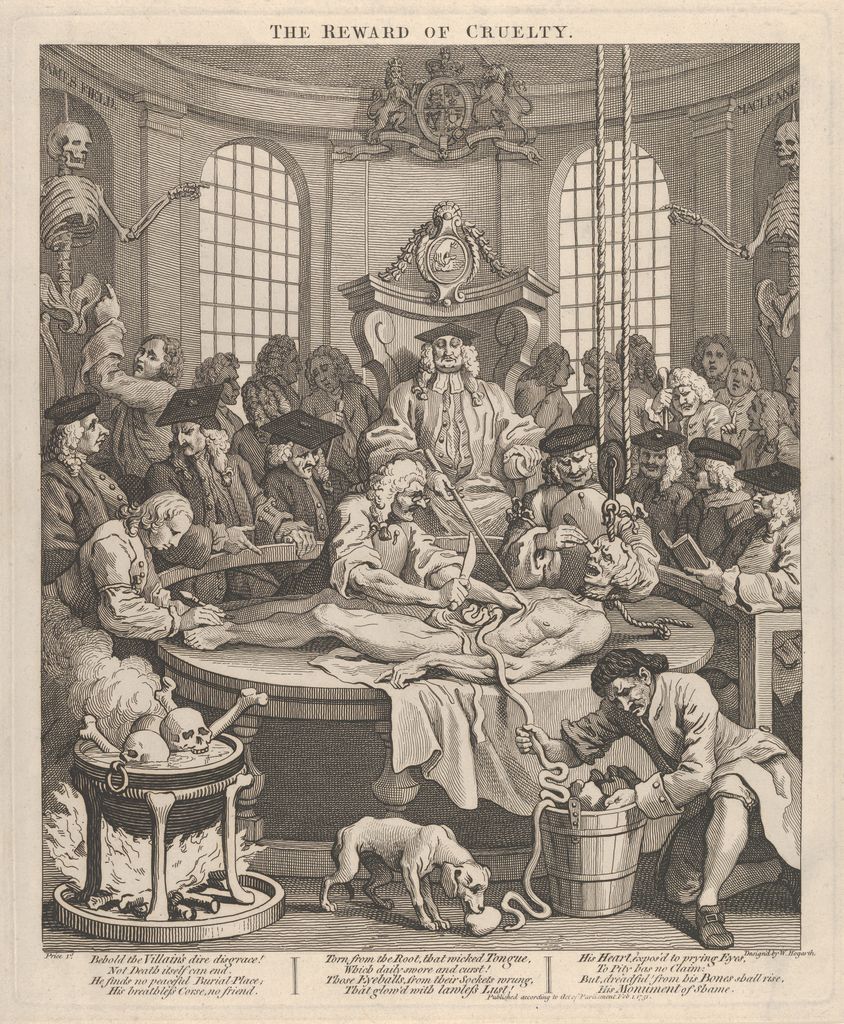
The Reward of Cruelty (The Four Stages of Cruelty), William Hogarth, February 1, 1751. Etching and engraving; third state of three. 91.1.139. Gift of Sarah Lazarus, 1891. Image source. CC0 / Public domain.
The names above the skeletons
The labels over the niches invoke two people who had recently been executed. The left names James Field, a boxer whose name already appears on a match notice in the second plate. In the final scene his name has moved from an advertisement promising a contest to an inscription over a skeleton. James Macleane, the highwayman named at the right, was executed in October 1750. Field was hanged for robbery in February 1751. Jennifer Tonkovich and Laurel O. Peterson place Field’s execution eleven days before the series came out and suggest that the names were a late addition to the engraved design. The labels bring recent cases into Nero’s fictional story. They identify the figures as Hogarth presents them, while leaving the historical fate of the men’s remains open. [1] [2] [3]
Macleane was already the subject of another kind of public display. An engraving in the Wellcome Collection, attributed to H. Carpenter and dated to around September 1750, shows fashionably dressed women waiting to see him in Newgate. Its warder promises to admit them. It is itself a satire on the fascination a prisoner could inspire. Hogarth’s image leaves little of Macleane beyond a name and a pose, yet it still gives him an audience. The two prints show how a figure familiar from news of a robbery could be used to direct attention towards the habits of the people who came to look. [2] [5]
What Londoners knew about public anatomy
The institutional details have prompted several identifications. Isobel Fiona Haslam connects the theatre to features of the old Barber-Surgeons’ theatre, the Royal College of Physicians’ Cutlerian theatre and the new Surgeons’ Hall. She also cites the commentator John Ireland’s suggestion that the presiding figure resembles John Freke, a surgeon at St Bartholomew’s Hospital. The resemblance remains a proposal. The broad chair, the presiding man’s dress and the rod extending down towards the table establish his status in the picture. His distance from the manual work also recalls earlier illustrations of public anatomies in which the lecturer sits above the person making the dissection. [1] [6]
Watch Hogarth’s paintings and prints
Five films on Hogarth’s painted stories, prints, drawing methods and work for the Foundling Hospital.
Crafting Cruelty: Hogarth’s Innovative Drawing Methods
The Morgan examines Hogarth’s drawings for The Four Stages of Cruelty and the methods he used to work out his designs.
Watch on YouTubeSuch arrangements were already part of London’s anatomical culture. Elizabeth T. Hurren discusses working papers from the 1730s concerning the arrangement of teaching at the surgeons’ company. Draft proposals assign different duties to professors and demonstrators and distinguish between public and private work on bodies. The papers show an institution concerned with who could demonstrate and what kind of audience would see the work. Hogarth compresses this division of labour into a single scene in which one figure directs, several work with their hands and a close-packed audience observes. [1] [7]
The series appeared in February 1751. Tonkovich and Peterson give 21 February as the issue date, with a qualification about New Style reckoning. The Murder Act followed. The London Gazette printed the Act in April 1752 and its main provisions began with Easter term that year. The Parliamentary Archives lists it under 1751, the session year. Under the Act, the sheriff was to deliver the body after a qualifying murder conviction and execution in London or Middlesex to the Company of Surgeons’ hall or a place the company appointed. The judge could instead order the body hung in chains. The Act barred burial unless the body had first been dissected and anatomised. This formalised the use of the executed murderer’s body to extend punishment beyond death, a prospect Hogarth’s audience had already encountered in the print. [1] [2] [8] [9]
The distinction matters for the skeletons. The statute specifies what was to happen in cases of wilful murder. The cauldron and the niches tell a more pointed visual story about continued exposure and the prospect of becoming an anatomical specimen. The new law could prescribe custody and treatment, while actual spectators still had to get into the room. Hurren records a July 1752 payment for iron railings in the surgeons’ theatre and a separate entrance through which bodies could be received. Hogarth gives his readers immediate access to the scene that such practical arrangements controlled. [1] [3] [7] [8]
The chair, the drawing and the woodcut
The large preparatory study at Windsor, Royal Collection Trust RCIN 913494, is dated 1750 and measures 46.3 by 38.3 centimetres. Dark ink strokes give the foreground its weight, with wash and lighter handling further back. The presiding figure began as a small graphite idea near the right of the sheet. In Bell’s woodcut and the engraved version, the high chair moves to the centre. That relocation gives the room an axis and places a representative of the institution directly above the body it has received. Tonkovich and Peterson also trace more local changes. The woodcut retains the bold parallel strokes of the Windsor study but makes the kneeling attendant’s legs easier to distinguish near the bucket. [2] [10]
The Morgan’s smaller Fourth Stage of Cruelty, III, 32e, shows the scene in red chalk at a scale much closer to the engraving. Its object record dates it to 1750 and gives the sheet as 35.9 by 30.4 centimetres. A stylus has left incised contours and the back is rubbed with red chalk, so pressure on the front could carry the design to another surface. The graphite squares were laid over the completed drawing. They show that a design which already looked finished was still available for transfer or further work. The surviving marks leave the immediate destination of that transfer uncertain. [2] [3]
Bell’s woodcut provides another way to see the choices made in the copperplate. The Met catalogues its woodcut, 21.72(1), as the work of John Bell after Hogarth, published by Boydell and Co. in 1790. Its sheet stands 45.6 centimetres high, compared with 40 centimetres for the larger Met impression from copper. The design and block go back to the earlier woodcut project. The Royal Collection dates the woodcut’s publication to January 1751, while Tonkovich and Peterson distinguish early test impressions from later commercial printing and discuss the January inscription on the companion woodcut. The 1790 date belongs to the Met sheet. Bell’s block prints from the raised portions of the wood, while the copperplate carries ink in recessed lines. An unfinished Windsor proof shows that the copperplate initially used open parallel lines, close in effect to the woodcut. A second set of lines crossing the first deepened the shadows as the plate was finished. The finished print can turn the wall behind the spectators into a dense, continuous shadow while leaving the face and torso of Nero conspicuously light. [1] [2] [10] [11]
The Met catalogues both 91.1.139 and its smaller sheet 32.35(121) as the third of three states of the etching and engraving. The National Museum of Western Art in Tokyo records its own impression, G.1994-0015, as state three of four under no. 190 in the 1989 revised edition of Ronald Paulson’s catalogue. A state marks a stage in the alteration of the printing surface. When the numbers differ between records, the accession and the named catalogue make clear which sheet and classification are being described. The woodcut comes from a separate surface, with its own history of printing. [1] [4] [11] [12]
Browse Hogarth’s artworks
All 54 individual artworks and series stages in the approved English cluster
Frequently Asked Questions
Surgeons dissect his body in an anatomy theatre before an audience. The hangman’s rope remains beside his head. [1]
It is print 4 of 4 in The Four Stages of Cruelty. Use that position to follow the change in setting from one episode to the next. [1]
Discussion
Look again at the images and ideas explored in The Reward of Cruelty. These editorial prompts invite your observations.
Reader Insights
How does the dog beneath the table change the meaning of the dissection after the first print’s scene of animal cruelty?
What changes when Hogarth moves the presiding figure from the edge of the Windsor drawing to the centre of the print?
Join the Conversation
Share a detail, comparison or question about The Reward of Cruelty below.
References
- The Metropolitan Museum of Art, William Hogarth, The Reward of Cruelty (The Four Stages of Cruelty), etching and engraving, 91.1.139. View source.
- Jennifer Tonkovich and Laurel O. Peterson, “Hogarth and the Making of the Four Stages of Cruelty,” Master Drawings 62, no. 1 (2024), pp. 21–40, especially pp. 30–32 and 35–36, figs. 4–8, 10, 15 and 24, and notes 2, 13 and 41. View source.
- The Morgan Library & Museum, William Hogarth, Fourth Stage of Cruelty (Reward of Cruelty), red chalk drawing, III, 32e. View source.
- The National Museum of Western Art, Tokyo, William Hogarth, Reward of Cruelty, etching and engraving, G.1994-0015, verse transcription and reference to Ronald Paulson, Hogarth’s Graphic Works, 3rd revised ed. (1989), no. 190. View source.
- Wellcome Collection, H. Carpenter, Well-dressed Women Queue Up to See James Maclaine, the Gentleman Highwayman in Newgate Prison, engraving, [September 1750], 579639i. View source.
- Isobel Fiona Haslam, Medical Images in Eighteenth-Century British Art, with Special Reference to William Hogarth and Thomas Rowlandson, doctoral thesis, University of St Andrews (1993), chapter 5, pp. 177–184. View source.
- Elizabeth T. Hurren, “Delivering Post-Mortem ‘Harm’: Cutting the Corpse,” Dissecting the Criminal Corpse (2016), chapter 4, pp. 125–169, “Under-Door at Surgeon’s Hall.”. View source.
- The London Gazette, “An Act for better preventing the horrid Crime of Murder,” 25 Geo. II c. 37, issue 9160, 21–25 April 1752, p. 1. View source.
- Parliamentary Archives, “Public Act, 25 George II, c. 37,” HL/PO/PU/1/1751/25G2n29, session catalogue record. View source.
- Royal Collection Trust, William Hogarth, The Reward of Cruelty, drawing, 1750, RCIN 913494. View source.
- The Metropolitan Museum of Art, John Bell after William Hogarth, The Reward of Cruelty, woodcut, Boydell and Co., 1790, 21.72(1). View source.
- The Metropolitan Museum of Art, William Hogarth, The Reward of Cruelty (The Four Stages of Cruelty), etching and engraving, 32.35(121). View source.







