



 by Tom Gurney
Tom Gurney BSc (Hons) is an art history expert with over 20 years experience
Published on June 19, 2020 / Updated on October 14, 2023
Email: tomgurney1@gmail.com / Phone: +44 7429 011000
Canvassing for Votes: Introduction
A country elector stands between two men offering him money and dinner. His hands are within reach of both offers, and the sideways glance under his hat suggests that he knows exactly how much his attention is worth. Above the three men, an advertisement shows the puppet Punch throwing coins to voters. William Hogarth gives the same transaction two scales in Canvassing for Votes. The banner makes buying support into a spectacle. The men below it show how quietly the business can be done. Sir John Soane’s Museum dates the oil on canvas to 1754–55. It measures 102.3 by 131.4 centimetres and is catalogued as P56. [1]
This is the second scene of The Humours of an Election. In An Election Entertainment, a banquet concentrates the work of winning favour around a single table. Here the street gives each group its own space. The eye can travel from the money passing between hands to the struggle at the far inn, then beyond both to a distant church spire. The view opens to blue sky and green hills, while in the foreground the parties compete for the few inches between an agent’s hand and an elector’s pocket. [1] [2]
At a Glance
- ArtistWilliam Hogarth
- SeriesScene 2 of The Humours of an Election
- PaintingOil on canvas, 1754–55, Sir John Soane’s Museum, P56
- Paris impressionEtching and engraving by Charles Grignion after Hogarth, inscribed 20 February 1757, Petit Palais, PPG6041
- New York impressionSixth state of six, The Metropolitan Museum of Art, 91.1.73
This work across William Hogarth’s career
Assembly at Wanstead House
1728–31The Heir
1734The Marriage Settlement
about 1743Gin Lane
1751Contents
- The Crown, the Royal Oak and the Portobello
- The price of an invitation
- From the canvas to Plate II
- From Garrick’s collection to the Picture Room
The Crown, the Royal Oak and the Portobello
The attack on the Crown is easy to overlook. Its sign projects over the street well behind the foreground bargain. Under the crown hangs a board marked “The Excise Office”, which gives the inn’s allegiance to the Whig interest an association with government taxation. One man saws at the sign’s support as others pull with a rope. A man leaning from a window fires towards the crowd. The rope and the saw promise success just as the arrangement of bodies makes that success look dangerous. The man astride the beam and the people beneath it are all in the path of the thing they are working to bring down. [1]
The Royal Oak occupies the left foreground in the painting. Its paved frontage, sash windows and carved balcony give the Tory headquarters a more imposing setting, while the inn sign looks almost like a picture in a gilt frame. The oak recalls the tree at Boscobel in which the future Charles II hid from Parliamentarian forces after his defeat at Worcester in 1651. A cloth hung from the sign’s support partly covers it. A passer-by can still see enough of the old emblem to recognise the establishment, but the space immediately before it has been given over to a campaign joke about the government of the day. [1] [3]
Across the street the Portobello has exposed timbers and a plainer sign. At its table are a cobbler and a barber. The six pieces of broken clay pipe arranged in front of the barber may stand for the six ships Admiral Edward Vernon took against Spanish-held Portobello in 1739. On that reading the tabletop becomes a chart for retelling the victory, and the barber may be recalling service at sea. His shaving gear establishes his trade more securely than the pipes establish his past. Joanna Tinworth’s Soane catalogue reads the house as a meeting place for political independents. She also points to the silver near the cobbler, which leaves open the possibility that independence has its price here too. [1] [4]
A second naval image sits under the landlady of the Royal Oak. The carved lion takes a French fleur-de-lis into its mouth, and the Soane links it to the figurehead of Admiral George Anson’s ship, the Centurion. Hogarth places a reminder of national rivalry at the level of an inn threshold. The apron and coins above the carving bring the eye back to the immediate business of the house. A grenadier watches from the doorway as the landlady counts, while diners visible through the curved window have a pie and a chicken before them. What an election costs the parties can be income to an inn that supplies the food, drink and rooms. [1] [4]
The price of an invitation
The two agents facing the elector come from rival houses. Tinworth identifies the offer from the Royal Oak as silver and the Crown’s as a gold guinea. Both approaches include an invitation to dine. The parallel gestures invite a comparison with the Choice of Hercules, in which the hero faces competing claims from Virtue and Vice. Here, both sides offer material advantage, and the man in the middle has room to accept both. The picture stops before he has to declare a preference. Hogarth can make the look in his eyes legible while leaving the eventual vote open. [1]
Watch Hogarth’s paintings and prints
Five films on Hogarth’s painted stories, prints, drawing methods and work for the Foundling Hospital.
William Hogarth, Marriage A-la-Mode (including Tête à Tête)
A close look at Tête à Tête and how its figures and furnishings advance the story of the marriage.
Watch on YouTubeAbove them, the Punch advertisement makes public money visible as a stream of coins coming from the Treasury. Sacks are loaded or carried off, and Punch distributes money from a wheelbarrow to people holding out their hats. In the painting, the word “OXFORD” appears on the wagon. “Guzzledown” in the advertisement belongs to a fictional geography. Robert L. S. Cowley traces the name to earlier comedies, including The Provok’d Husband and Henry Fielding’s Pasquin. The two names let Hogarth invoke a recognisable contest while setting his own election in a place already associated with comic political ambition. [1] [4]
In Oxfordshire, the Whig New Interest had been campaigning since 1752 against the Tory Old Interest. The county franchise depended on a man holding freehold property worth at least forty shillings a year. Securing the support of men who met that qualification meant reaching well beyond the town where the poll took place. Newcastle University’s research identifies a promise of £7,000 towards the Whig campaign by Prime Minister Henry Pelham. The banner also shows a sack labelled “7000”, a possible echo of that sum. Where the surviving record documents a promise towards campaign expenses, Hogarth pictures cash cascading out of Whitehall. Legislation restricted bribery and treating, the practice of providing food and drink, but the line between customary hospitality and an inducement remained disputed. Placing the cash and the invitations in the same outstretched hands makes the purpose of these particular dinners clear. [1] [5] [6]
The buying reaches people beyond the electorate. A well-dressed man below the Royal Oak balcony picks out a trinket while two women lean over the rail. A letter held out to him gives the name Timothy Partitool, which fixes him in the fiction even as his fine clothes distinguish him from the other figures working the street. Tinworth reads the purchase as a possible attempt to influence votes through relatives, with flirtation also suggested by his attention to the women. The historical campaign offers examples of women acting on their own political initiative. Lady Susan Keck was among those who canvassed for the New Interest. Hogarth’s scene leaves the pictured women’s response open. [1] [5] [6]
From the canvas to Plate II
The Petit Palais in Paris holds a separate impression, PPG6041, catalogued as an etching and engraving measuring 40.5 by 54 centimetres. Its title names it as Plate II, and the margin credits Hogarth with the painting and Charles Grignion with the engraving. The dedication names Sir Charles Hanbury Williams as ambassador to the Russian court. The publication line bears 20 February 1757. The Soane catalogue records that Hogarth announced a delay to subscribers that February and places the issue of the last three plates in 1758. The date carried by the Paris sheet and the year subscribers could obtain the delayed plates belong to different events. [7] [1]
The printed design reverses the street. The balcony and bow window of the Royal Oak move from left to right, and the Portobello table moves across to the left. Cowley also observes that the engraved version he discusses drops the name Oxford from the wagon. The wheelbarrow and the shower of coins still tell their story, while the removal of the place name weakens the direct reference to a particular election. [1] [4]
In the oil, the pale stonework, blue sky and warm red roofs carry the eye around groups that merge into the shadows. On paper, closely spaced lines supply the shadows and separate the lit figures and buildings. Tinworth singles out the smoke in the Royal Oak’s upstairs room, faint in the oil and clearer in the British Museum impression S,2.131, which she describes as a first state. The Met catalogues its own sheet, 91.1.73, as the sixth state of six. The Petit Palais gives the dimensions of its object and leaves its state unspecified. The Met gives sheet dimensions of 41.7 by 55 centimetres. Those measurements describe individual objects, while a state identifies a stage in the working life of the plate. [1] [4] [7] [8]
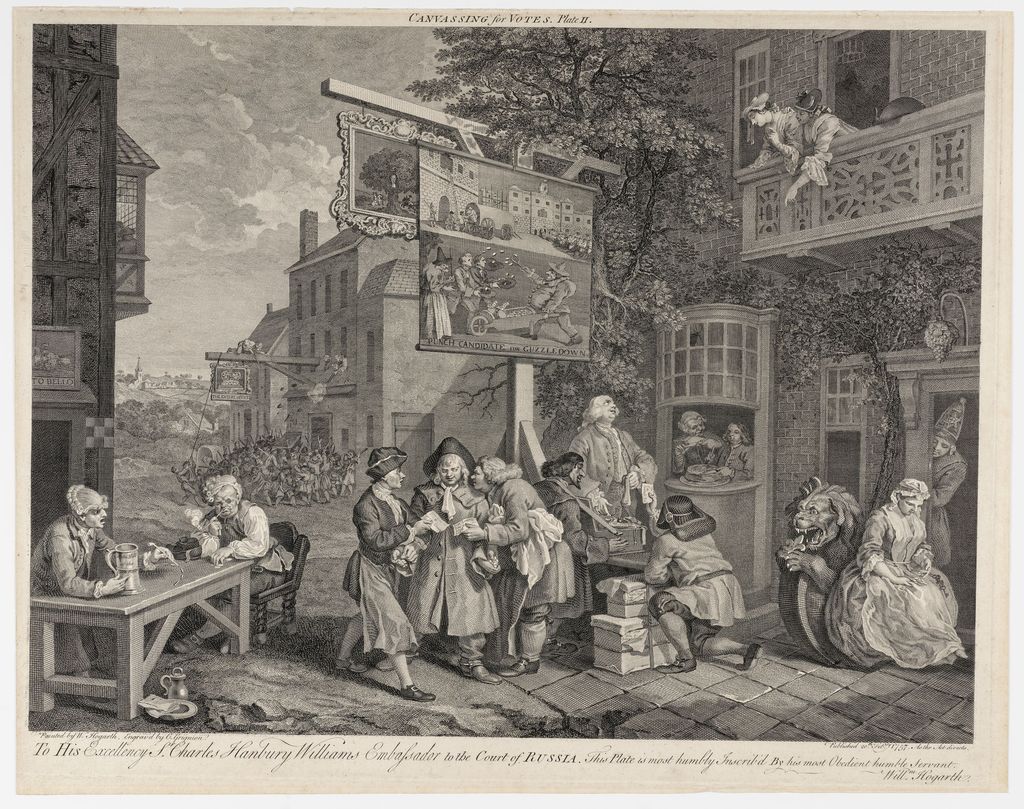
Canvassing for Votes, Charles Grignion after William Hogarth, Plate dated 20 February 1757. Etching and engraving. PPG6041. Paris Musées / Petit Palais, Musée des Beaux-Arts de la Ville de Paris. Image source. CC0 / Public domain.
From Garrick’s collection to the Picture Room
The actor David Garrick subscribed to the engravings and bought all four canvases directly from Hogarth, around 1762 according to the Soane provenance. John Soane acquired the paintings together at Christie’s sale of Mrs Garrick’s effects on 23 June 1823. The sale catalogue listed this canvas as the Canvass, and Soane recorded paying 1,650 guineas for the set. In the Picture Room the paintings occupy movable display planes. Seen alongside its companions, Canvassing for Votes makes the voter’s freedom to keep everyone guessing a short-lived pleasure. In The Polling, the rival interests converge on a crowded platform, where each voter has to declare his choice in public. [1] [9]
Browse Hogarth’s artworks
All 54 individual artworks and series stages in the approved English cluster
Frequently Asked Questions
The two men offer money and dinner to win the elector’s support. A sign above them depicts the puppet Punch throwing money to voters. [1]
It is scene 2 of 4 in The Humours of an Election. Sir John Soane’s Museum uses the same scene number for the original painting. [1]
Discussion
Look again at the images and ideas explored in Canvassing for Votes. These editorial prompts invite your observations.
Reader Insights
What does the elector’s sideways glance suggest about how he weighs the two dinner invitations?
How does the saw and rope arrangement make the crowd’s attack on the Crown sign dangerous to the crowd itself?
Join the Conversation
Share a detail, comparison or question about Canvassing for Votes below.
References
- Joanna Tinworth, Sir John Soane’s Museum, The Humours of an Election II: Canvassing for Votes, P56, catalogue entry, provenance and notes 2 and 17–23, October 2021. View source.
- Joanna Tinworth, Sir John Soane’s Museum, The Humours of an Election I: An Election Entertainment, P53, October 2021. View source.
- English Heritage, Charles II and the Royal Oak, the escape after Worcester and the Boscobel oak. View source.
- Robert L. S. Cowley, “William Hogarth’s Personal ‘Erewhon’: A Search for the ‘Guzzledown’ of His Election Series”, The British Art Journal 24, no. 3, pp. 67–73, especially figs. 1, 2, 5 and 6 and notes 5 and 7. View source.
- Eighteenth-Century Political Participation and Electoral Culture, Newcastle University, Oxfordshire Election, April 1754, campaign context and poll book. View source.
- Mark Knights, Eighteenth-Century Political Participation and Electoral Culture, Electoral Corruption in the Long Eighteenth Century, on treating, gifts and election law. View source.
- Petit Palais, Paris Musées, La Brigue des votes, planche II [Canvassing for Votes. Plate II], PPG6041, object details and inscriptions (in French). View source.
- The Metropolitan Museum of Art, Canvassing for Votes, Plate II: Four Prints of an Election, 91.1.73, engraver, medium, state and sheet dimensions. View source.
- Joanna Tinworth, Sir John Soane’s Museum, The Humours of an Election III: The Polling, P73, October 2021. View source.






