


 by Tom Gurney
Tom Gurney BSc (Hons) is an art history expert with over 20 years experience
Published on June 19, 2020 / Updated on October 14, 2023
Email: tomgurney1@gmail.com / Phone: +44 7429 011000
William Hogarth’s Paintings: Introduction
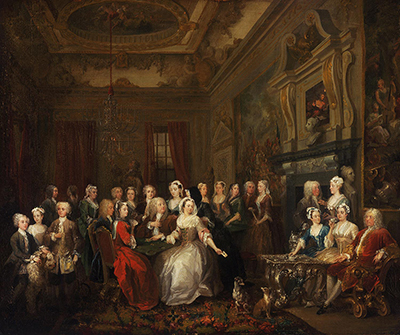
At a card table in William Hogarth’s Assembly at Wanstead House, Lady Castlemaine turns away from her game and raises the ace of spades towards her husband. She sits near the middle of the ballroom. He is almost at the edge of the canvas, conspicuous in red velvet. The distance between them makes a game of discovering the couple’s relationship. Her glance and the tilt of the card give us the clues. [1]
Hogarth could make a small gesture legible across a crowded room and a figure more than six feet tall legible from a staircase. He used oil paint to describe the furnishings around a family, to suggest the sound of a girl selling shellfish and to set up a joke that depended on how much of a picture within a picture was visible. Those tasks called for different arrangements of bodies, degrees of finish and distances from the spectator. The circumstances in which a painting was made also matter. The Child family’s assembly presents a household to its guests. A study kept by William and Jane Hogarth brings six members of their own household together on a single canvas. At St Bartholomew’s Hospital, two enormous paintings address people passing on their way to the Great Hall. [1] [2] [3]
Browse the Paintings


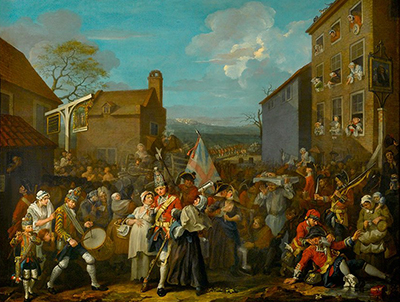
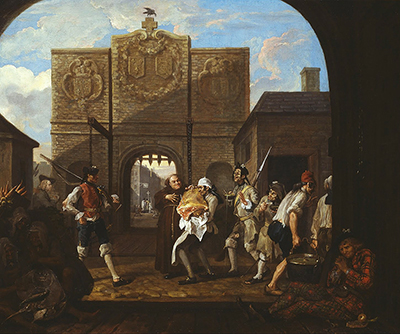



More paintings and complete series
At a Glance
- ArtistWilliam Hogarth
- Principal painting mediumOil on canvas
- FormatsPortraits, conversation pieces, theatre scenes and narrative series
Contents
- At the card table and the tea table
- From the household study to the institutional portrait
- Acting for a painted audience
- Paintings made for a staircase
- What the surface reveals
- Sets of paintings and their impressions
- Where the paintings are held
At the card table and the tea table
The Assembly at Wanstead House, dated 1728–31 by the Philadelphia Museum of Art, lets the eye move among several activities. Some of the Child family and their company play cards and others take tea. The ballroom rises well above the sitters’ heads, leaving room for the scale of the Childs’ house to register. Gaps between clusters let a turn of the head carry the eye across the room. The Philadelphia museum proposes that the gathering records the couple’s twenty-fifth wedding anniversary and reads Dorothy Glynne Child’s ace as a comment on the success of their marriage. The gesture can also be seen in its immediate setting as a move made for an audience. She makes her husband, sitting with two of their daughters, the person to whom the game momentarily matters. [1]
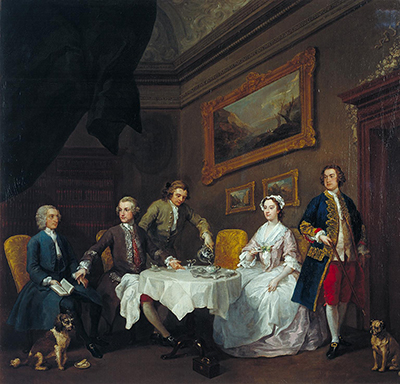
The gathering in The Strode Family has a much tighter centre. Tate dates the painting to about 1738 and gives the canvas dimensions as 87 by 91.5 centimetres. Its nearly square proportions suit the concentration of people around a round tea table. William Strode and Lady Anne Cecil sit in company that includes Colonel Strode and Dr Arthur Smyth. Silver and blue-and-white porcelain occupy a small bright area in front of the group. The servant leans into that space with the kettle. Behind them hang pictures, and a bookcase comes into view at the left. [4] [5]
The tea service gives those positions a reason. One person sits back while another bends forward. Warm clothes and glints on the vessels lead the eye around them. The servant’s careful pouring makes the ease of the seated company possible. In the Wanstead ballroom, the ace takes attention away from the card table. Here a kettle and teapot draw it back. Both scenes shape an impression of informality by giving each person something specific to do. [1] [4] [5]
The Graham Children brings the small actions of a household to the scale of the children themselves. The National Gallery’s canvas, signed and dated 1742, is about 161 centimetres high and 181 centimetres wide. Daniel Graham, an apothecary who served George I and George II, is the presumed commissioner. Of the four children, the eldest, Henrietta, is seated beside the youngest, Thomas, and holds cherries within his reach. Anna Maria lifts her skirt as if to dance. At the right Richard Robert balances a bird organ on his knee. Above him a caged goldfinch is exposed to the attention of a cat climbing the back of his chair. [6]
Each object sets a different sort of movement in train. The organ belongs with the boy’s intent attention to the bird, while the cat, rising from low down on the right, introduces a vertical movement within the broad arrangement of figures. At the other end of the picture the cherries keep the baby close to his sister’s hand. Henrietta’s apron falls in a long curve across the front of her dress and leads back towards the carriage. The children are connected by these events without everybody having to look at the same thing. In the Strode family’s gathering, the table helps hold conversation at a polite pace. Among the Grahams, the opposite ends of the painting seem to move at different speeds. [4] [5] [6]
Thomas died before the picture was completed, according to the National Gallery. His reaching hand gives the family a likeness in action. The clock, crossed carnations and fruit offer a second way of seeing the scene, and the Gallery reads some of these objects in relation to death and Christian hope. The gilded cage and carriage make a visual rhyme. Each is elaborately made and each shelters a small, vulnerable creature. [6]
The carriage’s carved bird and the curves of the apron and raised skirt give the Graham picture a different decorative character from the largely rectilinear ensemble of pictures and books behind the Strodes. In British Rococo design, such curves travelled between painting, carving, furniture and prints of ornament. French practitioners such as the engraver and illustrator Hubert-François Gravelot belonged to the St Martin’s Lane circle. The carved bird on the carriage extends the movement of the handle and brings ornament into the children’s play. In the Strode room the tea things supply finer curves within a largely stable arrangement. The Victoria and Albert Museum’s 1984 exhibition Rococo: Art and Design in Hogarth’s England brought these kinds of material together. [4] [5] [6] [7] [8]
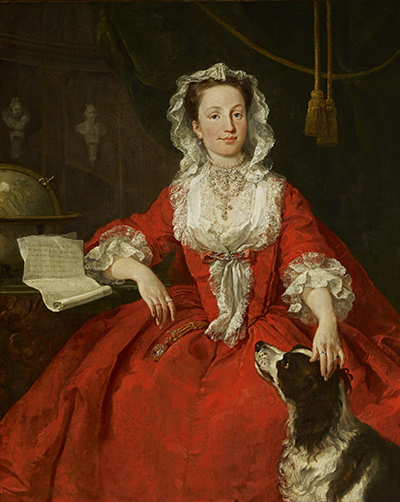
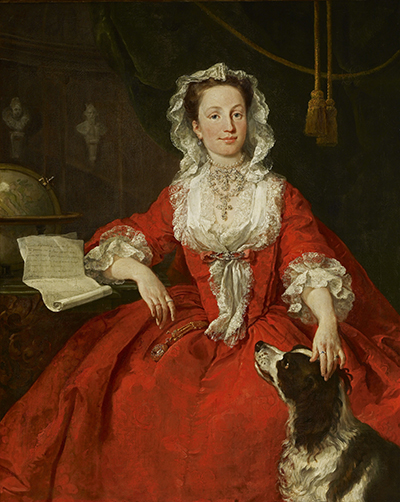
The Frick Collection’s 1742 Miss Mary Edwards makes a revealing comparison with the Graham canvas of the same year. Edwards, a wealthy patron of Hogarth, has a tall format to herself. Her red dress takes up much of the lower part of the picture. The jewels and light trim set off her face, and a large dog raises its head beside her. An open scroll makes liberty and property part of the display, as the Frick’s collection catalogue points out. Such an object has a very different task from the bird organ. It can be read at leisure as part of an accumulation of evidence about the woman who sits beside it. The dog adds an immediate physical exchange to a picture that otherwise gives a single sitter considerable control over how she is seen. [9]
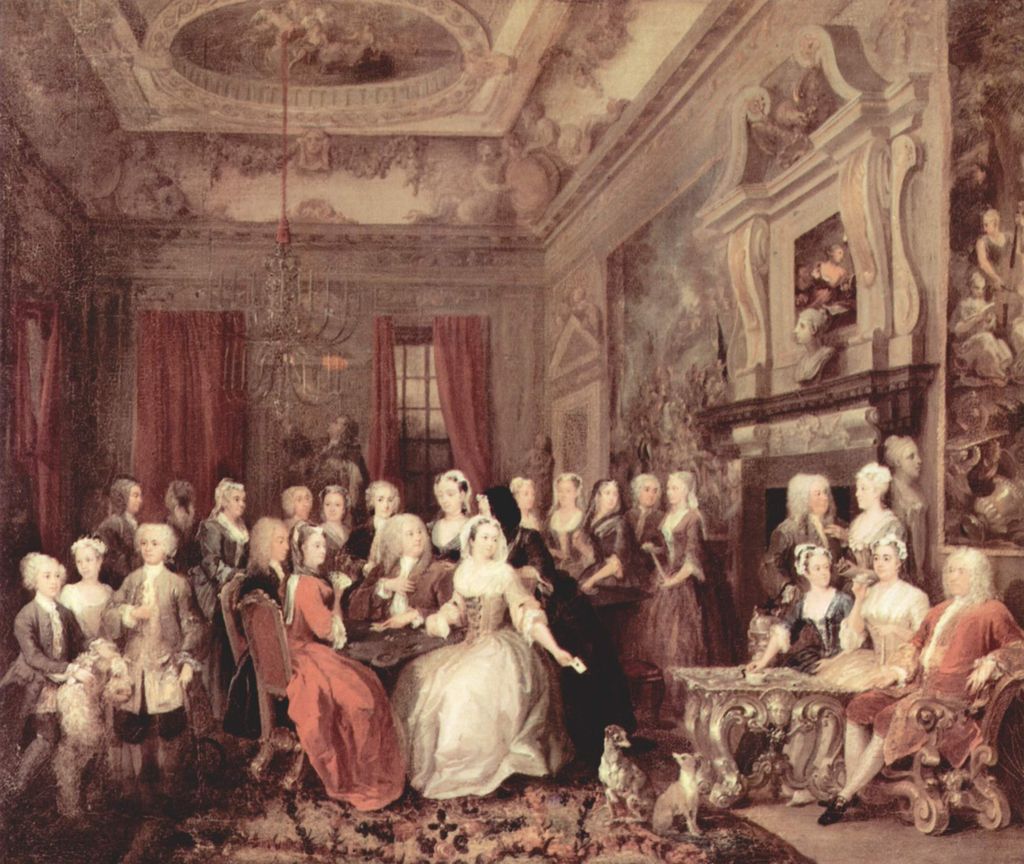
Assembly at Wanstead House, William Hogarth, 1728–31. Oil on canvas. M1928-1-13. The Yorck Project via Wikimedia Commons. Image source. Public domain.
From the household study to the institutional portrait
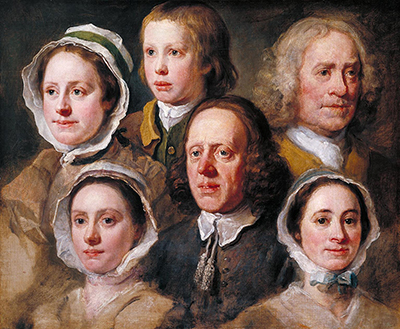
Hogarth’s Heads of Six of Hogarth’s Servants, an oil sketch of about 1750–55 in Tate’s collection, is 63 centimetres high and 75.5 wide. There is no tea table or apparatus of domestic service to bring the people together. The adjoining heads and shoulders emerge from a neutral background, with some faces seen more squarely than others. Small highlights in the eyes can make a glance feel very direct, even when the head itself is turned. Against the shaded ground, variations in the warmth and lightness of skin, and in the modelling around mouths and eyes, do much of the work a room and furnishings do in the family portraits. [2]
The picture stayed with William and Jane Hogarth and was sold after their deaths under a title identifying the figures as servants of Hogarth’s household. In Kate Retford’s account, a household in this sense could include employees who shared a roof and were subject to the master’s authority. She treats the older man’s identification as Ben Ives as likely and the proposed identification of one of the maids as Mrs Chapel as possible. The different ages and the composite arrangement have also suggested to Retford and other scholars a study in the Ages of Man tradition. The sale title supplies evidence about the group. It takes a different kind of evidence to give a name to any one face, and the range of ages can have pictorial interest regardless of those names. [2]
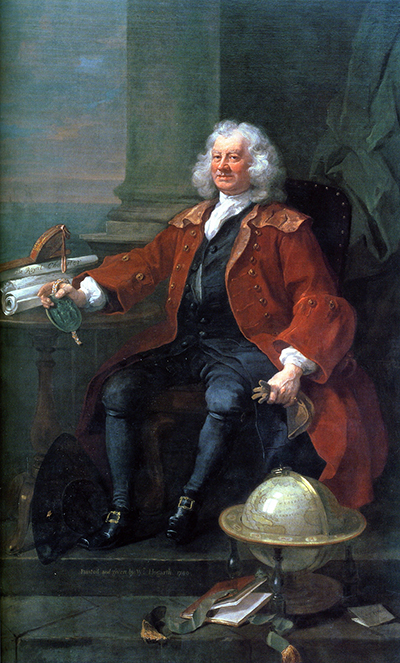
Light on skin also gives Hogarth’s 1740 portrait of Captain Thomas Coram much of its individuality. Follow it from the sitter’s weathered hands to his flushed face and uncovered white hair. Hogarth raises the sitter on a dais and frames him with a column and hanging fabric in the grand manner. The ample pose and unshowy clothes allow him to inhabit that setting without acquiring the appearance of a courtier. The charter seal in his hand identifies his association with the Foundling Hospital, and the globe, showing England and New England, suits a sitter whose earlier life as a shipbuilder and seafarer took him across the Atlantic. [2] [10]
Hogarth gave the portrait to the Hospital in 1740, the year after the charter was granted. It was the first painting presented to the institution and established a precedent for other artists’ gifts. The Hospital’s governors and supporters could see in the sitter a record of how their institution had come about. Placing the seal within reach of those conspicuously individual hands makes its connection to a person’s work readily visible. In Edwards’s portrait an object helps characterise a patron’s interests. Here an object also identifies the organisation in whose keeping the painting would remain. [9] [10] [11]
The Hospital’s Court Room, where the governors held formal meetings, offered still other possibilities. Hogarth helped bring together several artists to furnish it with pictures. Eight roundels included views of charitable institutions. They gave the governors a way to see their Hospital alongside other London foundations. The ensemble also included Hogarth’s Moses Brought Before Pharaoh’s Daughter, dated 1746 by the Foundling Museum and presented to the Hospital in April 1747. Differences in dress and bearing establish the distance between the group bringing the child and the royal party receiving him. The child is the smallest figure in the exchange and the one upon whom the action depends. This is a biblical subject with a precise institutional audience. The story of an infant found and taken into other hands gave the governors an image of reception and protection in the room where they conducted the charity’s business. The Hospital also attracted visitors to see its art. The same picture could prompt someone outside the institution to think about the kind of care for which it sought support. [11] [12]
Acting for a painted audience
In the Washington National Gallery of Art’s A Scene from The Beggar’s Opera, dated 1728/1729, a blue, gold-edged curtain surrounds the action. Captain Macheath stands in red in the middle of the stage, his legs apart and shackled. On either side a woman pleads for him. Lucy is the jailer Lockit’s daughter, while Polly kneels near her own father, Peachum, who has betrayed Macheath. A low barrier separates much of the audience from the players. Faces are visible beyond it, including a boy peering from the box at the right. Hogarth gives us space to notice the people who have come to see the performance while keeping their watching subordinate to the action in the middle. [13]
The Washington canvas is only 51.1 by 61.2 centimetres. The staging is easy to follow on that scale thanks to the spacing of the actors, the colour of Macheath’s coat and the paired appeals on either side. Thomas Walker played Macheath in John Gay’s ballad opera from its first performance in January 1728. John Kerslake’s National Portrait Gallery catalogue records as many as six versions of Hogarth’s subject, made between 1728 and about 1731. John Hayes’s National Gallery of Art catalogue identifies Macheath and Polly as likenesses of Walker and Lavinia Fenton and places this canvas fourth in the series of versions. Its radiograph shows that Hogarth originally put a satyr’s head at the top of the composition. In the related Yale Center for British Art painting, the satyrs pulling back the curtains remain visible. The device makes the act of unveiling part of that particular version’s setting. [13] [14] [15]
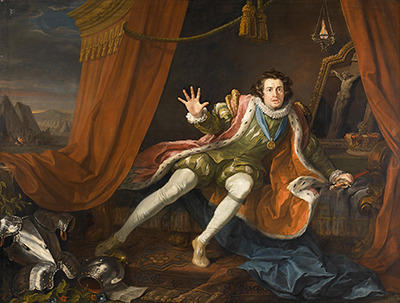
The Walker Art Gallery’s 1745 David Garrick as Richard III gives the central performer most of the space. Garrick’s Richard wakes from a nightmare before the Battle of Bosworth. The open hand and wide eyes are visible at a distance, and the twist of his torso and bracing arm give the impression of a man brought abruptly upright. Rich warm colour and the pale clothing catch the light in the tent. Outside, small watch-fires mark a camp receding into darkness. Near the helmet lies a crumpled note. The Walker’s account identifies it as a warning that some of Richard’s troops have betrayed him. An audience watching the actor might register his distress first. Hogarth gives anyone looking closely at the canvas time to find the paper and connect that distress to the events beyond the tent. [16] [17]
Garrick’s celebrated performance in the role began in 1741. As Robin Simon explains in a Royal Collection lecture, the one-tent scene has a particular relation to Colley Cibber’s adaptation of Shakespeare, which dispenses at this point with the second tent and Richard’s rival Richmond. The separation between the highlighted actor and the night outside makes the painted action self-contained. Garrick’s bodily reaction supplies much of what we have to imagine. The company looking on in the Beggar’s Opera is part of that picture’s design, down to the faces visible in the boxes. In the Metropolitan Museum of Art’s second-state impression of the print Hogarth made with Charles Grignion, dated 20 June 1746, line and tone give the pose and the distant camp their definition. [13] [16] [18]
Paintings made for a staircase
At St Bartholomew’s Hospital, the space through which people approach the picture is as important as the space represented in it. The two paintings in the North Wing are stretched canvases installed on the walls of the staircase leading to the Great Hall. Hogarth offered his work to the Hospital without a fee. He painted Christ at the Pool of Bethesda off site and it was installed in 1736. According to Barts North Wing, he painted The Good Samaritan on site and finished it in 1737. The Hospital archives identify the works as SBHX7/7.1 and SBHX7/8.1 respectively. The figures reach about seven feet in height. Their scale makes a raised hand or an exposed shoulder readable across the stairwell, through changes in the angle at which a person approaching the hall sees the canvases. [3] [19]
In Christ at the Pool of Bethesda, the encounter between Christ and the man awaiting healing is surrounded by people with differing prospects of reaching the water. The picture has room for several simultaneous meetings and interruptions. Naomi Billingsley draws attention to the mother with a sick child who is pushed aside by the servants of a wealthy woman. Attention can move from Christ’s gesture towards the man to the rival claims within the crowd. That secondary incident carries particular weight in a place devoted to treating the sick. Christ can attend to a man who has nobody to assist him into the pool. Other people in the scene have to negotiate with those who stand between them and help. [19] [20]
In The Good Samaritan the red-clad Samaritan bends down to tend the injured stranger beside the road. The group sits low in the landscape, with a horse close by and the figures who have passed the injured man farther away. Where Bethesda distributes attention among many people in need of help, the Samaritan canvas concentrates it on one person stopping to give aid. The small figures in the distance matter to that distinction. A viewer first catches the colour and inclination of the Samaritan’s body and then can look farther into the landscape to see the people who kept walking. The paintings thus suggest two ways of thinking about who receives care, one through a crowd waiting for healing and the other through a traveller’s decision to stop. [3] [20] [21]
Watch Hogarth’s paintings and prints
Five films on Hogarth’s painted stories, prints, drawing methods and work for the Foundling Hospital.
William Hogarth, Marriage A-la-Mode (including Tête à Tête)
A close look at Tête à Tête and how its figures and furnishings advance the story of the marriage.
Watch on YouTubeGarrick’s reaction is painted to be grasped from the front, along with the dimmer clues to the action beyond the tent. The canvases at Barts have to work while the viewer is moving, and one’s relation to the figures changes with the climb. An exchange between two distant figures may come into view before the eye settles on the foreground action. At a turn one can get a different view of the extent of the crowd at the pool or of the distance between the wounded man and the figures leaving him behind. The physical effort of looking up also makes the scale of the bodies apparent in a way a photograph reduces. The approach to the Great Hall gives the acts of care in the paintings a place in the life of the Hospital. [3] [16] [19] [20] [21]
The staircase also dictates what conservators can do. Writing about her work in 2024–25, Megan Buchanan-Smith recorded earlier lining, abrasion and a synthetic varnish applied in 1982. The team worked with the paintings in place. It carried out a light surface clean and adjusted old overpaint, retaining the varnish. A canvas can thus possess the physical features of an easel painting while posing a very different practical problem. The conservators worked from scaffolding, progressing downwards from the top of the canvases. Photographs in Buchanan-Smith’s account show adjustment of retouching along a seam in the Bethesda canvas. [22]
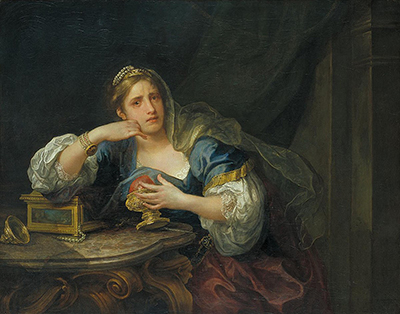
Hogarth approached a very different setting in Sigismunda Mourning over the Heart of Guiscardo. Tate’s canvas is dated 1759 and measures roughly 100 by 127 centimetres. The subject comes from Boccaccio’s Decameron and was retold in English verse by John Dryden. Sigismunda’s dead husband is represented by his heart in the cup, close to the hand that rests on it. Her other hand supports her head. The face has the scale and specificity that make the servants’ heads worth studying, but the relationship between eyes, hand and vessel gives the expression a particular cause. The stillness of her body allows a spectator to look back and forth between the object and her face. At Barts a distant spectator can grasp a story from the arrangement of several bodies. Here much of it is grasped by measuring the small space between one woman’s hands. [2] [19] [23] [24]
The painting was made for Sir Richard Grosvenor, who declined it. His reply, transcribed by John Ireland, makes the effect of prolonged domestic display part of his explanation. Having the picture before him, he said, would repeatedly call up melancholy thoughts. At the Society of Artists exhibition at Spring Gardens in 1761 it faced a different audience. Horace Walpole’s letter of 5 May, describing a studio viewing shortly before the exhibition, mocks the figure’s appearance and the details that were supposed to communicate grief. Grosvenor and Walpole were responding under different circumstances. For one it was a picture to live with. For the other it was an opportunity to judge how Hogarth had tackled an ambitious literary subject. [24] [25] [26]
What the surface reveals
The Shrimp Girl gives a face and upper body nearly the whole of a canvas 63.5 by 52.5 centimetres. The vessel balanced on the woman’s head is high enough to crowd the top of the picture. Hogarth gives a few quick touches to its contents, including what Judy Egerton identifies as a half-pint measure. Her description of London’s itinerant shellfish sellers helps explain the combination of a load on the head, a small measure and a face that seems on the point of addressing someone. There is no name securely attached to that face. Its animation comes from decisions small enough to follow close up, among them the bright touches on the cheeks and mouth, the partly open lips and the change in tone between the skin and the brim of the hat. [27]
A light area next to the face, beneath the brim on the viewer’s left, is exposed ground. Ground is the preparatory coating laid on the canvas before the image is painted. Here the lead-white and chalk ground, which Egerton describes as discoloured towards grey, remains visible in several places. Traces of Prussian blue in the darker hat paint, with black, white and a little yellow ochre, support her account of the intended bluish grey. Hogarth can indicate the edge of the hat by leaving a passage light instead of laying down another stroke of pale paint. Lower down, the loosely worked clothes have enough direction to suggest the turn of a body beneath them. A face made legible with comparatively few marks commands much of the viewer’s attention. [27]
Light passages also have histories of their own. Egerton records cleaning and relining in 1966 and describes a strip of slightly lighter paint at each side, roughly corresponding to the stretcher bars. These marginal effects and the exposed ground are different kinds of evidence. One concerns the way the paint has aged in relation to its support. The other is part of how the image was made. A viewer who attributes every shift of tone to a choice of brush or colour can miss that distinction. The thinness of the paint is one reason the history of the support and the handling of the portrait are both worth attending to. [27]
The painting remained with Jane Hogarth. John Nichols listed the oil sketch in 1781, and Egerton distinguishes Francesco Bartolozzi’s impression published before the title in December 1781 from the lettered Shrimps! issued in March 1782. The Metropolitan Museum of Art holds a March impression and the engraved copperplate as separate objects. The reversed print builds its modelling with dots, which can gather into deeper tones around the face and disperse into light. Its printed title supplies a street cry that the painted mouth leaves to the imagination. The Shrimp Girl is documented as the oil’s title in the 1790 studio sale. An object’s familiar name can be the result of an ownership and publication history that began after the artist had finished working on the image. [27] [28] [29]
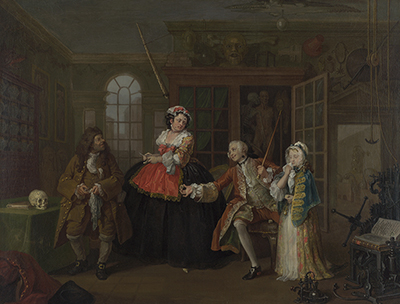
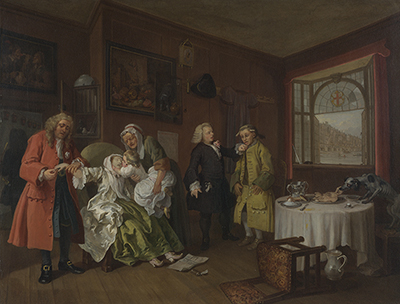
David Bomford and Ashok Roy’s 1982 study of the six Marriage A-la-Mode canvases shows several ways in which a seemingly settled surface can preserve an earlier decision. In The Marriage Settlement, the black-robed man at the window looks away from the business at the table towards the building outside. The radiograph shows that he originally faced towards the Earl and seems to have leaned in towards the man at the table. Hogarth had painted the whole window before adding the bed canopy. A plain rectangular picture on the wall was replaced by an elaborate oval framing the head of Medusa. These changes redistribute attention. The man in black directs it outwards, the canopy limits the view it partly covers and the Medusa gives the wall above the bride a forceful small image of its own. The changes survive in the painting because later marks and shapes cover earlier work. [30] [31]
The investigators suggested that the comparatively thin ground helped make the radiograph of that painting easier to read. In The Inspection, by contrast, a thicker ground and more X-ray-transparent upper paint gave them less contrast. The difference matters when one tries to compare how much Hogarth revised each scene. A clear radiograph gives positive evidence of changes, whereas few discernible revisions in a low-contrast image are harder to interpret. Chemical analysis offers another level of detail. A sample from the green wall of The Marriage Settlement produced a result consistent with linseed oil, while a sample of white from the groom’s cravat was close to the boundary between values for linseed and walnut oil. The authors treated this second result cautiously. A small sample can answer a question about one particular patch without settling how the artist mixed paint for the rest of the picture. [30]
In The Tête à Tête, the doorway offers a view into a room with a row of pictures. A curtain covers most of one of them, leaving a foot and ankle in view. Bomford and Roy used infrared reflectography to see through the green paint of the curtain more effectively than conventional infrared photography could. They found an earlier Madonna and Child and a kneeling figure that suggested a scene of adoration. They also found that the visible foot and ankle stopped at the curtain’s edge. The image Hogarth left for his public encourages the viewer to supply what is concealed. The examination shows that he painted enough of the foot to make the concealment convincing, and that the underlying image pursued a different idea altogether. The joke depends on how readily we supply an image from one painted fragment. [30] [32]
Sets of paintings and their impressions
Three of Hogarth’s securely preserved painted sets allow a viewer to compare one canvas with another and then with an impression taken from a related plate. The eight canvases of A Rake’s Progress are at Sir John Soane’s Museum, as are the four of The Humours of an Election. The National Gallery holds the six of Marriage A-la-Mode. Sharing the same subject with its print gave a canvas one purpose, while scale, colour and the hanging of a group of paintings gave it a life in rooms of its own. Judy Egerton’s account of Marriage A-la-Mode documents those different prospects. The engravings were available to subscribers in early June 1745, although the plates carry the line dated 1 April. The paintings stayed with Hogarth until he sold them together to John Lane in 1751. [31] [32] [33] [34]
A pair of objects makes the difference of direction in Marriage A-la-Mode particularly easy to see. Compare the National Gallery’s NG113 with the Metropolitan Museum of Art’s fifth-state impression of plate I, engraved by Scotin. In the painting the prospective bride and groom are on the left, while the Earl’s gesture and the window are on the right. In the specified impression the groups exchange sides. The papers and hands remain central to the negotiation. The painting uses the contrast between passages of light clothing, warm furnishings and the darker frame of the room to separate its incidents, while the engraved lines and their spacing have to give the print that clarity. The screen of pictures on the wall still crowds the figures, but it is built with marks of a different kind. [31] [32] [35]
In the final Rake painting, the scene at Bethlem, a pale Tom is conspicuous at the front of a dim interior. Behind him, the depth of the corridor and the figures in it take time to make out. In the National Museum of Western Art’s Tokyo impression, catalogued as Paulson 139 (2/3), ink lines articulate the passage and help separate incidents in the background. Two visitors become an especially readable pair behind Tom. The Soane catalogue also observes that the first state of the engraving shows a patch on Tom’s torso that is absent from the canvas. That first-state observation is separate from what can be seen in the Tokyo impression. An early engraving could supply a detail to the action as well as redistribute its shadows. [33] [36]
The Election paintings use a larger format than the Rake pictures. Canvassing for Votes puts a man receiving competing offers under a sign while other business goes on nearby. Paint separates the small flash of a gold guinea from the drab coat of the man taking it. In the Petit Palais impression PPG6041, the same negotiation depends more on where the hands meet and how the offered objects sit among the darks and lights. The street and its inn signs carry information in both media, though the signs in the print share the page with an inscription below the scene. That inscription names Hogarth as painter and Charles Grignion as engraver and dates the plate 20 February 1757. The Soane catalogue distinguishes the date of the inscription from the delayed issue of the last three plates in 1758. Hogarth engraved the Rake designs with some assistance, while three engravers shared the Marriage plates and the Election engravings appeared in separate instalments with different collaborators. The series guides and Engravings follow those sequences and issues in more detail. [32] [33] [34] [37]
Soane’s Picture Room brings both painted sequences into a history of collecting and hanging. Its hinged picture planes allow paintings to be revealed by moving the surfaces on which other works hang. This is a later arrangement, at a scale far removed from the hospital stair. It changes how much of the collection can be in front of someone at once. The Election canvases’ elaborate frames are themselves part of their history as furniture for rooms. The Soane catalogue leaves open whether they were commissioned by Hogarth or by David Garrick, who formerly owned the set. [34] [38]
The surfaces in the same collection also have distinct histories. In its report for 2024–25, Soane’s Museum recorded splits at the turnovers of the Rake linings and raised or flaking paint on seven of the eight canvases. Treatment began in April 2024. The first group included The Arrest, The Gaming House and the final Bethlem scene. Conservators removed degraded varnish and consolidated vulnerable paint, while structural specialists reinforced damaged edges by strip-lining. Early photographs helped inform the work. This offers a comparison with the decision at Barts to retain a previous varnish during the treatment described there. Different surfaces, histories of intervention and conditions of access can call for different choices. [22] [39]
A Harlot’s Progress has a different kind of survival. Egerton records William Beckford’s purchase of the painted cycle in 1745 and its reported destruction in the fire at Fonthill in 1755, while noting two badly damaged paintings proposed as possible survivors of scenes two and four. The Met’s first-state impression of plate I securely places the scene of Moll’s arrival in London in Hogarth’s graphic work. It supports a reading of how the characters and props are distributed in that impression. Questions about the original handling of colour, paint thickness or the direction of a brushstroke need evidence from an identified painted surface. For the Harlot cycle that evidence is much less secure than for Marriage, Rake and Election. [32] [40]
Where the paintings are held
The National Gallery in London holds The Graham Children (NG4756), The Shrimp Girl (NG1162) and the six Marriage A-la-Mode canvases (NG113–118). They provide three kinds of comparison within one collection, from a large group portrait to a small oil sketch and six mid-sized canvases whose rooms can be read in sequence. Tate holds The Strode Family (N01153), Heads of Six of Hogarth’s Servants (N01374) and Sigismunda (N01046). The three trace unusually different uses of faces, from a commissioned group gathered around a table to a privately held study and a single figure charged with carrying a literary drama. [2] [4] [6] [23] [27] [31] [32]
Sir John Soane’s Museum holds the Rake and Election series (P40–P47 and P53, P56, P73 and P78). The Foundling Museum cares for the Foundling Hospital paintings of Coram and Moses. The Barts pictures belong to the North Wing stair for which they were made. Beyond London, the Walker Art Gallery in Liverpool holds the Garrick canvas, Philadelphia the Wanstead assembly, Washington the small Beggar’s Opera described here and the Frick Collection in New York Miss Mary Edwards. The collection records also help distinguish paintings from the more widely dispersed impressions of their prints. [1] [3] [9] [10] [12] [13] [16] [19] [33] [34] [38]
The selection in this catalogue leads to closer readings of individual paintings and scenes. For the wider body of work, Elizabeth Einberg’s William Hogarth: A Complete Catalogue of the Paintings gathers work across genres, including portraits, conversation pieces, theatrical subjects and history pictures. Einberg’s 1997 Tate exhibition brought the gallery’s Hogarth paintings together with public and private loans. The research behind the subsequent 2016 catalogue, now documented in her archive at the Paul Mellon Centre, helps explain why a title or a familiar design is only a starting point. In The Beggar’s Opera there are several versions to distinguish. In The Shrimp Girl the familiar title arrived after the oil and the first print. Tracing which canvas, which collection and which object record belongs to a given image makes it possible to look closely at the decisions Hogarth made in that particular work. [13] [14] [27] [41] [42]
Browse Hogarth’s artworks
All 54 individual artworks and series stages in the approved English cluster
Frequently Asked Questions
It is a group portrait arranged around social activity. In Assembly at Wanstead House, a card game and a tea table give the sitters actions and exchanges that connect them across the room. [1]
Yes. At St Bartholomew’s Hospital in London he painted The Pool of Bethesda and The Good Samaritan for the staircase, on a scale very different from the portraits and domestic interiors he painted for private patrons. [3]
Discussion
Look again at the images and ideas explored in William Hogarth’s Paintings. These editorial prompts invite your observations.
Reader Insights
Where do a sitter’s hands or gaze help you understand a Hogarth portrait?
How does the intended room or building affect the scale and arrangement of a picture?
Join the Conversation
Share a detail, comparison or question about William Hogarth’s Paintings below.
References
- Philadelphia Museum of Art, William Hogarth, Assembly at Wanstead House, 1728–31, collection object 103800. View source.
- Kate Retford, “William Hogarth, Heads of Six of Hogarth’s Servants, c.1750–5,” Country House Servants exhibition, Manchester Metropolitan University, Tate N01374. View source.
- St Bartholomew’s Heritage, “History and restoration,” “The Hogarth Stair,” “The Good Samaritan” and “The Pool of Bethesda.”. View source.
- Tate, William Hogarth, The Strode Family, c.1738, N01153, historical collection export, support and named subjects. View source.
- Christine Walker, “‘We are starving for want of Tea’: Asian objects, domestic slavery and Caribbean sociability,” Global Goods and the Country House, pp. 114–16, fig. 4.2. View source.
- The National Gallery, William Hogarth, The Graham Children, NG4756, in-depth entry, key facts and provenance. View source.
- Victoria and Albert Museum, “The Rococo style – an introduction,” English Rococo and St Martin’s Lane. View source.
- Victoria and Albert Museum, Rococo: Art and Design in Hogarth’s England, 1984 exhibition catalogue, Rijksmuseum Research Library record. View source.
- The Frick Collection, William Hogarth, Miss Mary Edwards, 1742, collection entry reproduced from Art in The Frick Collection: Paintings, Sculpture, Decorative Arts, 1996. View source.
- Foundling Museum, “Captain Thomas Coram & Duchess of Somerset,” William Hogarth’s Captain Thomas Coram, 1740. View source.
- Foundling Museum, “Hogarth & Company,” Foundling Hospital gifts and Court Room ensemble. View source.
- Foundling Museum, William Hogarth, Moses Brought Before Pharaoh’s Daughter, collection entry and gift record. View source.
- National Gallery of Art, William Hogarth, A Scene from The Beggar’s Opera, 1728/1729, 1983.1.42, including image description, catalogue commentary and provenance notes. View source.
- John Kerslake, “Thomas Walker (1698–1744),” Early Georgian Portraits, National Portrait Gallery catalogue, 1977. View source.
- John Hayes, British Paintings of the Sixteenth through Nineteenth Centuries, National Gallery of Art, 1992, pp. 122–28, object 1983.1.42, especially figs. 1 and 4. View source.
- Robin Simon and William Chubb, “The little-ingenious Garrick and the ingenious little Hogarth,” Royal Collection Trust lecture, 23 April 2014, PDF pp. 4 and 16–17, Walker Art Gallery painting. View source.
- Walker Art Gallery, National Museums Liverpool, William Hogarth, David Garrick as Richard III, WAG 634, collection partner entry. View source.
- The Metropolitan Museum of Art, William Hogarth and Charles Grignion, Mr. Garrick in the Character of Richard III, 20 June 1746, second state of two, 32.35(238). View source.
- Barts Health NHS Trust Archives, Research guide: Artworks, v0.2, October 2024, p. 3, SBHX7/7.1 and SBHX7/8.1. View source.
- Naomi Billingsley, “Healing in the Hospital,” The Visual Commentary on Scripture, Christ at the Pool of Bethesda, SBHX7/7.1. View source.
- St Bartholomew’s Heritage, Exploring Barts: See, Think, Wonder, The Good Samaritan on the North Wing staircase. View source.
- Megan Buchanan-Smith, “My Icon Conservation Internship at St Bartholomew’s Hospital,” Institute of Conservation, 20 November 2025, section and photographs on the Hogarth Stair. View source.
- Tate, William Hogarth, Sigismunda Mourning over the Heart of Guiscardo, 1759, N01046, historical collection export. View source.
- John Ireland, Hogarth’s Works, with Life and Anecdotal Descriptions of His Pictures, vol. III, chapter V, Hogarth’s account and Sir Richard Grosvenor’s reply. View source.
- Society of Artists of Great Britain, A Catalogue of the Pictures, Sculptures, Models, Drawings, Prints, &c., Spring Gardens, 1761, no. 43, Getty Research Institute copy. View source.
- Horace Walpole, letter to George Montagu, 5 May 1761, The Yale Edition of Horace Walpole’s Correspondence, vol. 9, pp. 365–66. View source.
- Judy Egerton, “The Shrimp Girl,” The British Paintings, National Gallery catalogue, 2000, NG1162, “Technical Notes,” “Engraved,” and “Discussion.”. View source.
- The Metropolitan Museum of Art, Francesco Bartolozzi after William Hogarth, Shrimps!, stipple engraving, 25 March 1782, 32.35(188). View source.
- The Metropolitan Museum of Art, Francesco Bartolozzi after William Hogarth, copperplate for Shrimps!, 21.55.1. View source.
- David Bomford and Ashok Roy, “Hogarth’s ‘Marriage à la Mode’,” National Gallery Technical Bulletin, vol. 6, 1982, pp. 45–67, especially figs. 4–12 and “The medium.”. View source.
- The National Gallery, William Hogarth, Marriage A-la-Mode: 1, The Marriage Settlement, NG113, collection entry and provenance. View source.
- Judy Egerton, “Six pictures called Marriage A-la-Mode,” The British Paintings, National Gallery catalogue, 2000, NG113–118, “Provenance,” “Engraved,” “Discussion,” NG114 entry and note 19. View source.
- Sir John Soane’s Museum, William Hogarth, A Rake’s Progress VIII: The Madhouse, P47, collection entry and series context. View source.
- Sir John Soane’s Museum, William Hogarth, The Humours of an Election II: Canvassing for Votes, P56, collection entry, series context, engraving and frames. View source.
- The Metropolitan Museum of Art, Gérard Jean-Baptiste Scotin after William Hogarth, Marriage A-la-Mode, Plate I, fifth state of five, 91.1.107. View source.
- National Museum of Western Art, Tokyo, William Hogarth, A Rake’s Progress: (8), G.1994-0011, Paulson 139 (2/3), Japanese and English collection record. View source.
- Petit Palais, Paris Musées, William Hogarth and Charles Grignion, La Brigue des votes, planche II [Canvassing for Votes. Plate II], PPG6041, impression and transcribed inscriptions. View source.
- Sir John Soane’s Museum, “The Picture Room,” architectural arrangement and painted series. View source.
- Sir John Soane’s Museum, Report and Accounts for the Year Ended 31 March 2025, pp. 13–14, “Hogarth’s A Rake’s Progress.”. View source.
- The Metropolitan Museum of Art, William Hogarth, A Harlot’s Progress, Plate 1, before April 1732, first state of four, 32.35(2). View source.
- Paul Mellon Centre for Studies in British Art, “Archive of Hogarth Expert Elizabeth Einberg Acquired,” archive and exhibition history. View source.
- Yale University Press, Elizabeth Einberg, William Hogarth: A Complete Catalogue of the Paintings, 2016, publisher’s description. View source.


