



 by Tom Gurney
Tom Gurney BSc (Hons) is an art history expert with over 20 years experience
Published on June 19, 2020 / Updated on October 14, 2023
Email: tomgurney1@gmail.com / Phone: +44 7429 011000
The Marriage Settlement: Introduction
The Earl of Squander points to his family tree while a wealthy London alderman holds the parchment that will join their families. The alderman’s daughter sits close enough to touch the man she is to marry, but he is looking into a mirror. In William Hogarth’s The Marriage Settlement, the two fathers bargain over money, rank and the future of both families while the prospective bride and groom scarcely acknowledge each other. Painted about 1743, the oil on canvas is the first of six scenes in Marriage A-la-Mode. It measures 69.9 × 90.8 cm and belongs to the National Gallery, London (NG113). [1]
At a Glance
- Artist and dateWilliam Hogarth, about 1743
- Medium and dimensionsOil on canvas, 69.9 × 90.8 cm
- CollectionThe National Gallery, London, NG113
- Related printGérard Jean-Baptiste Scotin after William Hogarth, etching and engraving, fifth state of five, The Metropolitan Museum of Art, 91.1.107
- Plate date and issueInscribed 1 April 1745, available to subscribers in early June 1745
This work across William Hogarth’s career
Assembly at Wanstead House
1728–31The Heir
1734Gin Lane
1751Canvassing for Votes
1754–55Contents
- The business at the table
- What the earl puts on show
- The couple at the edge of the bargain
- What Hogarth revised on the canvas
- Scotin’s Plate I
- An earlier marriage scheme
The business at the table
The alderman bends over the document, peering through his spectacles. He wears his gold chain of office, a claim to standing in the City of London that has its counterpart in the coronets scattered around the earl’s room. The sword jutting out between the alderman’s legs makes his formal dress look awkward. Even so, he is the man holding the document and watching the money. An inkstand, quill, sealing wax and candle are ready on the table. Hogarth has chosen the moment when the terms are still being scrutinised and the implements for giving them effect sit idle. [1] [2]
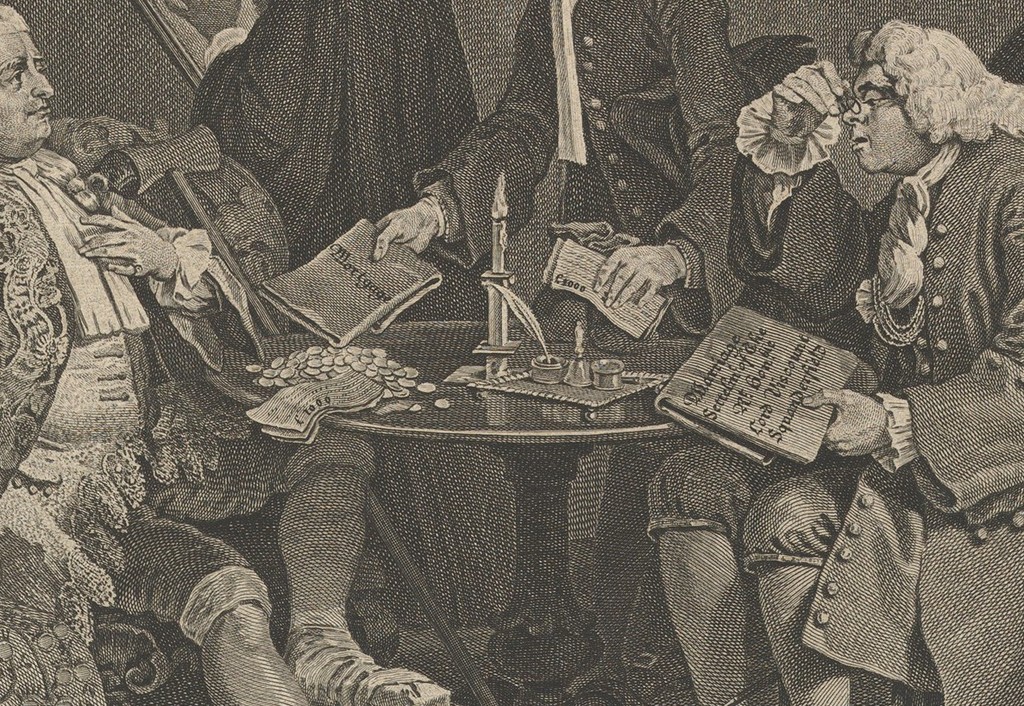
Judy Egerton reads the parchment’s heading as identifying a marriage settlement for a viscount. The rest of the business is suggested by objects distributed across the room. Guineas have been emptied from bags onto the table, and Egerton identifies the papers beside them as possible banknotes or promissory notes. She reads the paper extended by the alderman’s clerk as evidence of a mortgage being redeemed. The clerk holds his paper out from one side while the earl directs attention to the family tree on the other. The earl’s gesture makes the cash look beneath his notice even as the clerk presses a reminder of why he needs it. [2]
A marriage settlement could govern what happened to property decades after a wedding. The historian H. J. Habakkuk describes a pattern among early eighteenth-century English landowning families in which successive generations could use the estate during their lives while its descent was secured for the eldest son of the marriage. Arrangements could also provide income for a widow and set aside capital for daughters and younger sons. The pattern explains why the possibility of heirs could matter as much to the families around a table as the money changing hands that day. [3]
An attested copy of a settlement dated 6 May 1743, preserved in the Llanover estate records, shows how specific such arrangements could be. Henry Jayne conveyed a house and named parcels of land to Walter Lewis under a provision reserving their use to Jayne during his lifetime. After his death, they were to pass to the use of his daughter Mary, her husband Francis Watkins and their heirs. Hogarth’s partly legible parchment gives the viewer far less to work with. The coins and mortgage paper suggest the earl’s immediate needs, while the marriage holds out the prospect of an aristocratic connection for the alderman’s family. The picture leaves the disposition of property and any provision for the bride unclear. [2] [4]
What the earl puts on show
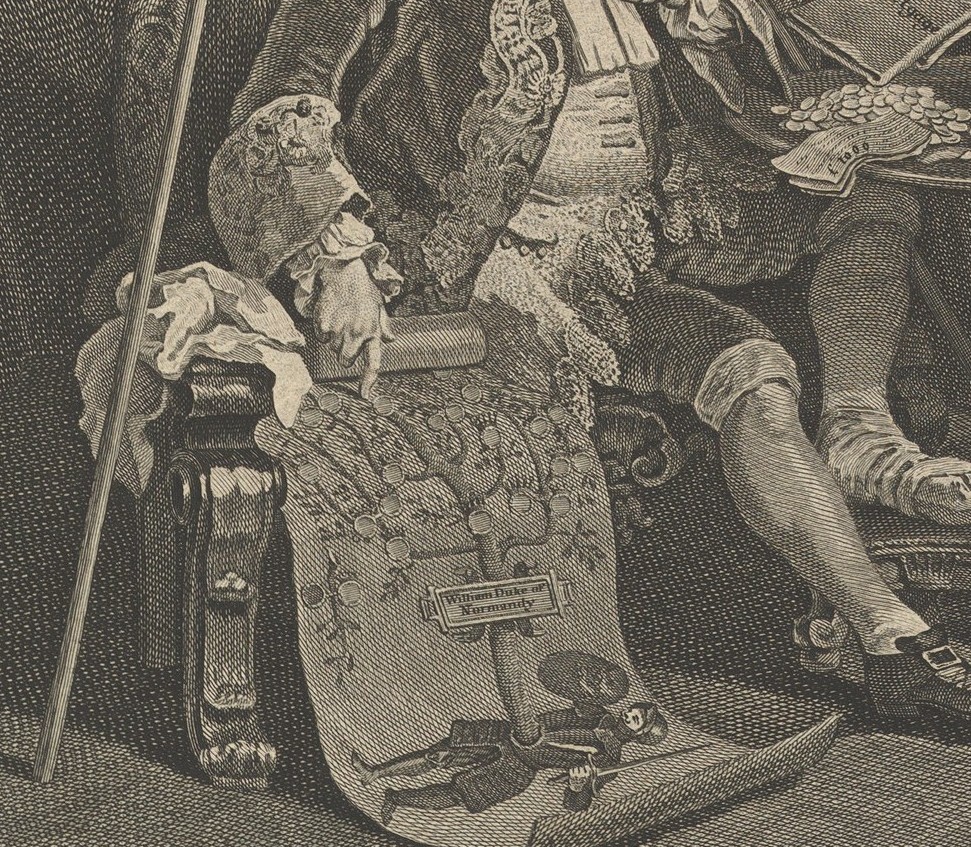
One of the earl’s hands rests against his chest and the other points to a pedigree claiming descent from William the Conqueror. His gesture encourages the alderman to see the lineage as something the marriage can confer on future children. To the viewer it looks like another piece of paperwork offered in support of a claim. Egerton treats that claim as questionable and reads the proliferation of coronets as a sign of the earl’s anxiety to assert his standing. They appear on objects as different as his crutches, his footstool and the bed canopy. In the portrait by the window a younger Lord Squander holds a thunderbolt. The man beneath it needs a footstool to prop up a bandaged foot, which the Gallery identifies as gouty. [1] [2]
The bed identifies this as the earl’s bedroom, where, as Egerton points out, a man of his rank could properly receive visitors at a levée. Here the canopy turns even the furniture behind him into an advertisement for his title. Beside the bed, the window gives the earl’s lawyer something else to examine. His framed plan and the scaffolded building outside can be read together. On the façade, three columns above sit over four below, an imbalance at odds with the classical order the design seems to claim. Figures linger near the scaffolding. The building suggests a project that has outrun the earl’s resources, although the scene supplies no account of the building costs. The earl offers his pedigree as proof of past glory. The lawyer can look past his plan to see how far the family is from possessing the house it promises. [1] [2]
Watch Hogarth’s paintings and prints
Five films on Hogarth’s painted stories, prints, drawing methods and work for the Foundling Hospital.
William Hogarth, Marriage A-la-Mode (including Tête à Tête)
A close look at Tête à Tête and how its figures and furnishings advance the story of the marriage.
Watch on YouTubeAnnotated Details from The Marriage Settlement
These details follow Scotin’s engraved plate. Compare their position with the painted scene in the article. Marriage A-la-Mode, Plate I, Gérard Jean-Baptiste Scotin after William Hogarth. Metropolitan Museum of Art, New York, NY, 91.1.107. Collection record.
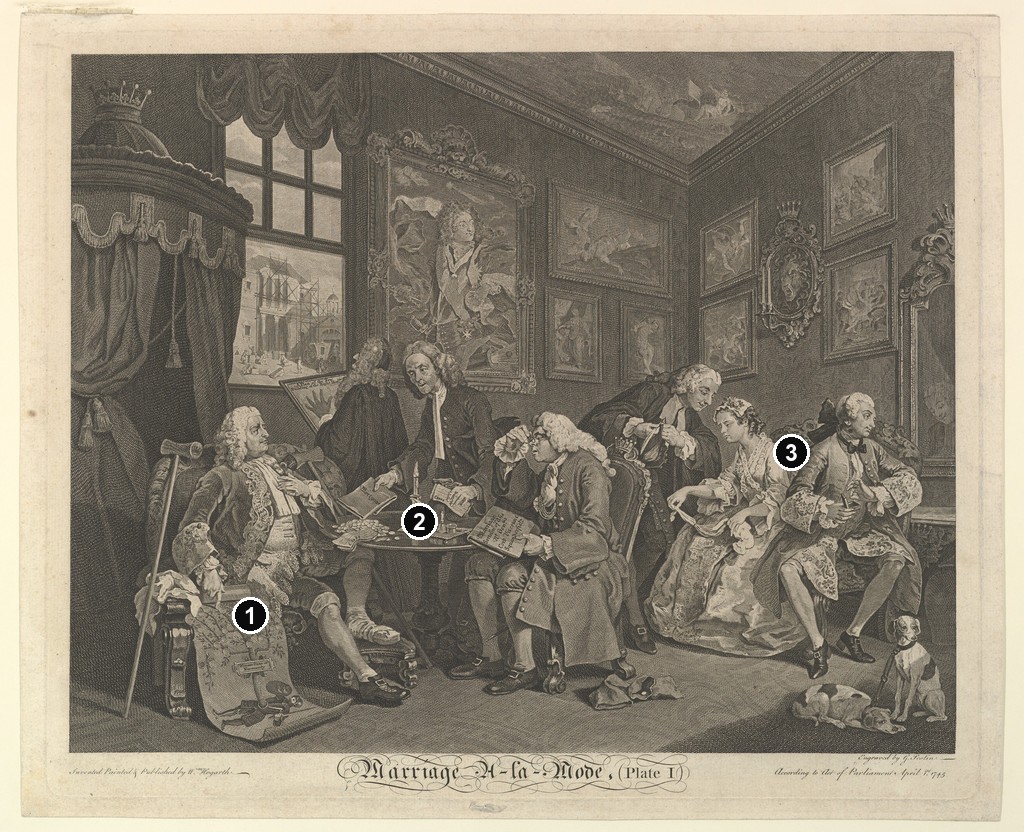
Details from THE MARRIAGE SETTLEMENT
Select a numbered point for a closer look.
The Earl’s pedigree
The Earl rests the pedigree across his lap. Its spreading lines make a visible record of descent while the men at the table negotiate the terms of the marriage.
Money and documents
Coins lie beside the papers on the table. Look from the goods being negotiated here to the pedigree and the Earl’s reliance on inherited rank.
The couple and Silvertongue
Silvertongue bends towards the woman while the Viscount turns away. Their positions make a small group at the other end of the room from the negotiations.
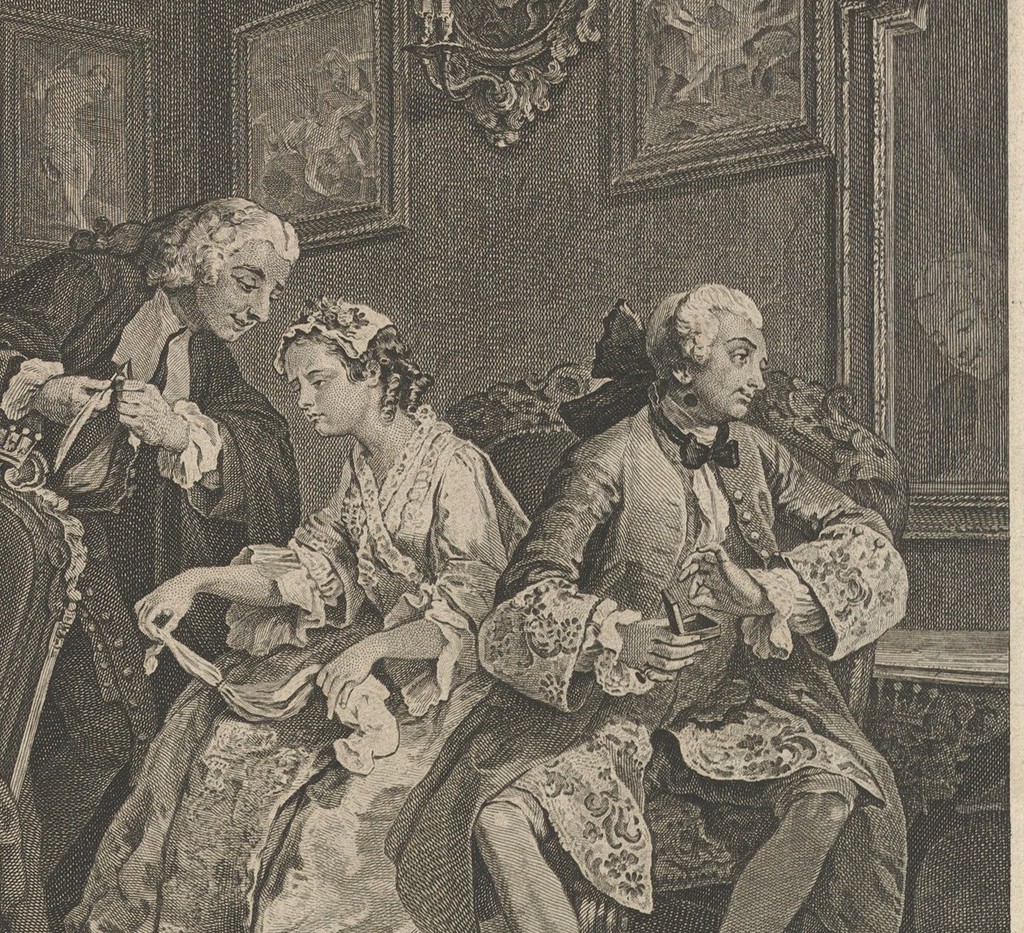
The couple at the edge of the bargain
The prospective bride slides a ring along her veil. Behind her, the lawyer later named Silvertongue leans close with a quill he is sharpening. His proximity suggests a familiarity that acquires more weight as the series continues. Here the tilt of his body gives him the appearance of attending to her, while the viscount takes snuff and directs his attention to his reflection. The viscount’s French-style clothes and the dark mark on his neck have been read as clues to venereal disease. The mark works as a hint in the story, and the painting leaves its medical history and any connection with foreign travel conjectural. [1] [2]
The bride’s pale dress catches the light in small changes of colour, helping her hold the eye in a room of emphatic displays. Egerton relates the wall pictures nearest the bride to her predicament. They include an oval Medusa and scenes of martyrdom. Medusa’s open mouth can suggest the protest the bride is unable to voice while the negotiations proceed. Below the couple, two dogs are joined at the collars. Their chain gives the spectator a visible counterpart to the bond the men at the table are arranging. The ring is slight enough to slide through the folds of the veil. The iron links below have weight and a very short reach. [1] [2]
What Hogarth revised on the canvas
The X-ray mosaic published by David Bomford and Ashok Roy records an earlier arrangement in which the lawyer with the plan faced towards the earl and seems to have leaned towards the standing man at the table. Hogarth had already painted the whole window when he added the canopy. The investigators also found that both dogs had once been lying down and that a tall, plainly framed rectangular picture had occupied the place of the oval Medusa. They could not identify its subject. The conservators attributed the unusual clarity of the radiograph in part to the comparatively thin ground beneath the paint. [5]
The changes affect the final picture’s distribution of attention. Turning the lawyer towards the window gives him a sightline out of the room and gives the spectator a reason to follow it. The building becomes part of the negotiation even though nobody has to point to it. The standing dogs make the short chain easier to read, and the Medusa adds a face to the wall that can be read in relation to the bride’s. Egerton also notes that the earl’s pointing finger appears to have been a late addition because it crosses the already painted parchment of the pedigree. The finished gesture is now so insistent that the genealogy can seem to be what the scene was organised around from the start. [2] [5]
Scotin’s Plate I
Gérard Jean-Baptiste Scotin made the printed version after Hogarth’s design. The Metropolitan Museum of Art’s impression (91.1.107) is an etching and engraving catalogued as the fifth state of five, meaning that it was printed from the plate in the fifth recorded form. The print reverses the arrangement of the painting. The earl, pedigree and window sit on the left, and the young couple and mirror move to the right. The two fathers still command the table in the middle. The reversal shifts which of those claims the reader might meet first. In the print the earl’s display can be the point of entry, with the disregarded couple further along the eye’s path across the sheet. Egerton also notes that the engraved settlement adds the name Squanderfield to the viscount’s title. [2] [6]
The Bibliothèque nationale de France separately catalogues a fifth-state impression and transcribes the publication line dated 1 April 1745, crediting Hogarth and naming the engraver as G. Scotin. Its catalogue indexes the engraver as Louis-Gérard Scotin. The institutional records describe separate impressions of the same plate. The lettering gives the plate its stated publication date. Egerton’s catalogue places collection by subscribers in early June. [2] [6] [7]
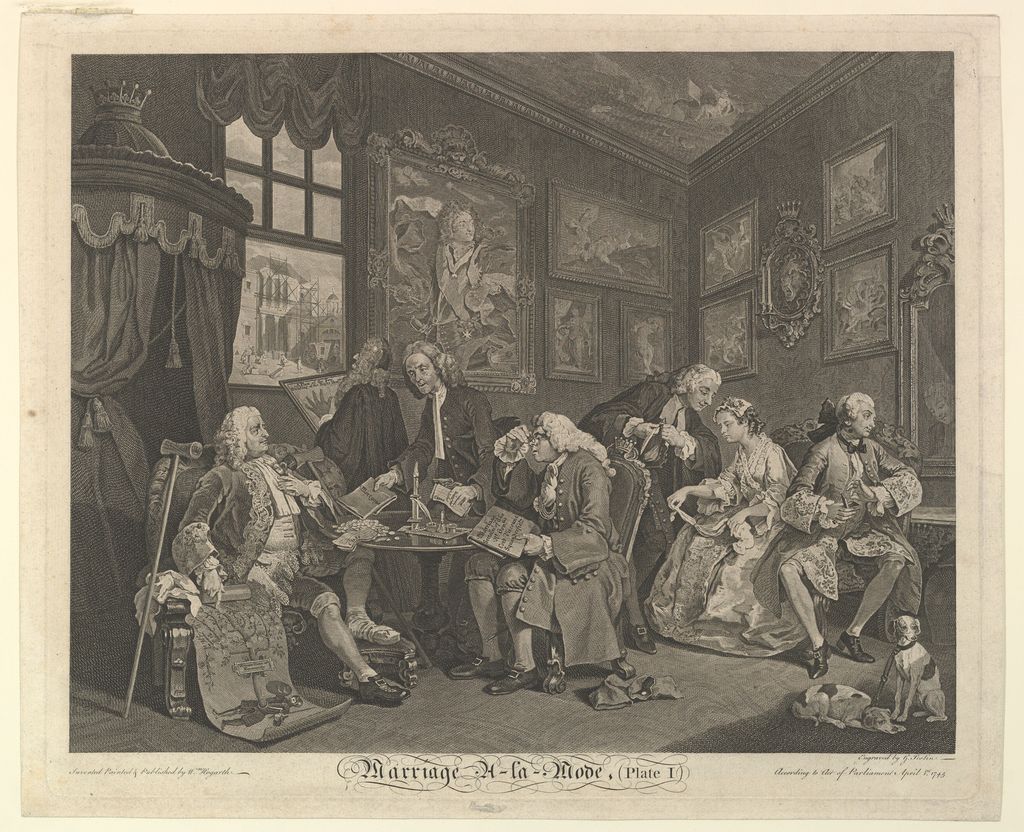
Marriage A-la-Mode, Plate I, Gérard Jean-Baptiste Scotin after William Hogarth, dated April 1745. Etching and engraving; fifth state of five. 91.1.107. Gift of Sarah Lazarus, 1891. Image source. CC0 / Public domain.
An earlier marriage scheme
Hogarth had already tried out a marriage negotiation around a table in The Marriage Contract, an oil sketch of the early 1730s in the Ashmolean Museum, Oxford. Egerton identifies it as a possible second scene for A Rake’s Progress, in which a settlement is discussed for the inattentive rake and an elderly heiress. The sketch was set aside. Some of its ideas about furnishing a room with art may have served Hogarth again in Marriage A-la-Mode. The finished fifth scene of the earlier series, The Marriage (1734, Sir John Soane’s Museum, P44), shows Tom Rakewell at the ceremony itself. In The Marriage Settlement, the interval before the ceremony gives Hogarth time to show the separate reasons the two fathers have for wanting it to take place. [2] [8] [9]
The next stage, The Tête à Tête, opens in the couple’s drawing room after the wedding. The two sit apart again, but the financial papers now belong to a departing steward with unpaid bills. The papers in the first scene promised to make a household possible. The papers in the second show what it is costing to keep that household going. [1] [10]
Browse Hogarth’s artworks
All 54 individual artworks and series stages in the approved English cluster
Frequently Asked Questions
The earl gestures towards his family tree, while the alderman holds the marriage document. Their exchange sets inherited rank alongside money. [1]
It is painting 1 of 6 in Marriage A-la-Mode. The National Gallery catalogues the original canvas under that number in the sequence. [1]
Discussion
Look again at the images and ideas explored in The Marriage Settlement. These editorial prompts invite your observations.
Reader Insights
How does the lawyer’s glance towards the scaffolded house change how you read the earl’s gesture towards his family tree?
What does the short chain between the dogs add to the way Hogarth seats the couple?
Join the Conversation
Share a detail, comparison or question about The Marriage Settlement below.
References
- The National Gallery, London, William Hogarth, Marriage A-la-Mode: 1, The Marriage Settlement, NG113. View source.
- Judy Egerton, The British Paintings, National Gallery Catalogues, 2000, “Marriage A-la-Mode”, pp. 148–149, 151–153 and 155–158, with technical notes by David Bomford. View source.
- H. J. Habakkuk, “Marriage Settlements in the Eighteenth Century”, Transactions of the Royal Historical Society 32, 1950, pp. 15–30, opening extract. View source.
- Gwent Record Office, Llanover estate records, attested copy of settlement dated 6 May 1743, D.751.241, catalogue p. 33, hosted by The National Archives. View source.
- David Bomford and Ashok Roy, “Hogarth’s ‘Marriage à la Mode’”, National Gallery Technical Bulletin 6, 1982, pp. 49–50, figs. 4–5. View source.
- The Metropolitan Museum of Art, Gérard Jean-Baptiste Scotin after William Hogarth, Marriage A-la-Mode, Plate I, 91.1.107, fifth state of five. View source.
- Bibliothèque nationale de France, G. Scotin after William Hogarth, Marriage A-la-mode. Plate I, fifth state, CD-13 (A)-FOL. View source.
- Art Fund, Ashmolean Museum acquisition record for William Hogarth, The Marriage Contract, oil on canvas, supported in 1952. View source.
- Sir John Soane’s Museum, William Hogarth, A Rake’s Progress V: The Marriage, P44. View source.
- The National Gallery, London, William Hogarth, Marriage A-la-Mode: 2, The Tête à Tête, NG114. View source.






