


 by Tom Gurney
Tom Gurney BSc (Hons) is an art history expert with over 20 years experience
Published on June 19, 2020 / Updated on October 14, 2023
Email: tomgurney1@gmail.com / Phone: +44 7429 011000
The Arrest: Introduction
A bailiff stops Tom Rakewell’s sedan chair on St James’s Street. Tom is dressed for court, the palace gate is in sight, and the woman he once promised to marry is offering her purse to keep him out of custody. William Hogarth makes this interruption the fourth of eight scenes in A Rake’s Progress. The oil on canvas, dated 1734 by Sir John Soane’s Museum, measures 62.5 × 75.2 cm and is catalogued as P43. The scene has also appeared under the title The Blessing of Tom by Sarah, which picks out the rescue and its comic echo in the oil spilled on Tom’s wig. [1]
At a Glance
- SeriesA Rake’s Progress, scene 4 of 8
- Painting1734, oil on canvas, 62.5 × 75.2 cm, Sir John Soane’s Museum, P43
- First-state print1735, etching and engraving, National Gallery of Art, 1944.5.30
- Third-state printEtching and engraving, date line 25 June 1735, Bibliothèque nationale de France, FRBNF40262627
This work across William Hogarth’s career
Assembly at Wanstead House
1728–31The Heir
1734The Marriage Settlement
about 1743Gin Lane
1751Canvassing for Votes
1754–55Contents
- A short distance from court
- The warrant and the purse
- What changes in plate IV
- The painting in the Picture Room
A short distance from court
The view down the street gives Tom a destination and lets the viewer measure how near he comes to it. The palace clock, which the Soane reads as showing about twenty to two in the afternoon, is small beside the cluster of figures around the chair. Carriages queue towards the gate. In the foreground, a man puts a hand on Tom while another produces the warrant. The stone marker at the right matters to the timing. The Soane identifies it as a boundary marker for the royal precinct, beyond which, in the catalogue’s reading of the scene, the officers would have lacked authority. The eye can travel to the palace in an instant. Tom has been stopped on the wrong side of the marker. [1]
The palace and the crowd suggest a public occasion. Two men have leeks in their hats, which point to St David’s Day, 1 March. This was also Queen Caroline’s birthday, and the Soane reads the traffic as the approach to her birthday reception. The clues give the episode a likely day and occasion, with the year left open. The coat’s gold braid along the front, sleeves and skirts, the neatly tied wig and the fringed gloves show how seriously Tom takes his appearance. The clothes are particularly conspicuous after The Orgy, where he sprawls dishevelled at the Rose Tavern. Here he has made a careful effort to present himself. It earns him a public that he had little reason to want. [1] [2]
A historical account helps explain what Tom hopes such a costume might do for him. In a letter to her sister reproduced by Historic Royal Palaces, Mary Delany recalled borrowing Lady Sunderland’s jewels for Queen Caroline’s birthday. The gathering was crowded, and Lady Carteret brought her forward. The queen noticed both the jewels and the clothes, for which Delany had drawn the pattern. Delany’s account shows how dress could start a conversation when a court connection supplied the introduction. Hogarth leaves the details of Tom’s hoped-for reception outside the picture. We see how much trouble he has taken to look the part before he even reaches the gate. [3] [1]
A sedan chair gave its passenger a small compartment in the middle of a busy street. A later eighteenth-century example in the Science Museum Group collection has long poles on either side so that two bearers can carry the enclosed seat. In Hogarth’s picture, the drawn curtains plausibly serve to conceal Tom from his creditors. The open door reverses that advantage. With the chair halted, its upholstery makes an emphatic frame around the body it was supposed to hide, just as the edge of the doorway catches Tom halfway between the seat and the street. [4] [1]
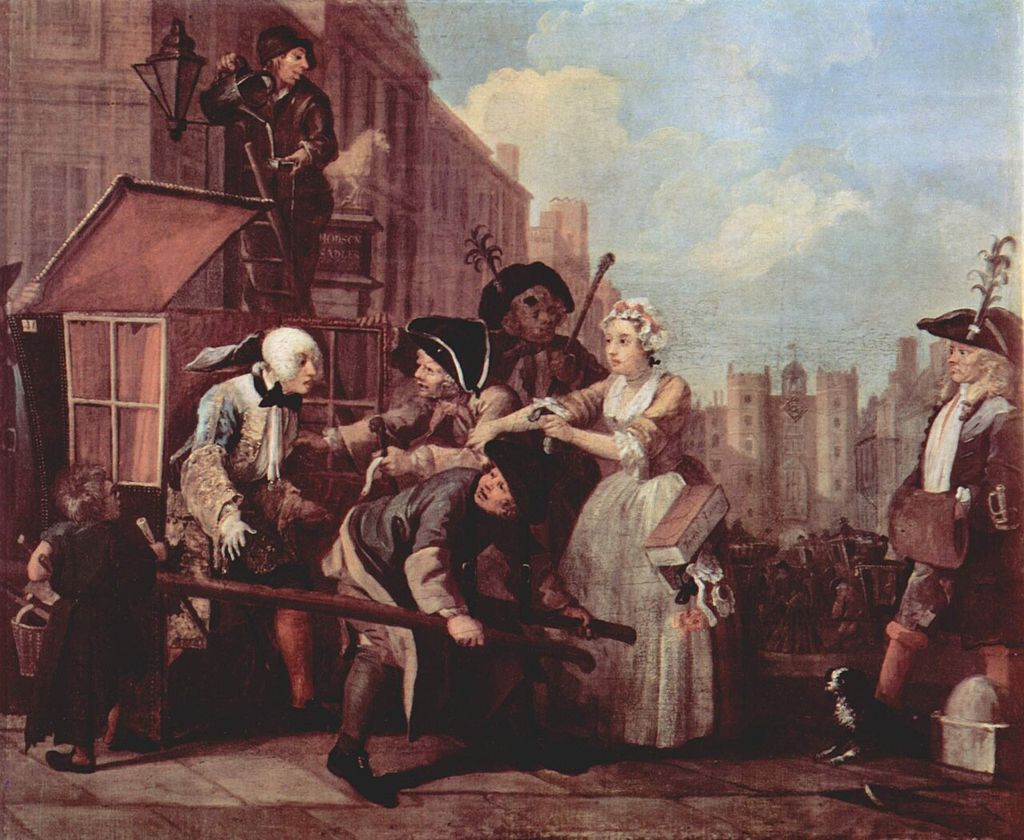
The Arrest, William Hogarth, 1734. Oil on canvas. SM P43. The Yorck Project via Wikimedia Commons. Image source. Public domain.
The warrant and the purse
The apparent creditor stands close by with his hands in a muff and a sword at his side. The Soane distinguishes this probable figure from the officers who stop the chair. The warrant supplies the immediate reason for the encounter. For the origins of the debt, the painting offers a suggestion overhead. The saddler’s sign bearing Hudson’s name alludes, in the museum’s reading, to the expensive world of horses and racing. It works as a clue to Tom’s spending while leaving the particular debt and its amount unknown. Down at street level a boy makes off with Tom’s gold-topped cane. The loss of this small piece of finery is a second consequence of his being pulled into view. [1]
Sarah’s dropped box helps explain what is at stake in her intervention. It bears her name, and the Soane takes its ribbons as evidence that she may work as a milliner. The purse she extends is tangible help from a woman who appears to earn her own living. The scene leaves the amount, the share of her savings and the terms on which Tom gets free unstated. In The Heir, Sarah and her mother bring a ring and letters as evidence of his promise. With an inherited fortune at hand, he offers money to send her away. Here an officer has a document of his own, and Sarah’s offer of money is what can keep Tom from being taken away. [1] [5]
Watch Hogarth’s paintings and prints
Five films on Hogarth’s painted stories, prints, drawing methods and work for the Foundling Hospital.
The Sequel: Hogarth’s "A Rake’s Progress" (1734–5)
The Paul Mellon Centre revisits the eight-scene story of Tom Rakewell and its place in Hogarth’s work.
Watch on YouTubeAbove the encounter, a lamplighter looks down and tips oil onto Tom’s wig. In the ordinary business of the street, his attention has strayed at exactly the wrong moment. Beside Sarah’s offer, the accident can also be read as a mock anointing. The Soane discusses this possible association and compares Sarah’s intervention with the angel stopping Abraham from sacrificing Isaac. The painting allows the two gestures to be seen together. Sarah reaches towards the officer with the means of release while oil falls from above onto the man she has come to save. Her action offers him a chance to change course. In The Marriage, she appears with their child at the back of the church while he proceeds with his marriage to a wealthy woman. [1] [6]
What changes in plate IV
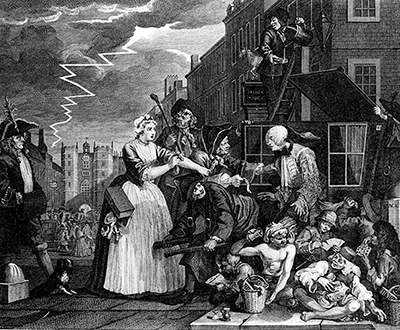
Hogarth’s printed plate reverses the street. The sedan that dominates the left of the oil occupies the right in the National Gallery of Art’s impression, and the palace is seen down the opposite side of the composition. The chair, the warrant, the purse and the lamplighter still do the work of telling the story. The Gallery’s etching and engraving, accession 1944.5.30, is a first state in Ronald Paulson’s 1965 catalogue numbering. Its sheet measures 35.9 × 41.2 cm. The Bibliothèque nationale de France records a third state as Paulson 135.3, notice FRBNF40262627. It gives 35.5 × 40.7 cm for the printed element and 39 × 43.8 cm for the sheet. Its record gives London and 25 June 1735 for publication, and transcribes the date in the line below the picture. That line dates the publication named on the plate. It cannot date the pulling of each surviving sheet. [1] [7] [8]
The version of The Arrest with lightning and boys playing cards comes from the reworked printing plate. The third-state impression 91.1.86 at The Metropolitan Museum of Art shows what Hogarth added to the street. A bolt of lightning cuts across the sky towards White’s Chocolate House. Across the composition, boys gamble beside a post lettered “Blacks”, giving the fashionable establishment an imitation on the pavement. One boy holds up a cup, while others are absorbed in their cards. The painting’s lone child seizing the cane takes advantage of a distraction. The boys in the reworked print have organised their game of gain and loss right under the adults’ feet. The bolt also acquires a topical edge from the history of White’s. The original premises burned on 28 April 1733, and the business temporarily moved to Gaunt’s Coffee House, the location the Soane identifies in the engraving. The fire belongs to the history of the street. The lightning is Hogarth’s addition to the story he tells there. [1] [9] [10]
A change to the canvas itself only came to light under infrared examination. Tate’s technical study with the Soane revealed a suspended figure beneath the painted sky. The museum has connected it with an effigy mocking the Welsh on St David’s Day, a motif that survives in an unauthorised version of the scene. The finding establishes that something was painted out, and the resemblance offers a reason to consider whether Hogarth wanted his published design to differ from the copy. The buried figure and the print cannot settle his motive on their own. The buried figure and the printed lightning together show how much of the street’s meaning Hogarth could alter by changing what appears in the sky. [11]
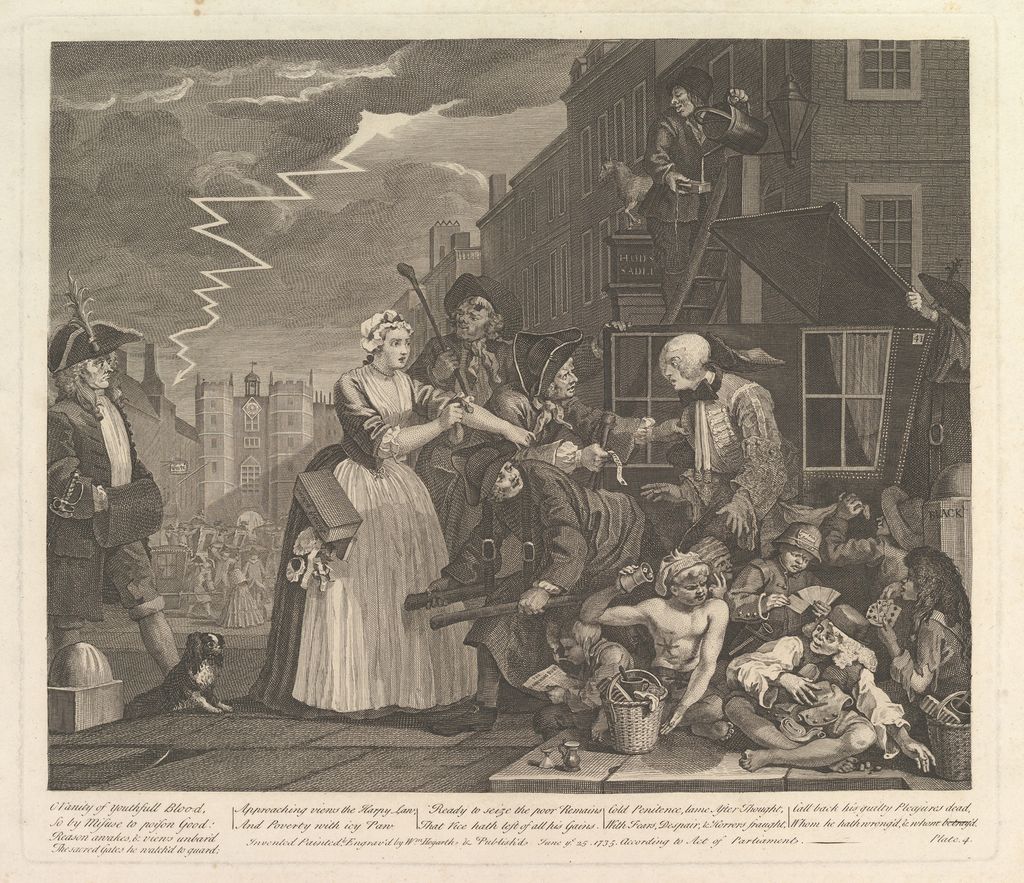
A Rake's Progress, Plate 4, William Hogarth, June 25, 1735. Etching and engraving; third state of three. 91.1.86. Gift of Sarah Lazarus, 1891. Image source. CC0 / Public domain.
The painting in the Picture Room
The Soane’s Picture Room uses hinged panels to hang the paintings in a small space. During conservation, the museum uses facsimiles in the room when originals are away for treatment. The Arrest entered the first treatment group of the eight canvases when the programme began in April 2024. The museum’s report describes work on vulnerable paint and the removal of discoloured varnish. This work on the painting’s surface is distinct from the infrared investigation that looked beneath it. Colour is one of the ways the oil tells this story. The warm interior of the chair helps make Tom’s predicament visible at a glance, while the third-state print makes its strongest new accent with a line of lightning in the sky. [1] [9] [11] [12] [13]
Browse Hogarth’s artworks
All 54 individual artworks and series stages in the approved English cluster
Frequently Asked Questions
A bailiff stops Tom’s sedan chair as he is going to court. Sarah Young offers her purse to keep him from being taken into custody. [1]
It is scene 4 of 8 in A Rake’s Progress. Sir John Soane’s Museum uses the scene number for the original oil painting. [1]
Discussion
Look again at the images and ideas explored in The Arrest. These editorial prompts invite your observations.
Reader Insights
How does the open door of the sedan chair change who can see Tom?
What does the card game beside the post marked Blacks add to the scene of arrest?
Join the Conversation
Share a detail, comparison or question about The Arrest below.
References
- Joanna Tinworth, Sir John Soane’s Museum, William Hogarth, A Rake’s Progress IV: The Arrest, P43, 1734, oil on canvas, catalogue entry and notes. View source.
- Sir John Soane’s Museum, William Hogarth, A Rake’s Progress III: The Orgy, P42, catalogue entry. View source.
- Historic Royal Palaces, Dressing for Georgian Court, fact sheet with Mary Delany’s account of Queen Caroline’s birthday. View source.
- Science Museum Group, Sedan chair, 1775–1800, object 1867-31. View source.
- Joanna Tinworth, Sir John Soane’s Museum, William Hogarth, A Rake’s Progress I: The Heir, P40, catalogue entry. View source.
- Sir John Soane’s Museum, William Hogarth, A Rake’s Progress V: The Marriage, P44, catalogue entry. View source.
- National Gallery of Art, William Hogarth, A Rake’s Progress: pl.4, 1735, Rosenwald Collection, 1944.5.30, Paulson 1965 no. 135, state i/iii. View source.
- Bibliothèque nationale de France, William Hogarth, A Rake’s Progress: The Arrest, plate 4, notice FRBNF40262627, Paulson 135.3. View source.
- The Metropolitan Museum of Art, William Hogarth, A Rake’s Progress, Plate 4, 91.1.86, third state of three. View source.
- Sir John Soane’s Museum, White’s Chocolate House, 37–8 St James’s Street, London, 1787, unexecuted, ARC10977, historical notes on the fire and temporary premises. View source.
- Sir John Soane’s Museum, Annual Review 2021/22, pp. 56–57, technical examination of The Arrest. View source.
- Sir John Soane’s Museum, The Picture Room, conservation programme and facsimiles. View source.
- Sir John Soane’s Museum, Report and Accounts for the Year Ended 31 March 2025, conservation report, HC 1547, pp. 13–14. View source.







