


 by Tom Gurney
Tom Gurney BSc (Hons) is an art history expert with over 20 years experience
Published on June 19, 2020 / Updated on October 14, 2023
Email: tomgurney1@gmail.com / Phone: +44 7429 011000
Miss Mary Edwards: Introduction
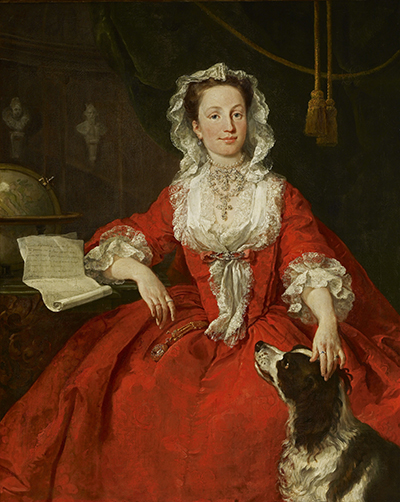
In William Hogarth’s Miss Mary Edwards, a woman in a red gown faces the viewer while a black-and-white dog looks up at her. One hand rests lightly on its head. Her other arm lies beside a sheet of writing that curls over the edge of a table. Edwards commissioned the picture from Hogarth, her friend and an artist whose work she collected. He painted it in 1742, a year before her death. The oil on canvas measures 126.4 × 101.3 cm and belongs to The Frick Collection in New York, where it is recorded as 1914.1.75. [1] [2] [3]
At a Glance
- Artist and dateWilliam Hogarth, 1742
- Medium and sizeOil on canvas, 126.4 × 101.3 cm
- CollectionThe Frick Collection, New York, 1914.1.75
- Related portraitGerard Anne Edwards Hamilton in his Cradle, c. 1732, oil on canvas, National Trust, Upton House, 446679
- Related printSamuel Phillips after William Hogarth, Taste in High Life, 1 May 1798, engraving and aquatint, The Metropolitan Museum of Art, 32.35(51)
This work across William Hogarth’s career
Assembly at Wanstead House
1728–31The Heir
1734The Marriage Settlement
about 1743Gin Lane
1751Canvassing for Votes
1754–55Contents
- Red cloth, lace and the turn of a head
- What the paper says
- The earlier portraits of Edwards’s family
- A patron of satire
- From Edwards’s commission to the Frick
Red cloth, lace and the turn of a head
The broad sweep of the skirt gives Edwards much of her presence. A deep fold cuts into the red at the lower left, while the cloth on her other side makes a bright field behind the dog’s dark head. The lace at her elbows breaks the red into small, irregular patches of light. At her chest, fine chains and bright stones cross a much paler expanse of fabric, and the lace around her head stands out against the dark curtain. Hogarth gives the eye different kinds of surface to follow. The wide folds of cloth read at a distance, while the little highlights on a ring or the fine edges of a cuff draw a viewer closer. [1]
Her elbows spread to either side, but the wrists are loose. The fingers nearest the table hang over the red cloth, and those on the dog’s head follow the shape of its ear. The dog lifts its muzzle far enough to show the pale underside of its jaw. That upward turn gives the still picture a small action. It also makes the difference between their two lines of sight especially clear. The dog attends to Edwards, whose attention reaches straight out of the picture. Tate describes the animal as a hunting dog, one of several attributes in the picture more commonly associated with portraits of men. It can suggest the pursuits of a landowner and, in the touch of her hand, an ordinary familiarity with an animal. [1] [4]
What the paper says
The paper beside her right elbow is placed where the light can catch both its marked surface and the underside of its curling edge. Look beyond it and the objects become progressively harder to make out. A celestial globe occupies part of the table, and two busts emerge from the shadows. Tate identifies them as Alfred the Great and Elizabeth I and connects the writing to Joseph Addison’s Cato. The Frick’s catalogue describes the scroll in terms of liberty and property. With its writing turned towards us, the sheet gives a viewer a reason to pause over themes that the splendour of the gown alone could scarcely express. [1] [4]
The passage associated with the scroll invokes laws and rights handed down by forebears. In Act III of Addison’s play, Cato appeals to his friends to preserve those rights. The literary scholar Alison Conway reads the painted text as an appeal to Englishmen and connects it with Elizabeth I. The resemblance to Addison’s lines helps explain how a Roman appeal to inherited liberty could take on an English setting beside the two monarchs. Read in light of Edwards’s efforts to keep control of her fortune, the text gives the portrait a personal resonance as well. That connection rests on the juxtaposition of sitter and objects. The painting leaves open how Edwards and Hogarth arrived at the wording and its placement. [4] [5] [6]
The earlier portraits of Edwards’s family
Edwards was born around 1705, the only child of Francis Edwards and Anna Margaretta Vernatti. Her father died in 1729, and the Frick describes her as reputedly one of the wealthiest women in England. She had a son, Gerard Anne Edwards, with Lord Anne Hamilton. Accounts differ in how they describe the couple’s marriage. The National Trust records that Edwards repudiated it and had her son baptised as the child of a single woman. Maisoon Rehani, writing for the Paul Mellon Centre, places the couple’s separation around 1734 and explains it in connection with Edwards’s efforts to protect her fortune. Read alongside that history, the title Miss Mary Edwards echoes the status she asserted. [2] [7] [8] [9]
Watch Hogarth’s paintings and prints
Five films on Hogarth’s painted stories, prints, drawing methods and work for the Foundling Hospital.
William Hogarth and the Foundling Hospital | HENI Talks
Caro Howell discusses Thomas Coram, Hogarth’s portrait of him and the artist’s work for the Foundling Hospital.
Watch on YouTubeHogarth had already painted Gerard alone. The National Trust dates its oil on canvas Gerard Anne Edwards Hamilton in his Cradle, at Upton House, to about 1732. In that painting, accession 446679, the child sits up with a toy in his hand, and a dog lies on the carpet. In the smaller, horizontal family group The Edwards Hamilton Family on a Terrace, dated 1734 in the Paul Mellon Centre’s account and recorded there in a private collection, the toy and dog recur. Edwards sits between her young son and Hamilton with an open book. Research for Elizabeth Einberg’s catalogue identified the passage she displays as coming from Addison’s Spectator, no. 580, on attending to the presence of God. Her open book makes a claim about the seriousness of the child’s education in a scene that also gives him room to play. [8] [9]
The family painting establishes relationships by making the eye travel along the terrace, from the child at a fountain to the adults and the dog near the stairs. Rehani reports that new photography revealed the dog’s bared teeth, which Einberg interprets as directed towards Hamilton. In the 1742 portrait the dog’s raised head carries the eye back towards Edwards, and Addison’s writing sits within reach of a woman who occupies the canvas by herself. The recurrence of animal and author makes the changed arrangement particularly striking. A reader can follow these changes in scale and address across the overview of Hogarth’s paintings. [1] [4] [9]
A patron of satire
Another painting of 1742 brings Edwards’s patronage into view. The published provenance of Hogarth’s Taste in High Life records her commission and the painting’s appearance at her posthumous sale in May 1746, where it was listed as Taste a-la-Mode. A later account collected by John Trusler, John Nichols and John Ireland says that Edwards had been laughed at and asked Hogarth to turn the ridicule back on her detractors. That story gives the commission a memorable motive, but the sale record establishes ownership more securely than the anecdote establishes what prompted her. [10] [11]
The Metropolitan Museum of Art holds a later version of that design, Samuel Phillips’s engraving and aquatint of 1 May 1798, in its second state, accession 32.35(51). The satire makes the little cup and saucer at its centre the objects of an elaborate exchange. The people handling them turn their attention inward, absorbed in the display. In the portrait, the lace and jewels similarly reward a close look, but their glints bring the eye back to Edwards, who meets the attention they attract. The print shows how the satirical composition continued to circulate decades after the commission. The evidence for Edwards’s part in it belongs to the painted work’s history. [1] [10] [12]
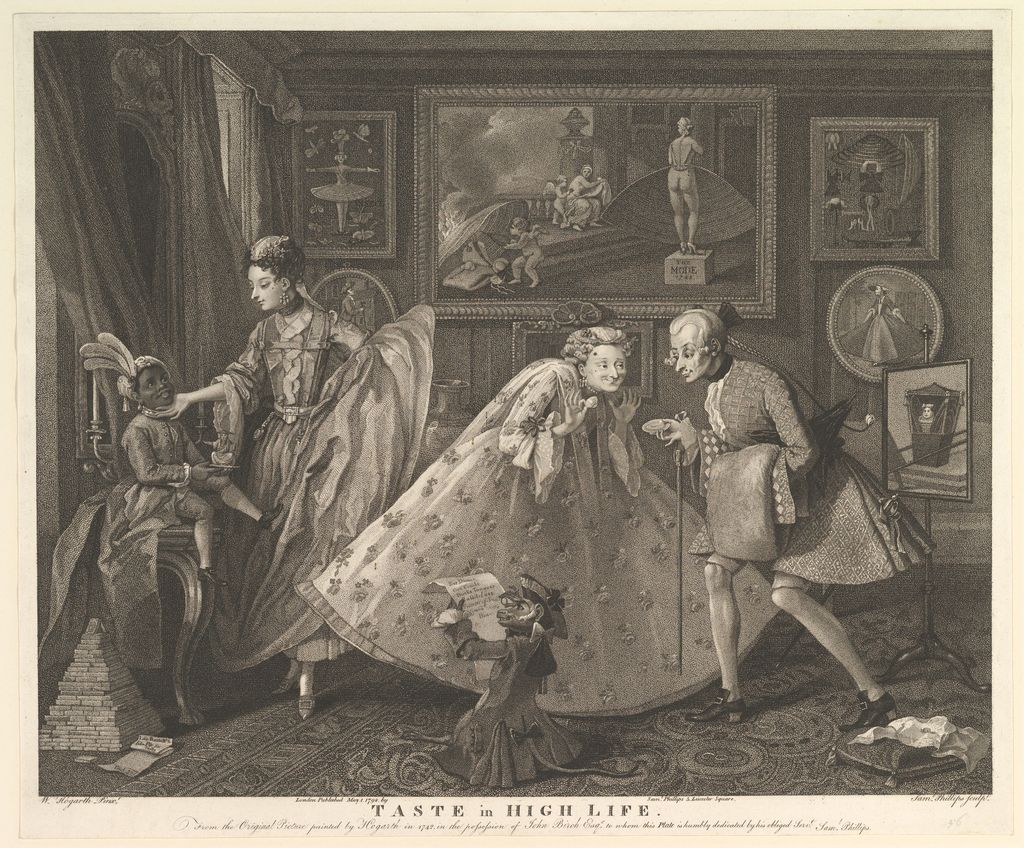
Taste in High Life, Samuel Phillips after William Hogarth, May 1, 1798. Engraving and aquatint; second state. 32.35(51). Harris Brisbane Dick Fund, 1932. Image source. CC0 / Public domain.
From Edwards’s commission to the Frick
Hogarth could give very different sitters this kind of authority. In his 1740 Portrait of Captain Thomas Coram, a full-length figure occupies a raised platform framed by a column and hanging fabric. The charter seal in Coram’s hand connects him directly to the Foundling Hospital, to which Hogarth gave the portrait. The scroll in Miss Mary Edwards has a more oblique relation to the sitter. It lies open beside her, inviting a viewer to read its appeal to rights in the company of the historical busts and the woman who commissioned her own likeness. [1] [2] [4] [13]
Henry Clay Frick bought the portrait from M. Knoedler & Co. on 28 February 1914. It entered The Frick Collection through his bequest. [2] [14]
Its title and date appear in the Frick Madison exhibition guide and in the guide to Tate Britain’s Hogarth and Europe, which included the painting in 2021–22. The title has particular force after the terrace picture. There, several names are needed to describe the company around Edwards. Here, her name alone introduces a picture in which even the grandest objects sit a little back from her face. [2] [4] [9]
Browse Hogarth’s artworks
All 54 individual artworks and series stages in the approved English cluster
Frequently Asked Questions
Discussion
Look again at the images and ideas explored in Miss Mary Edwards. These editorial prompts invite your observations.
Reader Insights
How does the dog’s upward gaze change the way you read Edwards’s direct look at the viewer?
How does placing the open scroll beneath the busts of Alfred the Great and Elizabeth I change the way you read its appeal to inherited rights?
Join the Conversation
Share a detail, comparison or question about Miss Mary Edwards below.
References
- The Frick Collection, William Hogarth, Miss Mary Edwards, 1742, collection catalogue entry and reproduction from Art in The Frick Collection: Paintings, Sculpture, Decorative Arts, 1996. View source.
- The Frick Collection, Frick Madison: A Guide to Works of Art on Exhibition, 2021, p. 38, Miss Mary Edwards. View source.
- Thought Gallery, “Drawing Together: Hogarth’s ‘Miss Mary Edwards’,” Frick Collection programme listing, 20 November 2024, accession 1914.1.75. View source.
- Tate, “William Hogarth: Miss Mary Edwards,” artwork note for Hogarth and Europe. View source.
- Joseph Addison, Cato: A Tragedy, London, Jacob Tonson, 1713, act III, p. 42. View source.
- Alison Conway, Private Interests: Women, Portraiture, and the Visual Culture of the English Novel, 1709–1791, University of Toronto Press, 2001, pp. 47–48. View source.
- Oxford Dictionary of National Biography, “Edwards, Mary (1705?–1743), art patron,” biographical entry abstract. View source.
- National Trust Collections, William Hogarth, Gerard Anne Edwards Hamilton (1732–1773) in his Cradle, c. 1732, Upton House, Bearsted Collection, 446679. View source.
- Maisoon Rehani, “Focus on New Photography: The Edwards Hamilton Family on a Terrace by William Hogarth,” Paul Mellon Centre, 2 April 2015. View source.
- Department for Culture, Media and Sport, “William Hogarth’s satirical painting ‘Taste in High Life’ at risk of leaving the UK,” 2023, notes 3–4, object description and provenance. View source.
- John Trusler, John Nichols and John Ireland, The Works of William Hogarth, with Descriptions and Explanations, “Taste in High Life,” p. 57. View source.
- The Metropolitan Museum of Art, Samuel Phillips after William Hogarth, Taste in High Life, 1 May 1798, engraving and aquatint, second state, 32.35(51). View source.
- Foundling Museum, “Captain Thomas Coram & Duchess of Somerset,” William Hogarth, Portrait of Captain Thomas Coram, 1740. View source.
- The Frick Collection Archives, Henry Clay Frick Art Files, box 10, folder 4, purchase of Hogarth’s Miss Mary Edwards and Gainsborough’s Sarah, Lady Innes. View source.







