


 by Tom Gurney
Tom Gurney BSc (Hons) is an art history expert with over 20 years experience
Published on June 19, 2020 / Updated on October 14, 2023
Email: tomgurney1@gmail.com / Phone: +44 7429 011000
The Idle ’Prentice at Play in the Churchyard: Introduction
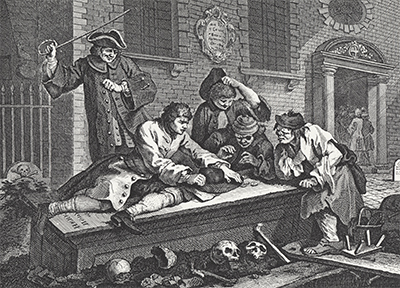
William Hogarth gives his fictional apprentice Tom Idle a tomb for a gaming table. The apprentice sprawls across its lid, reaching towards the other players, while worshippers pass into the church a few steps away. Behind Idle a beadle lifts his cane. The spectator can see the stroke coming while the players are still absorbed in the game. This is the third of twelve plates in Industry and Idleness. The Metropolitan Museum of Art catalogues its impression 91.1.11 as an etching and engraving in the second of two states, dated 30 September 1747. [1]
At a Glance
- ArtistWilliam Hogarth
- Series positionPlate 3 of 12 in Industry and Idleness
- MediumEtching and engraving
- Second-state impressionCatalogued 30 September 1747, The Metropolitan Museum of Art, 91.1.11
- Preparatory studiesBritish Museum, 1896,0710.6 and 1896,0710.7
This work across William Hogarth’s career
Assembly at Wanstead House
1728–31The Heir
1734The Marriage Settlement
about 1743Gin Lane
1751Canvassing for Votes
1754–55Contents
- A game on a tomb
- The beadle and the proverb
- From drawing to impression
- Inside the church and back at work
A game on a tomb
The stone slab is broad enough for Idle to stretch from one end to the middle. His companions have to bend or step in close. The player at the far right leans in with his head almost level with the others, and the boy behind them puts a hand to his head as he peers down. The eyes and hands gather over a patch of stone small enough to cover with a hat. Off to the right, the arched doorway frames a separate movement into the church. Hogarth gives the people crossing that threshold much less space than he gives the players, but their presence explains why the title specifies that the play takes place during divine service. [1]
The Rijksmuseum identifies the game as hustle-cap. Alice Bertha Gomme’s later collection of traditional games describes it as a game of tossed halfpence and records a description in which the coins are thrown up from a cap. The name was already in literary use near Hogarth’s time. In The Adventures of Peregrine Pickle, Tobias Smollett has Tom Pipes teach younger schoolboys hustle-cap alongside leapfrog and chuck-farthing. The novel places it among diversions that could be taught to children. The particular setting and the players’ dealings with each other give Hogarth’s game its moral weight. [2] [3] [4]
John Ireland reads Idle’s hand at the brim as an attempt to hide some of the halfpence. He identifies the companion who notices as a shoeblack and reads the man with an eye patch as demanding that the hats be lifted fairly. The plate leaves the size of the stake open. The low brim acts as a screen on the pale stone, and the men across the tomb crane forward to see around it. The game may be informal, but on Ireland’s reading the players have rules and resent a breach of them. That produces one dispute at the level of the slab just as the parish officer is about to intervene from above. [1] [5]
The beadle and the proverb
Look from Idle’s outstretched hand to the back of his coat, then up to the cane. The beadle’s raised arm clears the faces of the group and carries the thin diagonal of the cane across the brickwork. The action stops with the arm still raised. Hogarth leaves the back of Idle’s coat visible so the reader can make the connection with the words below the scene. The cartouche cites Proverbs 19:29, which says that judgements are prepared for scorners and stripes for the backs of fools. The biblical warning points to the living body on the tomb, while the distance the cane has yet to travel gives the scene its suspense. [1] [6]
In eighteenth-century London, a beadle could be a minor officer charged with carrying out orders. Parish beadles appear in the records assembled by London Lives summoning coroners’ inquests and acting on the instructions of churchwardens and overseers of the poor. In the City, ward beadles also had duties that included crowd control and enforcing restrictions on Sunday trading. Those records help explain how a man in such an office could be recognisable as a figure of local authority. Hogarth’s poised cane belongs to the story he tells with the proverb. The print shows the threat of a blow and gives no particulars of a charge or a formal penalty. [1] [7]
Watch Hogarth’s paintings and prints
Five films on Hogarth’s painted stories, prints, drawing methods and work for the Foundling Hospital.
In 60 seconds: Hogarth's 'Gin Lane' & 'Beer Street'
A short introduction to the contrasting streets, the shops and the people in Hogarth’s paired prints.
Watch on YouTubeThe ground under the players is as carefully arranged as the impending interruption. Skulls and loose bones lie at the foot of the monument, close to the open grave at the lower right. The slab gives Idle a convenient place to lie down, with burial lettering partly visible beneath him. Death is close enough to touch while the players’ attention remains on the money. The church entrance, the stone over a burial and the open grave give this small stretch of ground three distinct uses. It is a place people pass through to worship, a place where they remember the dead and, for the moment, a place where Idle’s company has settled in to play. [1] [5]
From drawing to impression
Two sheets in the British Museum show how early Hogarth settled the main action. In the preliminary study, 1896,0710.6, the congregation is already entering the porch, Idle is already on the tomb and the officer has his cane up. In the more finished study, 1896,0710.7, Hogarth develops the burial lettering and gives a headstone behind the group a skull and crossbones. His brushwork in grey wash and his pen lines sit over black chalk or graphite. The sheet is indented for transfer, a physical trace of the work of taking the design from paper towards the printing plate. [8] [9]
The finished study puts the porch on the left and the beadle on the right. Their positions are reversed in the print. The porch marks the far end of the scene in both versions and the cane rises from the opposite side, so the players are caught between the worshippers they ignore and the officer they have yet to see. In the print, the regular courses of brick make the raised cane easy to follow. [1] [9]
Both Met sheets depict plate 3, although 32.35(39) is catalogued as the first state and 91.1.11 as the second. The state numbers mark successive conditions of the printing surface. For the design number, Yale’s finding aid follows the third edition (1989) of Ronald Paulson’s Hogarth’s Graphic Works and lists this subject as no. 170. The National Gallery of Victoria catalogues its own impression 1278.454-3 as Paulson 170, state II of II, and transcribes the engraved publication date of 30 September 1747. A second Melbourne impression, 1995.358.3, is catalogued under John Boydell as publisher and carries the same date in the engraving. The date in the lettering can therefore travel with the design to a later issue. The Princeton University Library set places the churchyard plate alongside the church interior and the scene of Goodchild gaining his master’s trust. [1] [6] [10] [11] [12] [13]
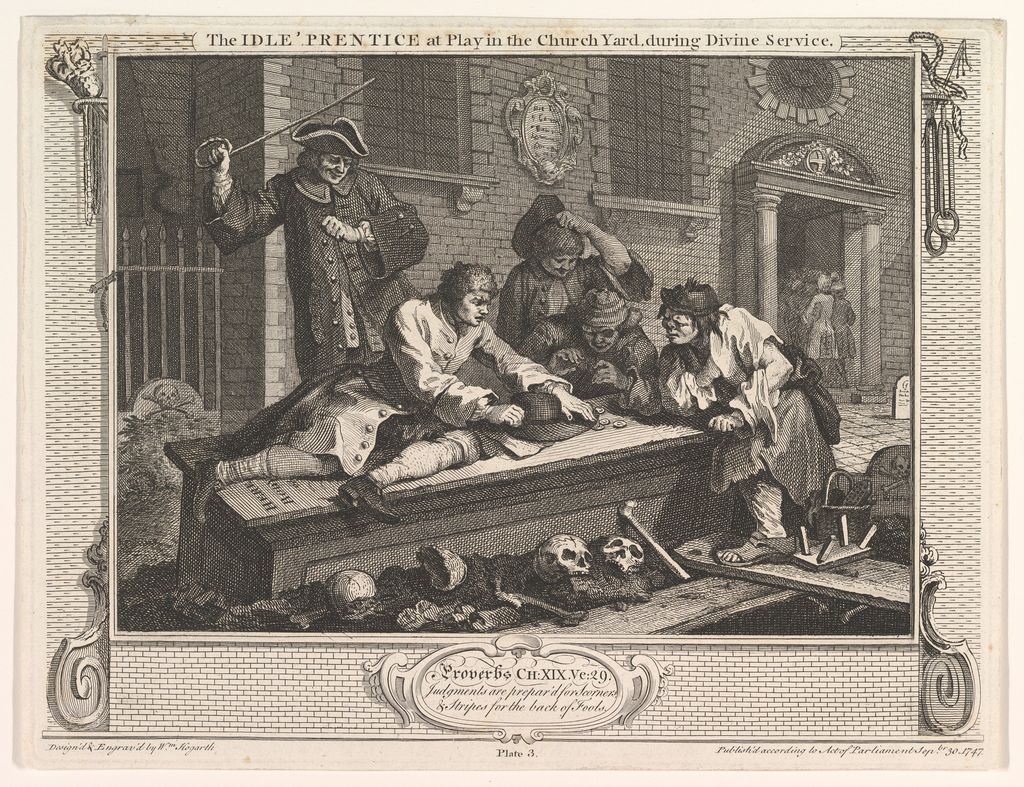
The Idle 'Prentice at Play in the Church Yard (Industry and Idleness, plate 3), William Hogarth, September 30, 1747. Etching and engraving; second state of two. 91.1.11. Gift of Sarah Lazarus, 1891. Image source. CC0 / Public domain.
Inside the church and back at work
In plate 2, The Industrious ’Prentice Performing the Duty of a Christian, Francis Goodchild and a young woman share a book at the front of a pew. Their heads are close and the book stays open between them. Hogarth makes the same closeness look awkward outside, where the players lean across one another and a hat may give Idle a way to conceal part of the stake. The doorway in plate 3 provides the cue to read the two settings together. Its function in the story is clear, while the identity of the church remains uncertain. [1] [5] [14]
The sequence moves on to plate 4, The Industrious ’Prentice a Favourite, and Entrusted by his Master, where Goodchild’s employer draws him into the business. The raised hand outside the church and the master’s hand at Goodchild’s shoulder mark two different ways an apprentice comes to the attention of someone with authority. The beadle’s hand holds out a threat that Idle has yet to notice. The master’s hand rests on Goodchild’s shoulder in full view. The position of each hand tells us how the apprentice stands with the person who has noticed him. [1] [5] [15]
Browse Hogarth’s artworks
All 54 individual artworks and series stages in the approved English cluster
Frequently Asked Questions
He and the other players are gathered around a tomb in the churchyard while worshippers go into the church. [1]
It is plate 3 of 12 in Industry and Idleness. Following the plate numbers keeps Goodchild’s and Idle’s episodes in the intended order. [1]
Discussion
Look again at the images and ideas explored in The Idle ’Prentice at Play in the Churchyard. These editorial prompts invite your observations.
Reader Insights
How does the brim of Idle’s hat affect what the other players can see?
How does reading the proverb below the scene change the way you look at the beadle’s raised cane?
Join the Conversation
Share a detail, comparison or question about The Idle ’Prentice at Play in the Churchyard below.
References
- The Metropolitan Museum of Art, William Hogarth, The Idle ’Prentice at Play in the Church Yard (Industry and Idleness, plate 3), 91.1.11, second state. View source.
- Rijksmuseum, William Hogarth, Tom Idle speelt hustle-cap op een tombe voor de kerk, RP-P-OB-18.781, Dutch collection title and series number. View source.
- Alice Bertha Gomme, The Traditional Games of England, Scotland, and Ireland, vol. 1, 1894, p. 246, “Hustle Cap”. View source.
- Tobias Smollett, The Adventures of Peregrine Pickle, vol. 1, chapter XVI. View source.
- John Ireland and John Nichols, Hogarth’s Works, with Life and Anecdotal Descriptions of His Pictures, vol. 1, Chatto and Windus collected edition, pp. 274–275, Industry and Idleness, plate III. View source.
- National Gallery of Victoria, William Hogarth, The idle ’prentice at play in the churchyard during Divine Service, 1278.454-3, state and inscription transcription. View source.
- London Lives, 1690–1800, “Policing”, section on beadles and their parish and ward duties. View source.
- British Museum, William Hogarth, preliminary study for Industry and Idleness, plate III, 1896,0710.6, collection record. View source.
- British Museum, William Hogarth, finished study for Industry and Idleness, plate III, 1896,0710.7, collection record. View source.
- The Metropolitan Museum of Art, William Hogarth, The Idle ’Prentice at Play in the Churchyard: Industry and Idleness, plate 3, 32.35(39), first state. View source.
- Lewis Walpole Library, Yale University, Collection of Prints after William Hogarth, LWL MSS 42, pp. 5, 29, keyed to Ronald Paulson’s Hogarth’s Graphic Works, 3rd ed. (The Print Room, 1989). View source.
- National Gallery of Victoria, William Hogarth, The idle ’prentice at play in the churchyard during Divine Service, 1995.358.3, Boydell publisher credit and inscriptions. View source.
- Princeton University Library, Vicki Principi, William Hogarth Collection, GC113, drawer 2, Industry and Idleness, plates II–IV. View source.
- The Metropolitan Museum of Art, William Hogarth, The Industrious ’Prentice Performing the Duty of a Christian (Industry and Idleness, plate 2), 91.1.10. View source.
- The Metropolitan Museum of Art, William Hogarth, The Industrious ’Prentice a Favorite, and Entrusted by his Master: Industry and Idleness, plate 4, 32.35(40). View source.







