


 by Tom Gurney
Tom Gurney BSc (Hons) is an art history expert with over 20 years experience
Published on June 19, 2020 / Updated on October 14, 2023
Email: tomgurney1@gmail.com / Phone: +44 7429 011000
The Fellow ’Prentices at Their Looms: Introduction
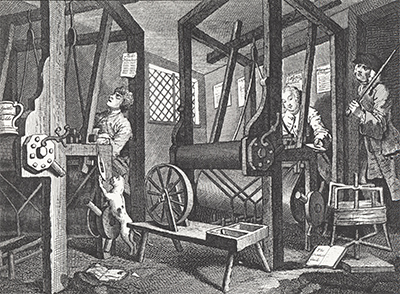
A cat reaches up at a loom while the apprentice seated at it sleeps. Across the room Francis Goodchild keeps his eyes on his work, and at the far right a man with a cane has spotted the sleeper, Thomas Idle. In The Fellow ’Prentices at Their Looms, William Hogarth gives two apprentices the same trade and puts their working habits on view at the same moment. This is the first of twelve prints in Industry and Idleness. The Metropolitan Museum of Art’s impression, 91.1.9, is an etching and engraving in the second of two states. The publication line carries the date 30 September 1747. [1] [2]
At a Glance
- SeriesIndustry and Idleness, plate 1 of 12
- Inscribed publication date30 September 1747
- PrintEtching and engraving, second of two states, The Metropolitan Museum of Art, 91.1.9
- Finished studyDrawing on paper, dated 1746–47 by the British Museum, 1896,0710.2
- CopperplateBritish Museum, 1990,1215.10
This work across William Hogarth’s career
Assembly at Wanstead House
1728–31The Heir
1734The Marriage Settlement
about 1743Gin Lane
1751Canvassing for Votes
1754–55Contents
- A working loom and a still one
- What the apprentices have to read
- Spitalfields and the master’s authority
- From the drawings to the copperplate
- From the workshop to the church
A working loom and a still one
The looms occupy so much of the sheet that at first it is easier to make out the timber uprights than to see what either apprentice is doing. Their faces appear between the beams. Goodchild leans towards the work and attends to the shuttle, which carries the weft across the warp, the threads stretched on the loom. Idle has tipped his head back, his body slack against the apparatus. Hogarth gives stillness a visible form by keeping a working loom within sight of the one that has stopped. The cat reaching up at Idle’s shuttle supplies the movement his hands ought to make. Its small intrusion is funny because the machinery around it is built for deliberate, repeated action. [1] [2]
The equipment for handling yarn continues the comparison below the apprentices’ faces. Colonial Williamsburg’s catalogue points out the empty reel on Idle’s side and the loaded wheel on Goodchild’s. A low bench runs into the foreground between the looms, and the big wheel near the middle stands out against the threads behind it. At the back, a lattice window opens a bright patch in a room otherwise crowded with dark lines. The light catches the notices on Goodchild’s side. Hogarth gives the eye a route between hands, tools and materials, then up to the stories the apprentices can read in the room where they work. [1] [2]
The master stands just inside the right edge. Goodchild is nearer to him, but the master’s attention crosses the workshop towards Idle. We see the raised cane before the sleeper reacts. That suspended gesture gives an otherwise quiet scene a very short future. Somebody is about to interrupt the sleep. It also gives the workshop a third point of view. The apprentices have a viewer within the picture, and he has the authority to act on what he sees. [1] [2]
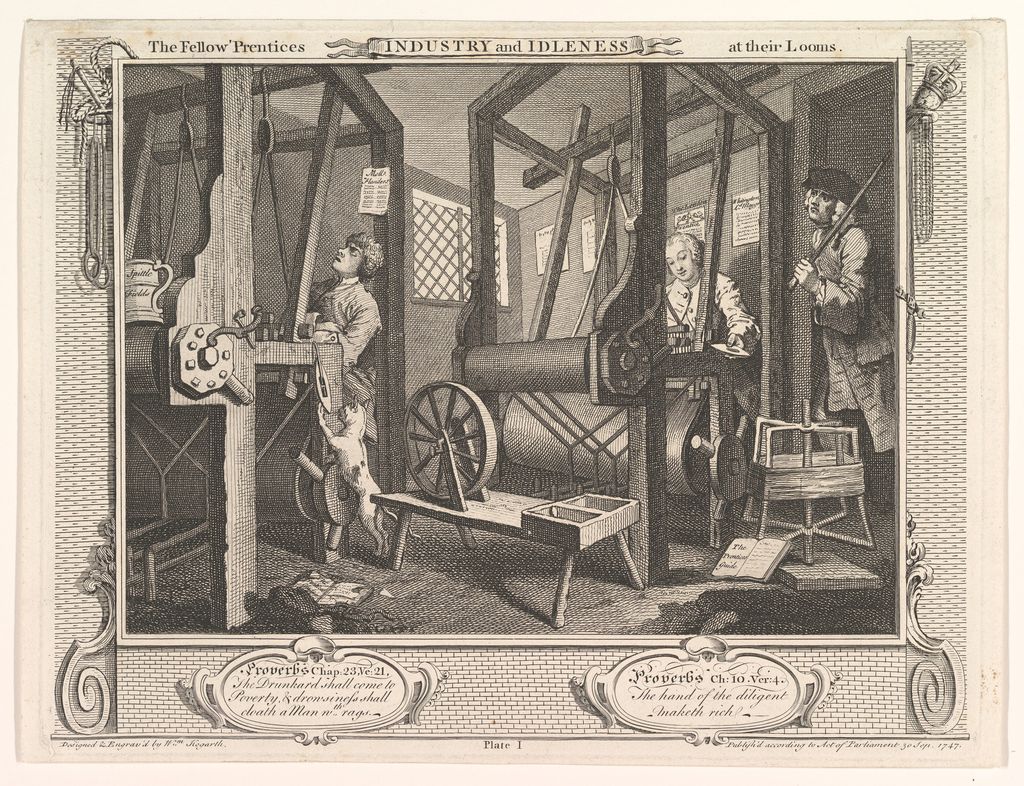
The Fellow 'Prentices at their Looms (Industry and Idleness, plate 1), William Hogarth, September 30, 1747. Etching and engraving; second state of two. 91.1.9. Gift of Sarah Lazarus, 1891. Image source. CC0 / Public domain.
What the apprentices have to read
Small pieces of print are scattered through the workshop. A torn Prentices Guide lies by Idle’s station and a guide lies open on Goodchild’s side. The sheets posted higher up are more individual. The Hessen Kassel Heritage impression preserves the titles Moll Flanders by Idle and The London Prentice and a reference to Whittington as Lord Mayor on Goodchild’s side. Whittington appears here as the subject of a popular story of advancement. His name brings a civic office into view while Goodchild is still learning to weave. The Moll Flanders title points to a different kind of story and gives the viewer a clue to the character Hogarth is building out of Idle’s surroundings. The papers are glimpsed between working parts of the looms, so reading them takes a closer look than recognising the sleeper or the cane. [1] [2] [3]
The two passages from Proverbs are easier to find. They sit in separate ornamental panels below the image, roughly under the figures to whom they apply. On the left, the extract from Proverbs 23:21 joins drunkenness and drowsiness to poverty and ragged clothing. On the right, Proverbs 10:4 promises that the diligent hand “maketh rich”. Goodchild’s hand is busy where the right-hand proverb directs us to look. Idle’s tankard and sleeping posture invite the reading supplied by the left-hand panel. A vessel and a pose can suggest the effects of drink, and the verse encourages that inference. The picture starts after whatever brought Idle to this state. [1] [3]
Watch Hogarth’s paintings and prints
Five films on Hogarth’s painted stories, prints, drawing methods and work for the Foundling Hospital.
In 60 seconds: Hogarth's 'Gin Lane' & 'Beer Street'
A short introduction to the contrasting streets, the shops and the people in Hogarth’s paired prints.
Watch on YouTubeSpitalfields and the master’s authority
The lettering “Spittle Fields” on the tankard helps locate the room. London Museum places the scene in the Spitalfields silk trade, which grew through the skills of Huguenot refugees and supplied cloth for garments such as waistcoats and gowns. Many of the weavers who made these luxury fabrics lived in poverty. That history gives a different weight to the promise in the right-hand panel. In the story a hand at the loom can be the beginning of wealth. In the district Hogarth invokes, a weaver could spend a working life supplying a luxury market on modest means. The location gives the story a recognisable trade without identifying a particular shop or the people who worked there. [3] [4]
A London apprenticeship was a binding arrangement for training and service. Indentures recorded who was bound, to whom and in what trade. The master or mistress undertook to teach and maintain the apprentice, commonly supplying food, clothing and lodging. The documents often existed in two copies, with matching cut edges, so the master and the adult or parish acting for the apprentice could each keep a copy of the terms. This helps explain the reach of the master’s authority in the picture. He could be responsible for more of an apprentice’s life than the work within sight of the loom. Hogarth gives that relationship an immediate form through the cane. The print leaves the two boys’ contractual terms and the outcome of this encounter to the imagination. [1] [5]
From the drawings to the copperplate
The British Museum has two preparatory drawings for the scene. In the freer sketch, 1914,0613.30, Goodchild is already busy and Idle is already asleep. The pair is arranged in reverse to the print, with Goodchild at the left. At the edge of the sheet are sketches of a mace, a Lord Mayor’s chain and a halter. The apparatus of civic office and the means of execution belonged to Hogarth’s thinking while he was still arranging the workshop. In the print the verses give each side a prediction in words. The surviving sketch lets us see how early the endings were in play, while Hogarth was still deciding how to show the apprentices at the same point in their lives. [3] [6] [7]
The British Museum dates its more finished drawing on paper, 1896,0710.2, to 1746–47. It establishes the workshop with looms, the labelled tankard and the master entering with his stick. In this drawing the master still enters from the left. The Art Fund describes the more finished studies for the first two plates as drawings prepared for transfer, with their ornamental frames already included. On the printed sheet the master appears at the right. Placing drawing and impression side by side makes it possible to follow the same gesture from one edge of the workshop to the other. [1] [5] [6] [8]
The incised copperplate survives at the British Museum as 1990,1215.10. When the plate is inked and pressed against paper, the design prints in reverse from the metal. Hogarth names himself below the scene as both designer and engraver. His credit and the dated publication line are part of the design, so they appear again when a new sheet is printed. In 1990 Bartolomeu Dos Santos printed a fresh impression of the scene at the Slade School of Fine Art, now British Museum 1991,0126.39.1. The Kassel catalogue records its own sheet as state II of II under no. 168 in the 1965 edition of Ronald Paulson’s Hogarth’s Graphic Works. A state describes a version of the design on the plate. The year a particular sheet passed through a press is a separate question. [1] [2] [3] [9]
From the workshop to the church
The Princeton University Library holds the opening plate alongside the next scenes in its William Hogarth Collection. Plate I gives both apprentices a common title and a common room. In The Industrious ’Prentice Performing the Duty of a Christian, Goodchild has a title to himself and appears in a church pew beside a young woman. The open book that lay by his loom has a counterpart in the book the two figures share. The change of setting shows what this first sheet leaves to be discovered. At the loom, Goodchild’s attention is visible in the position of his body and hands. At church, what he attends to also gives him a place among other people. [1] [10] [11]
Browse Hogarth’s artworks
All 54 individual artworks and series stages in the approved English cluster
Frequently Asked Questions
It is plate 1 of 12 in Industry and Idleness. Following the plate numbers keeps Goodchild’s and Idle’s episodes in the intended order. [1]
Discussion
Look again at the images and ideas explored in The Fellow ’Prentices at Their Looms. These editorial prompts invite your observations.
Reader Insights
How does the cat draw your eye to the difference between Idle’s loom and Goodchild’s?
What does the Whittington notice add to the proverb beneath Goodchild’s loom?
Join the Conversation
Share a detail, comparison or question about The Fellow ’Prentices at Their Looms below.
References
- The Metropolitan Museum of Art, William Hogarth, The Fellow ’Prentices at their Looms (Industry and Idleness, plate 1), 91.1.9. View source.
- Colonial Williamsburg Foundation, William Hogarth, Industry and Idleness – The Fellow ’Prentices at Their Looms, 1947-478,A, object and inscription record. View source.
- Hessen Kassel Heritage, William Hogarth, The Fellow ’Prentices at their Looms, GS 20352, fol. 43,1, inscription record and citation to Ronald Paulson, Hogarth’s Graphic Works, first complete edition, 1965, vol. 1, p. 194, no. 168 (in German). View source.
- London Museum, The Huguenots in London, “Silk weaving in Spitalfields”. View source.
- London Lives 1690–1800, Apprenticeship Indentures and Disciplinary Cases (IA), with the finished drawing and St Botolph Aldgate indentures, London Metropolitan Archives, MS 10027. View source.
- Art Fund, William Hogarth, Sketches for two Engravings from ‘Industry and Idleness’, British Museum acquisition record for sketches for plates I and II. View source.
- British Museum, William Hogarth, preliminary sketch for The Fellow ’Prentices at their Looms, 1914,0613.30, collection description reproduced by GetArchive. View source.
- British Museum, William Hogarth, The fellow ’prentices at their looms, a drawing for Plate 1 of Industry and Idleness, 1896,0710.2, collection record on Google Arts & Culture. View source.
- British Museum, William Hogarth, The Fellow ’Prentices at their Looms, impression printed by Bartolomeu Dos Santos, 1991,0126.39.1, with acquisition note on the copperplates, collection description reproduced on Wikimedia Commons. View source.
- Princeton University Library, Vicki Principi, William Hogarth Collection, GC113, drawer 2, Industry and Idleness, items for plates 1 and 2. View source.
- The Metropolitan Museum of Art, William Hogarth, The Industrious ’Prentice Performing the Duty of a Christian (Industry and Idleness, plate 2), 91.1.10. View source.







