


 by Tom Gurney
Tom Gurney BSc (Hons) is an art history expert with over 20 years experience
Published on June 19, 2020 / Updated on October 14, 2023
Email: tomgurney1@gmail.com / Phone: +44 7429 011000
Heads of Six of Hogarth’s Servants: Introduction
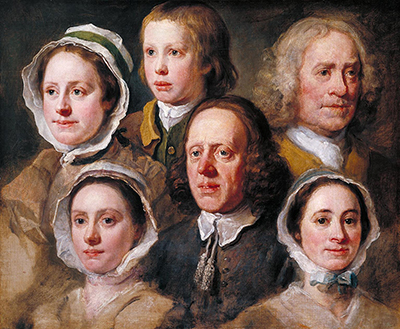
Six people fill a canvas barely three quarters of a metre wide. A boy looks to the left, a grey-haired man turns to the right, and three white caps frame faces at different heights. At the centre, a man in a dark coat looks slightly past us. William Hogarth painted these heads in oil on canvas, probably around 1750–55. Tate holds the painting as Heads of Six of Hogarth’s Servants, accession N01374. The canvas measures 63 by 75.5 centimetres. [1] [2]
At a Glance
- ArtistWilliam Hogarth
- DateAbout 1750–55
- MediumOil paint on canvas
- Dimensions63 × 75.5 cm
- CollectionTate, N01374
This work across William Hogarth’s career
Assembly at Wanstead House
1728–31The Heir
1734The Marriage Settlement
about 1743Heads of Six of Hogarth’s Servants (current article)
about 1750–55Gin Lane
1751Canvassing for Votes
1754–55Contents
- How six studies become a group
- What the paint gives each face
- The household and the names
- A household seen at close quarters
How six studies become a group
The boy’s head and the older man’s head occupy much of the upper edge. The woman’s head at the left appears a little lower, her cap edged with white against the dark background. Below her, the woman at lower left looks more squarely out, as does the woman with the blue bow at lower right. The central man’s head rises between the two lower faces. His dark coat occupies much of the interval between their pale clothing. At the top, glimpses of ochre at the boy’s collar and beneath the older man’s neckcloth carry a warmer colour across the picture. That alternation of light cloth, dark coats and warm accents helps the eye move among figures whose glances lead in different directions. [3]
Tate’s account describes the picture as a collection of studies held together by their arrangement and by light falling from the upper left. Look at the way the bright edge of the left-hand woman’s cap follows the light across the bridge of her nose and leaves part of her face in shadow. At the upper right, light catches the old man’s brow, nose and white neckcloth while his cheek falls into a darker tone. Such effects are consistent enough to give the heads a shared atmosphere. The shoulders overlap, but the shallow space gives little sense of how six bodies would be positioned in a room. The effect depends on the closeness of their heads and the small differences between their turns. [3] [4]
What the paint gives each face
The handling changes over very short distances. The central man’s white collar is picked out in angular strokes, and his neckcloth breaks up into smaller touches. The line of his lower eyelid and the pale glint above it make the eye a point of focus amid deep shadows. Below and to his right, a finer edge marks the woman’s lips, while the underside of her chin passes gently into the shadow of the cap. At the left edge, broad browns suggest a sleeve and shoulder. Following one figure from the eye down to the clothing shows how freely Hogarth varied the amount of detail. [3] [4]
The boy’s smooth forehead and the grey-haired man’s creased brow offer a particularly close comparison. The boy has a short, softly shaded passage from cheek to jaw. In the older face, the changes of colour and shadow give clearer definition to the lines beside the nose and below the mouth. Both faces have lively colour and small lights in the eyes. Kate Retford has suggested that the range of ages lends the oil sketch something of the tradition known as the Ages of Man, in which stages of life offer the painter a series of visible differences to explore. Here the ages are spread across a cluster of faces, with no fixed path through them. The viewer can return repeatedly from the older man to the boy and notice a different feature each time. [3] [4]
Robert L. S. Cowley, drawing on Elizabeth Einberg’s catalogue, reports that there was once another head at the lower left. Today that corner gives the eye a stretch of loosely brushed colour below the faces. The changes in finish can make it hard to tell by eye where Hogarth painted thinly and where he might have left the preparatory ground exposed. In The Shrimp Girl, National Gallery examination established that a pale patch beside the face is exposed ground. In the Tate picture, the brushwork alone shows how economically Hogarth could suggest the curve of a shoulder, leaving the eyes and the edges of the caps to carry the sharper accents. [3] [5] [6]
Watch Hogarth’s paintings and prints
Five films on Hogarth’s painted stories, prints, drawing methods and work for the Foundling Hospital.
William Hogarth and the Foundling Hospital | HENI Talks
Caro Howell discusses Thomas Coram, Hogarth’s portrait of him and the artist’s work for the Foundling Hospital.
Watch on YouTubeThe household and the names
The painting remained with William and Jane Hogarth and was sold after their deaths. In her exhibition essay, Retford gives the sale title as “The heads of 6 servants of Mr. Hogarth’s family”. The catalogue for Jane Hogarth’s estate sale dates the auction to 24 April 1790. As the historian Naomi Tadmor has shown, eighteenth-century usage could extend the word ‘family’ to people living under the same roof, including employees, apprentices and relatives. The sale title makes sense in that usage. It associates the six people through their place in the household, where sharing a roof also meant living under the authority of its head. [4] [7] [8]
A household connection is much easier to establish than a name for each face. Retford considers Ben Ives a likely candidate for the older man and suggests that one of the women could be Mrs Chapel, a name associated with the household. In his study of Hogarth’s London home, Cowley tentatively associates Ives with the central man and floats the name Samuel for the grey-haired figure at upper right. The different proposals show how difficult it is to match a name from an account of the household to a particular painted likeness. A coat or a cap can help us distinguish the figures within the picture. Their positions and clothing give little basis for naming their jobs or establishing their seniority. [4] [5]
There is a separate likeness of one member of the household whose name is known. Aberdeen Archives, Gallery & Museums holds Hogarth’s Miss Mary Lewis, ABDAG002763. Lewis was related to Jane Hogarth and lived in the household. In the Aberdeen painting, strong light falls on her face and a stiff white ruff stands out against sombre dress. Cowley notes that people have proposed Lewis as one of the women in the Tate group, but doubts the resemblance to her named portrait. The Aberdeen picture gives us a likeness tied to a name, while the faces in the group still have to be read against fragmentary accounts of the household. [5] [9]
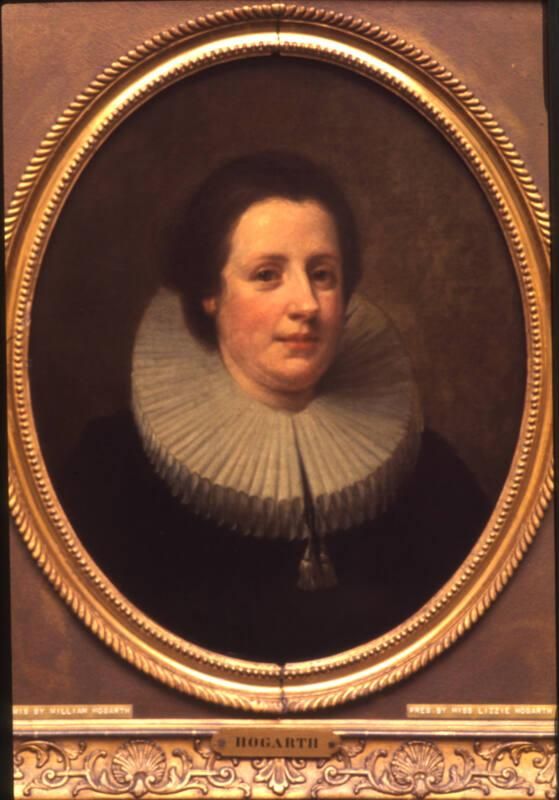
Miss Mary Lewis, William Hogarth, catalogued as 1755. Oil on canvas, photographed in its frame. ABDAG002763. Aberdeen Archives, Gallery & Museums. Image source. CC0 / Public domain.
A household seen at close quarters
In The Graham Children, a signed and dated painting of 1742 at the National Gallery, Hogarth establishes connections among four siblings with hands, objects and action. Richard Robert balances a small bird organ on his knee. Anna Maria holds out her skirt as if to dance. Their elder sister Henrietta guides the baby’s hand towards the cherries. The picture gives their gestures room to unfold within a prosperous home. The canvas is more than twice as wide as the servants’ picture, where the lower edge cuts across the shoulders and the sitters’ hands fall outside the composition. In the servants’ group it is possible to spend a long time looking at a single face, then find that a turn or colour in the neighbouring one leads the eye on. The survey of Hogarth’s paintings traces this range from domestic scenes to small studies and public portraits. [1] [3] [10]
The picture’s later history took it from the Hogarth household into a national collection. Maurice W. Brockwell’s 1909 catalogue calls it Portraits of Hogarth’s Servants and records the purchase at the Wedderburn sale in 1892. The National Gallery used the Lewis Fund to buy it and transferred the work to Tate in 1960. In the guide to Tate Britain’s 2021–22 exhibition Hogarth and Europe, Alice Insley and Martin Myrone suggest that a prospective client might once have seen the picture in Hogarth’s studio and taken it as evidence of his skill at portraiture. Its original purpose remains open. The possibility is easy to understand in front of the canvas, where six faces sharing a single light give Hogarth six different ways to paint the turn of a head. [11] [12] [13]
Browse Hogarth’s artworks
All 54 individual artworks and series stages in the approved English cluster
Frequently Asked Questions
Discussion
Look again at the images and ideas explored in Heads of Six of Hogarth’s Servants. These editorial prompts invite your observations.
Reader Insights
How does the light across the white caps and collars hold the group together when the sitters look in different directions?
How does the 1790 sale title shape your understanding of what the six people have in common?
Join the Conversation
Share a detail, comparison or question about Heads of Six of Hogarth’s Servants below.
References
- Tate, Heads of Six of Hogarth’s Servants, collection record, N01374. View source.
- Tate, Heads of Six of Hogarth’s Servants, collection data export, N01374, object ID 6616. View source.
- Tate Britain, Heads of Six of Hogarth’s Servants, collection interpretation and reproduction, Google Arts & Culture. View source.
- Kate Retford, “William Hogarth, Heads of Six of Hogarth’s Servants, c.1750–5,” Country House Servants, Manchester Metropolitan University, N01374. View source.
- Robert L. S. Cowley, “Hogarth’s house at the Golden Head, Leicester Fields,” British Art Journal, “Servants,” plate 24 and notes 88–91, citing Elizabeth Einberg, catalogue no. 210, pp. 310–11. View source.
- Judy Egerton, “The Shrimp Girl,” National Gallery Catalogues: The British Paintings, NG1162, “Technical Notes.”. View source.
- John Greenwood, A Catalogue of the Pictures and Prints; the Property of the Late Mrs. Hogarth, 24 April 1790, ESTC T161767, catalogue record in the Grub Street Project. View source.
- Naomi Tadmor, “The concept of the household-family,” Family and Friends in Eighteenth-Century England: Household, Kinship and Patronage, Cambridge University Press, 2001, pp. 18–43. View source.
- Aberdeen Archives, Gallery & Museums, Miss Mary Lewis, collection record, ABDAG002763. View source.
- National Gallery, The Graham Children, collection record, NG4756. View source.
- Maurice W. Brockwell, The National Gallery: Lewis Bequest, 1909, no. 1374, pp. 80–81 and plate XIX. View source.
- Judy Egerton, National Gallery Catalogues: The British Paintings, 2000, digital edition, “About this catalogue,” Lewis Fund and Tate transfer. View source.
- Alice Insley and Martin Myrone, “Heads of Six of Hogarth’s Servants,” Hogarth and Europe, Tate Britain exhibition large-print guide, 2021–22, p. 173. View source.







