



 by Tom Gurney
Tom Gurney BSc (Hons) is an art history expert with over 20 years experience
Published on June 19, 2020 / Updated on October 14, 2023
Email: tomgurney1@gmail.com / Phone: +44 7429 011000
The Graham Children: Introduction
In William Hogarth’s The Graham Children, a boy turns the handle of a bird organ while a cat climbs the back of his chair. At the opposite end of the painting, a baby reaches for a pair of cherries. The cat could almost go unnoticed amid the movement of the four children, but it lends urgency to a portrait in which one of them, the infant Thomas, had died before the work was finished. Hogarth signed and dated the picture in 1742. The life-size group fills an oil-on-canvas painting 160.5 by 181 centimetres, now in the National Gallery, London (NG4756). [1] [2]
At a Glance
- ArtistWilliam Hogarth
- Date1742
- MediumOil on canvas
- Dimensions160.5 × 181 cm
- CollectionNational Gallery, London (NG4756)
This work across William Hogarth’s career
Assembly at Wanstead House
1728–31The Heir
1734The Marriage Settlement
about 1743Gin Lane
1751Canvassing for Votes
1754–55Contents
- Four children at home
- Thomas and the chalk study
- The bird organ and the cat
- The clock, the flowers and the fruit
- A family portrait over time
Four children at home
The sitters are the children of Daniel Graham, royal apothecary to George I and George II, and his second wife, Mary Crisp. Daniel is the presumed commissioner. The National Gallery places the group at the family’s home in Pall Mall, London. Hogarth leaves much of the room in shadow, with just enough light to pick out paintings on the wall and a curtain behind the boy’s chair. The space devoted to the children gives their play the scale of a formal family portrait. Their clothes, the silver fruit basket and the gilded carriage convey the prosperity of the household even with the parents out of view. [1] [2]
Thomas sits at the far left in the carriage. Beside him is the eldest child, Henrietta Catherine, in blue. Her hand hangs in the gap between their bodies. She steadies Thomas’s hand as she offers him the fruit. Anna Maria, in the patterned dress, catches up her skirt as if about to dance. Richard Robert holds the organ at the far right. Henrietta’s steady look out of the canvas gives the viewer a point of contact while the boys are absorbed in what they are doing. Anna Maria stands between the two activities. The lift of her skirt interrupts the long fall of Henrietta’s apron and brings some of the energy of Richard’s music into the middle of the group. [1] [2]
The clothes also help distinguish the children’s ages. Thomas wears a skirt, as an infant boy commonly did, while Richard wears knee breeches. The girls’ aprons and fitted bodices echo adult dress. Henrietta is still a child, but by seating her within reach of the carriage and giving her the most composed expression, Hogarth lets her take on something of an adult’s role in the group. Her apron follows the bend of her seated figure. The National Gallery’s teachers’ notes point out the cherry pattern on Anna Maria’s dress, a small echo of the fruit her sister holds. The fabrics are painted on a scale that lets Hogarth distinguish a motif woven into a skirt from the fruit an infant could take in his hand. In the National Gallery’s Technical Bulletin, Jo Kirby and David Saunders record Prussian blue together with ultramarine in the elder girl’s dress. That finding identifies pigments in a specific part of the canvas. It leaves the distribution of the two blues across the folds and the original intensity of the colour open. [1] [2] [3]
Thomas and the chalk study
The date on the canvas fixes the year of the finished painting. Thomas’s death preceded its completion, and the National Gallery raises the possibility that it prompted the commission. The catalogue history also leaves room for an earlier commission. Mary Webster proposed that the project might have begun in 1741, in connection with Daniel Graham’s rebuilding in Pall Mall. The sequence of a first commission, any sittings and Thomas’s death remains uncertain. [1] [2] [4]
A chalk drawing in the British Museum, 1895,1214.1, shows a small head turned to the right, framed by the frill of a bonnet. The drawing has been called Head of a Sleeping Child. As reported in the museum’s catalogue commentary, Judy Egerton found the resemblance to the painted infant close enough to accept Webster’s identification of the child as Thomas. Egerton considered it likely that Hogarth drew him after death, while acknowledging that sleep and death are difficult to distinguish in the study. The Gallery’s account identifies it as the study Hogarth used for the infant’s likeness. In the oil painting, Hogarth gives the child open eyes and a body engaged in play. The reach is what makes Thomas belong to the same moment as his siblings. A study of a still face could supply a likeness. Henrietta’s hand, the rusk and the reaching arm supply the action. [1] [4]
Watch Hogarth’s paintings and prints
Five films on Hogarth’s painted stories, prints, drawing methods and work for the Foundling Hospital.
William Hogarth and the Foundling Hospital | HENI Talks
Caro Howell discusses Thomas Coram, Hogarth’s portrait of him and the artist’s work for the Foundling Hospital.
Watch on YouTubeThe bird organ and the cat
The instrument on Richard Robert’s knee was a kind of small barrel organ used to train caged birds to sing. A French serinette made around 1800, now in the Metropolitan Museum of Art, shows how such an instrument could work. Turning the crank rotates a pinned wooden barrel and supplies air to little pipes. The mechanism can repeat a tune for a bird to learn. In Hogarth’s painting, Richard directs his gaze up towards the goldfinch as he works the handle. The cat climbs towards the same bird from behind his chair. Richard and the cat share a focus for different reasons, and the narrow strip of space they occupy makes it easy to take in the player, the cage and the threat in a single glance. [1] [2] [5]
There is another scene on the side of the organ. The player there is Orpheus, whose music draws animals to him and who, in Greek myth, tried to bring Eurydice back from the underworld. The National Gallery connects the myth with Thomas’s death. That reading begins with a visible detail and with the choice of a musical subject for the box. It also depends on which episode a viewer brings to mind. The animals gathered around Orpheus suit an instrument played to a bird. His attempt to recover Eurydice, a separate part of the story, would have had particular resonance for a family that had lost a child. [1] [2]
Jean-Baptiste-Siméon Chardin’s La Serinette, dated 1751 by the Louvre (RF 1985 10), makes the relationship between the instrument and the bird especially clear. A woman turns towards a birdcage beside the window, with the small organ before her and her needlework set aside. The activity can sustain a painting on its own. In Hogarth, the cage hangs high above the player and the cat gives the exchange an uncertain outcome. Chardin’s scene helps explain why Richard’s attention to the bird would have made sense in an eighteenth-century interior even before a viewer noticed what else was happening around him. [1] [6]
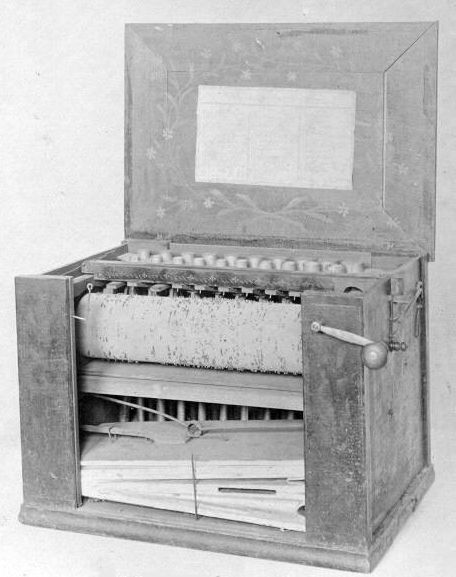
Serinette, Ch. Denis, ca. 1800. wood, various materials. 89.4.2137a–d. The Crosby Brown Collection of Musical Instruments, 1889. Image source. CC0 / Public domain.
The clock, the flowers and the fruit
At the left, a figure with wings, an hourglass and a scythe crowns the clock. Those attributes associate the figure with time and mortality. The dial appears to read about quarter to two. The Gallery suggests the hands might mark the hour Thomas died. The painted dial can bear that interpretation, but the hour remains conjectural. Below, the two crossed carnations near the carriage give a quieter indication of loss. The Gallery associates them with funerals. They sit below the action, at the level of the carriage wheels, where their small scale and deliberate placement encourage a second look. [1] [2]
Cherries have a traditional association with paradise, and the goldfinch can evoke Christ’s Passion. The National Gallery reads the pair of motifs as expressing hope for Thomas’s resurrection. The picture gives both details immediate work to do. The cherries bring Thomas’s hand towards Henrietta’s. The goldfinch turns Richard’s attention upwards and draws the cat after it. The cat is easy to spot once you follow the boy’s gaze, which helps explain the force of the Gallery’s reading of it as a reminder of how suddenly death can intrude. The gilded cage also answers the gilded carriage on the other side of the room, linking two small, vulnerable creatures. The suggestion that the carriage’s carved bird might have moved when the carriage was pulled remains a possibility. Its spread wings already give the eye a way to travel from the fruit and flowers at floor level towards Thomas. [1] [2]
A family portrait over time
Hogarth’s earlier The Strode Family, painted about 1738 and held by Tate (N01153), uses a much smaller canvas, about 87 by 91.5 centimetres. A tea table draws its group together around the service, so that the space between the sitters is occupied by objects they can share. The space between the Graham children is more open. Hogarth uses it for gestures that travel across the room or rise above the children’s heads. At the scale of the later painting, the objects catch the eye in stages. The toy-like carriage holds the attention long enough for the flowers at its feet to register. The cat’s paws bring the eye back from the bright birdcage to the dark edge of the chair. The overview of Hogarth’s paintings places both portraits among his experiments with group composition. [1] [7]
According to Judy Egerton’s provenance account, the picture passed from Daniel Graham to Richard Robert in 1778. The boy with the organ thus lived to inherit the portrait of himself and his siblings. It was sold in 1832 to the second Earl of Normanton, and Lord Duveen presented it to the National Gallery through the Art Fund in 1934. In 2023 the Foundling Museum showed it in Finding Family, an exhibition on the ties that make a family. In the painting, one of those ties takes the form of a small, unfinished gesture. Henrietta holds the cherries low enough for Thomas to try to take them, and his fingers are still reaching. [1] [8]
Browse Hogarth’s artworks
All 54 individual artworks and series stages in the approved English cluster
Frequently Asked Questions
Discussion
Look again at the images and ideas explored in The Graham Children. These editorial prompts invite your observations.
Reader Insights
How does noticing the cat change the way you read Richard Robert’s upward glance?
How do Henrietta’s cherries and the crossed carnations draw attention to different aspects of Thomas’s presence in the portrait?
Join the Conversation
Share a detail, comparison or question about The Graham Children below.
References
- The National Gallery, London, William Hogarth, The Graham Children, NG4756, collection entry, including the provenance extract from Judy Egerton, The British Paintings (2000), pp. 134–145 for the full catalogue entry. View source.
- The National Gallery, London, Primary Teachers’ Notes: The Graham Children, pp. 1–2. View source.
- Jo Kirby and David Saunders, “Fading and Colour Change of Prussian Blue: Methods of Manufacture and the Influence of Extenders,” National Gallery Technical Bulletin, vol. 25 (2004), p. 96, table 3, NG4756. View source.
- The British Museum, William Hogarth, chalk study traditionally titled Head of a Sleeping Child, 1895,1214.1, collection description and catalogue commentary, including the extract from Judy Egerton, The British School (1998), p. 139, as transcribed on Wikimedia Commons. View source.
- The Metropolitan Museum of Art, Ch. Denis, Serinette, about 1800, 89.4.2137a–d, collection record and technical description. View source.
- Musée du Louvre, Jean-Baptiste-Siméon Chardin, La Serinette, dit aussi Dame variant ses amusements, 1751, RF 1985 10, French collection record. View source.
- Tate, William Hogarth, The Strode Family, about 1738, N01153, collection data export. View source.
- The Foundling Museum, Finding Family, 2023 exhibition record. View source.






