


 by Tom Gurney
Tom Gurney BSc (Hons) is an art history expert with over 20 years experience
Published on June 19, 2020 / Updated on November 5, 2025
Email: tomgurney1@gmail.com / Phone: +44 7429 011000
A Harlot’s Progress by William Hogarth: Introduction
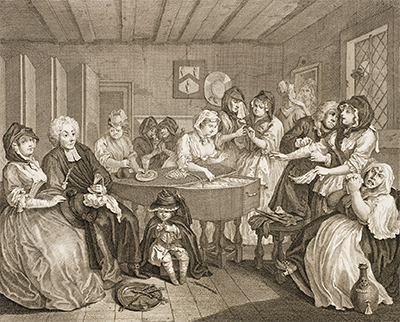
William Hogarth’s A Harlot’s Progress follows the fictional Moll Hackabout from her arrival in London to the gathering around her coffin. Hogarth developed the story as six paintings and published it as six etchings and engravings in 1732. At the inn where Moll arrives, a finely dressed woman can look her over while a man watches from a doorway. Moll becomes a wealthy man’s mistress, later sells sex from poorer lodgings and is put to work in Bridewell. By the last scene, her coffin occupies the middle of a crowded room, yet most of the people around it have found something else to attend to. Between those two gatherings, Hogarth repeatedly changes who can look, who can enter and who can make Moll do something. [1] [2] [3] [4] [5] [6]
The pictures leave much of her life between scenes. The reader sees the offer of an acquaintance at the inn, then a room already furnished for a woman supported by a wealthy patron. The next change of address has already occurred by the time the authorities arrive. The prints encourage readers to supply these transitions. Their evidence is often a shift in furnishings, the reuse of a gesture or a person visible at the edge of a room. [2] [4] [6]
At a Glance
- ArtistWilliam Hogarth
- Printed sequenceSix etchings and engravings
- Issue1732
- Central figureMary or Moll Hackabout
Contents
- The six scenes in order
- How a garret became a series
- Work, enforcement and care in Hogarth’s London
- A subscription and its changing design
- Impressions, copies and the painted set
- Rouquet’s London for readers abroad
- From full-size sheets to a folding fan
- Six cantos and a London pantomime
The six plates
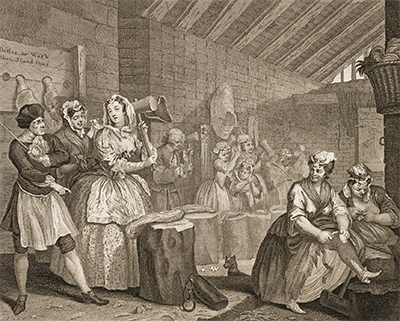
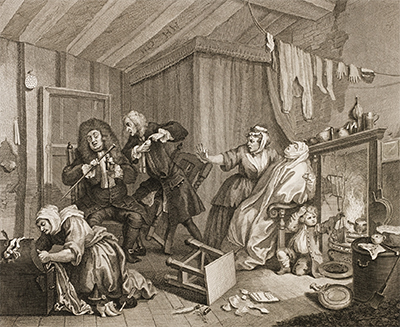
The six scenes in order
I. Arrival at the Bell Inn
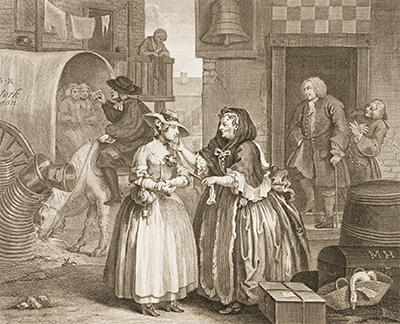
In the arrival at the Bell Inn, Moll stands in the open air with her luggage nearby and the wagon behind her. The older woman facing her has stepped close enough to reach towards her chin. Their conversation occupies the foreground, while two men in the doorway can watch from the shelter of the building. The clergyman further back attends to a letter. The Metropolitan Museum of Art identifies the woman as the brothel keeper Mother Needham and the older man at the doorway as Colonel Francis Charteris. That reading gives contemporary resonance to a composition whose unequal distribution of attention is visible before either figure has been named. The Met holds both a first-state impression, dated before April 1732, and the fourth-state impression on which its description of the encounter appears. [2] [7]
II. A room paid for by a patron
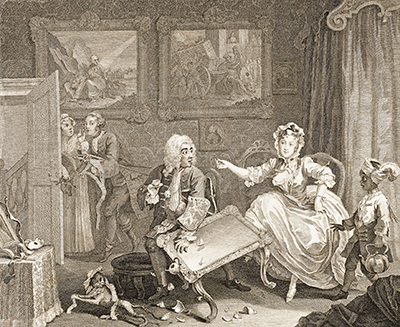
In the kept woman’s apartment, Moll kicks the tea table over while a maid helps a man leave by the rear door. The patron’s attention is drawn to the falling tableware. Hogarth gives the viewer both the disturbance and the escape within a single field of view. Furnished space offers Moll a resource here. The rear door and the maid’s assistance allow the lover to slip away behind Moll’s patron. At the right, Hogarth includes a Black child in page’s dress as part of the display of household wealth. The picture gives the child a place within the household hierarchy and leaves his own circumstances unexplained. Colonial Williamsburg explains the traditional identification of the patron as Jewish by reference to the biblical pictures and an inscription reported on a separate royal copy. The reading belongs to the history of the print’s stereotypes. The catalogue’s evidence concerns the way the patron was characterised and understood. [6] [8]
III. The officials enter
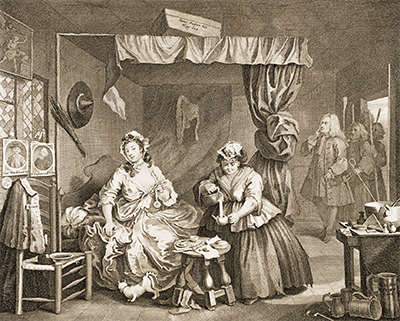
In Moll’s lodgings and arrest, the bed, attendants and small mirror tell of a much narrower domestic space. Moll holds up a watch by its chain. As she does so, the magistrate and his companions advance through the doorway. Wellcome identifies the magistrate as Sir John Gonson. Across the two prints, the door changes sides in the contest for information. In Plate II it gives the lover a way out. In Plate III it gives officials a way in. A purchaser who had already learnt to watch the background of the better-furnished room could recognise the danger before Moll seems aware of it. [4] [6] [9]
IV. Labour at Bridewell
In the Bridewell scene, Moll raises a mallet alongside the other prisoners. Her fine clothes still distinguish her, but the block places her in a row of workers and the keeper directs her attention to the hemp. Behind her, the stocks offer a visible example of what refusal or failure to work can cost. The Scottish National Galleries impression, P 6724, gives the scene as an etching and engraving with a plate mark of 31.2 by 38.7 centimetres. In that broad format Hogarth can put several kinds of coercion within the same room. Moll’s posture matters in relation to the worker next to her and the keeper’s gesture beside her. [5] [10]
V. The sickroom
In Moll’s final illness, a woman supports Moll close to the fire while two practitioners argue. A child occupies himself by the hearth. Open containers, papers and goods on the floor make the cramped setting serve as sickroom and household at once. Wellcome identifies the blankets with sweating and reads the scene in the context of period treatments for venereal disease. The first-state impression at the Met records the composition before April 1732. The practitioners’ quarrel and the attendant’s contact with Moll distribute attention very differently. The person holding her up performs the clearest act of care in the room. [11] [12]
VI. The wake
At Moll’s wake, the coffin gives the room a centre and its inscription gives the dead woman a name and age. Around it, people drink, look, handle mourning accessories and attend to one another. The child sits close to the coffin in the foreground. At the inn, the standing woman could at least return the look of the person examining her. At the wake, the living can direct their attention anywhere. Hogarth makes the viewer search the room for an act of remembrance amid the work and sociability of the funeral. [2] [3]
How a garret became a series
The antiquary and engraver George Vertue traced the series to a small painting of a woman rising around noon and being attended at breakfast in a lodging associated with Drury Lane. He described an idea that grew as Hogarth thought of further subjects. In the finished sequence, the social situation of that initial picture is closest to the third plate. Vertue’s account allows a different way to think about the work’s making. A scene seemingly complete in itself had to acquire a past and a future. The woman at breakfast needed an arrival, a change in circumstances and people who could carry the action beyond the room. [1] [13]
A squared red-chalk drawing in the British Museum offers a comparison. The museum’s catalogue connects its garret subject tentatively with the development of the third scene. A woman at the foot of a curtained bed bandages her arm, while a second woman brings a leaking vessel. Washing crosses the room on a line. The table and its implements make the occupant’s immediate problem a bodily and practical one. The third engraving gives a comparable room a different point of suspense. Moll displays the watch and the men at the back are about to change what she can do. The drawing’s grid suggests preparation for transfer. Which end use Hogarth had in mind remains uncertain, and the drawing cannot identify the appearance of Vertue’s first painting. It does show how much depends on the addition of people who can interrupt what is happening. [4] [13]
The outside world enters the series in stages. In the first plate an inn yard makes the approach to Moll easy. In the second, domestic service makes concealment possible. In the third, authority can pass the threshold. Bridewell changes the arrangement again by putting Moll under observation for the duration of her work. The keeper does not have to arrive or discover her. His office gives him the power to punish what he sees. With the sickroom, the sequence returns to an interior under less formal supervision, where the men who claim authority are engrossed in their own dispute. [2] [4] [5] [6] [11]
Work, enforcement and care in Hogarth’s London
Domestic employment was one possible destination for a woman arriving in the capital. Peter Earle’s study of London church court depositions from 1695 to 1725 found domestic service and making or mending clothes especially prominent among the women who named an occupation. Some migrants had already worked in service before moving to London, and some could stay with relatives while they found a place. The inn scene shows a different kind of first contact. The older woman gains access to Moll before Hogarth has supplied any indication of kin or a place to stay. Hogarth shows luggage and a meeting. The idea that she came specifically to find a place in a respectable household belongs to an early interpretation by André Rouquet. It was a plausible story to tell about a provincial arrival, and it sharpened the deceit Rouquet saw in the woman’s approach. [2] [14] [15]
The likenesses conventionally identified at the inn bring different evidence into play. A Dublin reprint in the Wellcome Collection names Anne Bond and reports that Francis Charteris was found guilty of rape at the Old Bailey in 1730. A reader acquainted with such publicity could find the watching man more threatening. Anne Bond’s role in a recorded prosecution and Moll’s part in Hogarth’s fiction are distinct. The print turns the encounter into a scene with several potential witnesses, and assigns each of them a different relation to what is unfolding. The clergyman’s inattention, the older woman’s intimate scrutiny and the men’s access to the doorway all contribute. [2] [16]
Gonson’s historical public office also had a printed presence. A third edition of his charges to grand juries appeared in 1730, gathering addresses delivered at sessions for Westminster and the Tower jurisdiction in 1728 and 1729. For a reader who recognised the magistrate in the third plate, entering the lodging was an act associated with an identifiable official. The fourth print lets the reader infer the outcome from labour already under way. Hogarth leaves the legal steps between the visit and the punishment outside the sequence. [4] [9] [17]
Bridewell’s records, described by the London Lives historians, distinguish two functions within one institution. Its governors oversaw both pauper apprentices and prisoners committed to a house of correction. Hard labour, including beating hemp, was an established punishment. Prostitution, petty theft and broadly defined disorder appear in the records of London houses of correction. That breadth helps explain the gathering of figures under one roof in the print. It also limits a reading based on any single legal category. What gives the scene its force is the common task imposed on people whose dress, age and conduct still distinguish them. [5] [10] [18]
The passage from Bridewell to the sickroom withholds a second kind of institutional history. The prints give no account of a release, the progress of Moll’s illness or where else she might have obtained treatment. Wellcome relates the papers and remedies in its own impression of Plate V to contemporary venereal medicine, and describes mercury used to induce salivation. Its interpretation of the heat and blankets makes the fire part of the treatment as well as the setting. Satirical evidence works differently here from the named practitioner’s advertisement or a patient’s account. The print makes rival claims to authority visible through gesture and leaves the attending woman to support the failing patient. [11] [12]
A subscription and its changing design
Sir John Soane’s Museum gives the price for the six prints as one guinea, half paid on subscription and half on delivery. The customer committed money before acquiring the whole sequence. That arrangement made sense for a work whose attraction depended on its parts. By taking subscriptions himself, Hogarth could test demand and collect part of the sale price while retaining control of publication. The offer gave the buyer six connected subjects at a single price, an inducement to read across the set. There was also an object to hold before the six scenes arrived. The design known as Boys Peeping at Nature served as the subscription ticket. [1] [19]
In the early design, putti practise making pictures in front of a many-breasted figure of Ephesian Artemis, used as an image of Nature. A satyr helps turn observation into a joke about peeping. The Flemish Art Collection connects the composition to a drawing in the Royal Collection and, in part, to Nature Adorned by the Graces, a painting associated with Rubens and Jan Brueghel that belonged to Hogarth’s father-in-law, James Thornhill. Its record identifies a ticket made out to the landscape painter George Lambert. A named recipient makes the object tangible as a commercial document. Its joke about what a picture-maker is entitled to see also suits a series that so often gives the paying viewer access to more of a room than its occupants can take in. [19]
Watch Hogarth’s paintings and prints
Five films on Hogarth’s painted stories, prints, drawing methods and work for the Foundling Hospital.
In 60 seconds: Hogarth's 'Gin Lane' & 'Beer Street'
A short introduction to the contrasting streets, the shops and the people in Hogarth’s paired prints.
Watch on YouTubeThe fourth-state Boys Peeping at Nature at the Met is an impression of Hogarth’s reworked design. The later form includes a picture of a woman’s head on a board where the earlier joke depended on the satyr. The plate was reused for other subscriptions, including the 1751 prints of Paul before Felix and Moses Brought to Pharaoh’s Daughter. The modified allegory could introduce biblical subjects as readily as a story about the streets and lodgings of London. The Met also holds Richard Livesay’s etching and aquatint, published on 23 April 1782 and catalogued as a copy of Hogarth’s first state. This is a fresh rendering of the early arrangement using another printmaker’s plate. Its tone and its date belong to Livesay’s work. The inscription places publication at Mrs Hogarth’s in Leicester Fields. Yale’s Lewis Walpole Library lists that version, a separate 1799 plate published for Samuel Ireland, and a later reproduction pairing the design with another ticket. Each made an object once used in a transaction available to a new reader as an example of Hogarth’s invention. [20] [21] [22] [23] [24]
Impressions, copies and the painted set
The six large prints combine etching and engraving. Their margins can name different roles in the work. The lettering on Wellcome’s fifth plate credits Hogarth with inventing, painting and engraving the subject. Copies may preserve the composition while changing the words at its foot, its technique, its size or its orientation. An impression’s state identifies a stage of work on a particular plate. The date of the design, the date of a given pull on paper and the date of a separately engraved copy answer different questions. [12] [25]
Several objects show the value of those distinctions. The Met’s Plate II first state is catalogued before April 1732 and its fourth state under April 1732. The same institution’s first-state Plate V offers another example of work before issue. In contrast, the British Museum’s Plate I published by John Bowles is catalogued as a copy after Hogarth, made about 1732. Its subject is still the encounter at the inn, but the dealer and the plate behind the impression are different. The engravings made it possible for Hogarth to sell more than one set. The designs’ availability also allowed another publisher to offer customers a version of the story. The later biographer John Nichols distinguished imitations from reduced versions that the printseller Thomas Bakewell published with Hogarth’s permission. His account documents two different relationships between the artist and the sellers who carried the series to new audiences. [6] [11] [25] [26] [27]
That tension carried over into the engravers’ petition to Parliament in 1735. George Lambert, whose name survives on a Harlot subscription ticket, was among the group of artists and engravers who petitioned with Hogarth and Vertue. Their complaint concerned dealers who could commission copies of successful designs and sell them in place of the original prints. The new protection for engravers addressed a problem made tangible by the Bowles sheet. Hogarth could keep a customer’s name and payment within his own business, but another publisher could still put a recognisable Moll before a different customer. [19] [26] [28]
The Morgan Library & Museum describes its set in terms of altered original copperplates and reimpressions, including reissues after Hogarth’s lifetime. Accumulated changes and crosses below the images help identify the versions it describes. The Met groups its impressions under individual plate and state descriptions. A catalogue’s statement about one set should be carried over to another only after the objects and the catalogue conventions have been checked. A picture can look thoroughly familiar and still derive from a different moment in the series’ physical history. [2] [3] [25] [29]
The paintings remained available to sell separately from the prints. At Hogarth’s auction in February 1745, William Beckford bought the Harlot canvases. The etched Battle of the Pictures in the Royal Collection was a ticket for that auction, where offers were made by ticket. Its painted combatants stage a competition between familiar kinds of historical picture and Hogarth’s subjects. The commercial objects bracket two different transactions. The early ticket secured a future set on paper. The later one admitted a bidder to a sale of oils on which prints had already been based. [1] [19] [30] [31]
In February 1755 fire broke out during work on Beckford’s house at Fonthill. The account in Fonthill Recovered describes the damage to the north range and hall and the rescue of some furnishings. Writing in 1785, Nichols reported that the Harlot canvases burned and the Rake series was saved. Judy Egerton’s National Gallery catalogue identifies this fire as the loss of the Harlot paintings, while allowing the possibility that two very damaged pictures in the Rosebery collection represent Scenes II and IV. Arthur Mayger Hind’s earlier catalogue gave II and V as the possible Rosebery survivors. The difference concerns which scene a purported survivor represents, as well as the larger question of whether it belonged to Beckford’s set. [27] [31] [32] [33]
The National Trust catalogues the oil of the second scene at Ascott as a work after Hogarth. Its entry records a separate claim that a fire-damaged original appeared at auction in 1991. It also traces the Ascott canvas through the Charlemont family and Leopold de Rothschild to the National Trust. That ownership history belongs to the copy. The 1991 claim would require the auction entry, provenance and conservation evidence for the particular canvas before it could establish a survivor. Hogarth’s prints preserve all six compositions and provide early evidence for how the scenes worked together. A copy in oils can show how a later painter handled colour or surface in adapting a scene. It gives us a different object to study from an impression of Hogarth’s plate. [2] [3] [4] [5] [6] [11] [31] [33] [34]
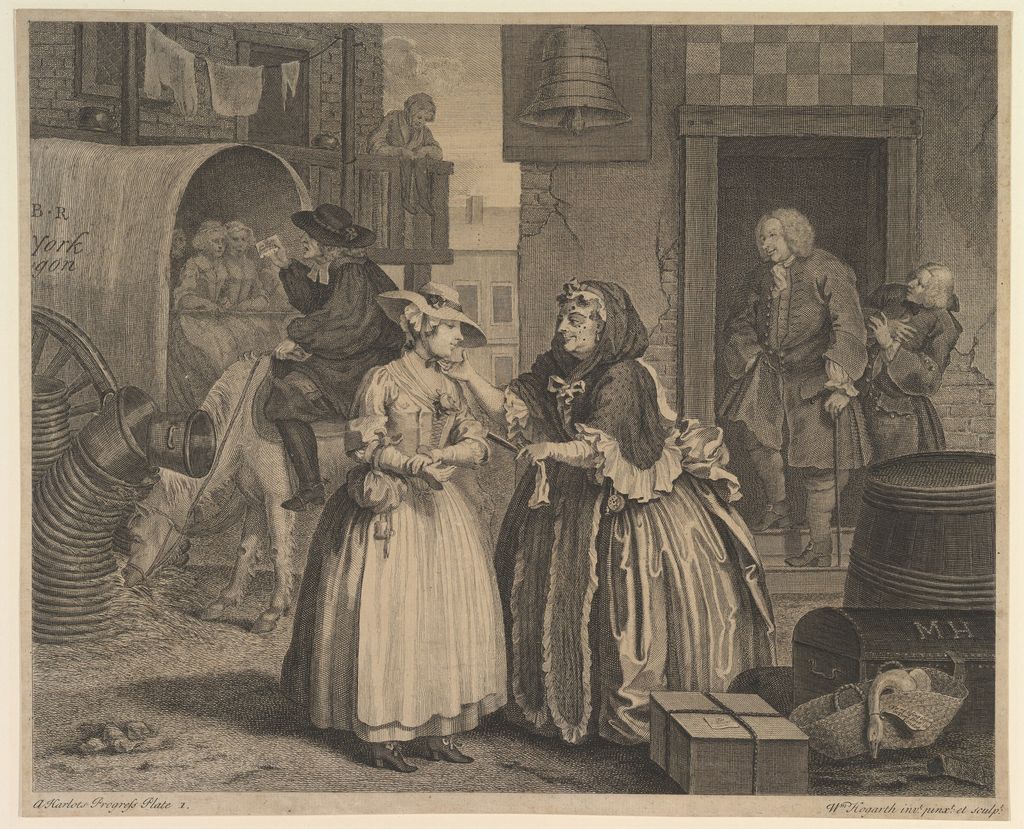
A Harlot's Progress, Plate 1, William Hogarth, before April 1732. Etching and engraving; first state of four. 32.35(2). Harris Brisbane Dick Fund, 1932. Image source. CC0 / Public domain.
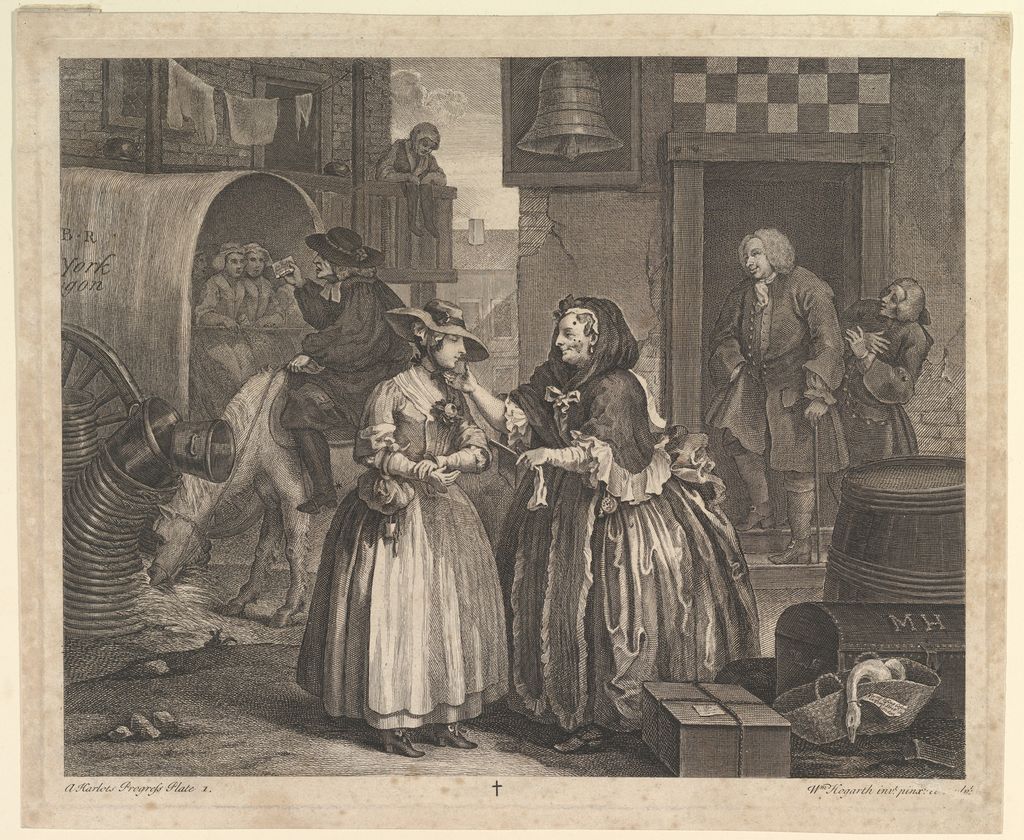
A Harlot's Progress, Plate 1, William Hogarth, April 1732. Etching and engraving; fourth state of four. 91.1.128. Gift of Sarah Lazarus, 1891. Image source. CC0 / Public domain.
Rouquet’s London for readers abroad
André Rouquet’s letters explaining Hogarth’s prints appeared in French in London in 1746. A German translation was printed as part of the Berlin and Potsdam edition of Hogarth’s Analysis of Beauty in 1754. The first letter, preserved in that translation, presents an argument for why these locally specific pictures needed explanation abroad. Rouquet thought English readers could recognise customs in a glance that readers across the Channel might need a page to understand. He also defended Hogarth’s decision to show vice at close range. In his view the artist meant to provoke revulsion, and he compared the device to the way a Spartan might teach by setting a repellent example before someone. This is a defence by an early interpreter with an audience in mind. [15] [35]
Rouquet supplies a family and a motive when he reaches the inn. He calls the clergyman Moll’s father, imagines him bringing a letter of recommendation to a bishop and explains the young woman’s approachability by her hope of securing service in a good household. These claims make a chain of circumstances out of people and things that share the yard. The letter and the country wagon are present in the picture. The relationship and its backstory are Rouquet’s additions. He also moves from the wealthy patron’s presumed Jewish identity to an explicitly prejudiced generalisation about Jewish men in trade and love. The explanatory letter shows how easily a reader’s own stock assumptions could supply what appeared to be missing from the picture. [2] [6] [15]
At the third plate, Rouquet turns to evidence small enough to overlook. The lettering on the beer jug tells him about the district through the supplier’s address. The paper used to wrap butter carries the title of a bishop’s pastoral letter, a joke in which public admonition has found a second life as shop wrapping. Rouquet reads those things alongside the loss of the silver tea service and the reduced scale of the mirror. Small marks locate the room, measure the change from earlier comfort and invite a joke about the reach of a moral text. A reader can accept the specificity of this looking while treating Rouquet’s explanation of the woman’s supposed improvidence as his moral judgement. [4] [6] [15]
For Rouquet, Plate V ends the tragedy. Plate VI is a burlesque afterpiece, an occasion to explain the undertaker’s role, the distribution of mourning accessories and the wine the distracted clergyman spills. His description separates one officiant who arranges the ceremony up to the grave from the clergyman who takes over there. That reading puts work back into a room that can seem at first to be filled with nothing but bad manners. Somebody has supplied the gloves, organised the drinking and handled the trappings of mourning. A surviving London Museum ring for Sam Forth, who died in 1724, shows how an actual mourning object could record a name, date and age in a portable form. In Hogarth’s wake the corresponding biographical information is most easily located on the coffin. The move from the room of the dying woman to the room of the funeral turns attention from a person who needs help to a person whose name can be carried away. [3] [11] [15] [36]
From full-size sheets to a folding fan
In the July 1732 issue of the Evening Post transcribed by the historian Rosanna Harrison, Martha Gamble advertised fans engraved from Hogarth’s prints and offered at the Golden Fan. The notice made faithful copying part of the sales pitch and invited purchasers to send the fans in cases. The prospect of carrying or sending these images changes the audience implied by the subscription. The scenes could circulate on an accessory that somebody could open, turn or pass to another person. [37]
An unmounted leaf in the Art Institute of Chicago shows what that change of format did to the sequence. Three separately etched subjects occupy one piece of paper just over 50 centimetres wide. Two are printed in red ink and one in olive green. The Bridewell labour, the deathbed and the funeral could now be taken in together, each in a space roughly 15 centimetres wide. The museum points to the folds as evidence that this leaf may once have been fitted for use, and explains that the first three scenes would have occupied the other side of a complete fan. The change of side would have divided the story just where the magistrate’s intervention gives way to Bridewell. [38]
The Schreiber catalogue at the British Museum records fan leaves with further reductions, including a version in which almost everything has been omitted except the partly hand-coloured arrival. That single scene has a life of its own as an encounter at an inn. The Chicago leaf works in the opposite direction, setting the institutional, medical and funeral rooms side by side. Gamble’s advertisement documents the trade in adapted designs. The surviving leaves give examples of what could be grouped together or omitted, with their own materials and catalogue dates. [37] [38] [39]
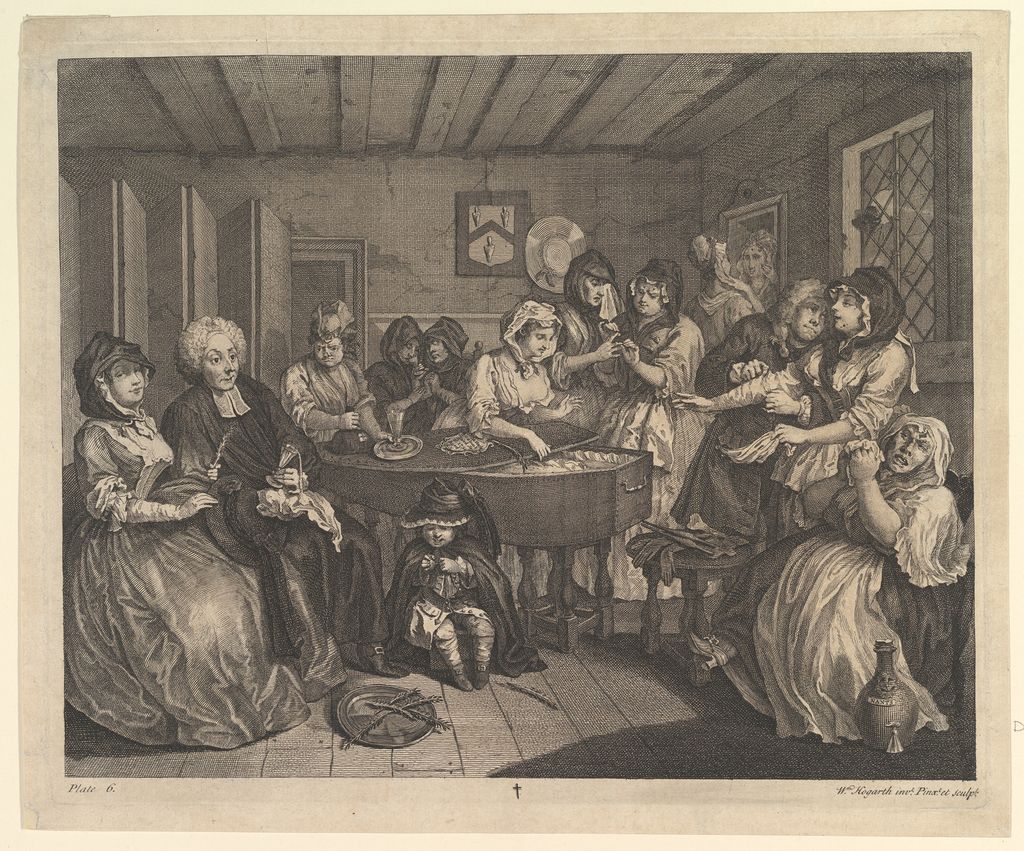
A Harlot's Progress, Plate 6, William Hogarth, April 1732. Etching and engraving; third state of three. 91.1.133. Gift of Sarah Lazarus, 1891. Image source. CC0 / Public domain.
Six cantos and a London pantomime
The Folger Shakespeare Library records The Lure of Venus, issued in London in 1733, as a reissue of Morality in Vice. The title page credits “Joseph Gay”, the name under which John Durant Breval wrote here, and advertises a mock-heroic poem in six cantos based on Hogarth’s six paintings and illustrated with prints of them. The form keeps the six-part structure and pairs a story in verse with plates within a book. The claim to derive from the paintings appears on the title page. It tells us how the publication presented its relationship to Hogarth while leaving open which images Breval or the publishers worked from. [40]
Theophilus Cibber’s The Harlot’s Progress, or, The Ridotto Al’ Fresco used Hogarth’s sequence differently. The 1733 Drury Lane text, preserved in the Huntington copy reproduced by the Augustan Reprint Society, dedicates the entertainment to Hogarth. The inn directions explicitly arrange the characters as in the first print. With the entrance of Harlequin, who jumps into the new arrival’s trunk, the print’s stationary baggage becomes a device for carrying a performer between scenes. The arrival of Miss Kitty, played by Miss Raftor, thus establishes a character who can return to help confound the other figures. [2] [41]
The tea-table episode makes the change in medium particularly clear. In Hogarth the audience can follow the falling tableware and the escape together. In Cibber’s directions, Harlequin drops his sword and cane, causing Beau Mordecai to turn and spot him. Kitty overturns the table after the discovery, and the quarrel becomes a duet. The pictures in the room subsequently change to mock Mordecai and depict Kitty and Harlequin embracing. The stage can give spectators a noise, a turn of the head and a transformation in succession. Even Bridewell has a change of props. As the women raise their implements to work, the blocks vanish and performers take their places as dancing partners. Cibber stages the arrest and the threat of forced labour, then carries Kitty and the company towards a masquerade and the Judgment of Paris. The sickroom and the wake disappear from the stage story. [5] [6] [41]
Cibber’s vanishing blocks give Kitty a way out at the point when Hogarth’s sequence takes away most of Moll’s freedom to act. The print series goes on to ask what other people do when she needs help and what they do when she can no longer see them. In the last plate they can make a social occasion out of her death. The spectator looking from the coffin to the guests has to decide where to give the attention that most of the room withholds. [2] [3] [6] [11] [41]
Browse Hogarth’s artworks
All 54 individual artworks and series stages in the approved English cluster
Frequently Asked Questions
Discussion
Look again at the images and ideas explored in A Harlot’s Progress by William Hogarth. These editorial prompts invite your observations.
Reader Insights
Which object or person helps you recognise Moll as the settings change?
Who pays attention to Moll at the inn and at the wake, and what do those people do?
Join the Conversation
Share a detail, comparison or question about A Harlot’s Progress by William Hogarth below.
References
- Sir John Soane’s Museum, Hogarth: 101, account of Vertue, the subscription and the 1732 issue. View source.
- The Metropolitan Museum of Art, A Harlot’s Progress, Plate 1, fourth state, 91.1.128. View source.
- The Metropolitan Museum of Art, A Harlot’s Progress, Plate 6, third state, 91.1.133. View source.
- The Metropolitan Museum of Art, A Harlot’s Progress, Plate 3, third state, 91.1.130. View source.
- National Galleries of Scotland, A Harlot’s Progress, Plate 4, P 6724. View source.
- The Metropolitan Museum of Art, A Harlot’s Progress, Plate 2, fourth state, 91.1.129. View source.
- The Metropolitan Museum of Art, A Harlot’s Progress, Plate 1, first state, 32.35(2). View source.
- Colonial Williamsburg Foundation, A Harlot’s Progress: Plate 2, 1972-409,4, curatorial notes on a later impression. View source.
- Wellcome Collection, Moll Hackabout dangles a watch, 38226i, catalogue description of Plate 3. View source.
- London Lives 1690 to 1800, Bridewell Prison and Hospital, sections on government, prisoners and conditions. View source.
- The Metropolitan Museum of Art, A Harlot’s Progress, Plate 5, first state, 32.35(6). View source.
- Wellcome Collection, Wrapped in “sweating” blankets and close to the fire Moll Hackabout nears death as two doctors argue, 38228i. View source.
- British Museum, Lindsay Stainton and Christopher White, catalogue commentary on A harlot in her garret attended by her bunter, Z,1.3, with George Vertue, Note Books, III, p. 58, reproduced with the museum’s object data. View source.
- Peter Earle, The Female Labour Market in London in the Late Seventeenth and Early Eighteenth Centuries, Economic History Review, 42, no. 3 (1989), pp. 328–353, especially tables 10–11 and the section on migration. View source.
- Jean-André Rouquet, Briefe des Herrn Rouquet an einen seiner Freunde in Paris, first letter in the 1754 German translation, original pp. [95]–[99], transcribed in Margaret Daly Davis, FONTES 54, pp. 13–16. View source.
- Wellcome Collection, The Tryal of Colonel Francis Charteris, for a Rape Committed on the Body of Anne Bond, Dublin reprint, Sylvanus Pepyat, 1730. View source.
- Sir John Gonson, Five Charges to Several Grand Juries, third edition, London, 1730, Wellcome Collection catalogue. View source.
- London Lives 1690 to 1800, Houses of Correction, grounds for commitment and forced labour. View source.
- Museum of Fine Arts Ghent and Flemish Art Collection, Boys Peeping at Nature (A Harlot’s Progress), 1958-V-10, design and George Lambert ticket. View source.
- The Metropolitan Museum of Art, William Hogarth, Boys Peeping at Nature, fourth state, 91.1.40. View source.
- Rebekah Higgitt, “In the Society’s Strong Box”: A Visual and Material History of the Royal Society’s Copley Medal, c. 1736–1760, Nuncius 34, no. 2 (2019), nn. 58–59. View source.
- The Fitzwilliam Museum, Boys Peeping at Nature, 1751 subscription ticket, 22.K.3-121. View source.
- The Metropolitan Museum of Art, Richard Livesay after William Hogarth, Boys Peeping at Nature, 23 April 1782, 91.1.42. View source.
- Lewis Walpole Library, Yale University, Guide to the Lewis Walpole Library Collection of Prints after William Hogarth, LWL MSS 42, p. 18, box 2, folders 1–2, and box 1, folder 3. View source.
- The Metropolitan Museum of Art, A Harlot’s Progress, Plate 2, first state, 32.35(3). View source.
- British Museum, A Harlot’s Progress, Plate 1, copy after William Hogarth published by John Bowles, 1872,1214.326. View source.
- John Nichols, Biographical Anecdotes of William Hogarth, third edition, London, 1785, notes on Bakewell’s reductions and catalogue discussion of the two Progresses. View source.
- Ronan Deazley, Commentary on the Engravers’ Act (1735), Primary Sources on Copyright, section 3. View source.
- The Morgan Library & Museum, A Harlot’s Progress, set record 361979, notes on the original plates and subsequent reissues. View source.
- Royal Collection Trust, The Battle of the Pictures, 1745, RCIN 811767. View source.
- Judy Egerton, Marriage A-la-Mode, National Gallery catalogue, 2000, note 19. View source.
- Caroline Dakers, editor, Fonthill Recovered: A Cultural History, UCL Press, 2018, account of the February 1755 fire at Fonthill House. View source.
- Arthur Mayger Hind, William Hogarth: His Original Engravings and Etchings, introduction, entry XI, discussion of the Fonthill paintings and Rosebery candidates. View source.
- National Trust, A Harlot’s Progress: Quarrels with her Jewish Protector, after William Hogarth, Ascott, 1535135. View source.
- Wellcome Collection, Jean-André Rouquet, *Lettres de Monsieur ** à un de ses amis à Paris, pour lui expliquer les estampes de Monsieur Hogarth*, London, 1746, edition record. View source.
- London Museum, Objects of Love & Loss: Mourning Jewellery, gold and enamel mourning ring for Sam Forth, 1724. View source.
- Rosanna Lucy Doris Colchester Harrison, A Study of George Wilson’s Eighteenth-Century Narrative Fans as Prints and Mobile Conduct Instructors, University of Birmingham, 2019, pp. 75–76, transcribing Martha Gamble’s notice, Evening Post, 15–18 July 1732, issue 722. View source.
- Art Institute of Chicago, Plates Four, Five, and Six from A Harlot’s Progress, unmounted fan leaf, 1947.144. View source.
- British Museum, Catalogue of the Collection of Fans and Fan-Leaves Presented to the Trustees of the British Museum by the Lady Charlotte Schreiber, division VII, nos. 151–155. View source.
- Folger Shakespeare Library, John Durant Breval, The Lure of Venus, or, A Harlot’s Progress, London, 1733, English Short Title Catalogue T1720. View source.
- Theophilus Cibber, The Harlot’s Progress, or, The Ridotto Al’ Fresco, London, 1733, title page, dedication and pp. 5–12, Huntington 151783, facsimile with an introduction by Mary F. Klinger, Augustan Reprint Society 181 (1977). View source.







