


 by Tom Gurney
Tom Gurney BSc (Hons) is an art history expert with over 20 years experience
Published on June 19, 2020 / Updated on October 14, 2023
Email: tomgurney1@gmail.com / Phone: +44 7429 011000
Industry and Idleness by William Hogarth: Introduction
William Hogarth’s Industry and Idleness begins with Francis Goodchild and Thomas Idle at their looms and ends with a London crowd trying to see each of them. Between the workshop and the two public processions, the twelve prints of 1747 follow the men through church, marriage, business, crime and civic office. Goodchild ends up in the Lord Mayor’s coach. Idle, bound for the gallows at Tyburn, rides in a cart with his coffin. The title makes diligence and idleness into characters’ defining habits. Watching the men begin as fellow apprentices gives their unequal endings much of their force. [1] [2] [3]
At a Glance
- ArtistWilliam Hogarth
- SequenceTwelve prints
- Issue1747
- Central figuresFrancis Goodchild and Thomas Idle
Contents
- The twelve plates in order
- The same work, two futures
- Church, workshop and the master’s household
- Private gains and public authority
- The second meeting and the two crowds
- What the words below the pictures do
- From drawings to impressions
- The sale of the series and its later readers
The twelve plates
, and taken in a Night-Cellar with his Accomplice William Hogarth.jpg)
The twelve plates in order
The sequence opens with both apprentices in the same room, then follows them separately. Goodchild and Idle come face to face again in plate X, where the apprentice who once worked at the next loom has become the magistrate who hears the accusation. Plates XI and XII separate the men for their final appearances. The twelve stages trace the two careers in the order Hogarth numbered them. [1] [4]
- The fellow apprentices at their looms — The master enters as Goodchild works and Idle sleeps. [1]
- The industrious apprentice at church — Goodchild sings beside a young woman in a pew. [5]
- The idle apprentice in the churchyard — Idle joins a game beside a tomb during the service. [6]
- The industrious apprentice entrusted by his master — Goodchild assumes responsibilities in the weaving business. [7]
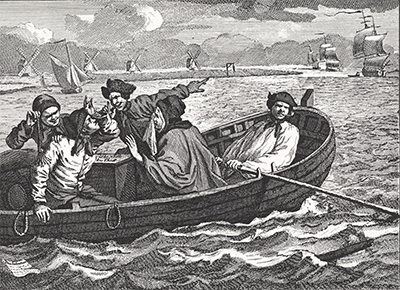
- The idle apprentice sent to sea — A smaller boat takes Idle towards a ship while his mother appeals to him. [8]
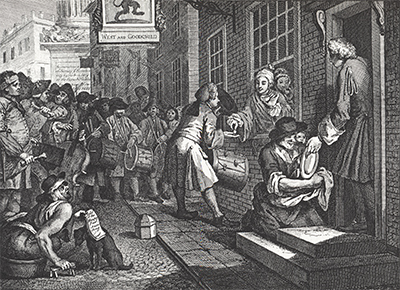
- The industrious apprentice marries his master’s daughter — The marriage and his new standing in the firm are announced on the same street. [9]
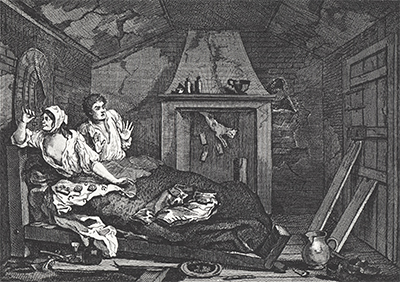
- The idle apprentice back from sea and in a garret — Idle and a woman respond differently to a disturbance in their room. [10]
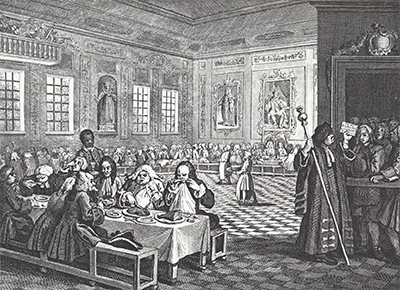
- The industrious apprentice becomes sheriff — A banquet brings officeholders, diners and servants into view. [11]
- The idle apprentice betrayed in a night cellar — A woman directs officers towards Idle and his accomplice. [12]
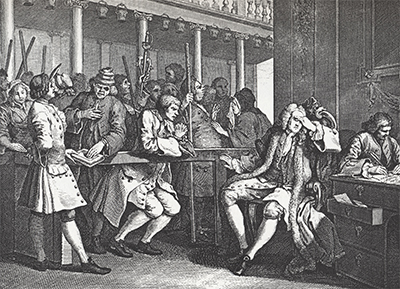
- The industrious apprentice as alderman hears the case against Idle — The former fellow apprentices meet across a bar. [4]
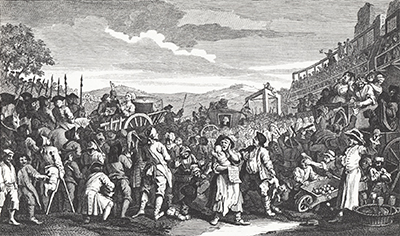
- The idle apprentice at Tyburn — A crowd packs the ground between Idle’s cart and the gallows. [2]
- The industrious apprentice becomes Lord Mayor — The coach moves through a street crowded with spectators. [3]
The same work, two futures
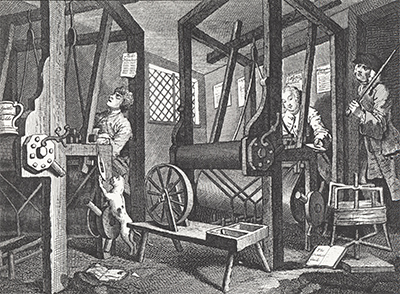
The looms in plate I make the comparison unusually precise. Each apprentice is seated at the same kind of machine. Goodchild watches his work and passes the shuttle carrying the weft across the warp. Idle’s head has sunk forward. The cat playing at his station gives that half of the shop a small movement of its own while the master comes in with a cane. Hogarth leaves room for a third person to assess the apprentices before either career has taken shape. Even the master’s entrance matters. He has the power to interrupt what he sees, and the path that opens to Goodchild will depend in part on his judgement. [1] [13]
The large tankard locates the scene through its lettering, “Spittle Fields”. The British Museum reads this as a reference to Spitalfields, the London silk-weaving district. The trade offers a point of comparison with surviving cloth. A design by Anna Maria Garthwaite records its sale to Peter Lekeux on 23 October 1747, the month in which Hogarth advertised the series. The Metropolitan Museum links it to a woven waistcoat and identifies different kinds of metal thread specified on the drawing. The drawing and textile show how specialisation, a trade relationship and knowledge of materials could lie behind an object destined for the clothing market. The two figures at Hogarth’s looms are at the beginning of learning one part of that work. [13] [14] [15]
An indenture committed the apprentice’s labour for a term and bound the master or mistress to teach and maintain the young person. The written terms could cover food, clothing and lodging as well as training. A premium commonly passed to the master. Work and domestic authority could therefore be exercised by the same person, with consequences for the apprentice’s daily life well beyond the hours spent at a loom. For a City company, completion of a seven-year term with a freeman was an established route to company freedom. Admission by descent or by payment offered other routes. The City’s own freedom was separately recorded, and the right to trade independently in the City gave it practical value. [16] [17] [18]
The cane makes discipline visible in an instant. Actual apprenticeship disputes could leave a record. The City Chamberlain enrolled indentures and heard complaints, including complaints brought by apprentices. The London Archives notes that the fire of 1786 destroyed the earlier complaint books, so the detailed surviving case series starts decades after Hogarth’s publication. London Lives also preserves apprentice records from Bridewell, a different institution with its own arrangements and discipline. The fictional master’s reaction belongs to a world where a young worker could be under close supervision, and where the arrangements for binding, disciplining or releasing an apprentice depended on who had placed them and who had jurisdiction. [1] [19] [16]
The things pasted above the looms imply that the young men already have stories to choose from. Goodchild’s side includes a ballad about Whittington as Lord Mayor. Hogarth has put the end of one apprentice story on the wall at the start of another. The ballad also gives special weight to the fact that the sequence was sold as prints. A reader of the first sheet sees an apprentice working beneath a popular example of advancement, then has eleven more sheets through which to follow a new example. [1] [20] [21]
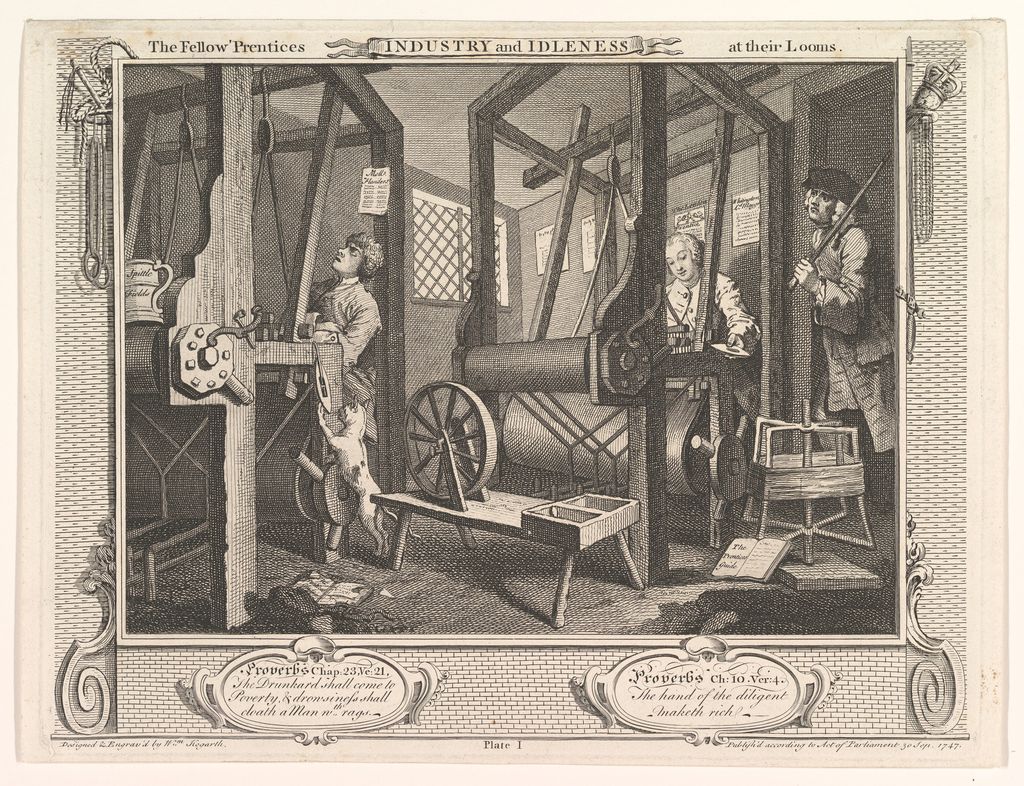
The Fellow 'Prentices at their Looms (Industry and Idleness, plate 1), William Hogarth, September 30, 1747. Etching and engraving; second state of two. 91.1.9. Gift of Sarah Lazarus, 1891. Image source. CC0 / Public domain.
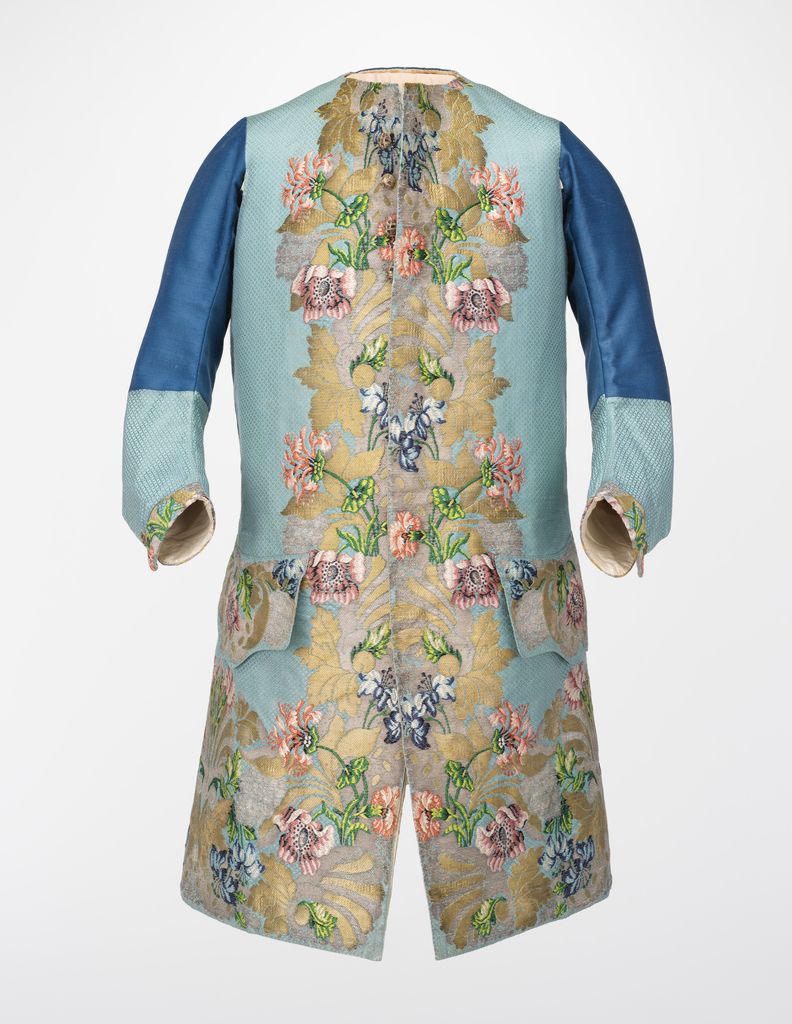
Waistcoat, Anna Maria Garthwaite, 1747. silk, wool, linen, metal. C.I.66.14.2. Purchase, Irene Lewisohn Bequest, 1966. Image source. CC0 / Public domain.
Church, workshop and the master’s household
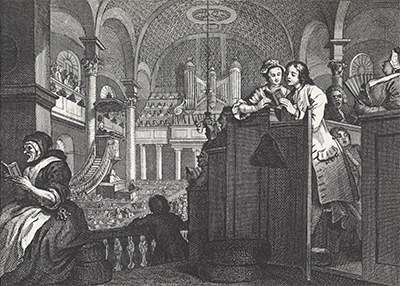
Plates II and III divide the setting into an interior and an exterior. Upright figures in pews, a shared book and the architecture of the church organise Goodchild’s picture. An early commentator, John Ireland, identifies the woman beside him as the master’s daughter. Read alongside the wedding scene, the proximity gives their later marriage a beginning in a place where they can already be seen together. The parish was a social and administrative unit as well as a place of worship. In the London parish of St Dionis Backchurch, for example, church collections and poor rates funded different channels of relief. In Hogarth’s picture, sharing a pew and a book makes Goodchild’s place in one company immediately visible. [5] [21] [9] [22]
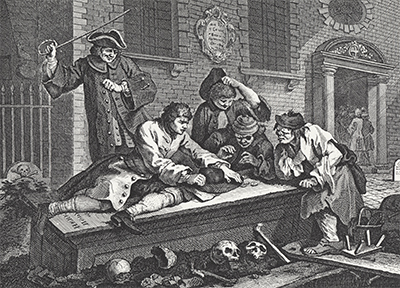
In the churchyard Idle bends with his companions over a tomb. The players make a small circle around the game, and the raised arm of the parish officer disrupts it. The place chosen for play is important. Moving the scene to an ordinary yard would lose both the tombstone under the players’ hands and the service taking place on the other side of the wall. Hogarth’s pair turns group activity into evidence of character. The people in the pew take their cue from a common text, while the people around the tomb watch the game and each other. Both apprentices have found company. The adjacent pictures ask the viewer to judge what each group does with its time and what sort of notice it attracts. [5] [6] [21]
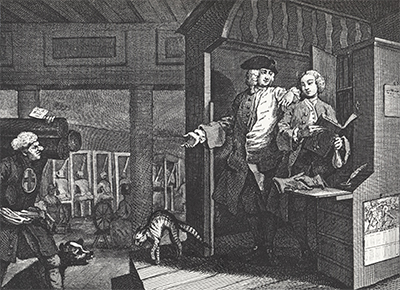
By plate IV, Goodchild’s relation to the master has changed. The older man stands close, with his hand on the apprentice’s shoulder. The keys and book bring the keeping of goods and accounts into a picture that still has work going on behind them. Goodchild’s hands now help manage the trade in which they were trained. The verse from Matthew’s parable of the talents promises a faithful servant responsibility over more things. In the workshop the biblical reward becomes visible as access to records and property, granted by a man whose business depends on finding someone he can trust with them. [7] [21]
The boat in plate V gives Idle’s departure a definite direction. The vessel carrying him is small, and the larger ships among the river traffic make the shore and the workshop seem further away. The woman customarily identified as his mother raises her hands. A figure hanging in the distance gives the waterman, who points towards it, an answer to her appeal. What appears as a warning beside the river becomes the destination in plate XI. The proverb below locates the injury of the son’s folly in the mother’s grief. A reader can see the dispatch, the family reaction and the boy’s behaviour together. Hogarth passes over the terms of Idle’s departure, the kind of service he enters and what happens aboard ship. The next time he appears, he is already back in London. [8] [10] [21] [2]
Goodchild’s return to the foreground in plate VI moves the story from an apprenticeship into a family and a firm. “Out of his time” means that his term of service has ended. At the top of the image, he reaches from a window towards the drummers gathered below. Lower down, a servant offers food at the door. Behind the street activity is the base of the Monument, and the name West and Goodchild appears on the sign. The lettering gives the business relationship a public form. Marriage to West’s daughter ties Goodchild to the household, while the sign associates him with West in trade. Anybody passing the house can read his name above the street. Hogarth gives the neighbourhood the same evidence of the change that he gives the viewer. [9] [21] [17]
The earlier city comedy Eastward Ho! offers a specific parallel. In the 1605 play by George Chapman, Ben Jonson and John Marston, two apprentices serve the goldsmith Touchstone. Quicksilver claims that changing money and lending to gambling gentlemen will make him useful to his master. Golding marries Touchstone’s daughter Mildred and later reports an unexpectedly rapid ascent in City affairs. Marriage and a family business give his advancement a setting, while Quicksilver tries to make an unofficial business of his companions’ losses. The play also gives Quicksilver a chance to win back sympathy through a public performance of repentance. In Hogarth’s version the public performance takes place at Tyburn, with Idle’s last words sold by a stranger. The comparison shows how differently two London stories can handle the same contrast between ways of getting ahead. [23] [24] [2]
Private gains and public authority
In plate VII, Idle sits up in bed at the sound of a cat coming down the chimney. Watches and pistols suggest a means of living that the picture leaves offstage. His companion is occupied with an earring while he looks towards the disturbance. Look back to the keys and book in plate IV. There, responsibility for goods makes an apprentice valuable to other people. Here, portable property gives its owners reason to fear discovery. One set of objects makes a worker accountable to his employer. The other gives the couple reason to listen for footsteps. The verse from Leviticus, about the sound of a shaken leaf putting people to flight, attaches the fear to Idle’s reaction. [10] [7] [21] [25]
Plate VIII replaces the garret bed with the long table of a civic feast. Faces cluster over food, and servants squeeze through the available space. Colonial Williamsburg identifies Goodchild and his wife as the guests of honour at Guildhall. She has gone from a shared pew to a place at a civic table. To one side, a man holding a staff inspects a paper addressed to Goodchild as sheriff. Wealth is apparent in what the household or hall can put on the table. Office is legible in the address on the document, which has to pass through somebody else’s hands. Hogarth allows appetite to compete with civic dignity. Some of the most conspicuous gestures in this picture of advancement belong to people eating. [11] [26] [21]
The sheriff’s title also leads forward to the workings of criminal justice. The City of London elected two sheriffs to annual office, and their historic duties at Newgate included custody of prisoners and bringing them to trial. Goodchild’s change in standing is therefore more consequential than his new access to a feast suggests. Later, as alderman, he receives a man whose liberty is at stake. Hogarth makes the path from wealth to office intelligible by showing the papers, people and privileges that accompany it, while leaving the elections that would have occupied a real candidate outside the story. [27] [11] [4]
The night cellar in plate IX is another crowded interior. Idle and his companion divide portable valuables, while a body is being put down an opening in the floor. In the doorway a woman brings the officers’ attention to the group. Hogarth has put an illicit reckoning and the means of its interruption in the same room. The scene is often read as a return of the woman from the garret, as Ireland reads it. Her action now changes the direction of the story. The print’s title and the extract from Proverbs cast it as betrayal and give the woman the role of a huntress. In the action of the picture she is also the person who can tell the officers where to look. Neither the title nor her position at the doorway establishes what anyone has promised her. [12] [10] [21]
The second meeting and the two crowds
Plate X returns to the relationship established in the workshop. Goodchild is seated with authority at one side of the composition. Idle, held at the bar, leans towards him. An accomplice gives evidence, and weapons are raised where they can be seen. The furniture and railing make the division between the two men as clear as their looms once made their equality. Goodchild raises a hand to his face, a gesture Ireland interprets as shock at recognising the man before him. A woman pleads at the opposite end of the room. Ireland reads her as Idle’s mother, recalling the raised hands in the boat scene. He also reads the informer as a man we have seen gaming in the churchyard. That identification makes the two groups in plates II and III more consequential. Giving evidence is a new way for one of Idle’s former companions to act on his own behalf. Ireland identifies the paper under the clerk’s pen as a warrant of commitment to Newgate. [4] [1] [6] [8] [21]
Watch Hogarth’s paintings and prints
Five films on Hogarth’s painted stories, prints, drawing methods and work for the Foundling Hospital.
In 60 seconds: Hogarth's 'Gin Lane' & 'Beer Street'
A short introduction to the contrasting streets, the shops and the people in Hogarth’s paired prints.
Watch on YouTubeAn eighteenth-century City magistrate could take statements and decide whether a suspect should be committed for trial. The hearing shown in plate X fits that function. The title says that Idle is brought before Goodchild and accused by his accomplice. The sequence jumps from the hearing to the cart at Tyburn, passing over trial, verdict and sentence. That gap matters when reading actual cases. The printed Old Bailey Proceedings recorded trials and sentences. For a capital case, a sentence and its eventual execution were distinct events, and other records can be needed to determine whether a prisoner received a pardon or was put to death. Newgate was a place of detention. For much of the century, those taken from it to be hanged typically travelled to Tyburn. [4] [28] [29] [30]
At Tyburn in plate XI, the triangular gallows stand beyond a broad field of heads. Idle’s cart carries his coffin and a man the London Museum identifies as a Methodist preacher. The act named in the title is imminent. The sheet devotes its space to waiting, looking and doing business in the crowd. A woman in the foreground holds up Idle’s supposed last speech and confession for sale. The words of the dying man are available as merchandise even before the punishment has taken place in the picture. A grandstand, customers on the ground and the riders moving with the cart make the occasion accessible to people with different places and purposes in the gathering. [2] [31]
Publication was part of the historical occasion too. The Ordinary of Newgate was the prison chaplain, and accounts issued under his name followed executions at Tyburn. A surviving title recorded by Wellcome names nine people executed on 21 January 1746–7 and dates the event by William Benn’s mayoralty. The chaplain’s published account, with its claim to supply behaviour, confessions and dying words, and the single sheet hawked in Hogarth’s fictional crowd belong to related forms of commercial print. The named mayor on the title page also puts the two endings of the series in an unexpectedly close historical relationship. A year of civic honour could serve as a way of dating the business of execution. [32] [33] [2] [3]
The execution awaits Idle at a distance. The closing print of Hogarth’s Four Stages of Cruelty, published in 1751, brings Tom Nero’s body close, on the dissection table, with watchers arranged around the work. In Industry and Idleness, the people packed between the condemned man and the gallows repeatedly take the eye away from him. In The Reward of Cruelty, the semicircle of watchers helps direct it towards the body. Hogarth makes public punishment visible at different moments and from different distances. [2] [34]
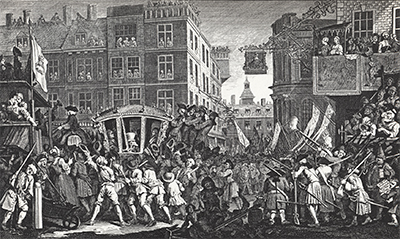
In plate XII the carrier of public honour is a coach. Its occupants are partly screened by the vehicle and the figures around it. The foreground offers a clearer view of a line of armed men, a discharge from a musket and spectators losing their balance. More people look down from windows and temporary stands. The annual Lord Mayor’s Show grew out of the incoming mayor’s journey to Westminster to take an oath. Its historical route could include the river as well as the streets. The gilded State Coach commissioned in 1757 belongs to a later moment than Hogarth’s print. Among the crowd a vendor offers an account of Idle’s ghost appearing to the Lord Mayor. It is a story advertised within the scene. The men’s physical reunion came in plate X, but the vendor supplies a further meeting in words. The confession sold at Tyburn and the ghost story at the Show turn the same man into a subject worth printing twice. [3] [21] [35] [36] [37]
A separate image of the same public ceremony makes Hogarth’s choice clearer. Canaletto’s Westminster Bridge, with the Lord Mayor’s Procession on the Thames, dated 1747 by the Yale Center for British Art, uses the river to spread out the procession and the vessels that attend it. Hogarth uses the near side of the street to pile up bodies, objects and incidents between the observer and the coach. The higher viewpoints within his print suggest how much a spectator’s position determines the view. Set beside plate XI, the raised viewing places are especially telling. People in the stands have a view across the crowd. Hogarth also makes us watch the other spectators. The prints themselves give the crowds more room. On two Princeton sheets, the plate measurements for XI and XII are each 40.5 centimetres wide against 34.8 for V and VI. The change becomes palpable when the two sets of impressions are compared. [38] [3] [2] [31] [39] [40]
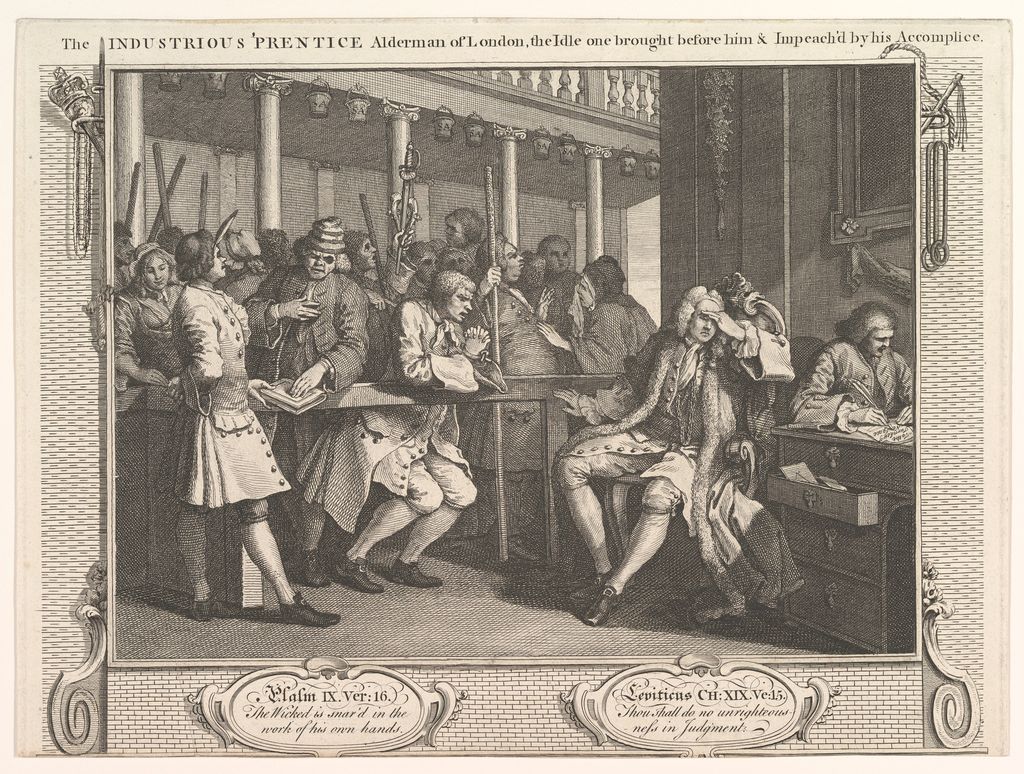
The Industrious 'Prentice Alderman of London, The Idle One Brought Before Him and Impeached by his Accomplices (Industry and Idleness, plate 10), William Hogarth, September 30, 1747. Etching and engraving; second state of two. 91.1.18. Gift of Sarah Lazarus, 1891. Image source. CC0 / Public domain.
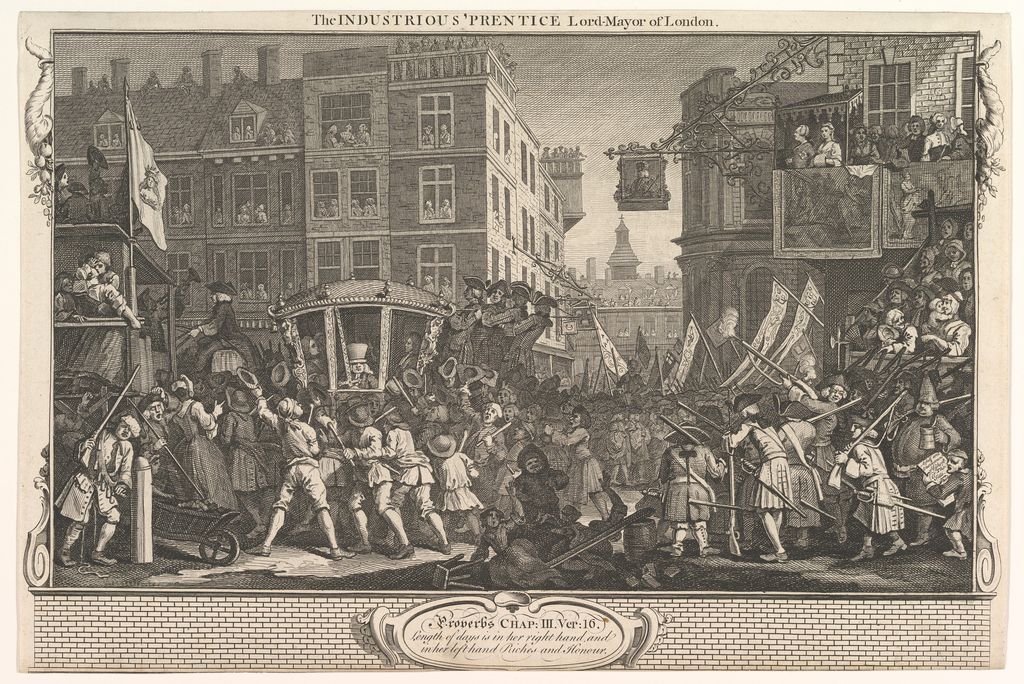
The Industrious 'Prentice Lord Mayor of London (Industry and Idleness, plate12), William Hogarth, September 30, 1747. Etching and engraving; third state of three. 91.1.20. Gift of Sarah Lazarus, 1891. Image source. CC0 / Public domain.
What the words below the pictures do
The biblical extracts act in different ways as the series progresses. Plate I sets two Proverbs against one another, attaching drowsiness and its cost to one loom, and the reward of the diligent hand to the other. Plate II speaks in the first person through Psalm 119, voicing the worshipper’s love of divine law. Plate IV borrows the approving speech of the master in the parable of the talents. By plate X, the double inscription has returned. The warning from Leviticus against injustice speaks to the person in authority, while the Psalm about the wicked being ensnared by their own works bears on the accused. The pairing gives the alderman a duty to discharge as well as giving Idle conduct to answer for. [1] [5] [7] [4] [21]
The last two sheets place threatened abandonment alongside the promise of riches and honour. In XI, Proverbs warns that a plea made in disaster will go unanswered. In XII, the book describes the rewards that wisdom carries. The plates’ margins reinforce the pairing. The opening plate sets fetters and a halter beside Idle’s verse and the symbols of civic office beside Goodchild’s. Even before either man leaves the workshop, the chain of office and the restraints of punishment sit within the same border. The crowded interiors and streets still leave room for comedy, business, fear and distraction. The words assign each scene a moral bearing. The pictures show how many people can be involved in making that judgement public, and how differently they can behave while it is being made. [1] [2] [3] [21]
From drawings to impressions
Hogarth devised Industry and Idleness for prints. Surviving drawings show how he worked towards the published sequence. The British Museum’s more finished workshop drawing, dated 1746–47, already includes the looms, the tankard and the intervention of the master. The Art Fund records two freer sketches acquired for the British Museum, for plates I and II, and distinguishes them from the more worked-out studies with ornamental frames. The frame around the action was a design problem in its own right. The title, verse, emblems and the figures inside it had to work together across a dozen separate objects. [13] [41]
The three British Museum studies for plate X make the development especially clear. Jennifer Tonkovich and Laurel O. Peterson track changes in the arrangement of figures, including the young apprentice in the foreground. Further adjustments separate the last wash drawing from the final print. That attention to the onlooker matters in the scene where both lives come together again. A young person in the room can watch what happens to the older apprentices just as the young reader for whom the series was intended can watch from outside the frame. [42] [4]
The British Museum also holds the copperplate used to print the first scene, 1990,1215.10. A design drawing records decisions on paper. The incised metal carries the image that can be inked and transferred repeatedly, turning it into an impression on paper with the image reversed from the matrix. Princeton University Art Museum holds impressions of plates V and VI on the same sheet, each with Hogarth credited for design and engraving. The two scenes show departure and advancement in consecutive order on one surviving piece of paper. That object establishes how the two impressions appear together there, while the Met’s separate impressions allow each plate to be examined in its own state. [43] [20] [40] [8] [9]
A plate number tells the reader where the action belongs. A state number identifies a distinct condition of the printing surface. The Met’s plate IV, 32.35(40), is catalogued as the first of two states, while its plate IX, 91.1.17, is the third of four. Its two impressions of the final scene, 91.1.20 and 32.35(50), are catalogued in different states. The final scene remains plate XII in both. In Princeton’s library, a hand-coloured impression of XII is listed separately from another impression of the same subject. Colour applied to a sheet is a further kind of difference and by itself tells us nothing about a change to the metal. [7] [12] [3] [44] [45]
The sale of the series and its later readers
The imprint transcribed on Princeton’s pair gives 30 September 1747 and cites an Act of Parliament. The London Evening Post for 15–17 October announced all twelve prints at twelve shillings. Mark McNally found further notices in three London newspapers, with announcements continuing into March 1748, and records an option on better paper at fourteen shillings. The September line is the date carried in the design, and the October notice documents the offer of the complete series for sale in the press. An impression pulled later can carry the same engraved line. The National Gallery of Victoria’s set, catalogued as published by John Boydell, retains the 1747 date in its printed inscriptions. [40] [46] [15] [37]
Hogarth’s stated wish to reach young people survives in an account John Ireland and John Nichols attribute to his handwriting. Hogarth explains the descriptive titles at the top and links ease of comprehension with the expense of making and buying the work. The two prices show how the same set could be offered on different terms. An employer or parent might buy prints for a young person to see. The description of the intended reader and the repeated offers in the press give a clearer picture of Hogarth’s sales pitch than of the people who paid for the set. [21] [46] [15]
The Act invoked in the imprint provided the legal framework for the trade in recent designs. The Engravers’ Act of 1735 gave qualifying designs fourteen years’ protection from publication, and required the date and proprietor’s name to be engraved. Cristina S. Martinez traces the difficulties Jane Hogarth faced after the earlier protection had elapsed and the further legislation that addressed her interests. Robert Sayer listed Industry and Idleness in his 1766 catalogue and included the series in the 1768 volume Les Satyres de Guillaume Hogarth. The volume pairs a French title with an index for readers of English. [47] [48] [40]
Another 1768 publication, John Trusler’s Hogarth Moralized, put explanatory prose beside newly engraved, smaller versions of Hogarth’s designs. In a later edition of Trusler’s account, the commentator takes the trouble to work through the foreground of the Tyburn scene, dwelling on the people who come to see it and the disturbances they cause. The same crowd that interrupts the view of the accused becomes a second moral example in the prose. Jane Hogarth’s involvement in that venture and her disputes with competing publishers show that a recognisable series could support several distinct commercial undertakings. Much later, the 1822 folio The Works of William Hogarth advertised a different proposition on its title page, impressions from original plates restored by James Heath. The smaller illustrations offered a place to pause within a book. The folio sold the authority of an older printing surface. [49] [25] [48] [50]
Thomas Cook’s engravings offer a particularly clear comparison. Princeton’s Graphic Arts Collection lists his copies of all twelve subjects, including the alderman’s hearing dated 1 July 1795 and a mayoral scene dated 1 December that year. In Wellcome’s copies of the opening scene and Tyburn, the credit separates Hogarth’s role as designer from Cook’s as engraver. The Proverbs are still in place at the looms. At Tyburn, the woman still offers Idle’s confession for sale. Those continuities preserved the narrative and its printed words for another public, while the address and date on the Cook sheets place the objects in the publishing trade of the 1790s. [51] [52] [53]
A periodical could alter the story through selection alone. Brian Maidment reproduces the 1824 Saturday Night adaptation of the opening plate, headed “The Idle Apprentice”, with two columns of explanation beneath the image. That heading already gives one figure priority in a scene Hogarth had titled for both. In 1834 the Penny Magazine selected among the stages and omitted plates VII, VIII, XI and XII. With the garret, feast and both public endings missing, a reader of that selection would lose the comparison between two ways of acquiring goods and between two ways of drawing a crowd. The complete series gives the two apprentices their separate careers, then insists that we judge the places, authorities and spectators they have in common. [54] [1] [10] [11] [2] [3]
Browse Hogarth’s artworks
All 54 individual artworks and series stages in the approved English cluster
Frequently Asked Questions
Yes. Plate ten brings them together in a hearing. Goodchild sits as an alderman while Idle is brought before him and implicated by his accomplice. [4]
Discussion
Look again at the images and ideas explored in Industry and Idleness by William Hogarth. These editorial prompts invite your observations.
Reader Insights
How do Hogarth’s settings change as the apprentices gain or lose authority?
What does the tenth plate make you notice when you go back to the first?
Join the Conversation
Share a detail, comparison or question about Industry and Idleness by William Hogarth below.
References
- The Metropolitan Museum of Art, William Hogarth, The Fellow ’Prentices at their Looms (Industry and Idleness, plate 1), 91.1.9. View source.
- The Metropolitan Museum of Art, William Hogarth, The Idle ’Prentice Executed at Tyburn (Industry and Idleness, plate 11), 91.1.19. View source.
- The Metropolitan Museum of Art, William Hogarth, The Industrious ’Prentice Lord Mayor of London (Industry and Idleness, plate 12), 91.1.20. View source.
- The Metropolitan Museum of Art, William Hogarth, The Industrious ’Prentice Alderman of London, The Idle One Brought Before Him and Impeached by his Accomplices (Industry and Idleness, plate 10), 91.1.18. View source.
- The Metropolitan Museum of Art, William Hogarth, The Industrious ’Prentice Performing the Duty of a Christian (Industry and Idleness, plate 2), 91.1.10. View source.
- The Metropolitan Museum of Art, William Hogarth, The Idle ’Prentice at Play in the Church Yard (Industry and Idleness, plate 3), 91.1.11. View source.
- The Metropolitan Museum of Art, William Hogarth, The Industrious ’Prentice a Favorite, and Entrusted by his Master (Industry and Idleness, plate 4), 32.35(40). View source.
- The Metropolitan Museum of Art, William Hogarth, The Idle ’Prentice Turned Away and Sent to Sea (Industry and Idleness, plate 5), 91.1.13. View source.
- The Metropolitan Museum of Art, William Hogarth, The Industrious ’Prentice Out of his Time and Married to his Master’s Daughter (Industry and Idleness, plate 6), 91.1.14. View source.
- The Metropolitan Museum of Art, William Hogarth, The Idle ’Prentice Returned from Sea and in a Garret with a Common Prostitute (Industry and Idleness, plate 7), 32.35(44). View source.
- The Metropolitan Museum of Art, William Hogarth, The Industrious ’Prentice Grown Rich and Sheriff of London (Industry and Idleness, plate 8), 91.1.16. View source.
- The Metropolitan Museum of Art, William Hogarth, The Idle ’Prentice Betrayed by his Whore and Taken in a Night Cellar with his Accomplice (Industry and Idleness, plate 9), 91.1.17. View source.
- British Museum, William Hogarth, The Fellow ’Prentices at their Looms, preparatory drawing for plate I, 1896,0710.2, collection record on Google Arts & Culture. View source.
- The Metropolitan Museum of Art, Waistcoat, textile designed by Anna Maria Garthwaite and woven by Peter Lekeux, C.I.66.14.2. View source.
- Mark McNally, The Marketing Techniques of William Hogarth (1697–1764), Artist and Engraver, Durham University, 2014, pp. 168–169 and note 65. View source.
- London Lives 1690–1800, Apprenticeship Indentures and Disciplinary Cases (IA), including the St Botolph Aldgate indenture and Bridewell apprentice records. View source.
- The London Archives, Livery Company Members and Apprentices. View source.
- The London Archives, Freedom of the City of London. View source.
- The London Archives, Reforming the Recalcitrant Apprentice, Chamberlain’s Court complaint books, COL/CHD/AP/04/02. View source.
- British Museum, William Hogarth, The Fellow ’Prentices at their Looms, 1868,0822.1572, museum description reproduced with the impression. View source.
- John Ireland and John Nichols, Hogarth’s Works, with Life and Anecdotal Descriptions of His Pictures, vol. 1, Industry and Idleness, pp. 268–296, Chatto and Windus collected edition. View source.
- London Lives 1690–1800, Parish Relief, section on parochial pensions and St Dionis Backchurch. View source.
- George Chapman, Ben Jonson and John Marston, Eastward Ho! (1605), acts I, II, IV and V, ed. Suzanne Gossett and W. David Kay, EMOTHE edition. View source.
- Maren L. Donley, “The Mechanics of Virtue,” Renaissance Drama 41 (2013), sections I–III. View source.
- John Trusler, The Works of William Hogarth, in a Series of Engravings, London, Jones, 1833, Industry and Idleness, plates VII and XI. View source.
- Colonial Williamsburg Foundation, William Hogarth, The Industrious ’Prentice Grown Rich & Sheriff of London, plate VIII, 1947-485,A. View source.
- City of London Corporation, An Historical Background of the Sheriffs. View source.
- London Lives 1690–1800, Justices of the Peace and the Pre-Trial Process. View source.
- London Lives 1690–1800, Old Bailey Proceedings: Accounts of Criminal Trials (OBP). View source.
- London Museum, The History of London’s Newgate Prison. View source.
- London Museum, William Hogarth, The Idle ’Prentice Executed at Tyburn, collection object 93353. View source.
- London Lives 1690–1800, Ordinary’s Accounts: Biographies of Executed Convicts (OA). View source.
- Wellcome Collection, Samuel Rossell, The Ordinary of Newgate His Account for 21 January 1746–7, London, 1747, title and imprint record, aj43p6ys. View source.
- The Metropolitan Museum of Art, William Hogarth, The Reward of Cruelty (The Four Stages of Cruelty), 91.1.139. View source.
- The Lord Mayor’s Show, History of the Lord Mayor’s Show, the journey to Westminster. View source.
- Cambridge University Library Special Collections, “A Day of Great Triumph” – the Lord Mayor’s Show at 800, including the State Coach of 1757. View source.
- National Gallery of Victoria, William Hogarth, Industry and Idleness, twelve impressions published by John Boydell, catalogue and inscription records. View source.
- Yale Center for British Art, Canaletto, Westminster Bridge, with the Lord Mayor’s Procession on the Thames, 1747, B1976.7.94, collection label. View source.
- Princeton University Art Museum, William Hogarth, Plates 11 and 12, from the Series Industry and Idleness, x1988-61, measurements and inscriptions. View source.
- Princeton University Art Museum, William Hogarth, Plates 5 & 6 from the Series Industry and Idleness, x1988-58, measurements and inscriptions. View source.
- Art Fund, William Hogarth, Sketches for Two Engravings from “Industry and Idleness”, plates I and II, British Museum acquisition. View source.
- Jennifer Tonkovich and Laurel O. Peterson, “Hogarth and the Making of the Four Stages of Cruelty,” Master Drawings 62, no. 1 (2024), pp. 28–29, figs. 11–14. View source.
- British Museum, William Hogarth, The Fellow ’Prentices at their Looms, copperplate, 1990,1215.10. View source.
- The Metropolitan Museum of Art, William Hogarth, The Industrious ’Prentice Lord Mayor of London (Industry and Idleness, plate 12), 32.35(50). View source.
- Princeton University Library, Vicki Principi, William Hogarth Collection, GC113, drawer 2, plate XII impressions. View source.
- John Rembury, “James Gillray and the Origins of the ‘Sunday Adventure’ Comic,” p. 50, transcription of the London Evening Post notice, 15–17 October 1747. View source.
- Ronan Deazley, “Commentary on the Engravers’ Act (1735),” Primary Sources on Copyright (1450–1900), section 4. View source.
- Cristina S. Martinez, “Jane Hogarth: A Printseller’s Imprint on Copyright Law,” Female Printmakers, Printsellers, and Print Publishers in the Eighteenth Century (2024), especially the section on Robert Sayer. View source.
- The Huntington, John Trusler, Hogarth Moralized, London, 1768, library record 125146. View source.
- National Library of New Zealand, The Works of William Hogarth, from the Original Plates Restored by James Heath, London, 1822, Alexander Turnbull Library G f759.2 HOG 1822. View source.
- Princeton University Library, GC113 England 18th C. Prints William Hogarth, pp. 1–2, “Copies of Hogarth by Thomas Cook”. View source.
- Wellcome Collection, Thomas Cook after William Hogarth, The Fellow ’Prentices at their Looms, 38360i, publication and lettering fields. View source.
- Wellcome Collection, Thomas Cook after William Hogarth, The Idle ’Prentice Executed at Tyburn, 38377i, publication and lettering fields. View source.
- Brian Maidment, “The Explicated Image: Graphic ‘Texts’ in Early Victorian Print Culture,” Drawing on the Victorians (2017), pp. 46–48 and figs. I.3–I.4. View source.







