


 by Tom Gurney
Tom Gurney BSc (Hons) is an art history expert with over 20 years experience
Published on June 19, 2020 / Updated on October 14, 2023
Email: tomgurney1@gmail.com / Phone: +44 7429 011000
The Gate of Calais: Introduction
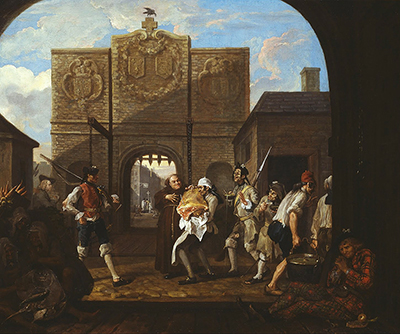
A cook staggers beneath an enormous joint of beef at the centre of William Hogarth’s The Gate of Calais. A friar reaches out to test the fat, while a soldier’s bowl tips as his attention wanders. At the far left, in a quieter corner of the scene, a hand comes down on the shoulder of a man sketching. That man is Hogarth. Tate holds the 1748 oil on canvas under its full title, O the Roast Beef of Old England (‘The Gate of Calais’), accession N01464. The canvas measures 78.8 by 94.5 centimetres. Tate credits the Duke of Westminster with presenting it in 1895. [1] [2]
Hogarth and Charles Mosley also produced an etching and engraving of the design. The Metropolitan Museum of Art dates its impression to 6 March 1749. The painting and print keep the same arrangement of incidents, including the easily missed arrest. In both, the cook’s effort and the friar’s appetite claim our attention before the artist’s predicament does. [2] [3]
At a Glance
- ArtistWilliam Hogarth
- Painting date and medium1748, oil on canvas
- Painting collectionTate, N01464
- Historic exhibition titleThe Gate of Calais, Society of Artists of Great Britain, 1761, no. 44
- Print impressionEtching and engraving by William Hogarth and Charles Mosley, dated 6 March 1749, The Metropolitan Museum of Art, 32.35(14)
This work across William Hogarth’s career
Assembly at Wanstead House
1728–31The Heir
1734The Marriage Settlement
about 1743Gin Lane
1751Canvassing for Votes
1754–55Contents
- A scene framed by two arches
- Beef, soup and the right to eat
- What happened to Hogarth at Calais?
- From the canvas to the printed sheet
- The gate as a model for later satire
A scene framed by two arches
Hogarth places us under a dark arch. Its curved edge cuts across the sky near the top of the picture, then widens into a shadow that takes in much of the right foreground. Across the open space, the sun picks out the upper stonework of the gate. Another arch opens beneath it, with the teeth of a raised portcullis silhouetted against the light. That narrow opening offers a view down the street, where a small religious procession is visible. The foreground arch gives the viewer a sheltered place to stand, while the distant gateway gives the crowd behind the beef room to recede. [2] [4]
The cook and the friar stand across the mouth of the distant arch. They are close enough for the friar to put a finger into the fat, and their movements are timed to that touch. The cook bends low and braces himself under the load. The friar draws in his free hand and extends the other, bringing his face close to the meat. Hogarth sets the ivory colour of the fat against the warmer flesh of the joint and the cooler white of the cloth below it. The apron and cap carry that brightness through the figure of the cook. There is enough light on the friar’s face and hands for us to follow his curiosity back to the same point. [2] [4]
The architecture also supplies a history for the joke. Hogarth remembered seeing traces of the English arms at Calais. The heraldic devices on the painted gate similarly evoke a time when the town was under English rule. The gate’s precise identity is uncertain. The drawbridge has prompted a comparison with the former Porte du Havre, but the rounded gateway and the English heraldry are among the details that complicate that identification. The combination works well on the canvas. An English commodity passes in front of stonework that recalls an earlier English presence, while the guards control who can stop and look. [4]
Beef, soup and the right to eat
The sirloin is destined for an English inn in Calais. Men carry a broad pot of thin soup through the same space, while a soldier in ragged clothes spills some of his portion as he looks at the beef. The fishwives to the left have a skate in a basket, its underside turned up so that it appears to have a face. Low in the right foreground sits a man in tartan, with bread and an onion close by. The pot, the basket and the scrap of bread give the eye three smaller concentrations of food around the great joint. [2] [3] [5]
The title takes up the refrain of a patriotic song associated with Henry Fielding’s The Grub-Street Opera. The song credited beef with giving Englishmen strength and courage. Tate links that appeal to the language of the eighteenth-century Patriot opposition, which looked back to an imagined age of English liberty and plenty. The picture makes the boast through bodies and portions. The meat is so substantial that a man almost buckles under it, and a serving of soup is so slight that the loss of a spoonful or a splash seems worth noticing. Those unequal portions make it easy for the viewer to equate English food with English strength. [2] [4] [5]
Hogarth gives the friar a full face and a broad body among angular, poorly fed soldiers. The Fitzwilliam Museum reads the contrast between English beef and French Lenten fare in the print as a Protestant joke about Catholic France. The little procession makes that reading visible in the painting, too. Its participants gather around a devotional act at the back, while the cook stoops and the friar attends to the beef in front. The alignment invites a burlesque comparison between the two gatherings. There is also a less flattering implication for the English claim to abundance. Plenty is on show, but the cook can only carry it, the friar can only test it, and the hungry men in the street go on eating soup. The inn’s customer remains outside the picture. [2] [5] [6]
Watch Hogarth’s paintings and prints
Five films on Hogarth’s painted stories, prints, drawing methods and work for the Foundling Hospital.
William Hogarth and the Foundling Hospital | HENI Talks
Caro Howell discusses Thomas Coram, Hogarth’s portrait of him and the artist’s work for the Foundling Hospital.
Watch on YouTubeThe seated man’s tartan adds a division within Britain to this dispute with France. In the account transmitted as Hogarth’s own, the Highlander represents one of the people who fled after the Jacobite rising of 1745. His slumped body stays low against the wall, and the provisions beside him look all the smaller for being so near the overflowing centre of the composition. He is a political type with a place in the joke about exile. His isolation also gives him a certain pathos. Most of the picture’s figures have someone beside them or something to do. Hogarth lets this man sit apart. [2] [5] [7]
What happened to Hogarth at Calais?
Tate dates the visit to 1748. In his retrospective account, Hogarth says he noticed what looked like the English arms, began to sketch, and was taken into custody. He presents his notes as the private observations of a painter and says he was confined to his lodgings until the wind changed for the crossing to England. On returning, he says, he began the picture and put himself into a corner with the soldier’s hand on his shoulder. The distinction he draws between a painter’s notes and drawings of military use explains why the sketch matters so much to the story. [2] [7]
A letter Horace Walpole wrote to Sir Horace Mann on 15 December 1748 shows that the story was already circulating that year. Walpole says Hogarth was sketching the drawbridge, was brought before the governor, and showed caricatures to establish what he did for a living. One reportedly showed a joint of beef landing for the Lion d’Argent, the English inn, with hungry friars in pursuit. According to Walpole, the officials were amused and let him go. The two accounts agree on the detention and its connection with drawing. Their details put the emphasis in different places. Hogarth recalls scrutiny of his notes and confinement. In Walpole’s telling, the caricaturist gets out of trouble by making people laugh. Walpole gives no indication that he saw it happen. [7] [8]
In the painting the encounter is still at its first moment. Hogarth, in profile behind the fishwives, looks towards the scene with his drawing hand raised. The hand behind him and the weapon coming in from the left give the guard a presence without bringing his whole body into view. Placing the incident in the shadow makes it easy to miss. Once found, it makes us reconsider our own position beneath the arch. We have been free to look into this street and linger over whatever catches our eye. Doing much the same thing with paper and pencil has exposed the man at the edge of the picture to suspicion. [2] [3] [7]
From the canvas to the printed sheet
The Metropolitan Museum of Art’s impression, 32.35(14), is an etching and engraving catalogued as the second of two states. The National Gallery of Art in Washington holds another impression, 1944.5.57, also catalogued in the second state and dated 1748/1749 in its record. Both collections credit Hogarth and Mosley. The printed design keeps the sketcher on the left and the Highlander on the right. The white cloth beneath the joint works much as it does in the painting, gathering light at the centre. On the sheet, dark hatching builds the heavy shadow beside the cook, while closer, finer lines give substance to the stonework. The printed title under the scene puts the song in the viewer’s mind at the same time as the picture. [3] [4] [9]
One difference is visible high above the action. A crow perches on the cross at the top of the gate in the oil painting. The bird is absent from the Met impression. An early anecdote held that Hogarth painted it over an accidental tear. Bernd Krysmanski, citing Elizabeth Einberg and Judy Egerton’s Tate catalogue, reports that the 1966 cleaning revealed no tear of the kind described. The bird’s presence in the oil and absence in the print establish a difference between the objects. The reason for the difference remains open. Hogarth’s paintings offer other examples of how a design changes when its colour, surface and scale are translated into line on paper. [2] [3] [4]
The gate as a model for later satire
The Society of Artists of Great Britain exhibited the painting in 1761 as The Gate of Calais, catalogue number 44. Kate Grandjouan records that when Walpole saw Henry William Bunbury’s drawing of a French post-house kitchen at the Royal Academy in 1770, he thought it might surpass Hogarth’s painting and recognised his manner in it. The British Museum holds an etching and engraving of Bunbury’s design, La Cuisine de la Poste, J,6.2, dated 1771. [10] [11]
The kinship is especially clear in the way food and clothing help locate the joke. Bunbury hangs a pot over the kitchen fire and gives his clergyman a conspicuous place among the inn’s occupants. The innkeeper’s wooden shoes and the thin postilion’s attention to his snuffbox make the room a gathering of recognisable types for a British print audience. The pot belongs to the kitchen’s ordinary activity. At Calais the pot has to be carried, the cook has to get through, and the friar interrupts his progress. Hogarth’s choice of a gateway gives the movements a political charge. For the people who turn to watch the meat go by, a meal intended for someone else briefly interrupts the ordinary business of the street. [2] [10] [11]
Browse Hogarth’s artworks
All 54 individual artworks and series stages in the approved English cluster
Frequently Asked Questions
Discussion
Look again at the images and ideas explored in The Gate of Calais. These editorial prompts invite your observations.
Reader Insights
How does finding the hand on Hogarth’s shoulder change the way you look at the scene beneath the arch?
What do the friar’s gesture towards the beef and the soldier’s tipping bowl tell you about who gets to eat?
Join the Conversation
Share a detail, comparison or question about The Gate of Calais below.
References
- Tate, O the Roast Beef of Old England (‘The Gate of Calais’), William Hogarth, 1748, N01464, collection data export. View source.
- Tate Britain, O the Roast Beef of Old England (‘The Gate of Calais’), William Hogarth, 1748, collection entry presented through Google Arts & Culture. View source.
- The Metropolitan Museum of Art, O the Roast Beef of Old England--The Gate of Calais, 6 March 1749, 32.35(14). View source.
- Bernd Krysmanski, ‘“O the Roast Beef of Old England”: Hogarth in BSEfreier Zeit vor dem Tor von Calais’, Lichtenberg-Jahrbuch, discussion of the bird and the patriotic song and notes 1–3, 41 and 51–54 (in German). View source.
- Kate Grandjouan, ‘Refugees, Patriotism, and Hogarth’s The Gate of Calais (1748)’, Studies in Ethnicity and Nationalism, vol. 20, no. 3, 2020, especially pp. 296–98. View source.
- The Fitzwilliam Museum, The Roast Beef of Old England &c., Feast & Fast, P.4776-R. View source.
- William Hogarth, retrospective account of the Calais incident, transcribed in John Ireland and John Nichols, Hogarth’s Works, vol. III, pp. 301–02. View source.
- Horace Walpole, letter to Sir Horace Mann, 15 December 1748, The Letters of Horace Walpole, vol. I, letter 267 in the linked edition. View source.
- National Gallery of Art, Washington, The Gate of Calais, or The Roast Beef of Old England, 1748/1749, 1944.5.57, Paulson 1965 no. 180, state ii/ii. View source.
- Kate Grandjouan, ‘Super-size Caricature: Thomas Rowlandson’s Place des Victoires at the Society of Artists in 1783’, British Art Studies, issue 4, 2016, fig. 4 and notes 1 and 34–35. View source.
- British Museum, The kitchen of a French post house La cuisine de la poste, after Henry William Bunbury, 1771, J,6.2. View source.







