


 by Tom Gurney
Tom Gurney BSc (Hons) is an art history expert with over 20 years experience
Published on June 19, 2020 / Updated on October 14, 2023
Email: tomgurney1@gmail.com / Phone: +44 7429 011000
The Bagnio: Introduction
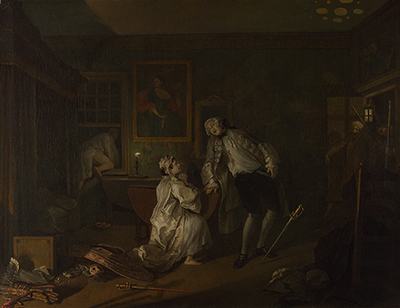
In William Hogarth’s The Bagnio, a mortally wounded earl buckles at the knees while his wife clasps her hands at his feet. Her lover, the lawyer Silvertongue, is already halfway out of the window. At the opposite edge of the room, a man with a lantern enters behind two others. Each figure moves at a different pace. The earl takes an agonisingly long time to fall, the lawyer has a moment to get away, and the men at the door are still taking in what they have walked into. [1] [2]
Painted about 1743, the oil on canvas measures 70.5 × 90.8 centimetres and belongs to the National Gallery, London, where it is catalogued as NG117. It is the fifth of six scenes in Marriage A-la-Mode. The invitation to a masquerade in The Toilette leads here to a hired room where the costumes lie discarded. The intervening masquerade takes place between pictures. Hogarth lets the abandoned masks explain where the lovers have come from while the open door and window show how abruptly their evening has changed. [1] [2]
At a Glance
- ArtistWilliam Hogarth
- PaintingAbout 1743, oil on canvas, 70.5 × 90.8 cm
- CollectionNational Gallery, London, NG117
- SeriesMarriage A-la-Mode, fifth of six scenes
- Related printSimon Francis Ravenet the elder, Plate V, etching and engraving, dated April 1745, Metropolitan Museum of Art, 91.1.111
This work across William Hogarth’s career
Assembly at Wanstead House
1728–31The Heir
1734The Marriage Settlement
about 1743The Bagnio (current article)
About 1743Gin Lane
1751Canvassing for Votes
1754–55Contents
- A room for hire
- The earl’s fall, the window and the door
- Pictures on the walls
- What Hogarth painted over
- Ravenet’s Plate V
A room for hire
The smallest clue to the setting is a crumpled bill on the floor. It bears a Turk’s head and the words The Bagnio. The term came from the Italian bagno, meaning a bath or bathhouse. Some London establishments offered Turkish-style baths, sometimes alongside a coffee house. The historian Louise Falcini cites a March 1700 advertisement for the Royal Bagnio in Newgate Street that promotes separate rooms for sweating at different degrees of heat. It is evidence of what one London business offered its customers. The emblem in Hogarth’s invented scene belongs to a sign used by more than one establishment and gives no secure street address for the countess’s room. [2] [3]
Hogarth makes the room’s immediate purpose clear through its furniture. The bed is rumpled, the candle has burned low, and two folded gateleg tables stand against the wall. Judy Egerton suggests that the tables might also have served for gambling. Here they are out of use, and what looks like a jumble of clothing near the bed resolves into stays, a hooped underskirt, shoes and a mask fringed to conceal the mouth. The ribbed hoop has partly collapsed. The overturned chair and the stays caught across a bundle of firewood suggest the haste with which the room was put to use. The scene gives little indication of how long the couple spent in the room. [1] [2]
The earl’s fall, the window and the door
The earl has been stabbed by the time we see him. His sword has dropped point down. The bloodied blade beside the hoop is Silvertongue’s. Egerton questions the familiar description of the fight as a duel, which ordinarily required a formal challenge and seconds. The broken lock suggests that someone forced the door, probably the earl. How he found the room and what happened as he entered are left open. His wife’s clasped hands are just as visible as the blades. They may express remorse, though the gesture also belongs to the theatre, where kneeling and clasping the hands can do duty for any number of appeals and protestations. [2]
A shadow under the bloodied blade prolongs the action after the blow. Egerton identifies its probable source as a pair of fire tongs hanging out of sight. On the floor the branching shadow resembles the earl’s long legs, and the blade crosses it as if delivering a second thrust. The figure above is still upright enough to dominate the composition. Below, he is already reduced to something as insubstantial as a shadow. Across the room the watchman’s lantern throws a barred shadow on the door, while the candle flame below the wall pictures bends in the draught. The entrance and escape register in the light as well as in the figures’ movements. [1] [2]
Egerton identifies the first man at the door as the proprietor, accompanied by a constable with a staff and a lantern-bearing watchman. She compares the proprietor’s simultaneous advance and recoil to the doctor in a scene by Antoine Watteau, engraved by Charles-Nicolas Cochin the elder. The Louvre holds an impression whose caption warns a young woman against the deceitful Harlequin. The comparison suggests how a pose from stage comedy can work in Hogarth’s darker scene. The proprietor has arrived in time to witness the consequences. Silvertongue, looking back into the room from the window, is still trying to avoid being seen. [2] [4]
Watch Hogarth’s paintings and prints
Five films on Hogarth’s painted stories, prints, drawing methods and work for the Foundling Hospital.
William Hogarth, Marriage A-la-Mode (including Tête à Tête)
A close look at Tête à Tête and how its figures and furnishings advance the story of the marriage.
Watch on YouTubePictures on the walls
The Judgement of Solomon hangs behind the action as a tapestry. Above the door Egerton identifies Saint Luke. Near the window a woman dressed as a shepherdess holds a squirrel. Her portrait overlaps a pair of booted legs visible below the frame, an arrangement that makes the two images look momentarily connected. The pastoral costume borrows the appearance of fashionable portraiture, while the squirrel carried a derogatory slang meaning that licenses a less genteel reading. The woman’s sidelong gaze seems to take in the kneeling countess. The earl, meanwhile, has his head framed by what Egerton reads as a looking glass. The frame gives his face the prominence of a portrait and recalls the mirror in the first scene, in which he seems preoccupied with his own reflection. The portrait gives the countess an apparent witness inside the room. [1] [2]
Egerton also suggests that the booted legs may echo those of Samuel McPherson in a popular engraving published in 1743, after the Highland corporal was shot for desertion. The identification is conjectural. Its point, if the allusion was intended, is in the juxtaposition. The legs in the decoration sit close to Silvertongue’s bare ones as he abandons the countess. Hogarth needs very little of the possible source to make the comparison work, and the joke of the ill-matched pictures is visible even without recognising the printed model. [1] [2]
What Hogarth painted over
When David Bomford and Ashok Roy examined the canvas, X-radiography revealed a woman moving away at the left edge with a sword held across her body. Infrared imaging also disclosed the figure, with the sword apparent only in the radiograph. Her cap and loose clothing recall those of the kneeling countess. If she is an earlier version of that character, as the researchers proposed, Hogarth changed the countess’s part in the action considerably. A woman taking a sword away draws attention towards evidence leaving the room. The kneeling figure keeps attention on what is happening between husband and wife while the sword stays in view. [2] [5]
The radiograph disclosed another woman close to the doorway, holding up a lantern. She may have been intended as the keeper of the bagnio. The door once leaned off its hinges. In the finished painting it stands open on its hinges, with the lock on the floor. Bomford and Roy drew a possible earlier arrangement in which both women appear. Their reconstruction tests how the exposed fragments might have worked together, since the two figures could belong to different stages of revision. They also found evidence of a lighter area beyond the window and wondered whether Hogarth had considered showing dawn. In the finished scene the darkness outside gives little away about the lawyer’s prospects. [2] [5]
Ravenet’s Plate V
Simon Francis Ravenet the elder made a separate etching and engraving after Hogarth’s finished composition. The Metropolitan Museum of Art’s impression, accession 91.1.111, is catalogued as the fourth state of four and dated April 1745. The Rijksmuseum’s impression helps track the reversal. In the print Silvertongue escapes through the window on the right, and the masks and the bill lie in the right foreground. The doorway is on the left. For an eye moving across the scene from left to right, the men at the door come into view before the escaping lawyer. In the oil a viewer starting at the doorway has to look back across the wounded man to catch sight of the retreating lawyer. [2] [6] [7]
The National Gallery of Victoria transcribes the engraver’s credit as R. F. Ravenet, the initials recorded by Egerton even though the engraver is identified as Simon Francis Ravenet. The lettering in the lower margin names Hogarth as designer, painter and publisher and gives 1 April 1745. The set was available for subscribers to collect in early June 1745, according to the notices cited by Egerton. The April date belongs to the publication line. The bill in the foreground belongs to the fictional night, where its small lettering does the different job of telling us what kind of room we have entered. [2] [8]
In The Lady’s Death, a printed last speech supplies the outcome of Silvertongue’s flight. The man whose face is already turning away in The Bagnio is present in the final scene only through news of his execution. The paper at the countess’s feet has changed from a bill for the room to an account of the scandal that escaped it. [1] [2]
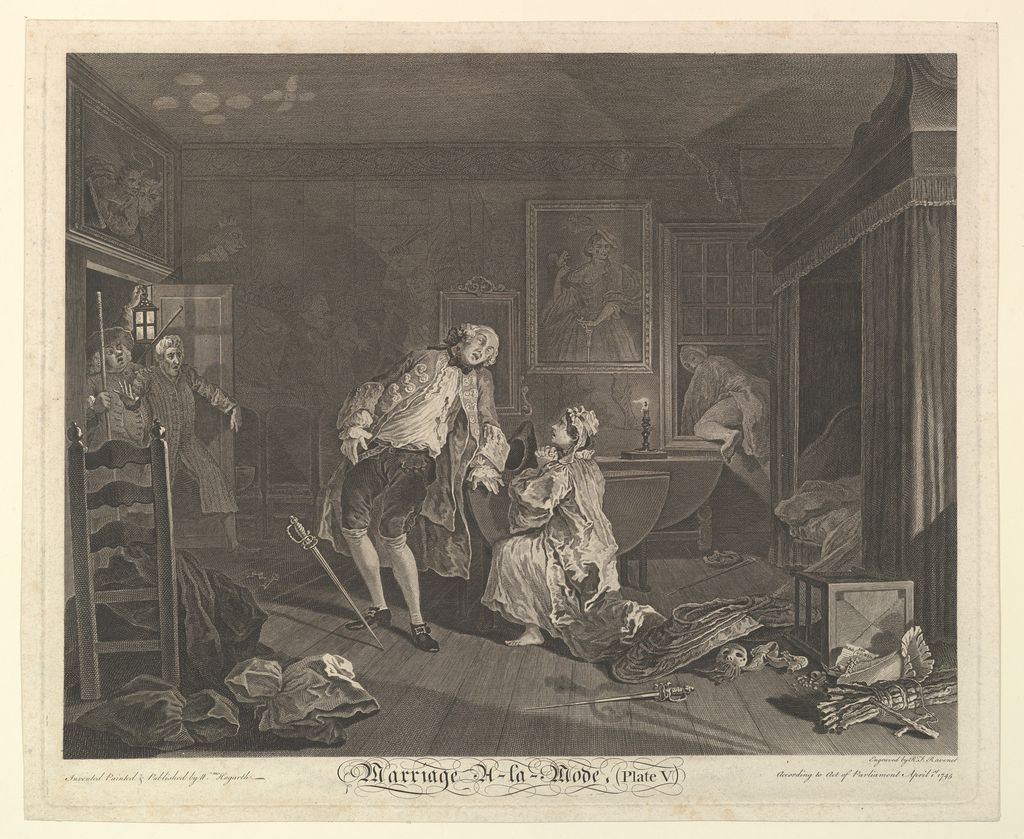
Marriage A-la-Mode, Plate V, Simon Francis Ravenet, the elder after William Hogarth, dated April 1745. Etching and engraving; fourth state of four. 91.1.111. Gift of Sarah Lazarus, 1891. Image source. CC0 / Public domain.
Browse Hogarth’s artworks
All 54 individual artworks and series stages in the approved English cluster
Frequently Asked Questions
It is painting 5 of 6 in Marriage A-la-Mode. The National Gallery catalogues the original canvas under that number in the sequence. [1]
Discussion
Look again at the images and ideas explored in The Bagnio. These editorial prompts invite your observations.
Reader Insights
What do the discarded mask and the crumpled bill each tell you about what happened before the men arrived?
How does moving Silvertongue’s escape from the left in the painting to the right in Ravenet’s print change the order in which you notice the action?
Join the Conversation
Share a detail, comparison or question about The Bagnio below.
References
- National Gallery, London, William Hogarth, Marriage A-la-Mode: 5, The Bagnio, about 1743, oil on canvas, NG117. View source.
- Judy Egerton, “Six pictures called Marriage A-la-Mode”, The British Paintings, National Gallery catalogues, 2000, NG113–118, especially “Engraved”, pp. 149–150 and 152, the discussions of NG116–118, pp. 167–174, and notes 191–192. View source.
- Louise Falcini, Cleanliness and the Poor in Eighteenth-Century London, University of Reading doctoral thesis, 2018, p. 70 and note 44, citing the Flying Post or The Post Master, 23–26 March 1700, issue 761. View source.
- Musée du Louvre, Charles-Nicolas Cochin the elder after Antoine Watteau, Belle n’écoutez rien, Arlequin est un traitre …, L 90 LR/142 Recto. View source.
- David Bomford and Ashok Roy, “Hogarth’s ‘Marriage à la Mode’”, National Gallery Technical Bulletin 6, 1982, pp. 45–58, especially figs. 15–18 and pp. 55–58. View source.
- The Metropolitan Museum of Art, Simon Francis Ravenet the elder after William Hogarth, Marriage A-la-Mode, Plate V, April 1745, etching and engraving, fourth state of four, 91.1.111. View source.
- Rijksmuseum, Simon François Ravenet the elder after William Hogarth, Dood van de graaf, Marriage A-la-Mode, Plate V, RP-P-OB-19.238. View source.
- National Gallery of Victoria, Simon François Ravenet I after William Hogarth, The bagnio, Plate V, 1745, 1995.357.5, inscription and edition fields. View source.







