


 by Tom Gurney
Tom Gurney BSc (Hons) is an art history expert with over 20 years experience
Published on June 19, 2020 / Updated on October 14, 2023
Email: tomgurney1@gmail.com / Phone: +44 7429 011000
The Industrious ’Prentice Entrusted by His Master: Introduction
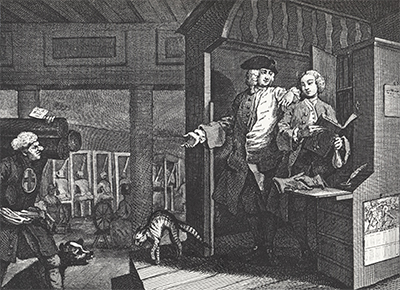
Francis Goodchild has moved from the loom to the counting house. In the fourth plate of William Hogarth’s Industry and Idleness, he holds the daybook open while his master rests a hand on his shoulder. A porter brings in rolls of cloth as the workers tend the wheels and looms at the back of the room. Hogarth shows the apprentice’s rise in the middle of an ordinary working day. A delivery gives the master an occasion to hand over some of the daily business, and gives the viewer something specific by which to judge the change in Goodchild’s position. The Metropolitan Museum of Art catalogues impression 32.35(40), an etching and engraving, as the first of two states. [1] [2]
At a Glance
- ArtistWilliam Hogarth
- SeriesIndustry and Idleness, plate 4 of 12
- Publication date inscribed on the print30 September 1747
- MediumEtching and engraving
- Metropolitan Museum of Art impressions32.35(40), first state of two, and 91.1.12, second state of two
This work across William Hogarth’s career
Assembly at Wanstead House
1728–31The Heir
1734The Marriage Settlement
about 1743Gin Lane
1751Canvassing for Votes
1754–55Contents
- The book, the keys and the purse
- A step above the workshop
- Time and the reward for service
- The impressions and the date
The book, the keys and the purse
Goodchild holds the open book in front of his chest. The words “Day Book” identify a record for entering transactions day by day. The quill in the inkstand and the other books visible through the open cabinet door put that one volume in a larger system of keeping accounts. The rolls at the left are still on the porter’s shoulder. At the right, the open book is ready for the kind of entry that would allow someone to look up the delivery later. Hogarth puts the goods and the means of accounting for them in view together. [1] [3] [4]
Keys and what appears to be a money pouch complete the group of objects. Gerald W. R. Ward, writing about the counting-house furniture in the print, suggests that the keys could belong to the desk and bookcase or to the shop. The print leaves the precise locks open to interpretation. Hogarth lets the viewer see a door swung back on the bookcase and the sloping writing surface lowered, with the compartments behind it available for use. Goodchild can now be trusted with things that ordinarily need to be locked away. His responsibilities are legible in what he is permitted to open, handle and record. [1] [3]
Two gloves lie across the front of the desk, their fingers arranged so that they seem to clasp. They suggest a handshake between men whose actual hands are occupied. Goodchild has the tools of his new duties in his grasp. The master keeps one hand on the apprentice and extends the other towards the business on the floor. Even the direction of the older man’s attention is divided. His face is turned towards Goodchild while his extended arm draws the eye towards the porter and the working room. The title calls the apprentice a favourite, a word that allows for affection as well as esteem. The little handshake makes the favour personal, while the delivery shows how much the business may depend on it. [1] [2] [3]
A step above the workshop
The step at the centre of the print is shallow. It puts both men above the workshop floor while leaving them close enough to deal with a delivery. At the left, the porter’s badge bears the arms of the City of London. The parcel tag, read by Colonial Williamsburg as “To Mr. West”, supplies the master’s name within the fiction. In the same part of the print the dog faces a cat that arches its back on the raised floor. The two animals make the change of level particularly easy to see. Their little quarrel also gives the eye a second encounter to follow below the men’s gestures and the carefully clasped gloves. [1] [2] [5]
Watch Hogarth’s paintings and prints
Five films on Hogarth’s painted stories, prints, drawing methods and work for the Foundling Hospital.
In 60 seconds: Hogarth's 'Gin Lane' & 'Beer Street'
A short introduction to the contrasting streets, the shops and the people in Hogarth’s paired prints.
Watch on YouTubeThe bright workroom at the back is full of repeated upright frames and small figures. Women appear at the looms and wheels, with much less space given to any one worker than to Goodchild or West. Hogarth has arranged the shop so that a viewer can see the labour on which the business depends at the same time as the record-keeping and personal favour that shape Goodchild’s future. R. Campbell’s The London Tradesman, published in the same year as the print, describes women spinning and winding silk in London and discusses their earnings. His trade guide supplies a context for the presence of women in the scene. Their individual duties, rates of pay and terms of employment are outside what the printed image can tell us. [1] [3] [5] [6]
The apprentice’s agreement belongs to a different kind of written record. As the London Lives archive explains, an indenture bound an apprentice to a master or mistress for a term and required training and maintenance in return. The book in Goodchild’s hands is a record of the enterprise’s daily dealings. His access to it depicts a responsibility granted within the relationship that the indenture set up. The indenture governed the larger relationship, including such matters as food and lodging. A viewer infers the particular arrangement at the desk from West’s familiar touch and Goodchild’s position beside him. The picture offers an example of how a master might reward a particular apprentice by widening the work he was allowed to do. [1] [7]
Time and the reward for service
A printed London Almanack is pinned to the desk. Its small picture above the calendar has been read as Youth or Industry seizing Time by the forelock. The calendar and daybook give time two forms in the counting house. One displays the days ahead and the other bears a name that identifies it with the business done each day. Below the workshop Hogarth sets a passage from Matthew 25:21 in a larger cartouche. In the parable of the talents a master rewards a faithful servant by putting him in charge of more. The passage lends the daily work of the shop a scriptural meaning, while the picture gives that reward the size and weight of a book, a purse and a set of keys. [1] [2] [3]
The change is easier to measure against the opening plate at the looms, where the apprentices’ behaviour is judged on the shop floor. The print immediately before this one shows Thomas Idle playing in the churchyard. There the companions give their attention to a game. Here Goodchild’s new company gives him access to goods and accounts. The next plate, in which Idle is sent to sea, takes him away from the workshop altogether. Princeton University Library’s complete sequence places those two scenes on either side of Goodchild at the desk. The alternation lets readers see the paths diverge before either apprentice reaches his eventual destination. [1] [8] [9]
The impressions and the date
Hogarth’s name and the date 30 September 1747 appear in the lower margin of the first-state Met sheet. The museum assigns that same date to 91.1.12, the impression it calls the second of two states. The National Gallery of Victoria’s impression 1278.455-3 is also catalogued as a second state. Its transcription records the same publication date in the margin and the same reference to Matthew in the cartouche. A state denotes a version of the printing plate, so the shared engraved date tells us about the publication of the design while the museum records distinguish the versions of the plate used for individual impressions. The day when either Met sheet was actually printed is uncertain. [1] [10] [11]
The scene was also remade on a separate plate. The Rijksmuseum holds Thomas Cook’s etched and engraved version, RP-P-2020-129, dated 1 December 1795. Cook preserves the workroom in the distance, the pair in the counting house and the passage from Matthew below. The later print shows how easily the composition could be recognised through the arrangement of people and objects. Even in another printmaker’s hands, Goodchild’s change of station is visible in the short distance between the looms and the open desk. [1] [12]
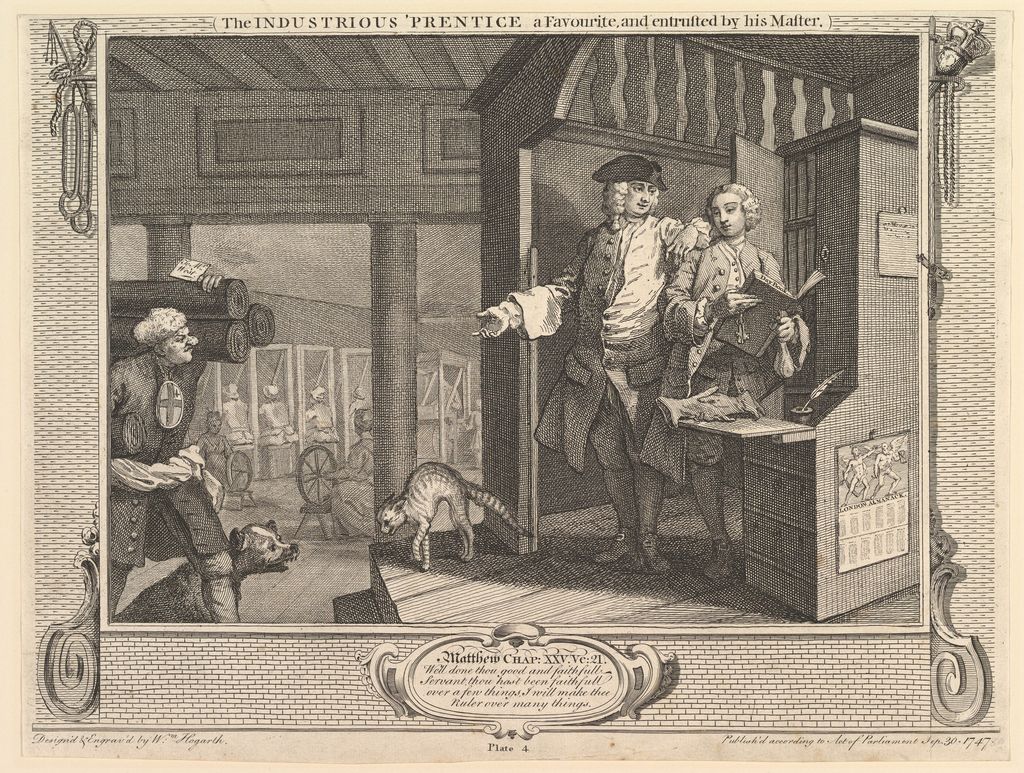
The Industrious 'Prentice a Favorite, and Entrusted by his Master: Industry and Idleness, plate 4, William Hogarth, September 30, 1747. Etching and engraving; first state of two. 32.35(40). Harris Brisbane Dick Fund, 1932. Image source. CC0 / Public domain.
Browse Hogarth’s artworks
All 54 individual artworks and series stages in the approved English cluster
Frequently Asked Questions
Goodchild holds the daybook open as a porter brings in cloth. His master stands beside him with a hand on his shoulder. [1]
It is plate 4 of 12 in Industry and Idleness. Following the plate numbers keeps Goodchild’s and Idle’s episodes in the intended order. [1]
Discussion
Look again at the images and ideas explored in The Industrious ’Prentice Entrusted by His Master. These editorial prompts invite your observations.
Reader Insights
How do the step and the placement of the looms make Goodchild’s new position visible?
What do the open daybook and the clasped gloves each suggest about the trust West places in Goodchild?
Join the Conversation
Share a detail, comparison or question about The Industrious ’Prentice Entrusted by His Master below.
References
- The Metropolitan Museum of Art, William Hogarth, The Industrious 'Prentice a Favorite, and Entrusted by his Master: Industry and Idleness, plate 4, 32.35(40). View source.
- Colonial Williamsburg Foundation, William Hogarth, Industry and Idleness – The Industrious 'Prentice a Favourite and entrusted by his Master, 1947-481,A, object description and label. View source.
- Gerald W. R. Ward, “The Merchants’ Real Friend and Companion,” in Boston Furniture, 1700–1900, Colonial Society of Massachusetts, opening discussion and fig. 1. View source.
- American Philosophical Society, Franklin Ledgers Database, “Data Structure,” explanation of daybooks and ledgers. View source.
- British Museum, William Hogarth, The Industrious 'Prentice a Favourite, and entrusted by his Master, 1848,1125.213. View source.
- R. Campbell, The London Tradesman, London, T. Gardner, 1747, p. 251. View source.
- London Lives 1690 to 1800, “Apprenticeship Indentures and Disciplinary Cases (IA),” introduction and section on apprenticeship indentures. View source.
- The Metropolitan Museum of Art, William Hogarth, The Fellow 'Prentices at their Looms (Industry and Idleness, plate 1), 91.1.9. View source.
- Vicki Principi, Princeton University Library, William Hogarth Collection, Graphic Arts Collection GC113, item listing, Drawer 2, plates 1–12 of Industry and Idleness. View source.
- The Metropolitan Museum of Art, William Hogarth, The Industrious 'Prentice a Favorite and Entrusted by his Master (Industry and Idleness, plate 4), 91.1.12. View source.
- National Gallery of Victoria, William Hogarth, plate 4 from Industry and Idleness, 1278.455-3, catalogue and inscriptions. View source.
- Rijksmuseum, Thomas Cook after William Hogarth, De ijverige leerling een favoriet en vertrouweling van zijn baas (plaat 4), RP-P-2020-129. View source.







