


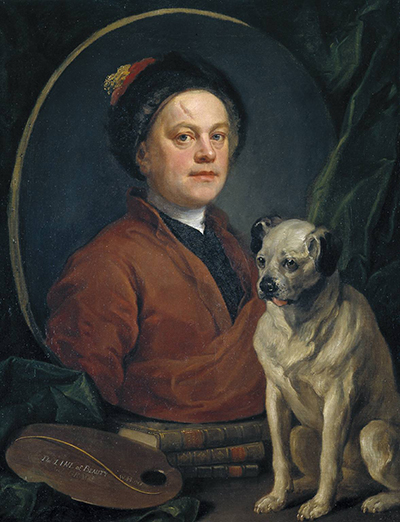
 by Tom Gurney
Tom Gurney BSc (Hons) is an art history expert with over 20 years experience
Published on June 19, 2020 / Updated on October 14, 2023
Email: tomgurney1@gmail.com / Phone: +44 7429 011000
William Hogarth Quotes: Introduction
In The Analysis of Beauty, William Hogarth asks readers to imagine a line winding around a cone. The paper gives them a single view, and they have to picture the line turning away from them. It is a small exercise in the kind of looking that Hogarth’s words demand. His comments about pictures make more sense when you can see what he is asking the eye to do, whether it is following a curve, working out who has stopped a sedan chair or trying to make out a landscape through pipe smoke. [1]
At a Glance
- The Analysis of Beauty1753 first edition, printed by J. Reeves in London. ETH-Bibliothek Zürich, Rar 265.
- The Arrest1734, oil on canvas. Sir John Soane’s Museum, P43.
- The First Stage of Cruelty1 February 1751, etching and engraving, first state of two. Metropolitan Museum of Art, 91.1.136.
- Walpole’s accountLetter to George Montagu, 5 May 1761, no. 750 in Helen Paget Toynbee’s edition.
- Time Smoking a PictureMarch 1761, etching and mezzotint, second state of three. Metropolitan Museum of Art, 32.35(76).
Contents
- What makes a line graceful?
- The picture as a stage
- What Hogarth hoped a print would do
- The conversation Horace Walpole wrote down
- Time with a pipe
What makes a line graceful?
“Simplicity, without variety, is wholly insipid” opens the chapter on simplicity in the 1753 London edition, printed by J. Reeves. Hogarth goes on to argue that simplicity helps the eye enjoy variety with ease. His example is a pyramid. The scale of its cross-section changes steadily from the base to the apex, and its appearance changes as the viewer walks round it. The cone also tapers, but circling it at the same height keeps bringing the viewer back to the same profile. The pyramid can give the eye more to do while remaining easy to take in as a whole. [1]
In the chapter on lines, Hogarth calls straight lines “least ornamental” because, considered individually, their only variation is in length. In a curved line he can vary the degree of curvature as well. The waving line, his “line of beauty”, joins two curves bending in opposite directions. His serpentine line adds a turn through space and can give grace to an already beautiful form. In figure 26 on the first plate, the cone helps the reader imagine which part of the line is approaching and which is receding. A flat outline can suggest that movement, but the movement itself is something the viewer supplies. [1]
The examples also show how much depends on what the object has to do. Hogarth can use the straight edges of a pyramid to explain variety and, a few chapters later, rank a single straight line low as ornament. The edges of the pyramid work together to make the change in its proportions apparent. In The Analysis of Beauty, the value of a line depends partly on what it helps the viewer see. [1]
The picture as a stage
“My picture is my stage, and men and women my players,” Hogarth wrote in a retrospective account transmitted by John Ireland and reprinted in the third volume of Hogarth’s Works. In the same passage he asks readers to imagine the figures in pictures and prints as performers dressed for different kinds of drama, from genteel comedy to farce. Gestures have to carry the action in a silent performance. The passage gives Hogarth’s later account of his method, and its first-person wording comes to us through an editor who arranged the material for publication. [2]
Look at the oil on canvas of The Arrest, the fourth painting in A Rake’s Progress, dated 1734 in Sir John Soane’s Museum (P43). The men who stop the chair have the warrant. Sarah Young arrives with an outstretched purse. Tom’s cane slips away as he is pulled from his seat, and a child is in position to take it. The purse and the cane give two actions different speeds. Sarah’s offer may still change what happens, while the falling cane has already passed out of Tom’s control. You can read the change in his fortunes through what the other figures are doing with their hands. [3]
The lamplighter adds a second joke at Tom’s expense. Absorbed in the commotion, he lets the oil fall on Tom’s wig. Someone coming from the earlier pictures already knows that Tom has rejected Sarah. The purse therefore carries a history of its own. The painting puts her decision, his predicament and the lamplighter’s distraction in view at once. Hogarth’s comparison with a stage helps explain why a figure apparently incidental to the arrest can alter the tone of the whole scene. [3]
What Hogarth hoped a print would do
In a separate passage printed in the same volume, Hogarth explains the choices he made in The Four Stages of Cruelty. He wanted a bold stroke to give the scene force. He also says finer engraving would have put the prints beyond the means of the people he hoped to reach. The choice of finish was a decision about who could buy the work as well as what they would see. He hoped to check the mistreatment of animals he saw in London. “If they have had this effect,” he says before declaring that he would take greater pride in the prints than in having painted Raphael’s Cartoons. The condition matters because he is describing the result that would justify that pride. [2]
Watch Hogarth’s paintings and prints
Five films on Hogarth’s painted stories, prints, drawing methods and work for the Foundling Hospital.
William Hogarth and the Foundling Hospital | HENI Talks
Caro Howell discusses Thomas Coram, Hogarth’s portrait of him and the artist’s work for the Foundling Hospital.
Watch on YouTubeIn the Metropolitan Museum of Art’s first-state impression of The First Stage of Cruelty (91.1.136), an etching and engraving dated 1 February 1751, the boy offering food to save the dog gives the viewer a point of entry into the crowded scene. The offer makes mercy visible as an action someone could take. [4] Raphael’s Cartoons, the surviving full-scale designs for tapestries, give a sense of the prestige Hogarth was willing to put in the balance. [5] In the account he left, his claim for the prints depends on what people might do after seeing them. [2]
The conversation Horace Walpole wrote down
Horace Walpole’s letter to George Montagu of 5 May 1761 gives the famous remark about the best judges of painting a setting. Walpole says he visited to see a portrait Hogarth was painting of Mr Fox. As he was leaving, Hogarth asked to read and correct the work on art that Walpole was preparing. In the dialogue Walpole records, Hogarth begins by claiming that painters know more about such matters. When Walpole presses him, Hogarth names Joshua Reynolds as a painter with genius who nevertheless offered a hundred pounds for a picture Hogarth would have kept out of his cellar. That example leads into the remark that those who “had studied painting least were the best judges of it”. [6]
The disagreement moves from buying pictures to writing about a painter. Hogarth wants Walpole to spare Sir James Thornhill, his father-in-law, from criticism. Walpole explains that his own project is antiquarian and based on George Vertue’s manuscripts. Hogarth in turn describes his undertaking as a defence of painters and blames the failure to paint better on “the good sense of the English”. Walpole makes the paradox his cue to leave. He vouches for the dialogue’s literal accuracy, yet he introduces it with a cutting description of Hogarth’s Sigismunda and ends by making fun of the painter. The letter records a participant’s version of an argument that he also wanted his friend to enjoy. [6]
The remark that genius is “nothing but labour and diligence” has a different history. William Seward’s Biographiana, published in 1799, puts it in a footnote to an account of the French naturalist Buffon and attributes it to something Hogarth told Gilbert Cooper. Seward supplies neither a date nor a source for the conversation. His comment on the anecdote admires how much Hogarth finds for every figure to do, even at the edges of a crowded canvas. The placement tells us why the story suited Seward’s discussion of talent and effort. Its exact phrasing remains the report of a later compiler. [7]
Time with a pipe
The words about Time belong to Time Smoking a Picture. The Metropolitan Museum of Art dates its etching and mezzotint impression to March 1761 and catalogues it as the second of three states (32.35(76)). Time sits on a broken statue and sends smoke from his pipe across an easel painting that his scythe has pierced. The frame carries Greek lettering headed with the name of Crates and a reference to The Spectator. John Ireland distinguishes the engraved wording from the sense of the verse he translates. His English rendering gives Time credit as an artist even as it says that he weakens what he touches. The Rijksmuseum’s paraphrase of the inscription on its own impression has Time fail as a craftsman. [8] [9] [10] The scythe doubles as a tool of Time’s trade. The mark he leaves is a hole in the canvas. The English verse under the image, “As statues moulder into worth”, gives the broken seat its own satirical value. [9] [10]
The varnish pot adds a complication. The dark surface might look to some buyers like the finish that age gives a prized old painting, but there is a man at work producing it in front of us. The Rijksmuseum says the print was probably intended as a subscription ticket for a print after Sigismunda. John Nichols described seeing an unfinished plate of that painting worked on by James Basire, with outlines completed under Hogarth’s direction. Nichols also reports that some subscriptions were taken and the money returned. [11] The picture on Time’s easel is a landscape. The link to Sigismunda comes through the proposed sale, in which Hogarth could put a satire about how buyers judge pictures into their hands as part of the transaction. [9] [10]
Browse Hogarth’s artworks
All 54 individual artworks and series stages in the approved English cluster
Frequently Asked Questions
Hogarth describes it in The Analysis of Beauty. The cone helps readers imagine how a line can turn away from view as it follows the surface of a solid object. [1]
Consult the first edition of The Analysis of Beauty, published in London in 1753. Its chapter and page numbers help distinguish Hogarth’s wording from explanations in later editions. [1]
It comes from a retrospective account reproduced by John Ireland and reprinted in the third volume of Hogarth’s Works. Hogarth describes the people in his pictures and prints as players in different kinds of drama. [2]
Discussion
Look again at the images and ideas explored in William Hogarth Quotes. These editorial prompts invite your observations.
Reader Insights
How do Sarah’s outstretched purse and Tom’s slipping cane tell different parts of the story in The Arrest?
How do the scythe and the varnish pot change the meaning of the inscription in Time Smoking a Picture?
Join the Conversation
Share a detail, comparison or question about William Hogarth Quotes below.
References
- William Hogarth, The Analysis of Beauty, first edition (London, printed by J. Reeves for the author, 1753), chapter IV, pp. 21–22, and chapter VII, pp. 37–39, plate I, fig. 26. ETH-Bibliothek Zürich, Rar 265. View source.
- William Hogarth, writings presented by John Ireland, in John Ireland and John Nichols, Hogarth’s Works, with Life and Anecdotal Descriptions of His Pictures, vol. III (London, Chatto & Windus), pp. 30–31 and 305–306. View source.
- Joanna Tinworth, Sir John Soane’s Museum, A Rake’s Progress IV: The Arrest, 1734, P43. View source.
- The Metropolitan Museum of Art, The First Stage of Cruelty (The Four Stages of Cruelty), 1 February 1751, 91.1.136, first state of two. View source.
- Victoria and Albert Museum, Explore the Raphael Cartoons. View source.
- Horace Walpole, letter to George Montagu, 5 May 1761, letter 750 in Helen Paget Toynbee, ed., The Letters of Horace Walpole, Fourth Earl of Orford, vol. V (Oxford, Clarendon Press, 1904), pp. 55–57. View source.
- William Seward, Biographiana (London, 1799), vol. II, pp. 293–294, footnote to “M. de Buffon”. View source.
- The Metropolitan Museum of Art, Time Smoking a Picture, March 1761, 32.35(76), second state of three. View source.
- John Ireland, “Time Smoking a Picture”, in John Ireland and John Nichols, Hogarth’s Works, with Life and Anecdotal Descriptions of His Pictures, vol. I (London, Chatto & Windus), pp. 80–82. View source.
- Rijksmuseum, Vadertje Tijd blaast rook op een schilderij (Time Smoking a Picture), 1761, RP-P-OB-18.728 (catalogue text in Dutch). View source.
- John Nichols, Biographical Anecdotes of William Hogarth, with a Catalogue of His Works, third edition (London, 1785), pp. 75–76, on the unfinished Sigismunda plate and subscriptions. View source.







