


 by Tom Gurney
Tom Gurney BSc (Hons) is an art history expert with over 20 years experience
Published on June 19, 2020 / Updated on October 14, 2023
Email: tomgurney1@gmail.com / Phone: +44 7429 011000
The Orgy: Introduction
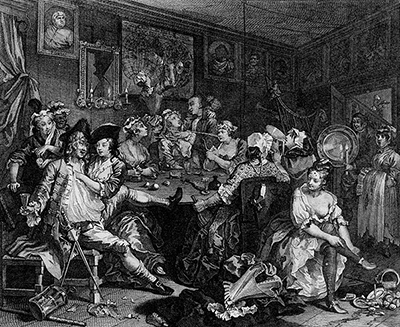
A woman reaches across Tom Rakewell’s chest while his pocket watch changes hands behind him. In William Hogarth’s The Orgy, that small theft takes place amid drinking, music and preparations for a dance at London’s Rose Tavern. Tom sits at the right of the oil painting. In the etched and engraved version, often called The Tavern Scene, he sprawls at the left. Both versions make the theft visible to the viewer while Tom is busy enjoying the attentions of the woman who distracts him. The painting, dated 1734 by Sir John Soane’s Museum, is an oil on canvas measuring 62.5 × 75.2 cm, inventory number P42. It is the third of eight scenes in A Rake’s Progress. [1] [2]
At a Glance
- ArtistWilliam Hogarth
- Place in the seriesThird of eight scenes in A Rake’s Progress
- Painting1734, oil on canvas, 62.5 × 75.2 cm, Sir John Soane’s Museum, P42
- Paris impressionEtching and engraving, third state, publication dated 25 June 1735, Bibliothèque nationale de France, FRBNF40262626
- Washington impression1735, etching and engraving, first state of three, National Gallery of Art, 1944.5.29
This work across William Hogarth’s career
Assembly at Wanstead House
1728–31The Heir
1734The Marriage Settlement
about 1743Gin Lane
1751Canvassing for Votes
1754–55Contents
- The Rose Tavern and the silver platter
- Who is watching?
- Songs, portraits and a map of the world
- Reading the painting and the plate
- Between the levée and the arrest
The Rose Tavern and the silver platter
Hogarth gives the tavern’s address to a man carrying a candle and a silver platter. The lettering runs around the rim, where the museum reads the surname Bonvin and the words that place the Rose Tavern at Drury Lane. The printed version adds a final e to the surname. The name suggests bon vin, French for good wine, and the Soane catalogue leaves open whether anyone named Bonvin actually kept the tavern. A proprietor’s name could sound plausible on a serving dish and still work as a joke about the establishment’s trade. [1]
The Rose was a real Covent Garden tavern. John Strype’s 1720 survey places it next to the Drury Lane theatre, and the historical records gathered by the Grub Street Project locate it on Russell Street. [3] In a diary entry for 18 May 1668, Samuel Pepys records leaving the playhouse to eat mutton at the Rose after finding a boy to keep his place. He then returned for the play. His visit predates Hogarth’s painting by more than sixty years, but it records how easily a theatre customer could pass between the two businesses. [4] Hogarth’s room draws on the tavern’s later reputation for sexual entertainment and sets a performance of its own just beyond the playhouse. [1]
The platter is equipment for that performance. In the foreground a woman undresses while the porter brings the platter in upright. The Soane catalogue identifies her as a dancer who would pose on the polished surface and interprets the reflection as part of the erotic display. Her performance is still in preparation, and the act of getting ready commands a prominent place in the composition. The porter has traditionally been identified with a man nicknamed Leather Coat or Leathersides. A poem published in 1735 advertised itself as a key to Hogarth’s prints and singled out the dish in its account of the third scene. It shows how readily a reader could make a story out of the prop, though the performer’s and porter’s names cannot be established from their painted faces. [1] [5]
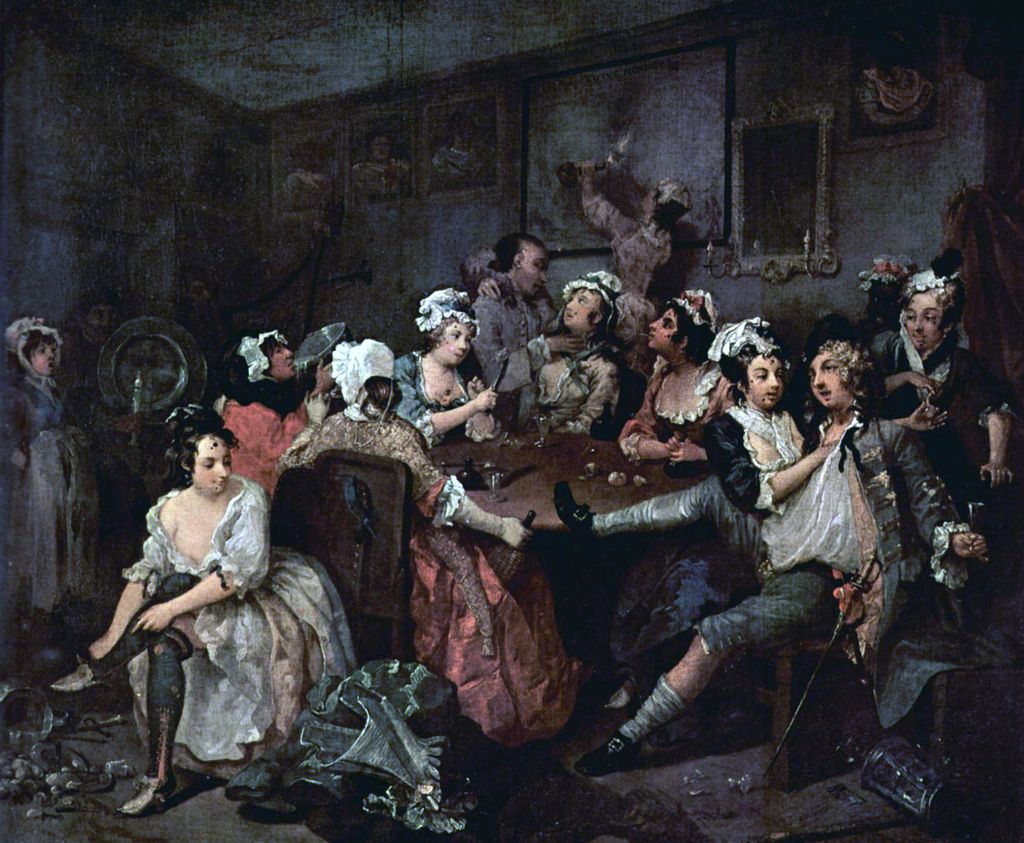
The Orgy, William Hogarth, 1734. Oil on canvas. SM P42. The Yorck Project via Wikimedia Commons. Image source. Public domain.
Who is watching?
The watch face, which the Soane reads as showing three in the morning, turns a general impression of late-night revelry into a particular hour. Two women cooperate in taking it. One keeps Tom occupied at close quarters while the other receives it behind him. His open coat, loose shirt and wrinkled stockings make his sprawl all the more conspicuous. The watch is small enough to escape his notice, yet in the Metropolitan Museum of Art’s print, accession 91.1.85, its pale dial stands out beside a patch of dark cloth. Hogarth allows the viewer time to trace an exchange that has to be over quickly for the people carrying it out. [1] [2]
A second kind of watch enters the scene through a staff and lantern discarded at Tom’s feet. The Soane reads them as the spoils of a prank on a night watchman, a man employed to patrol the streets. The objects imply that Tom’s outing has already spilled into public space before the moment we see. The presence of the equipment can support that inference, while the particulars of how Tom got hold of it belong to the catalogue’s reconstruction. In the sixth painting, The Gaming House, a watchman brings a staff and lantern into another crowded room after seeing smoke. Here the tools have come indoors without their keeper. There, the man arrives with a reason for everyone to pay attention. [1] [6]
Hogarth distributes attention unevenly around the table. One woman drinks from a punch bowl. Another sends a thin jet of drink across the company towards a woman holding a knife. A Black woman looks across the room, amused, during the commotion. Her expression gives the picture a spectator within the party and a response quite different from Tom’s pleasure in being cosseted. The Soane proposes a pun linking her laughter to the bawdy song named on the singer’s sheet in the prints. That is a reading of her place in the composition. The painting gives very little basis for assigning her a specific occupation or a historical identity. [1] [2]
Watch Hogarth’s paintings and prints
Five films on Hogarth’s painted stories, prints, drawing methods and work for the Foundling Hospital.
The Sequel: Hogarth’s "A Rake’s Progress" (1734–5)
The Paul Mellon Centre revisits the eight-scene story of Tom Rakewell and its place in Hogarth’s work.
Watch on YouTubeSongs, portraits and a map of the world
The ballad sheet is a way of giving the noisy room a recognisable tune. The Soane records that the song title is now illegible on the oil. The Metropolitan Museum impression shows the title Black Joke, which the Bibliothèque nationale de France also records on its sheet. [1] [2] [7] Henry Carey used the tune in his 1734 stage burlesque Chrononhotonthologos, where it was already treated as familiar interval music. [8] At the Rose, the singer holds a printed sheet at the doorway near the harpist. The title lets a reader who knows the tune supply something Hogarth can only suggest through open mouths and pictured instruments. [2]
The wall carries a second theatrical reference. A woman raises a candle to a world map carrying the words Totus Mundus, Latin for “the whole world.” The Soane connects these words with a longer motto associated with the Drury Lane stage, roughly “all the world’s a stage.” The shorter phrase is the wording visible on the Metropolitan Museum impression. The candle threatens the map’s surface and recalls the candle brought in for the dance. One flame is part of a planned entertainment. The other makes a picture of the world look as vulnerable as the broken mirror beside it. [1] [2]
Among the battered imperial portraits in the oil, the face of Nero survives. His reputation for cruelty and excess makes him an apt presiding figure, especially with a flame held so close to the map. In the Metropolitan Museum’s impression there is another intact head, labelled Pontac, on the other side of the map. John Nichols recorded that Pontac’s portrait replaced a mutilated Caesar during the plate’s revision. An allusion to a well-known London dining house therefore enters the company of emperors. In the print, those two intact faces bring different kinds of notoriety to the walls of a room whose patrons have made a mess of the place. [1] [2] [9] [10]
Reading the painting and the plate
The reversal extends beyond Tom. The dancer and the porter move from the left of the oil to the right of the print, where the plate also gives the singer’s sheet and the platter separate kinds of lettering to read. Nichols’s list of variations records changes to Tom’s head and the dancer’s, and a man’s hat on the woman beside Tom. The sweep of that hat’s dark brim is a striking detail in the Metropolitan Museum’s sheet. It nearly touches Tom’s tilted hat as the woman leans towards him. [1] [2] [9] Below the picture are twenty lines of verse arranged in five columns. The poem turns from youthful vanity and the poet’s warning about women to a personification of wine as a betrayer that lets a gang overcome the guard of reason. That moral makes a verbal counterpart to the theft above it. The picture leaves the reader free to follow the women’s skilful handoff or the work of the people providing entertainment, details that reward a second look at the scene. [2] [7] [11]
The Paris impression, catalogue record FRBNF40262626, is an etching and engraving recorded as the third state under Ronald Paulson’s 1965 numbering. Its publication line gives 25 June 1735, the date the Soane gives for Hogarth’s first publication of the plate. The National Gallery of Art in Washington catalogues its separate 1735 impression, 1944.5.29, as the first of three under the same Paulson entry. A state identifies a version of the printing plate, so even two sheets catalogued under the same year can preserve different details. The measures also describe different things. Paris records 35.5 × 40.7 cm for the printing element and 39 × 43.8 cm for the sheet. Washington’s 36 × 41.2 cm measures its sheet. The Spencer Museum of Art’s Tavern Scene, accession 1958.0005.03, has a plate mark close in size to the Paris printing element, with paper measuring 45.8 × 59.1 cm. Those measurements help explain why two reproductions of the same episode can have very different margins. [7] [1] [12] [13]
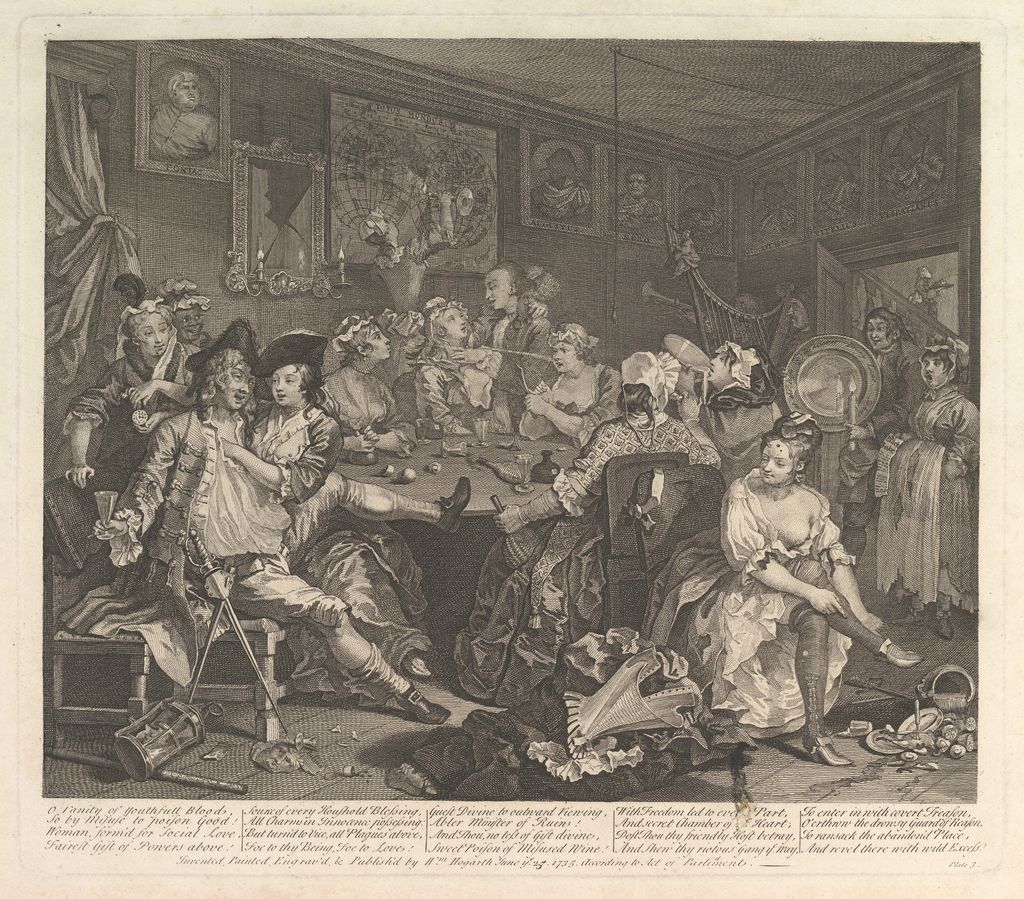
A Rake's Progress, Plate 3, William Hogarth, June 25, 1735. Etching and engraving; third state of three. 91.1.85. Gift of Sarah Lazarus, 1891. Image source. CC0 / Public domain.
Between the levée and the arrest
In The Levee, Tom receives people who cater to the ambitions of a newly wealthy man. A dancing master is on hand to teach him to move with assurance. At the Rose, he remains in his chair while a dancer prepares to perform for the company. His foot on the table brings him about as close to the space reserved for the dance as he can get without rising. In The Arrest he takes care with his dress again on the way to court, and a creditor has him stopped in the street. In the tavern the decisive transaction happens behind his back. In the street Sarah Young intervenes with her purse in full view. [14] [1] [2] [15]
Browse Hogarth’s artworks
All 54 individual artworks and series stages in the approved English cluster
Frequently Asked Questions
A woman takes his watch while another holds his attention. Hogarth lets the viewer see the theft as it happens. [1]
It is scene 3 of 8 in A Rake’s Progress. Sir John Soane’s Museum uses the scene number for the original oil painting. [1]
Discussion
Look again at the images and ideas explored in The Orgy. These editorial prompts invite your observations.
Reader Insights
Where does Hogarth place the watch so that the viewer can see it change hands while Tom is distracted?
How does replacing a damaged Caesar with Pontac change the joke on the tavern wall?
Join the Conversation
Share a detail, comparison or question about The Orgy below.
References
- Joanna Tinworth and Sir John Soane’s Museum, William Hogarth, A Rake’s Progress III: The Orgy, P42, object record and curatorial note, April 2021. View source.
- The Metropolitan Museum of Art, William Hogarth, A Rake’s Progress, Plate 3, 91.1.85, etching and engraving, third state of three. View source.
- The Grub Street Project, Rose Tavern, place record 90540, with historical map and survey references. View source.
- Samuel Pepys, Diary, 18 May 1668. View source.
- Wellcome Collection, The Rake’s Progress, or, The Humours of Drury-Lane, 1735, title-page synopsis of canto III. View source.
- Sir John Soane’s Museum, William Hogarth, A Rake’s Progress VI: The Gaming House, P45. View source.
- Bibliothèque nationale de France, William Hogarth, A Rake’s Progress: The Orgy, plate 3, FRBNF40262626, Paulson 134.3 (1965), French catalogue record. View source.
- Joy Van Cleef and Kate Van Winkle Keller, Selected American Country Dances and Their English Sources, “Black Joke” and figs. 18–20, Colonial Society of Massachusetts. View source.
- John Nichols, Biographical Anecdotes of William Hogarth, With a Catalogue of His Works, plate III variations in the catalogue of The Rake’s Progress. View source.
- Purdue University Galleries, William Hogarth, Rake’s Progress, Plate III, 2001.10.04.03, label text citing Sean Shesgreen. View source.
- Princeton University Art Museum, William Hogarth, The Tavern Scene, plate 3 from A Rake’s Progress, x1988-32, inscription record. View source.
- National Gallery of Art, William Hogarth, A Rake’s Progress: pl.3, 1944.5.29, Paulson 134 (1965), first state of three. View source.
- Spencer Museum of Art, William Hogarth, Tavern Scene, 1958.0005.03, catalogue record with plate mark and sheet dimensions. View source.
- Sir John Soane’s Museum, William Hogarth, A Rake’s Progress II: The Levee, P41. View source.
- Sir John Soane’s Museum, William Hogarth, A Rake’s Progress IV: The Arrest, P43. View source.







