


 by Tom Gurney
Tom Gurney BSc (Hons) is an art history expert with over 20 years experience
Published on June 19, 2020 / Updated on October 14, 2023
Email: tomgurney1@gmail.com / Phone: +44 7429 011000
The Strode Family: Introduction
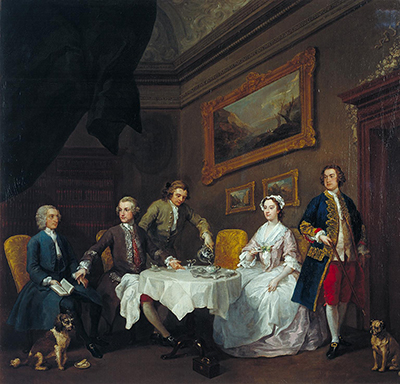
In William Hogarth’s The Strode Family, a butler tips a silver kettle towards a blue-and-white teapot. Lady Anne Cecil holds a cup and saucer, while a man at the other end of the table has a book open on his lap. The whole company occupies the lower part of a room whose walls climb well above their heads. Hogarth makes the bright patch of table linen the centre of this nearly square canvas. Even the people who look away from the tea are within reach of its little circle. Tate dates the painting to about 1738. The oil on canvas measures 87 by 91.5 centimetres and belongs to Tate, accession N01153. [1]
At a Glance
- ArtistWilliam Hogarth
- Datec. 1738
- MediumOil on canvas
- Canvas dimensions87 × 91.5 cm
- CollectionTate, N01153
This work across William Hogarth’s career
Assembly at Wanstead House
1728–31The Heir
1734The Strode Family (current article)
about 1738The Marriage Settlement
about 1743Gin Lane
1751Canvassing for Votes
1754–55Contents
- A household gathered for tea
- What the tea things show
- The room Hogarth changed
- From the ballroom to the tea table
A household gathered for tea
The man with the book at the far left is Dr Arthur Smyth. He had been William Strode’s tutor and later became Archbishop of Dublin. Strode sits beside him, between the book and the tea service. Lady Anne, whom Strode married in 1736, sits across the table. The figure standing at the right is Strode’s relative Colonel Strode. John Nichols identified the four sitters in 1782 and described the picture as a ‘Breakfast-piece’ in the possession of William and Anne’s son. The later account by Nichols and George Steevens supplies the names Samuel Strode and Jonathan Powell, the household’s butler. The arrangement brings a friendship and a working relationship into a picture that has come down to us under a family name. [1] [2]
Hogarth gives each person a different posture. Smyth keeps the open volume low, and the angle of his head draws attention towards the man beside him. William turns towards Smyth, with one hand extended towards the table. Lady Anne sits upright. The white cloth and the sheen of her dress make a continuous light shape across the lower centre, interrupted by her hand and the small bright curve of the saucer. Powell bends over the table with his eyes lowered to his work. The standing figure’s blue coat and red breeches pull the eye to the edge, where a dog close to his feet brings it back down to floor level. Its counterpart at the left makes another small interruption beneath the line of the seated figures. [1] [3]
This is a conversation piece, a group portrait in which the sitters’ relationship takes shape through shared activity. Hogarth painted small-scale portraits of this kind when they were fashionable in the 1730s. The art historian Frédéric Ogée reads the fragile porcelain in this painting as an emblem of the self-restraint that polite company demanded. The case for that reading is strongest in the small distinctions between the gestures. Smyth can stop reading without closing his book, and Lady Anne can attend to her cup while the men turn towards one another. Powell, whose clothes are comparatively plain, has the most exacting movement. The company’s ease depends on the person whose hands are busiest. [1] [3] [4]
What the tea things show
The kettle and the teapot perform separate tasks. Powell brings hot water to the teapot to brew the leaves. Lady Anne’s cup and saucer show how each guest would receive a share of the brew. The service gives Hogarth several kinds of surface to paint at close quarters. The kettle catches broad highlights, the pot has patches of blue against white, and the cloth scatters the light in creases towards the floor. The dark box on the floor near Lady Anne is a tea caddy. Its small fitting catches the light just below the hanging cloth. These objects make a route through the picture from storage to preparation to drinking. [1] [4]
Two objects in the Metropolitan Museum of Art help explain what a viewer of the period might have recognised in that equipment. A late seventeenth- or early eighteenth-century teapot from Jingdezhen, accession 79.2.189a, b, combines decoration in cobalt blue under the glaze with a European mount. The mount is evidence of a second stage of manufacture, in which a European maker adapted the Chinese vessel. One of a pair of silver tea caddies made by Augustin Courtauld in London in 1726/27, accession 68.141.269, carries the arms of a member of the Still family. The Met associates the pair with keeping green and black teas. The painted box and pot are comparable in function to these surviving objects. Their precise makers and origins remain uncertain. [1] [5] [6]
Watch Hogarth’s paintings and prints
Five films on Hogarth’s painted stories, prints, drawing methods and work for the Foundling Hospital.
William Hogarth and the Foundling Hospital | HENI Talks
Caro Howell discusses Thomas Coram, Hogarth’s portrait of him and the artist’s work for the Foundling Hospital.
Watch on YouTubeTate’s account of the family supplies another reason to look closely at such a display of taste. The Strodes’ fortune came from trading shares in the South Sea Company, which trafficked enslaved people. The tea table displays what the household could buy and how it wished to receive company. The portrait brings the signs of that prosperity into view at the scale of a hand lifting a cup. [1] [4]
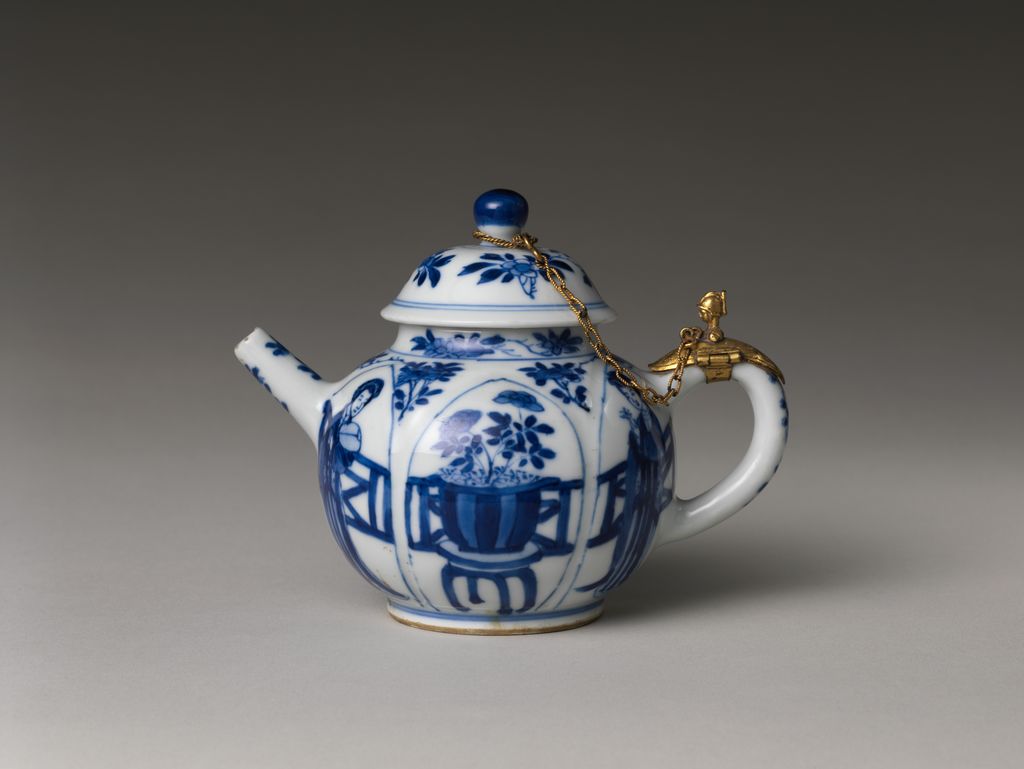
Teapot, China, Jingdezhen, late 17th–early 18th century. Porcelain painted with cobalt blue under transparent glaze (Jingdezhen ware); European mount. 79.2.189a, b. Purchase by subscription, 1879. Image source. CC0 / Public domain.
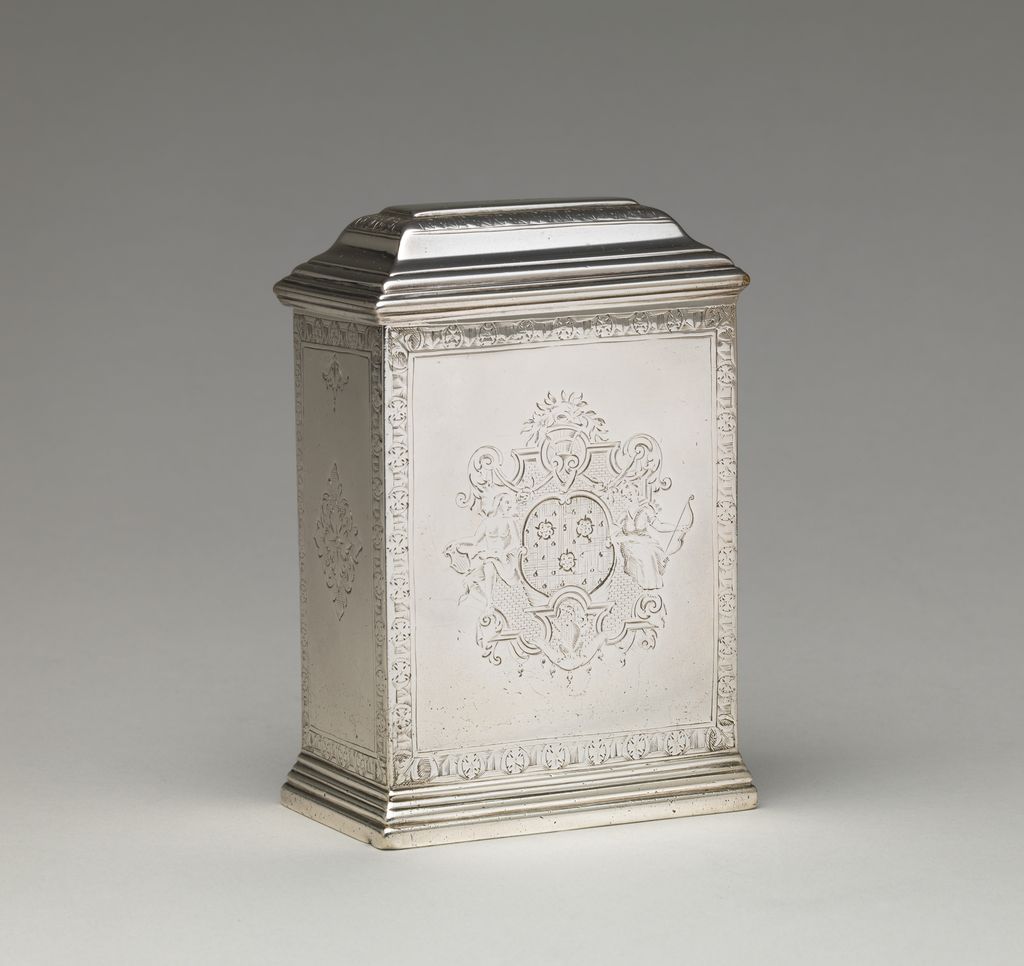
Tea caddy (one of a pair), Augustin Courtauld, 1726/27. Silver. 68.141.269. Gift of Irwin Untermyer, 1968. Image source. CC0 / Public domain.
The room Hogarth changed
Behind Smyth’s open book, a bookcase extends the theme of reading into the room. Across the corner, Hogarth hangs a large landscape above two smaller pictures. Tate’s catalogue describes the large canvas as being in the manner of Salvator Rosa and identifies a small view of Venice, tentatively associated with Guardi. The catalogue also cites a 1737 letter in which Strode calls Smyth an intimate friend. The two had been in Venice in 1733. The view on the wall can be read as a reminder of travel shared by the two men, much as the open book connects a particular sitter to the books behind him. The painted room gives those connections a place in the family portrait. [1]
Cleaning and X-radiography in 1984 revealed how much Hogarth had changed the arrangement. He had first planned a pedimented doorway where the bookcase now stands, with oval paintings high on either side. Hogarth painted part of the barrel vault before covering it with the curtain, and he first left the table bare. Powell originally stood considerably farther right. William leaned forward towards the right, and the figure at that end raised an arm above the area of Lady Anne’s chair. Tate’s catalogue suggests that the reworking may have accommodated Lady Anne. The evidence establishes that the positions changed, while the reason and timing remain open. In the version we see, the cloth, Lady Anne’s skirt and the relocated kettle concentrate light and action in a much smaller part of the room. [1]
The catalogue connects the approximate date to the handling of the painting and the absence of children. William and Anne’s son was born in July 1738, but a decision about whom to include in a portrait can outlast a change in the household. That son later owned the canvas, as Nichols’s account records. The Reverend William Finch bequeathed it in 1880 subject to his sister Charlotte’s life interest. It entered the National Gallery in 1884, the year Tate records it as no. 38 at the Royal Academy’s Winter Exhibition. It transferred to the Tate Gallery in 1951. [1] [2]
From the ballroom to the tea table
In Hogarth’s Assembly at Wanstead House, dated 1728–31 by the Philadelphia Museum of Art, the Child family and their company are spread across a ballroom. Some take tea while others play cards. Dorothy Glynne Child raises the ace of spades towards her husband, Richard Child, at the far right. Philadelphia suggests that the gathering may mark the couple’s twenty-fifth wedding anniversary and reads the ace as a tribute to their partnership. The space Hogarth leaves between the couple makes us follow the direction of her gaze across the ballroom. [7]
In The Strode Family, Hogarth brings the action closer. The figures at opposite edges are only a few steps apart, and the furniture and gestures keep returning our attention to the tea service. At Wanstead, the ace directs our gaze away from the game and towards a man seated with two of his daughters. In the Strode household, the tilt of the kettle keeps our attention on the exchange unfolding at the table. Read alongside other paintings by Hogarth, the two portraits show how readily he could change the pace and scale of a group scene by giving his sitters something to do. [1] [3] [7]
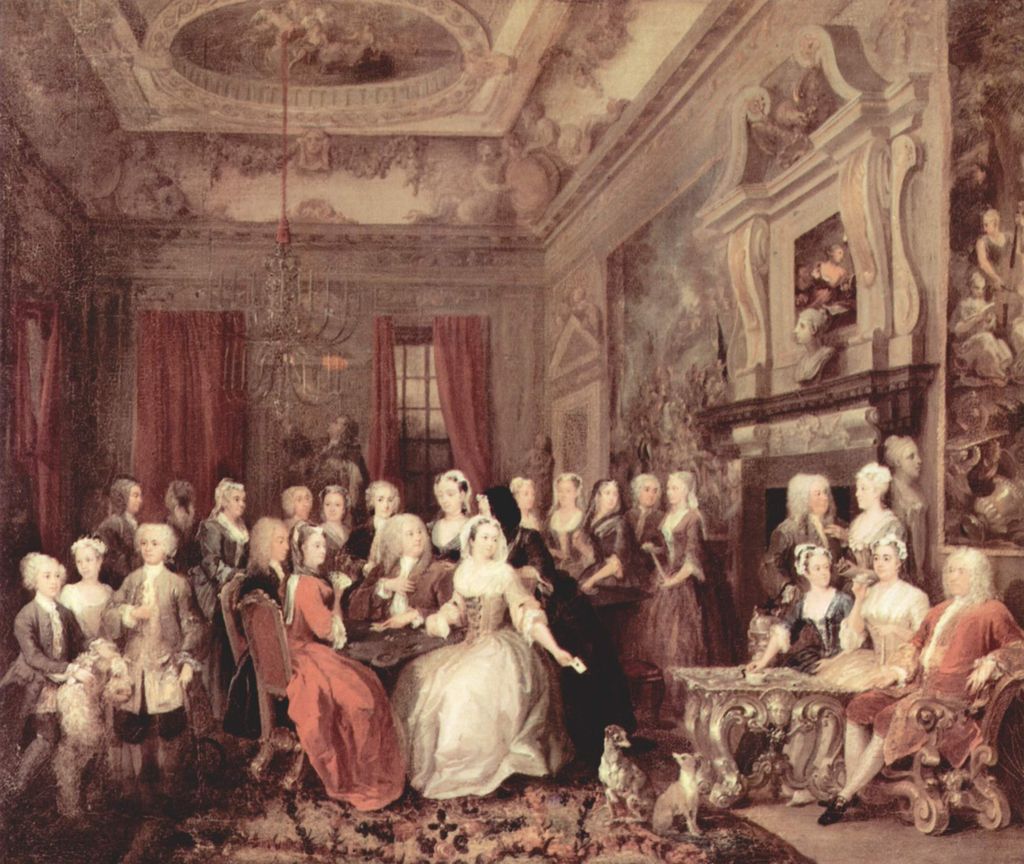
Assembly at Wanstead House, William Hogarth, 1728–31. Oil on canvas. M1928-1-13. The Yorck Project via Wikimedia Commons. Image source. Public domain.
Browse Hogarth’s artworks
All 54 individual artworks and series stages in the approved English cluster
Frequently Asked Questions
He pours from a silver kettle into the blue-and-white teapot while Lady Anne Cecil holds her cup and saucer. [1]
Discussion
Look again at the images and ideas explored in The Strode Family. These editorial prompts invite your observations.
Reader Insights
How does the butler’s position make the pouring of water the centre of a scene in which several people look elsewhere?
How does replacing the painted doorway with a bookcase change the way you read the open book on Smyth’s lap?
Join the Conversation
Share a detail, comparison or question about The Strode Family below.
References
- Tate, Elizabeth Einberg and Judy Egerton, William Hogarth, The Strode Family, c.1738, N01153, collection record, gallery label and catalogue entry from The Age of Hogarth: British Painters Born 1675–1709, 1988, fig. 32. View source.
- John Nichols, Biographical Anecdotes of William Hogarth, with a Catalogue of His Works, 3rd ed., 1785, Postscript, “A Breakfast-piece”. View source.
- Frédéric Ogée, “Sociability and Portraiture from William Hogarth to Thomas Lawrence”, Interfaces 51 (2024), paras. 11–13 and fig. 4. View source.
- Christine Walker, “‘We are starving for want of Tea’: Asian objects, domestic slavery and Caribbean sociability”, in Jon Stobart, ed., Global Goods and the Country House, 2023, pp. 113–16 and fig. 4.2. View source.
- The Metropolitan Museum of Art, Teapot, China, late seventeenth to early eighteenth century, 79.2.189a, b. View source.
- The Metropolitan Museum of Art, Augustin Courtauld, Tea caddy (one of a pair), London, 1726/27, 68.141.269. View source.
- Philadelphia Museum of Art, William Hogarth, Assembly at Wanstead House, 1728–31, collection object 103800. View source.







