


 by Tom Gurney
Tom Gurney BSc (Hons) is an art history expert with over 20 years experience
Published on June 19, 2020 / Updated on October 14, 2023
Email: tomgurney1@gmail.com / Phone: +44 7429 011000
The Second Stage of Cruelty: Introduction
A horse has fallen in a London street. Behind it, the hired coach leans under the weight of its passengers. Tom Nero stands over the animal with his whip raised, while a man beside the coach attends to its identifying number. In William Hogarth’s The Second Stage of Cruelty, the smallest action in this group may have the longest consequences. The passengers have a way out, and the man with the number has a way to report what he has seen. The horse is still in harness. The Metropolitan Museum of Art holds a first-state impression of the etching and engraving, accession 91.1.137, catalogued under the date 1 February 1751. [1] [2]
This is plate two of The Four Stages of Cruelty. In The First Stage of Cruelty, Nero and the other boys make sport of hurting animals. Here he is earning a living as a hackney coachman, driving passengers for hire. The change matters because the horse’s exertion has a purpose the customers can readily understand. Hogarth makes the abuse visible within that ordinary transaction. As the street opens up behind the coach, other kinds of work and other ways of disregarding suffering come into view. [1] [2]
At a Glance
- ArtistWilliam Hogarth
- SeriesPlate 2 of The Four Stages of Cruelty
- Met impressionEtching and engraving, 1751, first state of two, The Metropolitan Museum of Art, 91.1.137
- Preparatory drawingRed chalk with graphite, incised, with red chalk on the back, 1750–51, The Morgan Library & Museum, III, 32c
- Tokyo impressionEtching and engraving, 1750/51, The National Museum of Western Art, G.1994-0013
This work across William Hogarth’s career
Assembly at Wanstead House
1728–31The Heir
1734The Marriage Settlement
about 1743Gin Lane
1751Canvassing for Votes
1754–55Contents
- The weight of the coach
- Passengers, freight and livestock
- What changed between chalk and print
- How the caption changes the street
The weight of the coach
Hogarth gives the fallen horse much of the lower left of the print. Its head is up and its forequarters are down, with the coach and the cluster of passengers rising behind it. The broad side of the vehicle puts a solid mass immediately above the animal. Nero’s lifted arm completes a movement in the opposite direction, towards the ground. The arrangement makes the different forces easy to follow in a crowded scene. The animal has been pulling the load, the vehicle has tipped, and the driver is using the handle of his whip to beat the horse that can no longer draw it. Jennifer Tonkovich and Laurel O. Peterson read the passengers as lawyers and the horse’s foreleg as broken. The contrast in weight between the clustered passengers and the buckled animal carries the scene even before those details register. [1] [2]
The man at the coach has found one piece of information that will still be useful after the crowd disperses. Thomas Almeroth-Williams reads his gesture as recording the coach’s number with a view to reporting Nero. His study of horse traffic in Georgian London gives the gesture a practical context. In 1756, for example, the vestry of St James’s, Piccadilly, instructed its beadles to take the numbers of hackney coaches and chairs whose drivers opposed them while they were keeping order around places of worship on Sundays. That later parish instruction concerns street order. It shows how a number could connect a passing vehicle to an allegation, which is the possibility Hogarth gives his witness. The print leaves the result of the man’s intervention open. [1] [2] [3]
Passengers, freight and livestock
The road behind the coach carries several kinds of traffic at once. A donkey bears a bulky trunk, a dray carries barrels, and sheep press into the foreground near a man with a raised club. The donkey’s burden makes for an especially close comparison with the horse. One animal is carrying its load on its back and the other has been hauling a vehicle, yet the men beside them both answer the strain on the animal by raising a tool. At the right, the sheep that has dropped to the ground makes a smaller counterpart to the horse. Its body is at the edge of the flock, where the viewer can pick it out from the animals still on their feet. [1] [2]
The dray introduces another danger. A child and a hoop are down beside a wheel, while the drayman appears oblivious. Farther away, a bull tosses a figure above the level of the surrounding crowd. Near and far, the street gives a person on foot very little room to anticipate what a vehicle or an animal might do. The child’s situation differs from that of the horse and the sheep because there is no raised arm directing a blow at the child. The position of the wheel, the child’s proximity to it and the driver’s inattention are enough to tell the story. The child and the airborne figure extend the argument within this plate to the people who share the road with working and driven animals. [1] [2]
Watch Hogarth’s paintings and prints
Five films on Hogarth’s painted stories, prints, drawing methods and work for the Foundling Hospital.
Crafting Cruelty: Hogarth’s Innovative Drawing Methods
The Morgan examines Hogarth’s drawings for The Four Stages of Cruelty and the methods he used to work out his designs.
Watch on YouTubeWhat changed between chalk and print
The Morgan Library & Museum holds Hogarth’s preparatory drawing, III, 32c. The Morgan’s exhibition dates it 1750–51, while Tonkovich and Peterson date it to 1750 in their study. It is in red chalk with graphite, with stylus incisions and red chalk rubbed on the back for transfer. Running a stylus over selected contours of a sheet prepared in this way could deposit chalk on a surface beneath it. That makes the incisions evidence of an operation as well as of the artist’s choice of lines. The surviving drawing and the printed design leave room for an intermediate transfer or further revision. Tonkovich and Peterson also identify a Strasbourg lily watermark and IV countermark matching the stock used for the Morgan’s Beer Street and Gin Lane designs. The match connects the papers Hogarth used for the projects, while the dating of the individual drawing still rests on the wider evidence. [2] [4]
The main arrangement of the coach, horse and crowded roadway survives into the print, with the composition reversed. In the street behind Nero, the loaded donkey gains a pitchfork at its flank. On the wall Hogarth adds notices for cockfighting and a boxing match, making the spectator’s stake in a contest part of the scene. As the eye moves up from the fallen horse to the notices, it passes from an act that a witness might report to entertainments being openly advertised. The additions make two kinds of change to an already worked-out design. One makes the physical treatment of a working animal more explicit and the other gives the buildings something to say about the people using the street. [1] [2] [4]
The boxing notice supplies names, too. It pairs James Field with George Taylor at Broughton’s Amphitheatre. Doreen Skala traces the pairing to a bout held there in December 1743. The date belongs to the documented bout. The street scene is Hogarth’s invention. A reader who recognised the names would have had more to go on than the bare fact that prizefights were advertised. Benjamin Chew, a spectator whose journal Skala cites, was disturbed by the crowd’s delight at a severe blow. His reaction gives the verse’s final question about pleasure an echo in an account of an actual fight. Field’s name appears again beside a skeleton in the published final plate. The lettering establishes the connection across the series. How much of that connection an individual reader would have recognised remains open. [1] [2] [5]
How the caption changes the street
Beneath the image are three stanzas. The opening describes an ageing horse whose strength gives out after labour. The middle stanza gives the lamb a complaint of its own and describes its death under the blows. The verse thus singles out two animals that the image puts on opposite sides of the road. It gives the eye a reason to travel from Nero’s coach to the edge of the flock and gives the ear, in the lamb’s bleating, something that a print can only suggest. The third stanza changes from description to accusation. Its closing questions ask what advantage and what pleasure can come from causing misery. In a street filled with paying passengers, goods in transit and advertised contests, those questions reach beyond the man holding the whip. [1] [6]
The chalk drawing carries the street design. In the print, title, verse, design credit, publication line and price frame it for a purchaser. The Morgan credits the series verses to the Reverend James Townley and places the series’ appearance on 21 February 1751. Tonkovich and Peterson give the same issue date from the announcement, with a qualification about calendar style. The plate’s publication line is dated 1 February 1751, the date under which the Met catalogues its impression. The National Museum of Western Art in Tokyo catalogues its own impression, G.1994-0013, as an etching and engraving of 1750/51, first of two states under Ronald Paulson’s 1989 third revised edition, no. 188. Its bibliography gives no. 202 for the 1965 edition. Those numbers are identifiers for the design in different editions of the catalogue. The printed impression is a sheet pulled from an inked copperplate, and the state describes the version of that plate from which the sheet was printed. [1] [2] [6] [7]
In Cruelty in Perfection, writing takes on a new role when a letter helps the people gathered around Ann Gill make sense of what has happened. The coach number anticipates that attention to written evidence, at the scale of something a passer-by can take down on the spot. It is easy to miss the man beside the carriage because the fallen horse and Nero’s raised arm command so much of the foreground. Finding him changes the scene. Among the people doing business, struggling out of the coach or hurrying along the road, somebody has stopped long enough to make a record. [1] [2] [3]
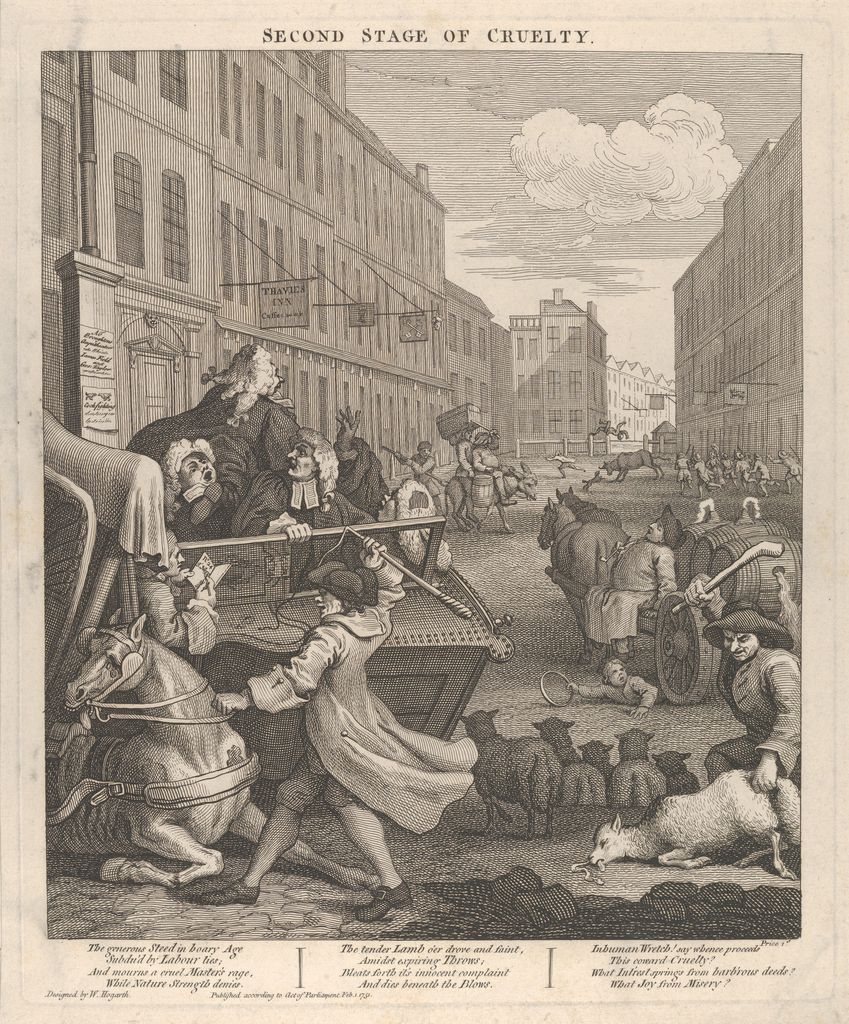
The Second Stage of Cruelty (The Four Stages of Cruelty), William Hogarth, February 1, 1751. Etching and engraving; first state of two. 91.1.137. Gift of Sarah Lazarus, 1891. Image source. CC0 / Public domain.
Browse Hogarth’s artworks
All 54 individual artworks and series stages in the approved English cluster
Frequently Asked Questions
It is print 2 of 4 in The Four Stages of Cruelty. Use that position to follow the change in setting from one episode to the next. [1]
Discussion
Look again at the images and ideas explored in The Second Stage of Cruelty. These editorial prompts invite your observations.
Reader Insights
How does the man taking down the coach number change the way you read the crowd around Nero?
How do the boxing and cockfighting notices change the force of the final stanza’s question about pleasure?
Join the Conversation
Share a detail, comparison or question about The Second Stage of Cruelty below.
References
- The Metropolitan Museum of Art, William Hogarth, The Second Stage of Cruelty (The Four Stages of Cruelty), 91.1.137. View source.
- Jennifer Tonkovich and Laurel O. Peterson, “Hogarth and the Making of the Four Stages of Cruelty,” Master Drawings 62, no. 1 (2024), pp. 21–26 and 33–36, figs. 2 and 6, nn. 1–2, 6 and 38. View source.
- Thomas Almeroth-Williams, The Impact of Quadrupeds in Hanoverian London, University of York MA by Research thesis (2010), pp. 152–154 and plate 23. View source.
- The Morgan Library & Museum, Hogarth: Cruelty and Humor, selected works, William Hogarth, Second Stage of Cruelty, III, 32c. View source.
- Doreen Skala, “The miseries of others: boxing in Hogarth’s Second Stage of Cruelty,” Sport in History 40, no. 2 (2020), pp. 157–178, especially fig. 1 and the account of the Taylor–Field bout. View source.
- The National Museum of Western Art, Tokyo, William Hogarth, The Four Stages of Cruelty: Second Stage of Cruelty, G.1994-0013, inscriptions and bibliography. View source.
- The Morgan Library & Museum, Hogarth: Cruelty and Humor, “First Stage of Cruelty [print],” exhibition stop 005. View source.







