


 by Tom Gurney
Tom Gurney BSc (Hons) is an art history expert with over 20 years experience
Published on June 19, 2020 / Updated on October 14, 2023
Email: tomgurney1@gmail.com / Phone: +44 7429 011000
The Industrious ’Prentice Performing the Duty of a Christian: Introduction
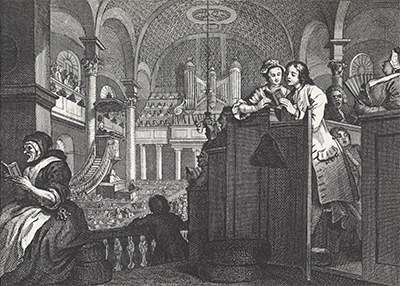
Francis Goodchild leans towards an open book as he sings beside a young woman in a crowded church. The book is small, but William Hogarth makes it easy to find. Their faces and hands rise above the dark panelling of the pew, with the organ and a gallery full of worshippers behind them. In this second of twelve plates in Industry and Idleness, the apprentice’s diligence takes the form of attention to a shared text. Hogarth designed and engraved the print, which bears the publication date 30 September 1747. The Metropolitan Museum of Art holds the impression discussed here, 91.1.10, an etching and engraving catalogued as the second of two states. [1] [2]
At a Glance
- SeriesIndustry and Idleness, plate 2 of 12
- Inscribed publication date30 September 1747
- MediumEtching and engraving
- ImpressionThe Metropolitan Museum of Art, 91.1.10, second state of two
- Later copyThomas Cook after William Hogarth, 1 February 1796, Wellcome Collection, 38361i
This work across William Hogarth’s career
Assembly at Wanstead House
1728–31The Heir
1734The Marriage Settlement
about 1743Gin Lane
1751Canvassing for Votes
1754–55Contents
- A shared book in a crowded church
- The words beneath the pews
- From the looms to the churchyard
- Drawings, impressions and a later copy
A shared book in a crowded church
The viewpoint is high enough to look down on the congregation below. The pulpit projects from the left, accessible by a curving stair, and the organ pipes rise beyond the pews at the far end. Columns and arches repeat into the distance, with small heads gathered behind the gallery rails. In the foreground the panels of Goodchild’s pew occupy much of the right half of the picture. His light coat shows up against them, and the inclination of his head brings his face close to the young woman’s. The room contains many people, but the scale of those two faces and the clear space above the book give their act of singing particular weight. [1]
At the opposite edge an older woman reads from a book of her own. The British Museum identifies her as a pew-opener, an attendant who admits people to their seats. She sits on a pile of hassocks, or kneeling cushions, with keys visible against her dress. The pulpit and organ give the service its public scale. The cushions and keys suggest the work of making room for people within it. Behind the young pair a man’s head tips back with his mouth open. Wellcome’s account of Thomas Cook’s later engraving reads him as asleep. His open mouth resembles a singer’s, which makes the angle of his head and the slackness of his posture important to the joke. Hogarth gives the congregation room for different degrees of attention. [1] [3] [4]
The church is traditionally identified as St Martin-in-the-Fields, as Wellcome notes. Colonial Williamsburg identifies the young woman as the master’s daughter, a reading that gains force when plate 6 announces Goodchild’s marriage to her. The title over plate 2 identifies the apprentice by his conduct and leaves the young woman unnamed. Seen on its own, the sheet gives us two people close enough to follow one book. Read as part of the story, the same arrangement puts the apprentice beside a member of the household to which his work already binds him. The sharing is practical, and it gives Hogarth a way to place them together in public without interrupting the service for an encounter of their own. [1] [2] [4] [5]
The words beneath the pews
The cartouche below the scene identifies Psalm 119, verse 97, and reads, “O! How I love thy Law it is my meditation all the day.” The National Gallery of Victoria’s impression, 1278.453-3, preserves the verse, the credit to Hogarth and the notice of publication according to Act of Parliament. The heading names a duty. The verse gives that duty a first-person voice and extends it across the whole day. The words in the cartouche can be read without deciphering the little book the couple hold. The line supplies a way to understand Goodchild’s absorbed posture while leaving the precise words sung in the church open. [1] [6]
Watch Hogarth’s paintings and prints
Five films on Hogarth’s painted stories, prints, drawing methods and work for the Foundling Hospital.
In 60 seconds: Hogarth's 'Gin Lane' & 'Beer Street'
A short introduction to the contrasting streets, the shops and the people in Hogarth’s paired prints.
Watch on YouTubeAt the upper corners of the frame, the same emblems appear here and on the churchyard sheet. On the left the mace and chain suggest civic office. On the right a looped rope and restraints evoke punishment. Hogarth puts these objects above the congregation, in the printed border. Their presence brings the possible ends of both apprentices’ stories into a scene that follows only one of them. Taken with the psalm, they also give the sheet two different timescales. The verse concerns a repeated habit of attention, while the emblems anticipate consequences that the young man in the pew is still a long way from seeing. [1] [7]
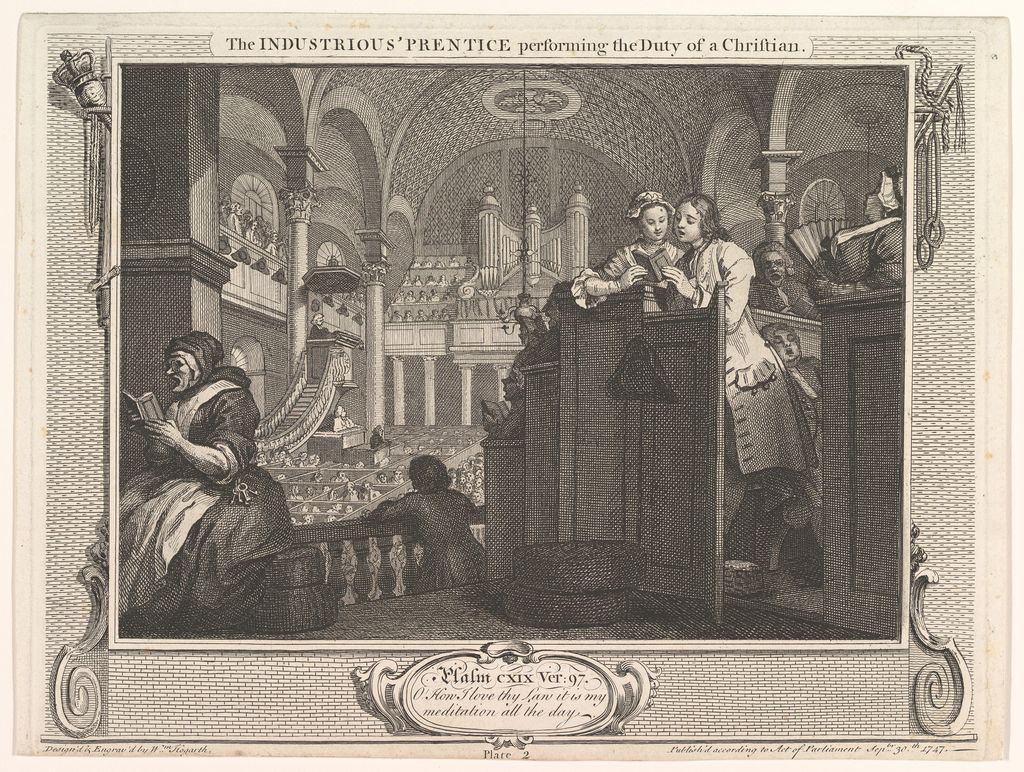
The Industrious 'Prentice Performing the Duty of a Christian (Industry and Idleness, plate 2), William Hogarth, September 30, 1747. Etching and engraving; second state of two. 91.1.10. Gift of Sarah Lazarus, 1891. Image source. CC0 / Public domain.
From the looms to the churchyard
In The Fellow ’Prentices at their Looms, both apprentices occupy the same workshop, where a viewer can compare what each does at his loom. Plate 2 moves Goodchild into a different company. His hands now help hold a book in common, and the person beside him shares the task. The pew, open above its panelling, makes the pair conspicuous to the viewer and places them within an assembly of other parishioners. Their visibility is one of the changes Hogarth makes as the story leaves the workshop. The scene suggests how a young tradesman could come to be known outside his work through the groups he joined and the habits he displayed there. [1] [8]
The next sheet, The Idle ’Prentice at Play in the Church Yard, supplies the other half of the comparison. Its full inscription places the game during divine service. Thomas Idle and his companions gather around a tomb, and a man behind them raises a cane. In plate 2 the vertical boards of the pew mark out the place where Goodchild and his companion stand. Outside, the flat surface of the tomb supports the players’ hands. Concentration belongs to both scenes. The difference lies in what holds each group’s attention and how the people around them respond. With the threat of a blow and the warning from Proverbs beneath the churchyard scene, the third plate gives a sharper edge to the second plate’s invitation to participate. [1] [7]
Drawings, impressions and a later copy
Hogarth worked out the church scene in drawings. The British Museum’s preliminary sketch, 1914,0613.31, places the young pair on the left and the pew-opener on the right. The positions are reversed in the Met print, and the sketch already includes emblems in the margin. The Hessen Kassel Heritage catalogue identifies a second British Museum drawing, 1896,0710.4, alongside the preliminary sketch. The pair and the pew-opener give the design large figures at either side of an interior where most people are seen at a distance. That arrangement survives the reversal and remains legible within the title, emblems and verse that surround the printed scene. [1] [9] [10]
The Met also holds a first-state impression, 32.35(37). Both Met records give the same date and call the subject plate 2. The plate number fixes the scene’s place in the story, while the state identifies a condition of the printing surface. Hessen Kassel Heritage records its own impression as the second of two under no. 169 in the 1965 edition of Ronald Paulson’s Hogarth’s Graphic Works. The precise date on which the Met’s second-state sheet came off the press remains uncertain. The date engraved in the margin could be printed again whenever the plate was inked. [1] [10] [11]
Vicki Principi’s finding aid for Princeton University Library lists the church scene in drawer 2 between the looms and the churchyard. As three separately numbered subjects, the prints let a reader move from the shared workshop to the congregation and then look back from the churchyard to the pews. A later reader could also encounter the scene through Thomas Cook’s engraving after Hogarth, dated 1 February 1796 on Wellcome Collection’s record, 38361i. Its lettering still credits Hogarth for the design and retains the psalm and plate number. Cook signs as engraver, and the publication line belongs to his own issue. A reader can place the scene in the story by the same numeral even on a sheet made more than forty years later. [4] [12]
Browse Hogarth’s artworks
All 54 individual artworks and series stages in the approved English cluster
Frequently Asked Questions
He sings from an open book shared with a young woman in the adjoining part of the pew. [1]
It is plate 2 of 12 in Industry and Idleness. Following the plate numbers keeps Goodchild’s and Idle’s episodes in the intended order. [1]
Discussion
Look again at the images and ideas explored in The Industrious ’Prentice Performing the Duty of a Christian. These editorial prompts invite your observations.
Reader Insights
How does the dark pew panelling draw your attention to the book Goodchild and the young woman share?
How does Psalm 119 beneath the scene change the way you read Goodchild’s posture?
Join the Conversation
Share a detail, comparison or question about The Industrious ’Prentice Performing the Duty of a Christian below.
References
- The Metropolitan Museum of Art, William Hogarth, The Industrious ’Prentice Performing the Duty of a Christian (Industry and Idleness, plate 2), 91.1.10. View source.
- Colonial Williamsburg Foundation, William Hogarth, Industry and Idleness – The Industrious Apprentice performing the Duty of a Christian, 1947-479,A, description and inscriptions. View source.
- British Museum, William Hogarth, The Industrious ’Prentice performing the Duty of a Christian, 1848,1125.211, museum description reproduced with its collection image. View source.
- Wellcome Collection, Thomas Cook after William Hogarth, The industrious prentice performing the duty of a Christian, 38361i, description, lettering and publication record. View source.
- The Metropolitan Museum of Art, William Hogarth, The Industrious ’Prentice Out of his Time and Married to his Master’s Daughter (Industry and Idleness, plate 6), 91.1.14. View source.
- National Gallery of Victoria, William Hogarth, The industrious ’prentice performing the duty of a Christian, 1278.453-3, inscriptions. View source.
- The Metropolitan Museum of Art, William Hogarth, The Idle ’Prentice at Play in the Church Yard (Industry and Idleness, plate 3), 91.1.11. View source.
- The Metropolitan Museum of Art, William Hogarth, The Fellow ’Prentices at their Looms (Industry and Idleness, plate 1), 91.1.9. View source.
- British Museum, William Hogarth, preparatory sketch for plate 2 of Industry and Idleness, 1914,0613.31, museum description reproduced with its collection image. View source.
- Hessen Kassel Heritage, William Hogarth, The Industrious ’Prentice Performing the Duty of a Christian, GS 20352, fol. 43,2, related drawings and citation to Ronald Paulson, Hogarth’s Graphic Works, 1965, vol. 1, p. 195, no. 169, II of II. View source.
- The Metropolitan Museum of Art, William Hogarth, The Industrious ’Prentice Performing the Duty of a Christian: Industry and Idleness, plate 2, 32.35(37), first state. View source.
- Princeton University Library, Vicki Principi, William Hogarth Collection, GC113, drawer 2, plates 1–3 of Industry and Idleness. View source.







