


 by Tom Gurney
Tom Gurney BSc (Hons) is an art history expert with over 20 years experience
Published on June 19, 2020 / Updated on October 14, 2023
Email: tomgurney1@gmail.com / Phone: +44 7429 011000
Assembly at Wanstead House: Introduction
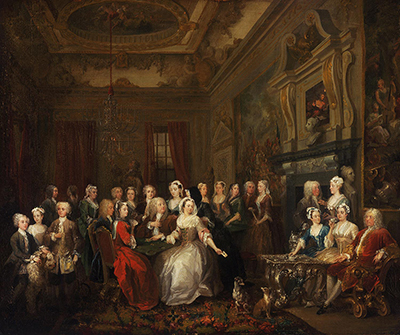
Dorothy Glynne Child has a card to show her husband. Seated near the centre of William Hogarth’s Assembly at Wanstead House, she extends the ace of spades towards Richard Child, who sits in red velvet at the far right with two of their daughters. Her hand reaches past the edge of the card table towards the company taking tea. The Philadelphia Museum of Art, which dates the painting to 1728–31, reads the winning card as a possible tribute to the couple’s marriage. That small gesture gives the eye a route through a room full of competing faces and activity. [1]
The painting is an oil on canvas measuring 64.8 by 76.2 centimetres, held in Philadelphia’s John Howard McFadden Collection under accession M1928-1-13. On that modest surface Hogarth reserves much of the upper half for the room itself. A chandelier drops on a long cord from the painted ceiling, the mouldings recede along the right wall, and the fireplace rises above the people seated beside it. The ballroom at the Child family’s Essex house has a presence of its own. Its proportions are felt in the descent from ceiling to carpet and in the distance Hogarth leaves between the foreground and the far window. [1] [2] [3]
At a Glance
- ArtistWilliam Hogarth
- Date1728–31
- MediumOil on canvas
- CollectionPhiladelphia Museum of Art, John Howard McFadden Collection, M1928-1-13
- Exhibited titleConversation at Wanstead House, International Exhibition of 1862, no. 823
This work across William Hogarth’s career
The Heir
1734The Marriage Settlement
about 1743Gin Lane
1751Canvassing for Votes
1754–55Contents
- Cards, tea and conversation
- A twenty-fifth anniversary?
- The ballroom in the painting and on paper
- The tea table in The Strode Family
Cards, tea and conversation
A conversation piece is a group portrait that shows sitters occupied with one another, often in a setting that helps explain their relationships. Kate Retford points out that the genre’s reduced scale allowed painters to include an unusually large company and still show bodies at full length. Here the people standing behind the game and the figures gathered at the left build up the sense of an assembly. Many faces are too small to register a subtle expression. A turn of the head or a hand offered to a neighbour carries more readily across the room. Near the fireplace, a standing man touches his chest as he addresses the woman facing him. Their gestures make a small exchange intelligible amid the larger gathering. [3]
At the card table Dorothy’s light skirt catches the eye, then her extended forearm draws it to the much smaller patch of white in her hand. The card is held out against dark clothing, where it is easy to pick up. Richard’s red coat gives the gesture an endpoint some distance from the players. At floor level, the dogs between the tables add movement to the gap and draw attention to just how much space Dorothy’s gesture has to cross. Nearby in the tea group, a daughter brings her cup towards her mouth. The room contains several actions that can be followed in turn, even when much of the standing company seems at first to form a continuous line. [1] [3]
Rodris Roth’s Smithsonian study of tea drinking singles out the carved square table and its matching stand for the kettle. Cups and saucers flank the squat teapot. Their arrangement suggests that several people can be served, and the furniture gives the tea drinkers a place of their own beside the fireplace. At the gaming table a card can change who has everyone’s attention. The tea service gives the seated group something to do together while people nearby talk in pairs. By giving these activities separate tables, Hogarth allows them to proceed at the same time. A glance across the gap can then bring the two groups together for a moment. [3] [4]
A twenty-fifth anniversary?
The Essex estate records date Richard Child’s marriage to Dorothy Glynne to 1703, which puts their twenty-fifth anniversary in 1728, at the start of Philadelphia’s date range. That coincidence supports the museum’s proposed occasion. Hogarth’s own account of unfinished pictures, transcribed by John Ireland, adds a second date. The entry for an assembly of twenty-five figures for Lord Castlemaine carries the date 28 August 1729 and appears under the heading for 1 January 1731. The marriage record, the entry in the painter’s account and the museum’s date range each refer to a different part of the history. The account leaves the date and purpose of the depicted gathering open. [1] [5] [6]
Watch Hogarth’s paintings and prints
Five films on Hogarth’s painted stories, prints, drawing methods and work for the Foundling Hospital.
William Hogarth and the Foundling Hospital | HENI Talks
Caro Howell discusses Thomas Coram, Hogarth’s portrait of him and the artist’s work for the Foundling Hospital.
Watch on YouTubeRead as an anniversary painting, Dorothy’s ace makes a public compliment out of a moment in a game. She has turned the face of the card where Richard can see it, and the half-turned figures around the table give her gesture witnesses. Retford also identifies the bust and the picture at the mantel as representations of Julia and Portia, Roman women associated with marital devotion in this reading. The two works near the fireplace extend that reading from the fleeting gesture at the table to the more permanent things the family chose to display. Even a guest who missed those associations could still recognise the pleasure of a winning hand. [1] [3]
The title has shifted over time. At the International Exhibition of 1862, a label listed the painting as Conversation at Wanstead House, no. 823, and named Robert Peel as its owner. The older title catches the way a gesture can link people at different ends of a room. Philadelphia’s current title gives equal weight to the size of the gathering. [1] [7]
The ballroom in the painting and on paper
Colen Campbell’s published plan of the principal floor, plate 23 of Vitruvius Britannicus, records an earlier design. As architectural historian Hannah Armstrong explains, it shows a library and two smaller adjoining rooms in the area later occupied by the ballroom. Armstrong traces the change through a description of a long gallery and later visitor accounts, the 1795 house inventory and the 1822 sale catalogues, which call the room a ballroom. The comparison gives the plan and the painting different uses. Campbell’s engraving shows the intended divisions of the floor. Hogarth shows how a party might occupy the enlarged space, with the tables set far enough apart for people to circulate. [8] [9]
The furnishings offer a way to test what Hogarth shows. Armstrong connects two large tapestries in the painting with those described in the later inventory and sale catalogues. Their subjects are Alexander at the Battle of the Granicus and Telemachus with Calypso. Their size helps explain how the painted hangings can dominate the wall and tower above the seated figures. The later records give weight to the identification of particular objects, while their arrangement at the moment Hogarth painted remains harder to establish. He could put a furnishing where it helped the composition or gave an action a particular resonance. The agreement over the tapestries makes the painting valuable evidence for a lost interior, with the placement of individual things still open to interpretation. [9]
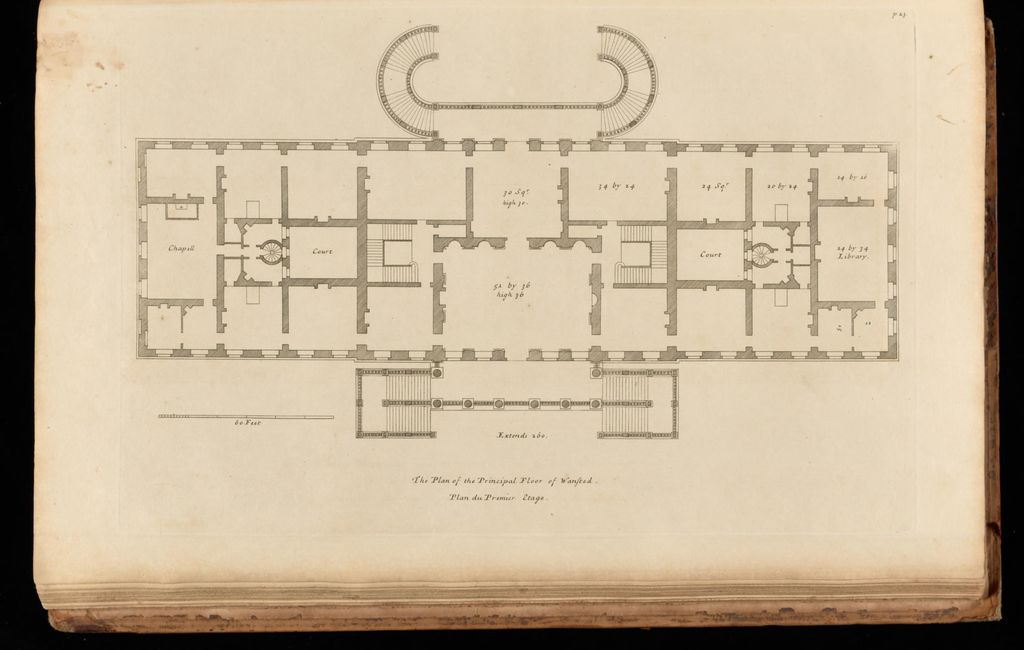
The Plan of the Principal Floor of Wanstead, Colen Campbell, 1717 in this edition. Engraving reproduced from a digitised volume. Vitruvius Britannicus, vol. 1, plate 23. Getty Research Institute scan via Internet Archive. Image source. Public domain.
The tea table in The Strode Family
Hogarth gave the tea table a different place in The Strode Family, an oil on canvas of about 1738 in Tate’s collection, N01153. Its canvas is 87 by 91.5 centimetres, larger than the Wanstead painting, yet it depicts fewer people in a more tightly framed room. A bookcase and framed pictures behind the figures give a sense of the household, while the white tablecloth brings the eye down towards the hands of Lady Anne Cecil. Christine Walker notes that the servant pours hot water from a silver kettle into the blue-and-white teapot as Lady Anne holds her cup and saucer. The two actions show different stages of the service within the same compact group. [10] [11]
At Wanstead the man in red can remain seated at the tea table and still acknowledge a card played elsewhere in the room. At the Strodes’ table Hogarth brings those who serve, drink and converse within reach of the same set of objects. The servant has to lean towards the centre, where the seated figures have space to draw back or reach in. Looking from one to the other shows how differently Hogarth’s paintings can organise the company in a room. So much of the Wanstead canvas is given to things far above or behind its sitters that the tiny card has an unusually large task. It carries one person’s attention through the space the house has provided. [1] [3] [10] [11]
Browse Hogarth’s artworks
All 54 individual artworks and series stages in the approved English cluster
Frequently Asked Questions
She raises the ace of spades towards Richard Child, who sits in red at the far right. The Philadelphia Museum of Art suggests that this may refer to the couple’s marriage. [1]
The Philadelphia Museum of Art holds the canvas and dates it to 1728–31. [1]
Discussion
Look again at the images and ideas explored in Assembly at Wanstead House. These editorial prompts invite your observations.
Reader Insights
How do the dark clothing behind Dorothy’s card and Richard’s red coat help you follow her gesture across the room?
What does Campbell’s plan tell you about the ballroom that you could not learn from looking at Hogarth’s painting alone?
Join the Conversation
Share a detail, comparison or question about Assembly at Wanstead House below.
References
- Philadelphia Museum of Art, William Hogarth, Assembly at Wanstead House, 1728–31, collection object 103800. View source.
- A&AePortal, William Hogarth, Assembly at Wanstead House, M1928-1-13, object metadata accompanying Kate Retford’s The Conversation Piece. View source.
- Kate Retford, “Conversation piece,” DIGIT.EN.S, discussion of Assembly at Wanstead House and notes 3–6. View source.
- Rodris Roth, Tea Drinking in 18th-Century America: Its Etiquette and Equipage, Smithsonian Institution, United States National Museum Bulletin 225 (1961), pp. 61–91, discussion of Hogarth and the tea table. View source.
- Essex Record Office, Essex Estates of Child, Tylney Long and Wellesley Families, D/DCw, catalogue description citing marriage record D/DCw T13. View source.
- William Hogarth, account of unfinished pictures dated 1 January 1731, British Library Add MS 27995/1, f. 1, transcribed in John Ireland, Hogarth Illustrated from His Own Manuscripts, vol. 3, 3rd ed. (1812), p. 21. View source.
- The National Gallery, picture label for Conversation at Wanstead House, International Exhibition of 1862, no. 823, archive NGA27/32/1/9. View source.
- Colen Campbell, Vitruvius Britannicus, vol. 1, pl. 23, plan of the principal floor of Wanstead House, Yale Center for British Art, Folio A 2016 54. View source.
- Hannah Armstrong, The Lost Landscapes and Interiorscapes of the Eighteenth-Century Estate: Reconstructing Wanstead House and its Grounds, Birkbeck, University of London, vol. 1, pp. 173–82. View source.
- Tate, William Hogarth, The Strode Family, c.1738, N01153, historical collection export. View source.
- Christine Walker, “‘We are starving for want of Tea’: Asian objects, domestic slavery and Caribbean sociability,” in Global Goods and the Country House, pp. 115–16, fig. 4.2. View source.







