



 by Tom Gurney
Tom Gurney BSc (Hons) is an art history expert with over 20 years experience
Published on June 19, 2020 / Updated on October 14, 2023
Email: tomgurney1@gmail.com / Phone: +44 7429 011000
William Hogarth’s Prints and Engravings: Introduction
William Hogarth’s Beer Street survives as a worked sheet of copper at the Metropolitan Museum of Art in New York. At the British Museum, a paper impression of the same subject shows a man lifting a joint of meat beneath a tavern sign. The copper is the printing plate, or matrix. The London sheet is one of the impressions printed from the plate after Hogarth revised it. The lettering is cut backwards on the face of the copper so that the title reads normally on paper. Each digital image reproduces a different object, even when a catalogue gives both objects the same title. [1] [2] [3]
A print takes its reversed image from direct contact with the plate. The printer works ink into the incised lines, wipes the surface and runs the plate through a press with damp paper. Under pressure the paper reaches into the lines and picks up the ink. It can also leave a shallow indentation around the plate’s edge. This is the plate mark. The paper beyond it may be wide or narrow, and it can be trimmed after printing. Accordingly, the measurements of the copper, the printed area or plate mark, and the sheet answer different questions. [4] [5]
Hogarth used printed pictures to tell stories that readers could follow from sheet to sheet, to put a street scene into circulation and to sell images after paintings. The physical plate let him revisit those pictures after they had reached the public. The earlier sheets kept the choices he had cut away. In Beer Street, they still show a man being lifted where later viewers would see a joint of meat. The change reshapes the comparison between Beer Street and Gin Lane. [2] [3]
Browse the Engravings

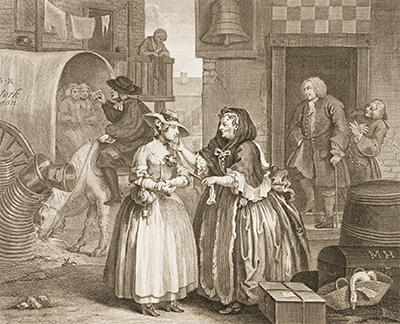
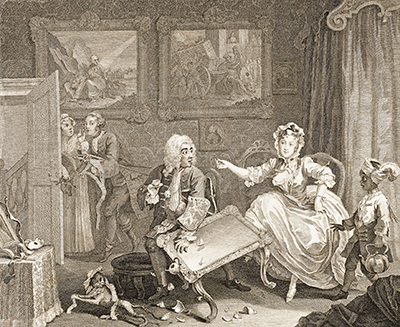
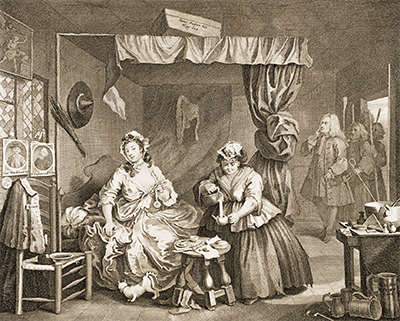
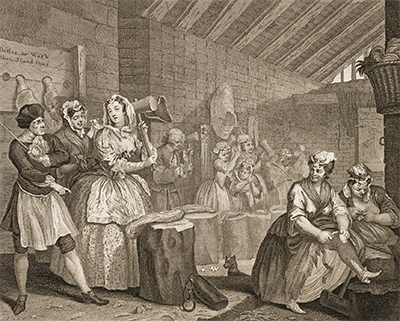
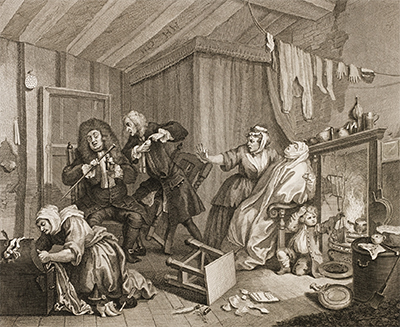
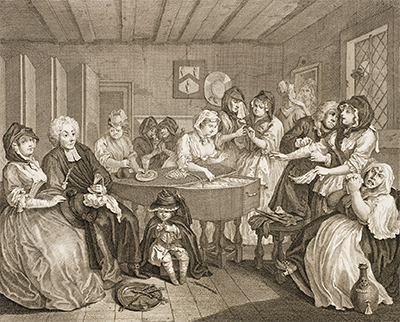
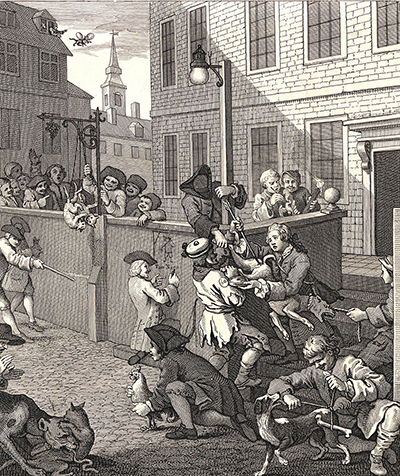
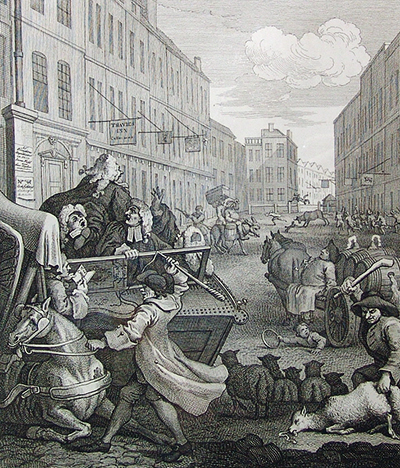
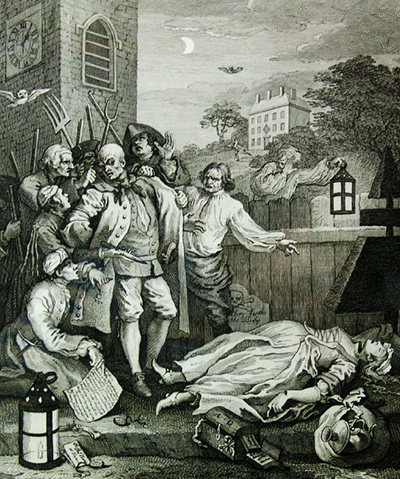
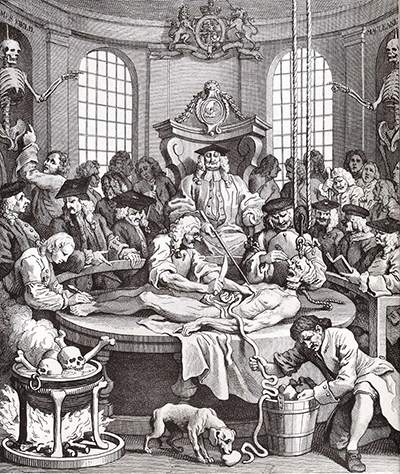
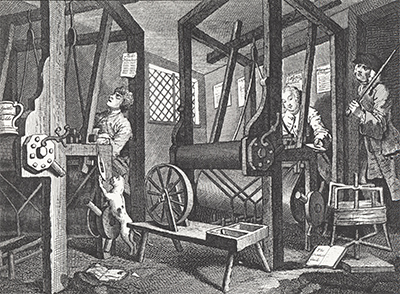
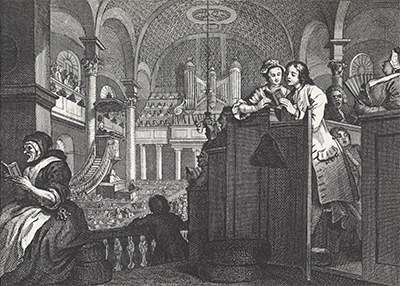
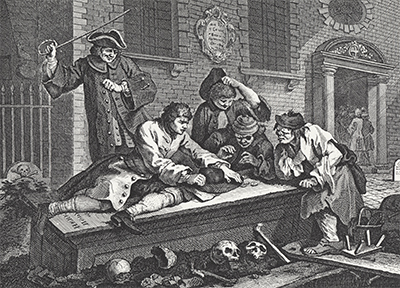
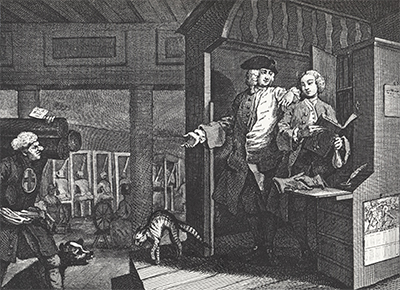
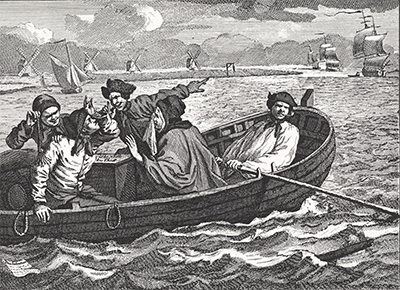
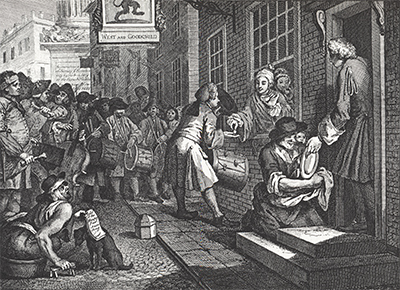
, and taken in a Night-Cellar with his Accomplice William Hogarth.jpg)
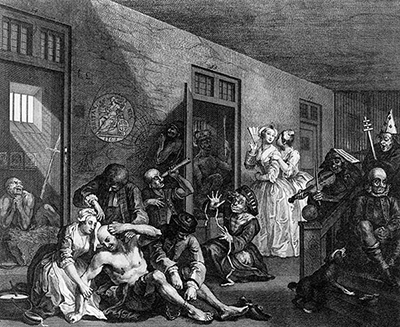
Complete series and related prints
- Beer Street and Gin Lane
- A Harlot’s Progress
- A Rake’s Progress
- The Four Stages of Cruelty
- Industry and Idleness
- Marriage A-la-Mode
- The Humours of an Election
- The Analysis of Beauty
- The March of the Guards to Finchley
- The Gate of Calais
- The Painter and his Pug
- David Garrick as Richard III
- Miss Mary Edwards
- Portrait of Captain Thomas Coram
- Sigismunda Mourning over the Heart of Guiscardo
At a Glance
- ArtistWilliam Hogarth
- ProcessesEtching and engraving
- Printing surfaceCopper plate
- Key comparisonBeer Street impressions and surviving plate
Contents
- Drawing, etching and engraving
- One composition, different matrices
- From paintings to published plates
- Selling the sheets
- Reading a catalogue entry
Drawing, etching and engraving
The Morgan Library & Museum’s red-chalk drawing for Beer Street shows traces of a hand and the edge of a bag left around a missing paper overlay. Jennifer Tonkovich reconstructs the larger figure from these marks and the print. In the British Museum’s early impression S,2.119, a seated figure hoists a startled Frenchman holding a bag. The Morgan sheet preserves fragments of this intervention, even though the paper carrying most of the added figure has vanished. Tonkovich used raking light to see where a fine stylus had passed over the drawing. Details like these connect the drawings to the work of moving a composition onto a plate. They also show changes being worked out on paper alongside changes in the print. [3] [6]
In engraving, the printmaker cuts the metal directly with a burin. The tool gives the line a controllable width, so an engraved stroke can broaden and then taper. To etch, a printmaker coats the plate with a protective ground, draws through that coating with a needle and lets acid bite the newly exposed metal. The drawn line determines where the metal is opened to the acid. The length of the bite helps determine how deep the resulting groove will be. A single plate can take both processes. An etched line and an engraved one both hold ink below the surface and print together in one pass. On a crowded Hogarth sheet, a network of lines can set the darkness of a coat, model the curve of a cheek or establish the depth of a room. A catalogue’s “etching and engraving” identifies two kinds of work behind that single impression. The difference is easier to follow with the two printmaking techniques side by side. [4] [7]
A trial proof lets a printmaker see how the worked plate is printing while there is still time to change it. The Royal Collection’s proof of Gin Lane, RCIN 811913, preserves the street, figures and pawnbroker at a stage before the title and verses were printed in the margin. A state is a version of a matrix identifiable through changes to its printable surface. Impressions are the individual pulls. An edition is a group of impressions issued together. Each of those terms can describe a different aspect of the same sheet. Several separate issues can use one state, and a single design can survive in trial proofs, published impressions from a revised plate and later printings. “Before letters” usually points to absent title or publication lettering. In an image full of street signs, those are different from words already worked into the scene. [3] [5] [8]
Set S,2.119 beside the British Museum’s later Beer Street, 1880,1113.4473. The upraised arm in the earlier sheet supports the Frenchman. In the later one it lifts meat. Hogarth also introduces an embracing couple in the reworked passage. Tonkovich traced the earlier figure’s bent, ruffled sleeve into the outline of the new joint. Her examination of the copper explains how the revision was possible. The deep work in the area was burnished away, thinning the metal. The plate was then hammered out from the back to give the engraver enough surface to rework it. The Met’s copper preserves the material consequence of an alteration that looks effortless on paper. The 1751 date on the Met’s record gives the year the design first appeared. Tonkovich links the revised image to a probable reissue announced in the Public Advertiser on 13 December 1759. The date of the work on the plate remains uncertain. [1] [2] [3]
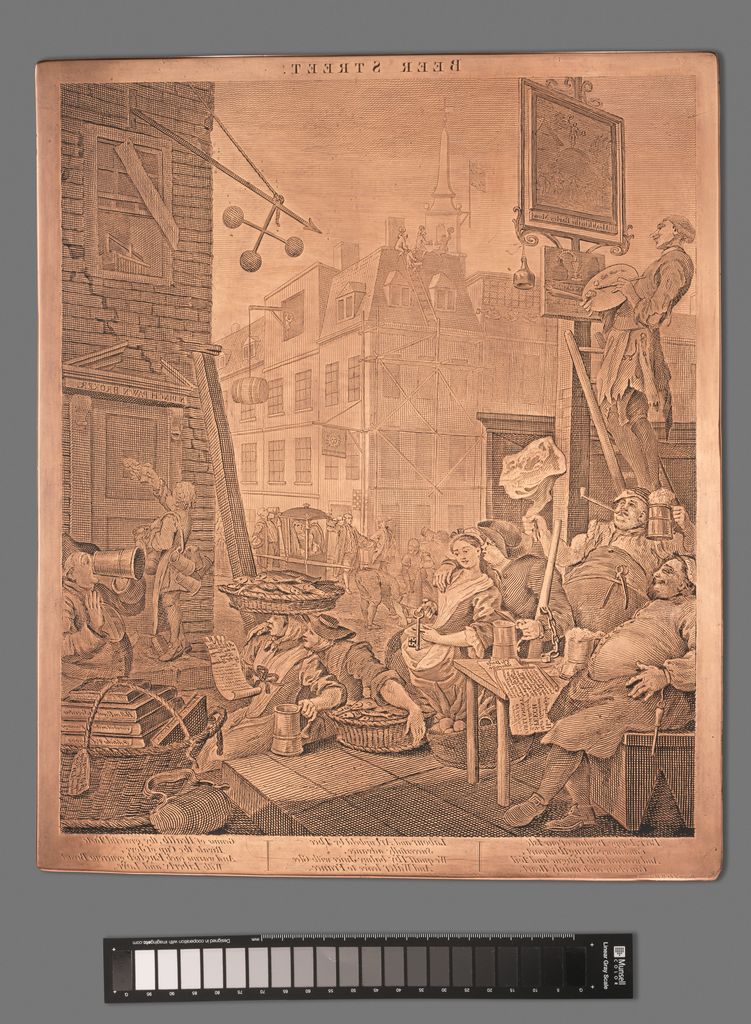
Beer Street, William Hogarth, 1751. Engraved copper plate. 21.55.2. Rogers Fund, 1921. Image source. CC0 / Public domain.
One composition, different matrices
The design for Cruelty in Perfection survives in a print cut on wood by John Bell after Hogarth and in an etched and engraved impression associated with Hogarth’s four-part series. On the woodblock, ink sits on the raised surfaces and the cuts leave the white intervals. In the copperplate print, the lines recessed into the metal supply the ink. The Met records the printing area of Bell’s woodcut at 45 by 37.5 centimetres and the plate mark of its engraved Cruelty in Perfection at 38.8 by 32.2 centimetres. The change of scale is visible even before one compares the lettering or the figures. The woodblock can be revised independently of the copperplate. [9] [10] [11]
In Bell’s woodcut, the little letter in the scene is an especially useful clue. Jennifer Tonkovich and Laurel O. Peterson found that the earliest examples carry letterpress text, probably inserted into the block. In the revised woodcut a piece of wood carries the cut lettering. The words run at a different angle and the new arrangement is closer to the one in the engraving. [12] The researchers connect the later woodcut issue to John Boydell around 1790. The Met’s woodcut 21.72(2) is catalogued with Boydell and the date 1790, and separately labelled first state of two. [9] The researchers identify earlier trial pulls from their thin laid paper, uneven inking and letterpress note. They date the National Gallery of Art’s thick-paper impression to the Boydell issue, although it still carries the block’s January 1750 publication line. In the calendar then used for legal and official purposes in England, January 1750 corresponds to January 1751 in modern year numbering. [12] [13]
Bell cut woodblocks for the two final subjects, Cruelty in Perfection and The Reward of Cruelty. The 1751 etched and engraved series runs to four. Its surviving drawings help explain the development of the printed series, and the full division of work on the copperplates remains uncertain. [11] [12]
From paintings to published plates
Hogarth developed Industry and Idleness through drawings for print. In three studies for plate X at the British Museum, Tonkovich and Peterson trace him from laying out the figures to altering the position of the young apprentice in the foreground. The etched and engraved print shows further revisions beyond the last wash drawing. [12]
Watch Hogarth’s paintings and prints
Five films on Hogarth’s painted stories, prints, drawing methods and work for the Foundling Hospital.
Crafting Cruelty: Hogarth’s Innovative Drawing Methods
The Morgan examines Hogarth’s drawings for The Four Stages of Cruelty and the methods he used to work out his designs.
Watch on YouTubeThe first scene puts two apprentices at adjacent looms and gives their diverging prospects a framing device. The two extracts from Proverbs beneath the image align one kind of conduct with each side. A purchaser could see that contrast in the opening sheet before knowing how the twelve-part story would unfold. The Metropolitan Museum’s The Fellow ’Prentices at their Looms, 91.1.9, is an impression of plate I and is also catalogued as the second state of two. The Roman numeral gives its place in the narrative. The state describes the version of the first plate that printed this particular sheet. Princeton’s exhibition checklist assigns the whole series the design numbers 168 to 179 in Ronald Paulson’s catalogue. [14] [15]
The six oils of Marriage A-la-Mode gave the engravers a different starting point. In Hogarth’s painted Tête à Tête, the steward with his unpaid bills is leaving at the left. In Bernard Baron’s print he moves towards the right. The painter’s coloured surfaces become a network of black lines on paper. Look for the little stack of bills at the edge of each scene. The figure’s movement across the image reverses, while the thrust of his gesture remains clear. [16] [17] Baron made squared red-chalk drawings for plates II and III, now in the Royal Collection. The grid is material evidence of how he prepared the painted composition for engraving. [16] [17]
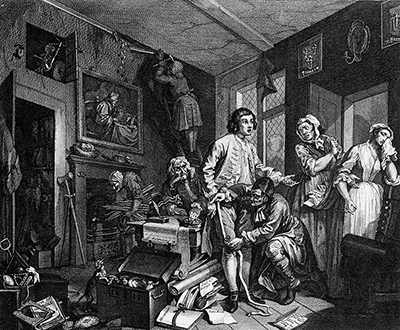
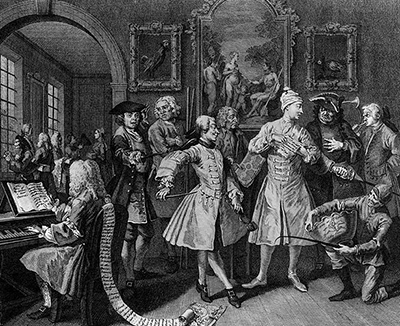
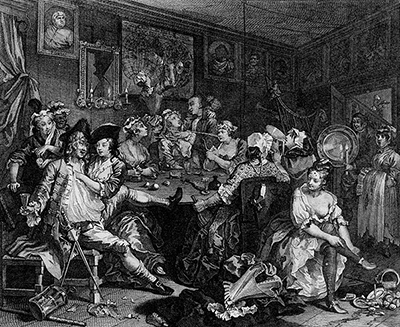
Judy Egerton’s National Gallery catalogue identifies Gérard Jean-Baptiste Scotin as the engraver of plates I and VI, Baron of II and III, and Simon-François Ravenet of IV and V. The Bibliothèque nationale de France’s plate I names Hogarth as inventor, painter and publisher, with Scotin credited separately as engraver. Egerton also identifies earlier assistance from Scotin on plate II of A Rake’s Progress. Princeton’s Sin & the City checklist credits some engraving to Scotin and lists a 1735 printed key to the eight designs. [15] [16] [18]
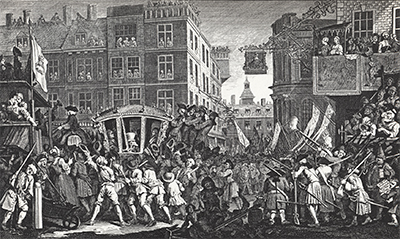
The lower margin of Canvassing for Votes in the Petit Palais names Hogarth as painter and Charles Grignion as engraver, gives the date 20 February 1757 and dedicates the print to Sir Charles Hanbury Williams. [19] Two other sheets from Four Prints of an Election in the same collection name Hogarth alongside collaborators. Plate III, The Polling, names Le Cave. Plate IV, Chairing the Members, names F. Aviline in the museum’s transcription. Plate IV bears 1 January 1758. Plate III bears 20 February 1758. The date engraved on the fourth scene therefore falls before the date engraved on the third. [20] [21]
Selling the sheets
Collectors could subscribe to Marriage A-la-Mode before the set was ready. A receipt gave them a print to take away. Characters and Caricaturas, the etching used for that purpose, is listed among Princeton’s subscription tickets alongside Four Prints of an Election. One surviving copy of Characters and Caricaturas at the Met acknowledges that John Blackwood paid half a guinea in July 1743, with the other half due when the six prints were delivered. Below a crowd of faces that Hogarth intended readers to distinguish from caricatures, a signature and wax seal authenticate a transaction. The receipt also advertises a price of one and a half guineas after the subscription closed. [22] [23] [24] Egerton cites further receipts for the draper William Tothall and John Huggins, Warden of the Fleet Prison. No full list of subscribers survives. [16]
The date engraved on each Marriage A-la-Mode plate is 1 April 1745. Egerton traces the subscribers’ collection of the prints to early June. The inscription and the date recorded for delivery are both useful, especially when a catalogue gives only April for the object. [16] [17] [18]
Hogarth sold Beer Street and Gin Lane by the sheet at the Golden Head. His advertisement in the London Evening Post of 14–16 February 1751 named a price of one shilling each and proposed a better-printed issue at one shilling and sixpence per sheet. Tonkovich considers it likely that the more expensive offer for the drink pair was dropped. The advertisement explains that Hogarth wanted a low price to extend the reach of the pictures among the people whose conduct he hoped to influence. Its wording tells us how he presented the audience and the offer. A signed subscription receipt provides the separate evidence needed to place a print with an individual buyer. [3] [23]
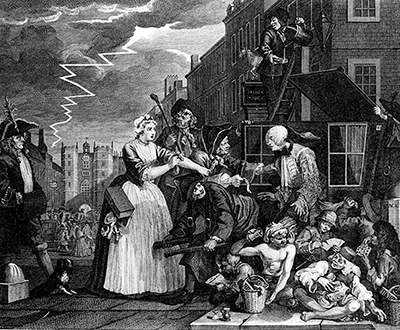
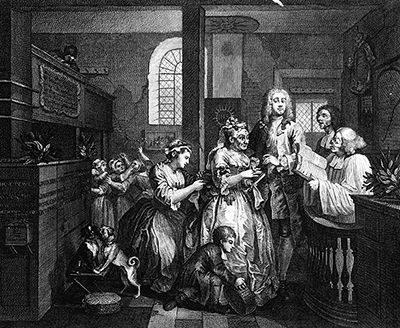
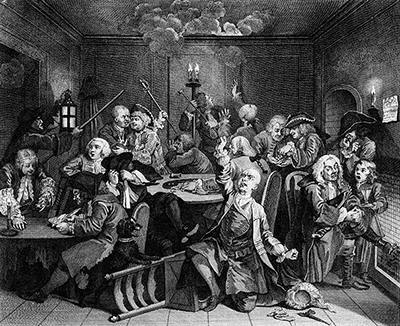
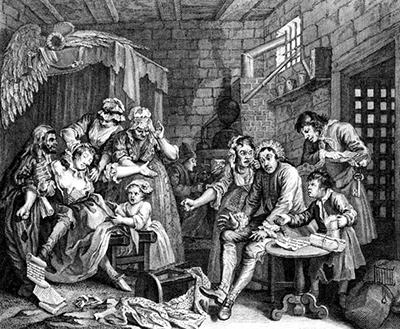
Publication dates also mattered in law. The Engravers’ Copyright Act of 1735 came into force on 25 June. From first publication it provided fourteen years of exclusive printing and reprinting rights for qualifying designs. Hogarth helped press for the legislation and issued A Rake’s Progress on the day it took effect. The Bibliothèque nationale’s plate VI identifies where the print was sold, at the Golden Head in Leicester Fields, and transcribes the date and the reference to the Act. The same publication date appears on its plate VIII. The wording places both sheets within a project whose maker was also its publisher and seller. [25] [26] [27] [28]
The prints continued to be a business after William’s death in 1764. Jane Hogarth and her cousin Mary Lewis sold impressions, and Jane defended her property in William’s designs. The later Engravers’ Act, catalogued under 1766 as 7 Geo. III, c. 38, received royal assent on 29 June 1767. It gave Jane a special twenty-year term reckoned from 1 January 1767, restoring protection to prints whose earlier rights had already expired. She also worked with John Trusler on Hogarth Moralized. As Cristina S. Martinez documents, it offered newly engraved versions at a smaller scale, first in parts and later as a bound volume. Jane ultimately bought out Trusler’s share. She also sold William’s work to the trade. An account from 1782–84, which Martinez reads as recording the dealer John Boydell’s purchases from Jane, lists the Marriage A-la-Mode set at £1 7s. 6d. [29] [30] [31]
Reading a catalogue entry
A sheet of The Second Stage of Cruelty at the National Museum of Western Art in Tokyo brings several kinds of numbering together. The museum’s accession number G.1994-0013 identifies its own sheet. Ronald Paulson’s third edition calls the design number 188. His first complete edition of 1965 calls it 202. In the Tokyo museum’s “188 (1/2),” the fraction identifies the first of two states. The title’s “Second” marks the print’s place in the story. These figures describe four different things. At the Bibliothèque nationale de France the references 137.2 and 139.2 identify the second states of plates VI and VIII of A Rake’s Progress in Paulson’s 1965 edition. Reading the catalogue edition and the state together explains what its numbering is counting. The British Museum calls its Crace impression of Beer Street Paulson 185 IV. Tonkovich describes the major redesign with the joint of meat as the third state in her account of the print’s development. The change from Frenchman to joint of meat is easier to recognise across catalogues than the state number alone. [2] [3] [27] [28] [32]
Later impressions can carry Hogarth’s publication line because it was already on the plate. The folio Works of William Hogarth of 1822 advertised impressions from original plates restored by James Heath, with additional subjects also collected in the volume. A newly cut copy can share the earlier design, too. Wellcome Collection’s Fellow Prentices at Their Looms makes the distinction explicit in its lettering by naming Hogarth as designer and Thomas Cook as engraver. A modern facsimile made from a photograph or scan can reproduce a date, plate mark or paper stain as part of the image. A visible outline that looks like a plate mark on a screen is therefore a clue to what was photographed. On the physical sheet the indentation, paper, ink and provenance can be examined together. [4] [5] [33] [34]
Begin with the object’s medium and accession, then read the credits and date below the image. If the catalogue names a state, look for the alteration it describes in a second identified impression. The differences may be as small as changed lettering or as large as the replacement of a figure. This approach also works across Hogarth’s series and his drawings. In Beer Street, the hand preserved on the drawing, the figure printed on the early sheet and the reworked copper preserve successive decisions that no single object records on its own. [1] [2] [3] [6]
Browse Hogarth’s artworks
All 54 individual artworks and series stages in the approved English cluster
Frequently Asked Questions
Discussion
Look again at the images and ideas explored in William Hogarth’s Prints and Engravings. These editorial prompts invite your observations.
Reader Insights
What is the first difference you notice between the early and later versions of Beer Street?
Which advantage did engraving give Hogarth when he wanted a reader to inspect words or objects closely?
Join the Conversation
Share a detail, comparison or question about William Hogarth’s Prints and Engravings below.
References
- Metropolitan Museum of Art, William Hogarth, Beer Street, engraved copperplate, 21.55.2. View source.
- British Museum, William Hogarth, Beer Street, impression 1880,1113.4473, Paulson 185 IV. View source.
- Jennifer Tonkovich, “Hogarth and the Making of Beer Street and Gin Lane,” Master Drawings 60, no. 2 (2022), pp. 201–218, esp. pp. 203–204 and 207–214, figs. 1, 11, 13 and 20, n. 24. View source.
- Metropolitan Museum of Art, Engraving, Materials and Techniques. View source.
- The Boston Printmakers, Glossary, entries for edition, plate mark, proof, reproduction and state. View source.
- Morgan Library & Museum, William Hogarth, Beer Street, drawing III, 37. View source.
- Metropolitan Museum of Art, Etching, Materials and Techniques. View source.
- Royal Collection Trust, Gin Lane – unfinish’d proof, RCIN 811913. View source.
- Metropolitan Museum of Art, John Bell after William Hogarth, Cruelty in Perfection, woodcut 21.72(2). View source.
- Metropolitan Museum of Art, Woodcut, Materials and Techniques. View source.
- Metropolitan Museum of Art, William Hogarth, Cruelty in Perfection (The Four Stages of Cruelty), etching and engraving 91.1.138. View source.
- Jennifer Tonkovich and Laurel O. Peterson, “Hogarth and the Making of the Four Stages of Cruelty,” Master Drawings 62, no. 1 (2024), pp. 21–40, esp. pp. 26–33, figs. 11–19 and n. 32. View source.
- National Gallery of Art, Washington, John Bell after William Hogarth, Cruelty in Perfection, 2012.2.1, especially “Inscriptions & Marks.”. View source.
- Metropolitan Museum of Art, William Hogarth, The Fellow ’Prentices at their Looms (Industry and Idleness, plate 1), 91.1.9. View source.
- Princeton University Library, Sin & the City, full exhibition checklist. View source.
- Judy Egerton, National Gallery, Marriage A-la-Mode, in The British Paintings (2000), NG113–NG118, especially “Engraved,” “Discussion” and “NG 114.”. View source.
- Metropolitan Museum of Art, Bernard Baron after William Hogarth, Marriage A-la-Mode, Plate II, 91.1.108. View source.
- Bibliothèque nationale de France, Marriage A-la-mode. Plate I, FRBNF40262669 (in French). View source.
- Petit Palais, Paris Musées, Canvassing for Votes. Plate II, PPG6041 (in French). View source.
- Petit Palais, Paris Musées, The Polling. Plate III, PPG6042 (in French). View source.
- Petit Palais, Paris Musées, Chairing the Members. Plate IV, PPG6043 (in French). View source.
- Vicki Principi, Princeton University Library, William Hogarth Collection, Graphic Arts Collection finding aid GC113, Box 1. View source.
- Metropolitan Museum of Art, William Hogarth, Characters and Caricaturas, receipt 32.35(152). View source.
- Caroline Karpinski, “Prints for Sale,” The Metropolitan Museum of Art Bulletin 22, no. 6 (February 1964), fig. 12, the John Blackwood receipt and its printed price. View source.
- Parliament of Great Britain, Engravers’ Copyright Act, 8 Geo. II, c. 13 (1735), Durham University Library facsimile at Primary Sources on Copyright. View source.
- Ronan Deazley, “Commentary on the Engravers’ Act (1735),” Primary Sources on Copyright, §§ 3–4. View source.
- Bibliothèque nationale de France, A Rake’s Progress, The Gaming House, plate VI, FRBNF40262629, Paulson 137.2 (in French). View source.
- Bibliothèque nationale de France, A Rake’s Progress, The Mad House, plate VIII, FRBNF40262631, Paulson 139.2 (in French). View source.
- Hogarth’s House, London Borough of Hounslow, William Hogarth, on Jane Hogarth and Mary Lewis. View source.
- Parliament of Great Britain, Engravers’ Copyright Act, 7 Geo. III, c. 38 (1766), Durham University Library facsimile at Primary Sources on Copyright. View source.
- Cristina S. Martinez, “Jane Hogarth: A Printseller’s Imprint on Copyright Law,” in Female Printmakers, Printsellers, and Print Publishers in the Eighteenth Century (2023), pp. 189–206. View source.
- National Museum of Western Art, Tokyo, William Hogarth, The Second Stage of Cruelty, G.1994-0013, Paulson 188 (1/2) (in Japanese and English). View source.
- John Nichols and Son, The Works of William Hogarth, from the Original Plates Restored by James Heath, London, 1822, title page transcribed in the Victoria University Library Bentley collection catalogue, item 738. View source.
- Wellcome Collection, Thomas Cook after William Hogarth, The Fellow Prentices at Their Looms, ef3tm5qr, credit line in the print. View source.





