


 by Tom Gurney
Tom Gurney BSc (Hons) is an art history expert with over 20 years experience
Published on June 19, 2020 / Updated on October 14, 2023
Email: tomgurney1@gmail.com / Phone: +44 7429 011000
Portrait of Captain Thomas Coram: Introduction
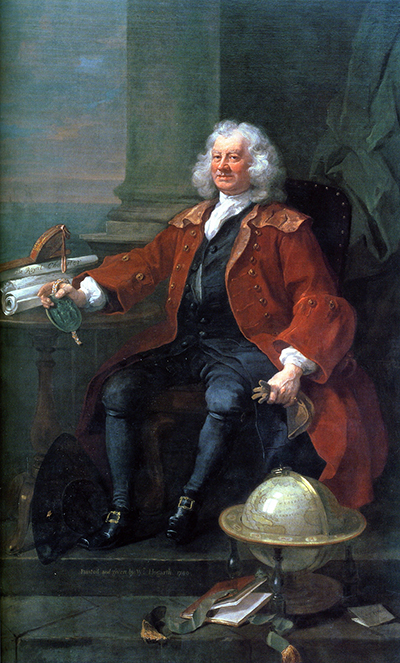
William Hogarth painted Thomas Coram in 1740 with his coat open, his white hair loose and the seal of the Foundling Hospital’s charter hanging from his right hand. Behind the sitter rise a classical column and a sweep of drapery. In front of him, a globe turns its Atlantic face towards the viewer. At nearly two and a half metres high, the portrait gives a retired sea captain the scale and setting associated with royalty and aristocracy. The oil on canvas measures 238.7 cm high by 147.3 cm wide and is in the care of the Foundling Museum, London, where it is catalogued as FM32. [1] [2] [3]
Hogarth gave the picture to the Hospital in the year he painted it. The museum identifies it as the first artwork to enter the collection. Coram had spent years seeking support for an institution to take in abandoned infants. King George II granted its royal charter on 17 October 1739, and the Hospital received its first thirty babies on 25 March 1741. The portrait therefore belongs to the interval between the establishment of the charity and the arrival of the children it would care for. The seal commemorates a legal achievement whose consequences were still ahead. [1] [4] [5] [6]
At a Glance
- ArtistWilliam Hogarth
- Date and medium1740, oil on canvas
- Dimensions238.7 × 147.3 cm (height × width)
- CollectionFoundling Museum, London, FM32
- GiftGiven by Hogarth to the Foundling Hospital in 1740
This work across William Hogarth’s career
Assembly at Wanstead House
1728–31The Heir
1734The Marriage Settlement
about 1743Gin Lane
1751Canvassing for Votes
1754–55Contents
- A grand setting and an informal sitter
- How the charter enters the portrait
- From the Hospital to the exhibition gallery
- Coram in print and on paper
A grand setting and an informal sitter
The raised platform, column and gathered drapery belong to the grand manner, a style of portraiture that uses scale, architecture and formal arrangement to confer public dignity. The dais sets Coram above the objects in the foreground, and the column extends the picture’s vertical axis high above his head. Across the middle, his broad coat and extended arm give the composition its width. The dark curtain sets off the white hair, while the red-brown coat keeps the figure distinct from the furniture and shadow around him. The effect depends as much on these broad divisions of colour and space as on any of the emblems. [1] [2]
At the level of the face and hands, the painting changes register. The Foundling Museum identifies the hair as Coram’s own, and Hogarth gives its soft, irregular outline room to spread around the cheeks. The right cuff opens onto the reddened hand that grips the seal. The other hand rests near his knee, holding gloves, and the unfastened coat falls on either side of the darker waistcoat and breeches. His knees are apart and both buckled shoes are in view. The disposition of the body does much to make him seem at ease in a setting designed to command attention. [1] [2]
Coram had worked as a sea captain and shipwright and established a shipbuilding business in colonial Massachusetts. Hogarth gives that part of his life two different scales within the picture. The distant water and shipping occupy a narrow opening beyond the column. The globe sits close to the viewer, its Atlantic bringing England and New England into the same field of view. Coram’s black hat lies low on the opposite side of the canvas. The museum identifies it as a gift from London hatters whom he had helped in a trade dispute. The hat makes a smaller act of assistance visible alongside the achievement commemorated by the charter. [1] [2]
How the charter enters the portrait
Some of the picture’s most consequential details would reward a viewer who could get close to the canvas. The charter seal hangs against the shadow beneath Coram’s cuff, and the papers beside it lie in the side light. The Foundling Museum draws attention to the faint figure of Charity on the wall behind him. The image gives that personification a quieter presence than the seal, which has weight, colour and a hand to hold it. Read together, the two details connect a general ideal of care with the means by which Coram’s particular institution came into being. [1] [2]
The charter also points to work done by people beyond the frame. In the Foundling Museum’s account, Charlotte, Duchess of Somerset, was the first person to sign Coram’s petition, in 1729. The museum pairs Hogarth’s work with a separate portrait of Charlotte by Charles d’Agar. Encountering the two likenesses together gives the viewer a way to recover part of the campaign behind the seal. Hogarth concentrates the achievement in a single sitter and a single gesture. The petitions and their supporters explain how much collective effort that gesture can stand for. [1] [5]
Watch Hogarth’s paintings and prints
Five films on Hogarth’s painted stories, prints, drawing methods and work for the Foundling Hospital.
William Hogarth and the Foundling Hospital | HENI Talks
Caro Howell discusses Thomas Coram, Hogarth’s portrait of him and the artist’s work for the Foundling Hospital.
Watch on YouTubeFrom the Hospital to the exhibition gallery
The gift became part of the furnishings of a working charity. Drawing on the Hospital’s records, the National Portrait Gallery’s Jacob Simon notes that Hogarth gave a gold frame for the painting in April 1741. Simon proposes that it may have been reframed in 1746 to match other Hospital portraits. The egg-and-dart ornament on its present frame also appears on frames around Thomas Hudson’s portraits of Theodore Jacobsen and John Milner. If the reframing took place as proposed, the choice made the founder’s portrait part of a recognisable group through a repeated detail just outside the painted surface. [7]
In December 1747 an order directed that Coram’s portrait be moved to the Secretaries’ Office and that Allan Ramsay’s portrait of Dr Richard Mead take its place. The Foundling Museum records that Coram later hung in the girls’ dining room among other eighteenth-century portraits, before the works were brought together in a Picture Gallery. The museum now presents the painting in its recreation of that gallery. In 1868 it also travelled outside the institution. The South Kensington Museum’s third National Portrait Exhibition catalogued the Hospital’s loan as Capt. Thomas Coram, no. 803, and transcribed the inscription crediting Hogarth with both painting and giving the portrait in 1740. A likeness once seen in rooms used by the charity’s staff and children could also take its place in a national exhibition of historical figures. [7] [8] [9]
Hogarth helped assemble the paintings for the Hospital’s Court Room, where its governors held formal meetings. One was his Moses Brought Before Pharaoh’s Daughter, dated 1746 by the Foundling Museum and donated in April 1747. In that picture a child clings to his birth mother’s dress as she brings him to the princess. The gesture ties the change in the child’s circumstances to the cost of separation. Coram’s hand on the seal puts the emphasis on the act that established the Hospital, while the child’s hand in the later work draws attention to what it means for a family to entrust a child to someone else. Both pictures make a public subject legible through the way a person holds something. The survey of Hogarth’s paintings traces how he used such details across portraits and scenes made for institutions. [1] [10] [11]
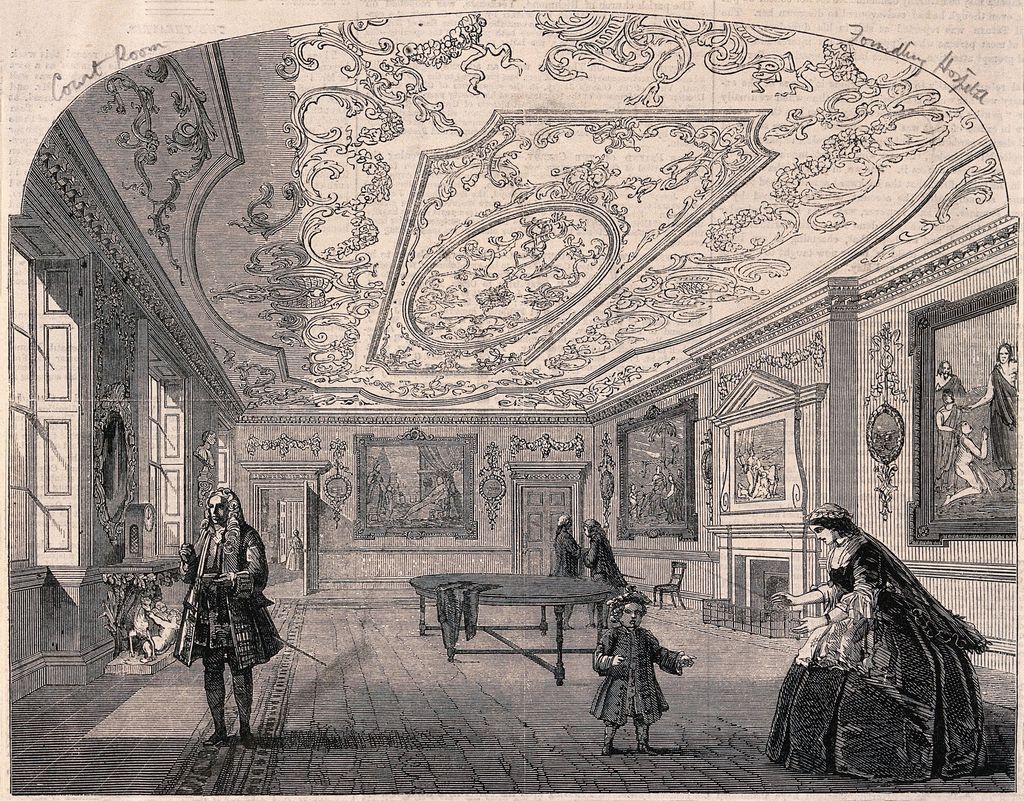
The Foundling Hospital, the interior of the Court Room, unidentified printmaker, undated. Wood engraving. 37960i. Wellcome Collection. Image source. Public domain.
Coram in print and on paper
James MacArdell’s 1749 print after Hogarth shows how much of the likeness could travel without the surroundings. In the National Gallery of Art’s impression, Captain Thomas Coram (1950.14.329), the lifted edges of the white neckcloth and the sheen on the buttons stand out against a dark oval. The coat is still open and the hair still spreads across the shoulders. The image ends above the hands, leaving the globe, dais and charter seal outside the composition. The National Gallery of Art catalogues its impression as an engraving. The National Portrait Gallery catalogues its MacArdell example, NPG D1554, as a mezzotint. [12] [13]
Below the portrait, the printed lettering names Coram and credits his petitioning with obtaining the royal charter from George II. It supplies the date, 17 October 1739. The information carried in the painting by the conspicuous seal and a hand extended into the light now reaches the viewer through an engraved caption. Without the landscape and globe, Coram’s work at sea drops out of the image. The reduced format gives his features and the history of the charter a larger share of the viewer’s attention. [2] [5] [12]
A separate head-and-shoulders portrait, NPG 2427, takes the reduction further. The National Portrait Gallery describes it as pencil, tentatively identified, and wash on paper, set within a painted oval. It catalogues the work as after Hogarth and based on a work of 1740. That year identifies the model for the likeness. The copy’s own date remains uncertain. John Kerslake’s catalogue notes its close resemblance to MacArdell’s composition and suggests that the copy may have been made through the print. Old inscriptions associate it with Hogarth, but the gallery retains the attribution to an unidentified copyist. [14] [15]
Across these three objects, the open coat and the irregular outline of Coram’s hair carry much of his identity. In the canvas, the same likeness is surrounded by objects that tell us about his work, from the Atlantic globe to the charter seal. MacArdell kept the face and put the charter into words beneath it. The small copy brings the viewer closer still to the face. Looking back at the painting after seeing the two works on paper makes the space below Coram’s shoulders newly conspicuous. It contains the hands, the objects they touch and the seal that identifies his role in the Hospital’s founding. [1] [2] [12] [14] [15]
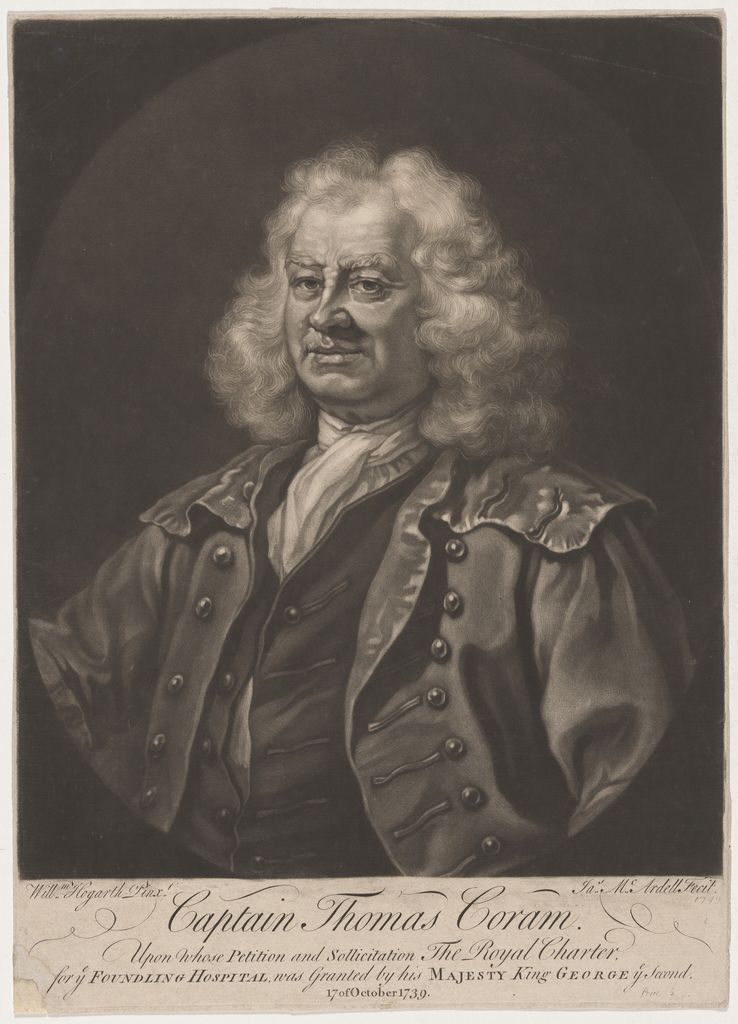
Captain Thomas Coram, James MacArdell, after William Hogarth, 1749. Engraving. 1950.14.329. Rosenwald Collection. Image source. CC0 / Public domain.
Browse Hogarth’s artworks
All 54 individual artworks and series stages in the approved English cluster
Frequently Asked Questions
Discussion
Look again at the images and ideas explored in Portrait of Captain Thomas Coram. These editorial prompts invite your observations.
Reader Insights
How do Coram’s open coat and wide seated stance affect the impression created by the column and raised platform?
How does the engraved caption change the way a viewer learns about the charter in MacArdell’s print?
Join the Conversation
Share a detail, comparison or question about Portrait of Captain Thomas Coram below.
References
- Foundling Museum, “Captain Thomas Coram & Duchess of Somerset,” William Hogarth’s Portrait of Captain Thomas Coram, 1740, and the account of Charlotte’s petition. View source.
- Foundling Museum, William Hogarth, Portrait of Captain Thomas Coram, 1740, reproduction and object details on Google Arts & Culture. View source.
- Mark Hallett, Reynolds: Portraiture in Action, fig. 47, Captain Coram, FM32, Paul Mellon Centre and Yale University Press. View source.
- Foundling Museum, “Portrait of Thomas Coram,” first artwork and record of gift. View source.
- The London Archives, “The Foundling Hospital,” royal charter and archival holdings. View source.
- Foundling Museum, “The Holy Bible,” object entry and first admissions on 25 March 1741. View source.
- Jacob Simon, “Picture Frames at the Foundling Museum, London,” National Portrait Gallery, 20 August 2006. View source.
- Foundling Museum, “Picture Gallery,” historical and museum display of Hogarth’s Coram portrait. View source.
- Science and Art Department of the Committee of Council on Education, Catalogue of the Third and Concluding Exhibition of National Portraits, South Kensington Museum, 1868, no. 803. View source.
- Foundling Museum, “Hogarth & Company,” Court Room paintings and their institutional setting. View source.
- Foundling Museum, William Hogarth, Moses Brought Before Pharaoh’s Daughter, 1746, gift of the artist in 1747. View source.
- National Gallery of Art, James MacArdell after William Hogarth, Captain Thomas Coram, 1749, Rosenwald Collection, 1950.14.329. View source.
- National Portrait Gallery, James MacArdell after William Hogarth, Thomas Coram, 1749, NPG D1554. View source.
- National Portrait Gallery, Thomas Coram, after William Hogarth, based on a work of 1740, NPG 2427. View source.
- John Kerslake, Early Georgian Portraits, National Portrait Gallery, 1977, p. 62, “Thomas Coram,” NPG 2427 and iconography. View source.







