


 by Tom Gurney
Tom Gurney BSc (Hons) is an art history expert with over 20 years experience
Published on June 19, 2020 / Updated on October 14, 2023
Email: tomgurney1@gmail.com / Phone: +44 7429 011000
A Rake’s Progress: Introduction
William Hogarth’s A Rake’s Progress follows Tom Rakewell from a tailor’s fitting in his dead father’s house to a hospital ward where attendants put him in restraints. In the first picture Tom can pay almost anyone in the room, including Sarah Young, to whom he has promised marriage. In the last, Sarah is still at his side, and all the signs of wealth that once made him worth attending to have gone. Sir John Soane’s Museum dates the eight oil paintings to 1734. Hogarth first published the eight prints on 25 June 1735. They carry the same story through London, with changes in the details, the direction of the compositions and the words available to the viewer. [1] [2] [3]
The title makes a joke out of advancement. Tom puts on better clothes and acquires more fashionable connections, but over the course of the series other people gain increasing control over where he can go and what he can do. Hogarth shows those changes through transactions, often two or three in the same room. While Tom offers Sarah money in the first scene, a man trusted with the estate helps himself from a bag. At the other end of the series a man who has lost the means to command an audience attracts visitors’ attention at Bethlem. Between these two moments, money changes from the thing that can rearrange a room around Tom to the thing everyone keeps asking him for. [1] [2]
At a Glance
- ArtistWilliam Hogarth
- Painted sequenceEight oils, 1734
- Prints issued1735
- Paintings held bySir John Soane’s Museum, London
Contents
- The eight scenes
- What changes from scene to scene
- From a studio visit to a set of prints
- The prints in other hands
- How the eight canvases came to Soane
- What conservation changes about looking
- The opera and David Hockney’s two encounters with the Rake
The eight scenes
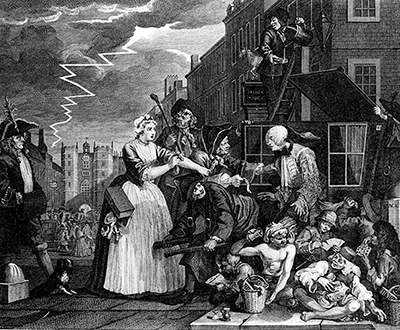
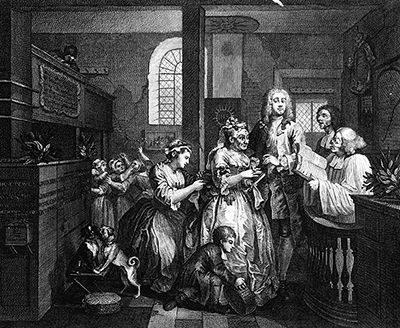
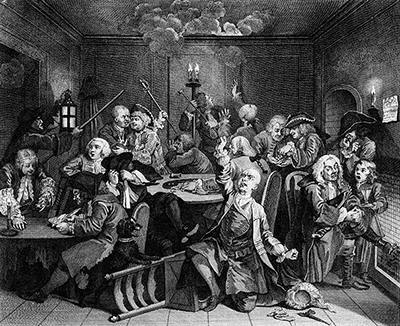
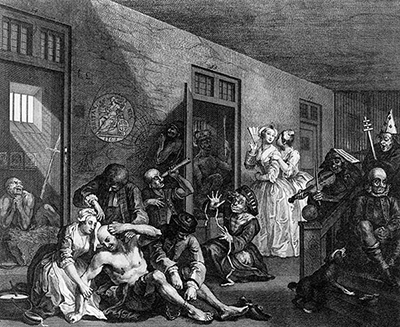
The eight scenes
I. The Heir
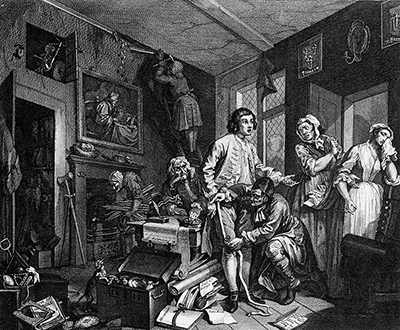
The tailor takes Tom’s measure while the household takes stock of his inheritance. A portrait above the fireplace shows his father weighing money. Nearby, the old man’s cap and his carefully preserved possessions survive him. The furniture and fire give little impression of comfort, but the chest, the labelled financial papers and the coins falling from behind a cornice reveal substantial resources. Different forms of wealth occupy the same picture. There is silver that can be put on display, hidden gold that has done nobody in the room any good, and paperwork recording financial interests beyond the household. The scene allows us to see why Tom can set himself up in a different world, and why that possibility was unavailable to people who needed to live by their work. [1]
Sarah’s evidence is of a different kind. She brings a ring, and letters spill from her mother’s hands. What Tom once wrote about marriage can be compared with what he does while the tailor measures him. Sarah’s mother presses a claim whose force depends on a promise. Tom offers coins as if its force depended on the price he could name. His turn towards them exposes him to the inventory taker reaching for the money behind him. Hogarth makes each person’s attention selective. The lawyer’s chance depends on Tom looking away, while Tom has calculated that Sarah and her mother can be induced to go away. [1]
In the National Gallery of Art’s impression of plate I, the tailor, the claiming women and the man at the moneybag can all be found again, with the main composition reversed. The French catalogue for the Bibliothèque nationale de France’s third state describes the discovery of the coins by a man hanging cloth. Neither the oil nor the print requires the viewer to establish precisely how much the household is worth to see the comedy of its accounts. The strongest clue is the way the people in the room occupy themselves with different measures of value. [4] [5]
II. The Levee
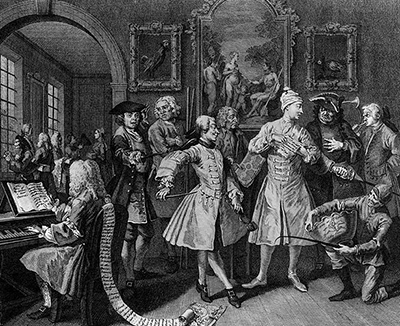
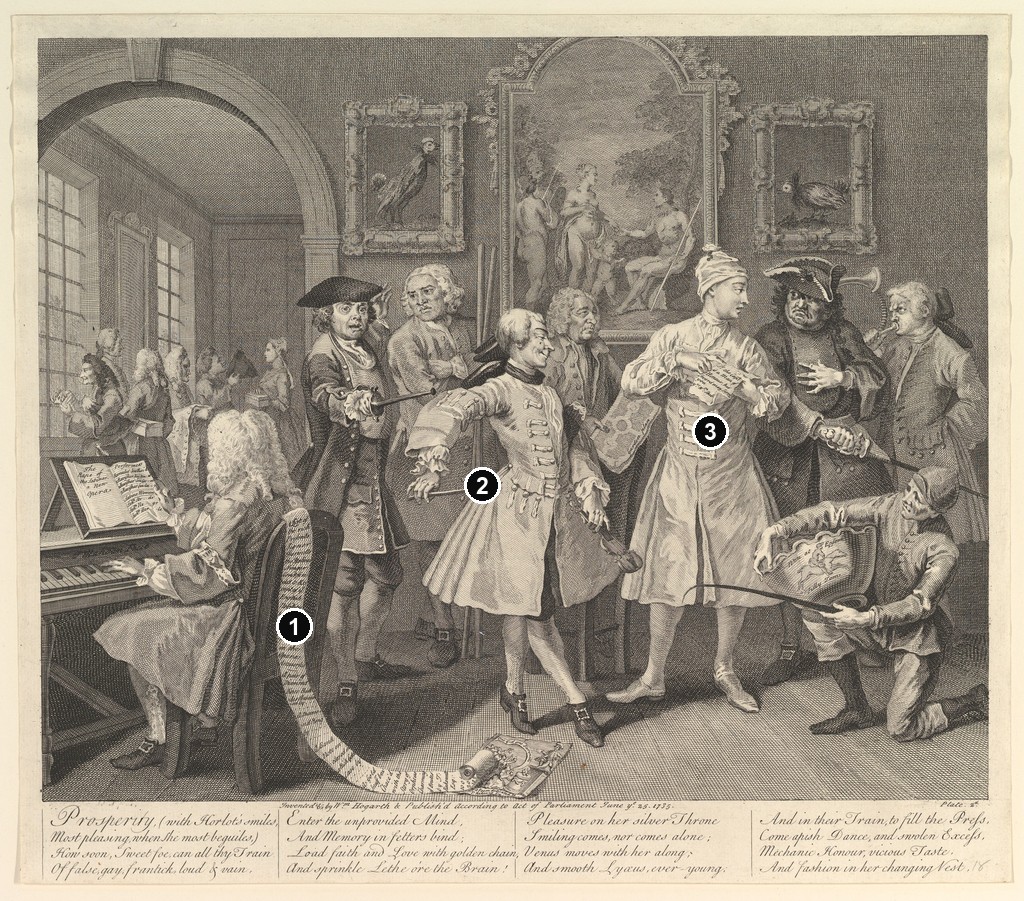
Tom now has a room of his own in which people wait for him to get dressed. The levée originated as a court ceremony in which a ruler received people as he rose. It also offered a useful model for an ambitious private gentleman seeking to make access to himself seem valuable. Tom receives the company in a pink morning coat and slippers. A dance master displays his skill, a fencing master demonstrates a stance, a gardener offers a plan and a jockey presents a trophy. Tom can buy the services required to prepare for fashionable society. The difficulty is that his assembly, crowded with people selling different things, makes the labour and expense behind his new manner unusually easy to see. [6]
The furnishing supplies its own judgment. Behind Tom hangs the Judgement of Paris, flanked by pictures of fighting cocks. The painting about a choice with disastrous consequences is conspicuous enough to be admired as decoration and read against Tom’s predicament. The two game birds also belong to the world of sporting bets that the jockey’s trophy introduces. It is possible to look at the scene first as a handsome interior, then as a room in which expenses have been adding up while Tom has been learning how to be seen. [6]
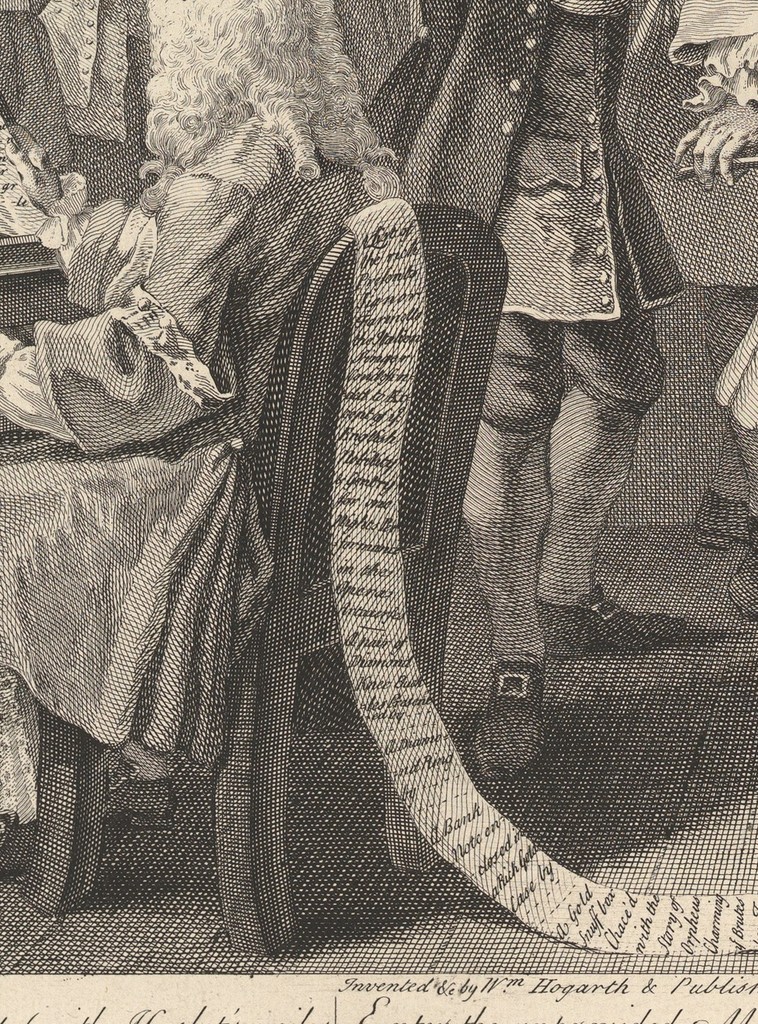
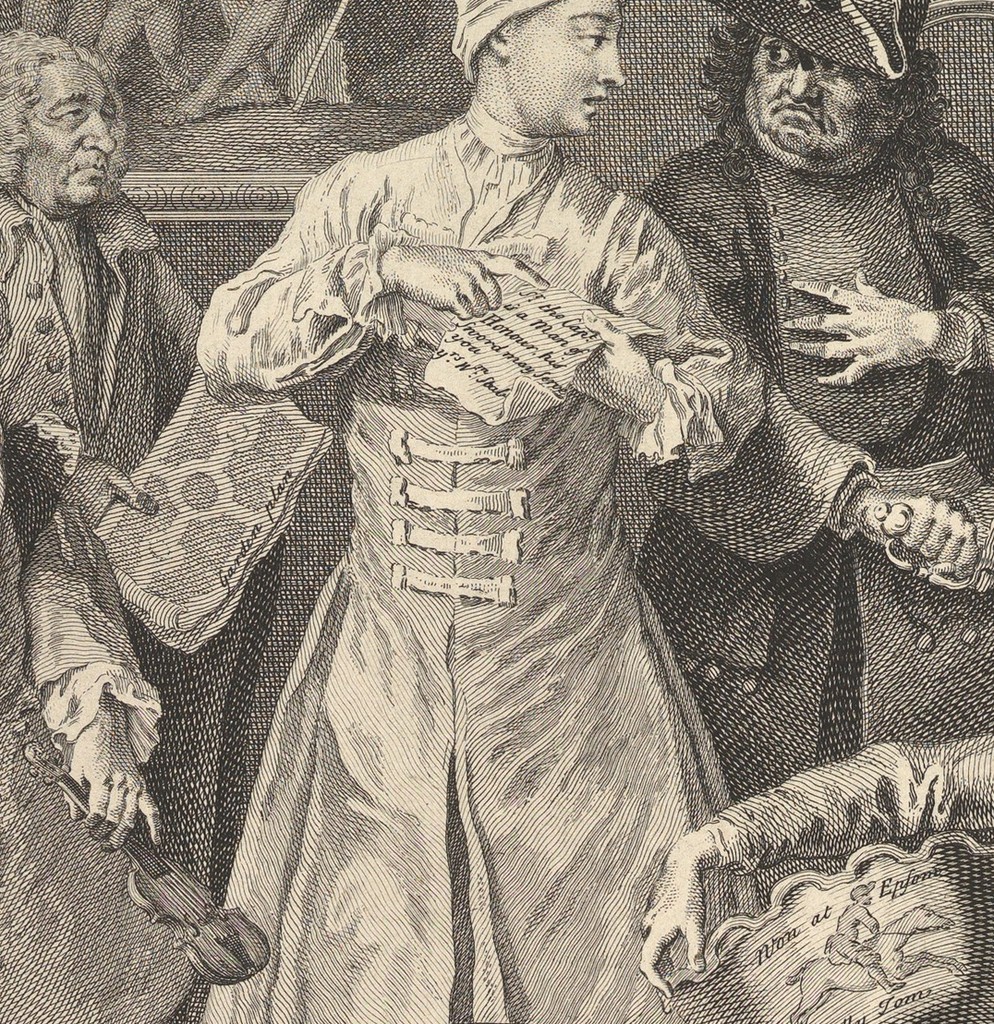
In the painting a musical joke is already underway at the harpsichord. The paper version gives it a life beyond the figure of the player. Yale’s impression, B1981.25.1412, contains a mock opera score and a tribute to the visiting singer Farinelli, a celebrity whom wealthy patrons showered with gifts. At the Metropolitan Museum of Art, the third-state impression credits Hogarth as artist and publisher and Gérard Jean-Baptiste Scotin as engraver. The National Gallery of Art’s impression is also catalogued in the third state. Small invented documents gave buyers of the print a particular route into the joke. They could examine an opera cast and the language of celebrity adulation within a picture about the purchase of social distinction. [6] [7] [8] [9] [10]
III. The Orgy
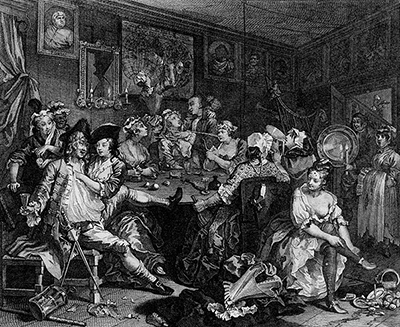
At the Rose Tavern in Covent Garden, the terms of company change. Tom is surrounded by entertainers and women working in a tavern that the Soane catalogue describes as a brothel. He slumps in his chair while a woman distracts him with a caress and passes his watch to another woman behind his back. This is a quicker, more intimate deception than the theft in the first picture. The watch condenses a night’s spending into something small enough to change hands while Tom is still wearing the clothes in which he came out. His attention is on the person touching him. The viewer sees where her other attention lies. [11]
The walls belong to the comedy as much as the figures. The portraits of Roman emperors have been defaced, with Nero left intact. A woman holds a candle to a picture of the world. The museum connects its motto with the theatre in Drury Lane, a reminder that the tavern is in a district where performances can be found on and off a public stage. In the Soane painting a watchman’s staff and lantern lie by Tom. The catalogue reads them as evidence of an earlier street prank on a watchman. In scene VI a man carrying this sort of equipment will enter with a warning the gamblers scarcely heed. Objects a customer can carry off as a joke in one episode belong to the small apparatus of public safety in another. [11] [12]
There is a particularly economical mark of locality in the lettering around the silver platter brought in by a porter. The museum reads the name in the oil as Bonvin, a possible French play on good wine, and notes the added final e in the engraved versions. The BnF’s third-state record and the National Gallery of Art’s first-state impression make it possible to follow the scene’s company and wall pictures without assuming that every painted word passed into the plate unchanged. [11] [13] [14]
IV. The Arrest
Tom’s elegant dress has become a liability in a street where people know what he owes. As his sedan chair approaches St James’s Palace, officers acting for a creditor stop it and pull him into view. The leeks worn in two hats help the Soane Museum read the crowd as assembling on St David’s Day for festivities associated with Queen Caroline’s birthday. Tom has dressed to be admitted into select company. He falls short of his destination and gets a public audience for the debt that his costume conceals. A child retrieves his falling cane, while a lamplighter looks down and spills oil. The street scene briefly gives those who serve or wait outside an excellent view of the aspiring courtier. [15]
Sarah has an occupation as well as a history with Tom. Her name is on the box that the catalogue associates with her work as a milliner. She offers her purse to the officer. The turn from the first scene is precise. Each has had the means to give the other money, and each has used the offer to a different end. Tom wanted the woman to whom he was indebted to disappear. Sarah spends or risks her savings to keep him out of custody. Hogarth puts her resourcefulness in the foreground of a scene in which court dress, a seat in a sedan and an impressive destination offer Tom very little help. [15]
In the BnF’s third state of plate IV, the street turns stormy and a bolt of lightning points towards White’s. The same late state brings a group of street gamblers into the scene. The National Gallery of Art holds a first-state example of the design. Their game and the sign of the fashionable resort make two versions of the appetite that has helped put Tom in this position. That connection is more explicit than the clues in the painted street. The alteration also matters to the order of the set. The trophy in the second painting ties Tom to the expensive sport of horse racing. The late print of the arrest links him to a wider culture of betting and points ahead to the crowded gaming house. [15] [16] [17] [6] [12]
V. The Marriage
Hogarth makes this wedding intelligible by giving the bride and the woman at the back of the church different relations to the ceremony. Tom’s bride wears costly fabric and jewellery. Sarah arrives with their child, and her mother argues with a man barring the way. The service continues. Tom’s attention seems already to be straying towards the bride’s attendant. In the London marriage law of Hogarth’s day, coverture gave a husband broad control over his wife’s personal property, although settlements and other arrangements could protect certain assets. The plot depends on what a marriage to a wealthy woman appeared to offer an indebted man. The picture leaves the precise terms of the couple’s finances offstage. [18] [19]
The Soane oil places the vows in St Mary-le-Bone, identified by an inscription above the body of the church. Damage to the commandment board makes the setting a visual commentary on the good faith of the proceedings. The two dogs make a second, lower register of comedy. Sarah’s family has moved farther from Tom in the composition since their first appeal in his father’s house. There her mother can show him the letters at close quarters. Here the women have to contend with a church official before they can even get near him. The BnF’s first-state impression and the Princeton University Art Museum’s separate print both give the sudden disturbance at the door a place in the same frame as the formal ceremony. [18] [20] [21]
VI. The Gaming House
A second source of money has opened and closed. Tom kneels with a fist raised, while his empty purse and wig have fallen near him. The blue coat and its trimmings keep the man who hoped to enter court recognisable. Around him, money is counted, drawn across the gaming table or made available for further play. Tom’s collapse is only one of several incidents unfolding at the same time. One man produces a sword and another tries to restrain him. Behind the players the room is filling with smoke. Some of the company have become so intent on immediate gains or losses that it takes a watchman rushing in to bring a different danger into view. [12]
The collar of the dog helps place the painted scene in Covent Garden. The Soane catalogue suggests that the fire may also recall the blaze at White’s in St James’s in 1733. The two locations can coexist as a depicted district and a possible topical allusion. The crowded room is useful for another reason. The man doing business as a lender has an interest in play continuing even when men around him have exhausted their cash. His presence recalls the elder Rakewell’s way of accumulating a fortune and helps connect several kinds of exchange across the set. The game can be unprofitable to the players and still be good business for people nearby. [12] [1]
Te Papa identifies its discrete impression as the sixth plate and a scene in a gaming house. The BnF assigns its own impression to Paulson’s second state and records the Golden Head sales address. At the edge of a sheet about a room devoted to money, the maker’s place of business remains part of the object. Running below the picture, the lettered area is also one of the cues that distinguishes the published print from the depicted room and its own small inscriptions. [22] [23]
VII. The Prison
At the Fleet prison there are fresh expenses for a man who has lost his ability to pay. A keeper points to a book and a boy holds out his hand for payment for the drink he has brought. A letter beside Tom’s manuscript dismisses the play he had hoped to sell. The Soane catalogue reads the abbreviated signature as a reference to John Rich, the successful theatre manager associated with Covent Garden. In the tavern, Tom spent money in a district full of performances. In prison, he hopes a man in the theatre trade will pay him for one. Something of his former finery persists in his clothes, already the worse for wear. [24]
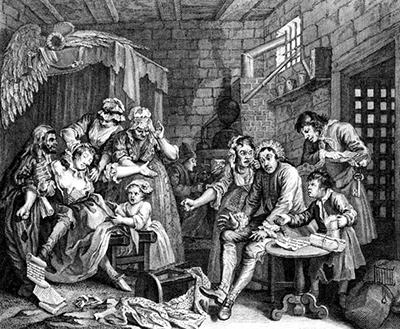
The two women linked to Tom’s fortunes now share a room. His wife confronts him directly. On the other side a woman identified by the Soane Museum as Sarah has fainted, and her child tugs at her. The identification has been debated. The museum compares her clothing and ribbons with the earlier Sarah and points to the mother’s matching dress in the first and seventh paintings. That evidence is characteristic of the series. A reader can use a costume seen in an earlier scene to recognise a person whom Tom himself has ceased to pay attention to. The museum also notices how his wife’s raised fist recalls his own in the gaming house. The consequences have a new speaker and a familiar gesture. [24] [12]
The Commons had already investigated the Fleet by the time Hogarth devised this scene. The 1729 Commons committee report on the Fleet records contested rents and charges, and instances in which the warden used confinement to enforce demands for money. One prisoner’s case involved the exaction of a second commitment fee and a dispute over what he should pay for a room. [25] Hogarth brings the same sort of incentive into view in small, familiar items. Charges for the daily business of staying alive continue inside an institution where the original reason for detention is a failure or inability to pay. The BnF and Te Papa hold separate impressions of plate VII. The print gives the increasingly desperate schemes in the prison, including the experiments at the back, their place alongside the keeper’s account and Tom’s letter. [25] [24] [26] [27]
VIII. The Madhouse
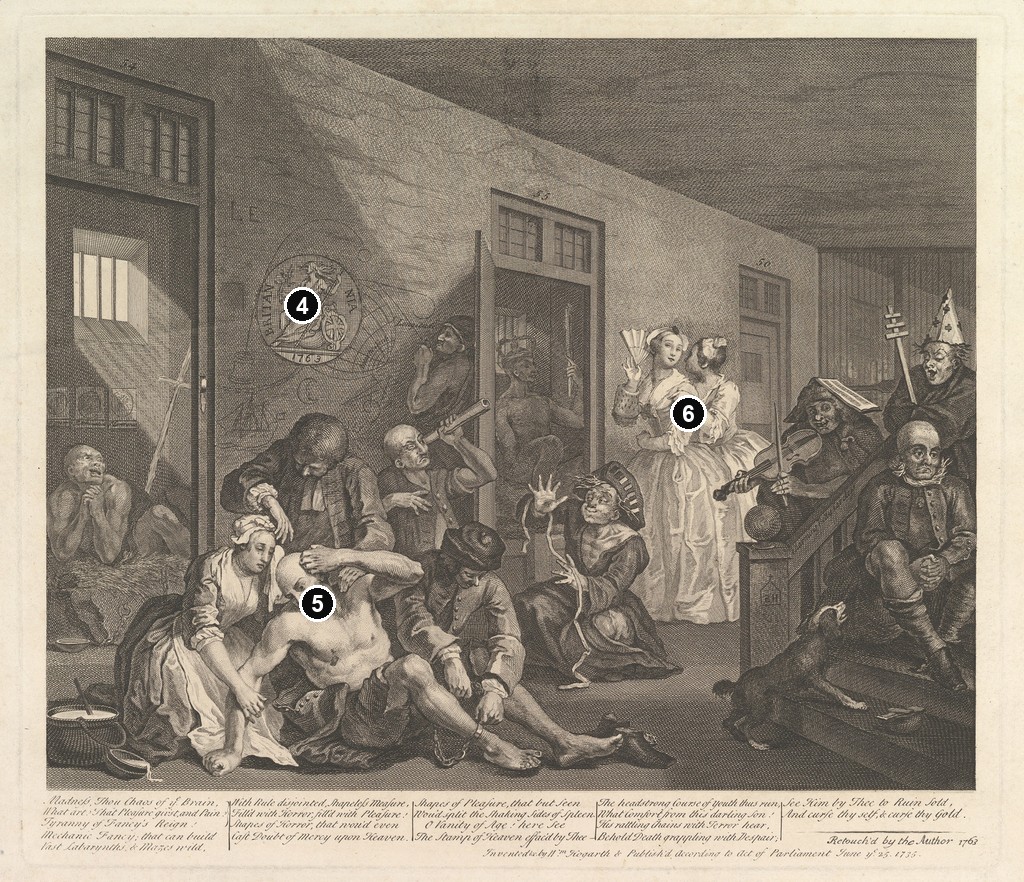
The title used by the Soane Museum is the historical title for the scene set in Bethlem Hospital, commonly called Bedlam. In the foreground, attendants restrain Tom. His nearly naked figure echoes one of Caius Gabriel Cibber’s sculptures of reclining men that stood at the gate of the historical institution in Moorfields. Inside the picture, an imagined king wears a straw crown, and another man bends to the task of covering a wall with marks. The figures and their accessories draw on a satirical vocabulary for representing mental distress and delusion. Tom’s presence among them is the endpoint of the story Hogarth has constructed for him. [2] [28]
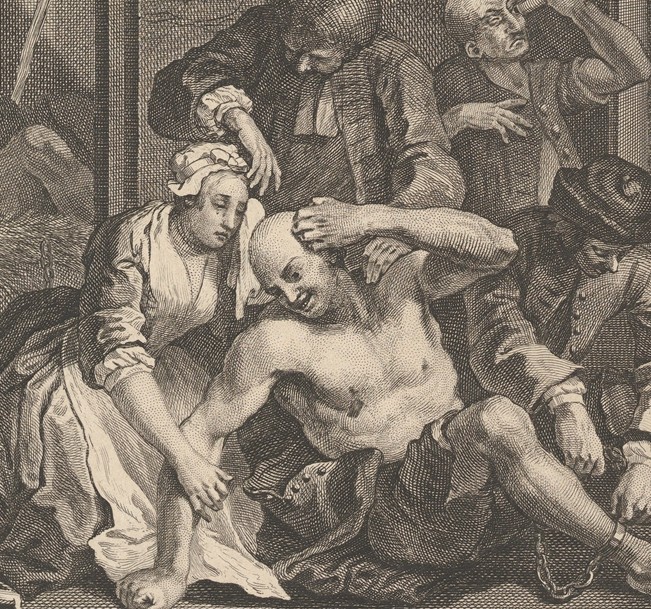
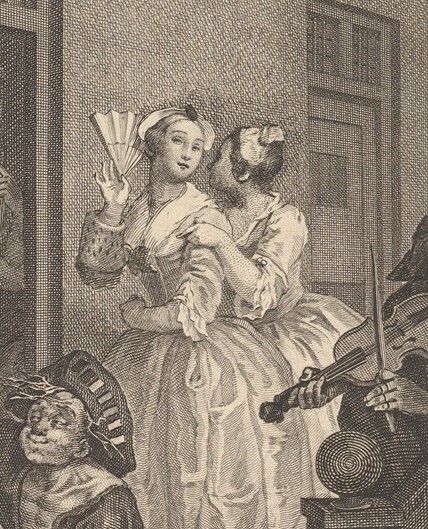
Two well-dressed visitors look at the patients, and Sarah attends to Tom. The visitor with the fan has some control over what she sees and how much of her response she lets others see. Sarah is close to the floor, by the man and the bowl the museum identifies as broth she has brought him. Light reaches both groups. Following its course makes a difference to the ending. A person intent on looking at society in the second and fourth pictures has become a sight for society. A person whose means let her do relatively little has found a way to stay near him. [2]
Hogarth’s spectators have a basis in the hospital’s practice of admitting visitors at specified times. The Bethlem Museum of the Mind notes the donation boxes and the public interest in institutions maintained by charity. It also records the ending of general public access in 1770. The record allows room for different reasons for entering the building. Hogarth puts curiosity and personal care in the same space and makes the difference in behaviour visible. William Cowper later recalled visiting as a boy and feeling both entertained and angry with himself for it. His account shows that one visitor could watch with several feelings at once. [29] The print in Tokyo, Paulson 139 (2/3), and the BnF’s second-state impression both carry verse outside the scene. Their readers could leave the ward for the lines below it and return to the figures with the words in mind. [28] [30] [31]
What changes from scene to scene
The first canvas offers a useful way to recognise the rest. Take the tailor, the pose of the young customer and the father’s portrait as three details that make different demands on the eye. The tailor is looking at the body he is paid to fit. Tom turns elsewhere with the attention of someone who can afford to have his clothes made while he conducts other business. The father, a fixed representation over the mantel, is absorbed in weighing money. By the second picture Tom has become a patron of people who sell expertise, and by the eighth the series has brought tailoring back in a different form. Near the restrained Tom at Bethlem, the museum identifies a kneeling man with a measure and fabric samples. The tools of a profession familiar from the opening are still recognisable. Their purpose has become part of an imagined encounter with a customer. [1] [6] [2]
Tom’s readiness to pay for one sort of attention sits beside his failure to recognise another. The offers made by Sarah change with the resources and access she has. Her first visit is backed by a ring, letters and a parent ready to argue. In the street she has money she can give an officer, and the small tradeswoman’s box that identifies an independent means of support. In the church, her mother has words for the official but has difficulty getting the family through the door. At the Fleet Sarah needs other people’s help herself. At Bethlem she can sit near Tom and bring food. The scale of what she offers is reduced by circumstance, but Hogarth still makes it possible to recognise an intention that no one in Tom’s fashionable circle has displayed. The sequence gives her work, money, a claim of her own and a life that goes on across the gaps between appearances. [1] [15] [18] [24] [2]
A related change can be traced through clothing without relying on facial resemblance. The first fit promises control over appearances. In the levée Tom has an indoor costume in which to receive his clients and suppliers. At the tavern the garment is still fine and the effect has become untidy. The arrest restores outward order with a costume suited to the royal occasion. The wig falls away again in the gaming house. When an attendant has to restrain Tom at Bethlem, the sitter’s clothes, status and earlier attentions to his person can do nothing for him. The series shows the facilities that make a polished appearance possible at the same time as it shows the appearance being lost. A tailor and a dance master can prepare a body for fashionable company. A prison and a hospital can determine what happens to that same body under entirely different conditions. [1] [6] [11] [15] [12] [24] [2]
Hogarth also builds continuity through the people at the edges. In the first scene a man charged with accounting for money has an opportunity to take it. At the tavern two people can work together to make good use of Tom’s diverted attention. In the gaming house a lender and a man raking in money have different ways to profit from the congregation around the table. The sequence repeatedly shows individuals alert to the possibilities of immediate gain, even when Tom misunderstands who is doing him a service. At the Fleet the keeper’s demand has the force of institutional authority. Moving from one exchange to another turns a story of overspending into a broader study of the people who supply pleasure, extend credit and charge for essentials. [1] [11] [12] [24] [25]
The arrangement of company gives the series a history of its own spaces. Tom first takes on the manners of an aristocrat who even receives callers in his slippers. Two scenes later his attempt to reach the royal court ends in the street outside the palace. A church sets him briefly at the centre of a socially recognised rite. His last two settings allow him rather less say over where he will stand or sit. Hogarth places several reversals at thresholds. A sedan chair is stopped from passing, a family has to get past a pew keeper, and prison and hospital interiors bring the confinement well into view. The episodes therefore do more than enumerate spending. They keep asking who decides whether somebody can come in, go out or reach a person in the room. [6] [15] [18] [24] [2]
There was room for rearrangement while the story was in development. An oil sketch now in the Ashmolean shows a marriage contract being discussed around a table. Judy Egerton proposed it as a possible second scene for A Rake’s Progress, set aside before the sequence took its finished form. In the eight canvases the second scene is the social expenditure of the levée. Hogarth puts the wedding ceremony inside a church after Tom’s arrest, when he is already in debt. The comparison gives a sense of what the order achieves. A marriage arranged while Tom is still newly rich would ask a different question about choice from one he enters after other ways of sustaining his position have failed him. Hogarth would give a distinct negotiation over marriage a central role in Marriage A-la-Mode about a decade later. [32] [6] [15] [18]
The pictures let time elapse with a minimum of explanation. In the first room the dated memorandum recalls Tom’s return from Oxford. At the levée a date appears on a punch bowl. These are dates on things within the story and have different uses from the date of first publication on a print. They are a way to place the fictional life near remembered events and habits. Meanwhile a child appears at the wedding and again at the Fleet. The difference between a father’s notes about a son and a child tugging at a fainting mother is part of what the sequence can establish across pictures. Years can be suggested by a line of writing, a lived relationship by the change in who is at whose side. [1] [6] [18] [24] [3]
Gambling harms are now understood to affect household finances, relationships and health, including the wellbeing of people around the person who gambles. The World Health Organization also describes gambling disorder in terms of a pattern of impaired control and significant consequences. Hogarth gives a fictional history of losses and distress, organised according to the conventions of moral satire. A clenched fist, a wig on the floor and the sheets that follow do their work as parts of that story. In the hospital scene, the artist also composes a difference between attending to a person in distress and watching from curiosity. That distinction survives the historical change in how distress is understood and talked about. [33] [12] [24] [2] [28]
Annotated Details from A Rake’s Progress
Compare a crowded morning reception with Bethlem in two engraved versions. Each gives the central figure a different relationship to the people around him.
A Rake’s Progress, Plate II
A Rake’s Progress, Plate II, William Hogarth with Gérard Jean-Baptiste Scotin. Metropolitan Museum of Art, New York, NY, 32.35(29). Collection record.
A Rake’s Progress, Plate VIII
A Rake’s Progress, Plate VIII, William Hogarth. Metropolitan Museum of Art, New York, NY, 91.1.90. Collection record.
Details from A RAKE’S PROGRESS
Select a numbered point for a closer look.
A Rake’s Progress, Plate II
The long roll
The seated musician plays while a long roll hangs down behind him. Printed lettering adds a detail about the culture Tom pays to bring into the room.
An offer of instruction
A man demonstrates an exercise with a foil. Several kinds of instruction compete for Tom’s attention in the time it takes him to get dressed.
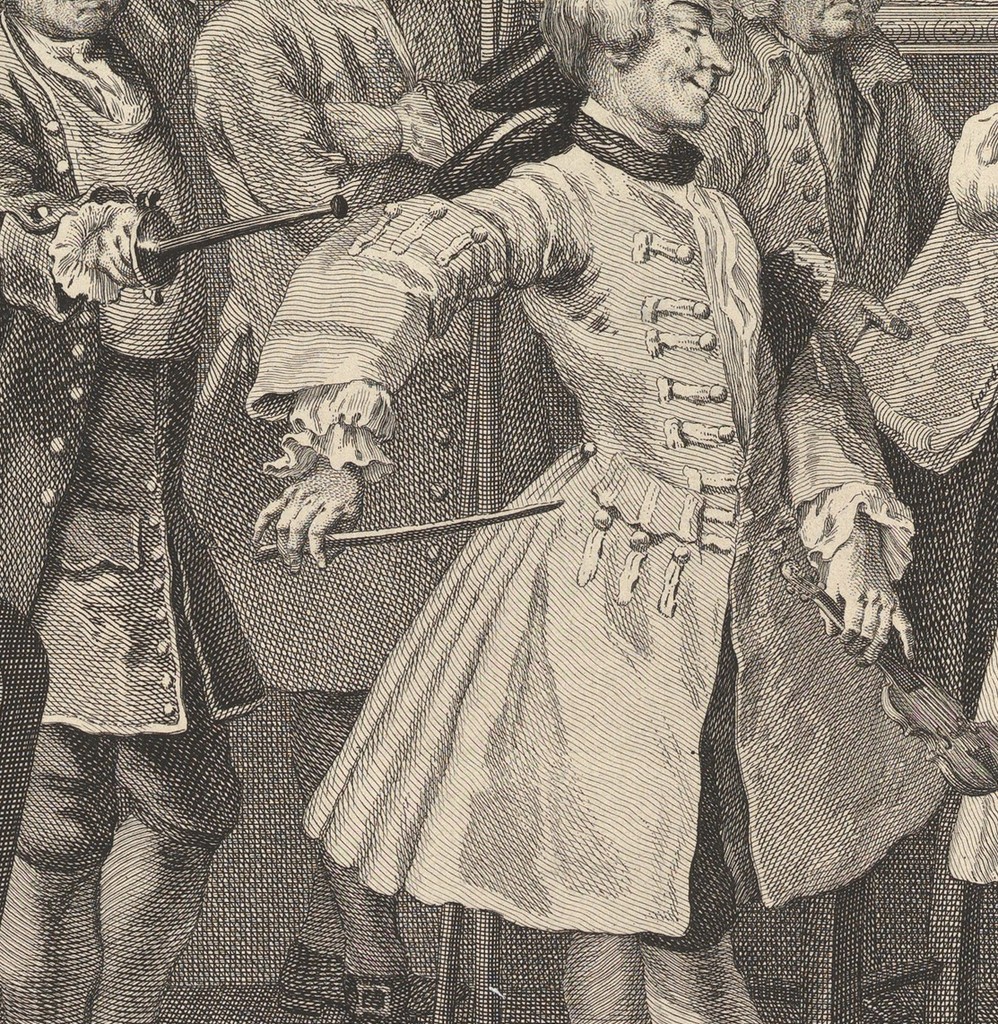
Tom’s morning clothes
Tom receives the men in a robe and cap. He can make them wait on his own routine, which puts him in a position of authority even before he has dressed.
A Rake’s Progress, Plate VIII
Britannia on the wall
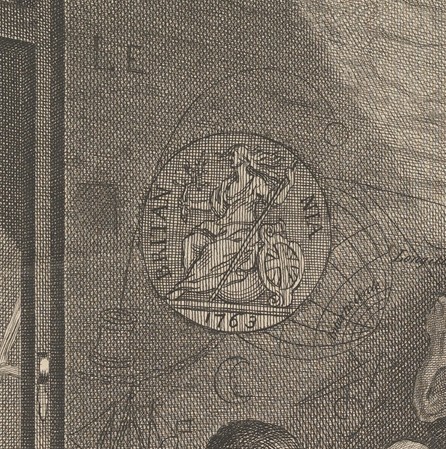
The round image bears the date 1763. This impression preserves a later alteration. Compare the wall with an earlier print or the corresponding part of the painting.
Sarah beside Tom
Sarah bends close while attendants deal with Tom’s restraints. In the earlier scenes she addresses him as someone who can act. Here her proximity has a different meaning.
Visitors to Bethlem
The two visitors stand upright behind the ward’s occupants. The raised fan and their distance from Tom distinguish this kind of looking from Sarah’s attendance.
From a studio visit to a set of prints
The canvases now at the Soane are almost uniform in scale, each roughly 62 to 63 centimetres high and 75 centimetres wide. In Leicester Fields, visitors had a chance to see the developing venture at Hogarth’s house and studio. The museum’s provenance records studio exhibition from December 1733, while its object records date the paintings to 1734. Its curatorial account cites the engraver and antiquary George Vertue on the stream of visitors, among whom he noticed artists and people of fashion, as well as the flow of subscription money. Taken together, the evidence describes a public rollout in which seeing the paintings and obtaining the prints were distinct events. Seeing a picture was one way of deciding whether to order the story in its coming form. [1] [6] [2]
The subscription advertisement offered a commercial arrangement as well as a story. Subscribers were to pay half a guinea for the receipt and another guinea when the prints were delivered. The offer included Southwark Fair alongside the eight scenes of the Rake. The fair was an additional design in the purchase and had its own subject and title. The transaction was a promise that Hogarth would deliver a product which had yet to be issued, and the period between the receipt and delivery continued while he held the canvases. After publication the Rake set was advertised at two guineas. The studio visit could give the set a reputation before buyers could take it away, and the difference in price rewarded those who had put down money early. [34] [1] [35]
The decision to withhold delivery until 25 June 1735 can be read in Hogarth’s own notice, reproduced by John Nichols. The notice describes the Rake and fair prints as already going through the press and says that publication and delivery have been deferred to secure his property under a bill then awaiting royal assent. In advertising to prospective buyers, Hogarth also explained why the distinction between his work and a copy mattered. He represented cheap or inferior reproductions as capable of damaging the return on the original work and of discouraging painting and engraving. His petitioning colleagues made a related public argument in The Case of Designers, Engravers, Etchers, &c.. They asked Parliament to protect the work of people who invested in designs before somebody else could profit from copying them. [34] [36]
Watch Hogarth’s paintings and prints
Five films on Hogarth’s painted stories, prints, drawing methods and work for the Foundling Hospital.
The Sequel: Hogarth’s "A Rake’s Progress" (1734–5)
The Paul Mellon Centre revisits the eight-scene story of Tom Rakewell and its place in Hogarth’s work.
Watch on YouTubeThe law gave a qualifying print a fourteen-year term reckoned from first publication and required the proprietor’s name and the publication day to be marked on each print. The statute uses the words “from and after” 24 June. The BnF records the Rake’s publication date as the 25th, and its set record transcribes the line placing the work under the Act of Parliament. A sheet held by the Morgan Library bears an imprint with the same June date. That date tells the buyer something about the publication of the design. A plate could retain it while being altered or reprinted. The wording is therefore valuable evidence of the relationship between image, author and market even when a different line or a different object is needed to establish the age of an individual impression. [37] [3] [38]
Calling the paper series an engraving is customary. The BnF uses both eau-forte and burin in its material descriptions, referring to etching and engraving. The two intaglio techniques give artists different ways to set lines into a surface that can be inked and printed. Once lifted from the matrix, the paper image reverses what has been worked on the plate. Comparison with the oils shows that the effect on A Rake’s Progress can be more consequential than an exchange of left and right. A recognisable grouping can be reversed while a background is sharpened, the lettering filled out or a different detail inserted. In the first scene the two main transactions remain easy to compare across versions. In the fourth an altered sky and street add a relationship between Tom’s debts and gambling at more than one level of society. [3] [4] [1] [15] [16]
Prints allowed small lettering to carry much of that extra argument. Take the levée. In the painted room Tom’s morning clothes and the activities of the visitors already tell a story about expenditure. In the Metropolitan Museum’s third-state plate II, the space near the harpsichordist gives a reader more clues to the stock of operatic jokes around him. The Soane note identifies names of singers on the score in a third-state example. Yale’s own impression supplies a fuller reading of the fictional opera and the tribute to Farinelli, including the image of the singer receiving hearts. A buyer who followed the London opera world could recognise topical jokes in the cast list and imagery. The book and the scroll can also be looked at as a smaller drama about acquiring distinction inside the main scene. [6] [8] [7]
The same comparison is a reminder that the name of the inventor of a series leaves details of the labour open. In the Met record, the engraving credit to Scotin sits beside the credit to Hogarth for his part as artist and publisher. Princeton’s exhibition checklist acknowledges Scotin’s work in the set, and the National Gallery’s account describes his contribution to the Rake engraving before later collaboration on Marriage A-la-Mode. The attribution matters to the reading of a highly lettered impression because it identifies some of the expertise between the painted scene and the finished sheet. It gives an actual example of collaboration in a work whose second scene is itself full of specialised services. [8] [35] [32]
The eight individual French records can also be read together as evidence of what a surviving set may contain. The BnF entries assign the impressions of plates I to IV to the third, fourth, third and third states respectively. The next four are entered as first, second, fourth and second. A state describes the configuration of the plate that made an impression. An alteration to a single plate lets historians distinguish its earlier and later appearances even when the initial publication date stays in the lettering. The same set title can therefore bring together evidence about several stages of work. A fixed sequence of eight subjects still leaves considerable latitude as to which form of each subject a collector, a reader or a museum actually encounters. [5] [10] [13] [16] [20] [23] [26] [31]
Plate VIII shows what those distinctions can yield. The second-state impression in Tokyo gives a figure working by the wall between the numbered cells a place among the other patients. Above and beside him there is space for the marks that the Soane curator relates to the problem of finding longitude at sea. In the Met’s third-state example, 91.1.90, the scene includes the retouched design of a coin bearing Britannia and the date 1763. The addition puts a national emblem into a space where viewers were already being invited to consider the things that could preoccupy a person’s mind. The British Museum’s account of another late example reads the retouching in the context of Hogarth’s disputes towards the end of his life. The move from a picture about one man in a hospital to an image with a potential application to Britain depends on the state of the plate before the viewer. [2] [30] [39] [40]
Hogarth also revised the same stretch of wall in the painting. The Soane entry reports X-rays from 1997 that show that Hogarth worked over other figures in the area between the cells, including a well-dressed gentleman under part of the later composition. In both named impressions the figure drawing at the wall comes through clearly. The oil exposes some of the labour of changing a group of figures on a single surface. The prints expose other decisions because completed impressions carry away a record of what the matrix looked like at a particular stage. The history of the coin belongs to the second process, and the paint that covers the gentleman belongs to the first. [2] [30] [39]
The verses beneath the plates add a distinct voice. In the sixth plate’s register below the picture, a reader leaves the disorder in the room to encounter an account of the appeal and damage of gaming. In Tokyo’s plate VIII the lines begin by asking what madness is and end by charging the father’s gold and vanity with a share of responsibility. The father has long since disappeared as a person in the story, but the printed ending can still address him. The invocation gives readers a reason to look back to the first plate and its opening economy of cash, inherited habits and neglected people. In the painting the same backward glance is available through the recurring tailor and Sarah. The etching and engraving make room for a more explicit declaration. [23] [30] [1] [2]
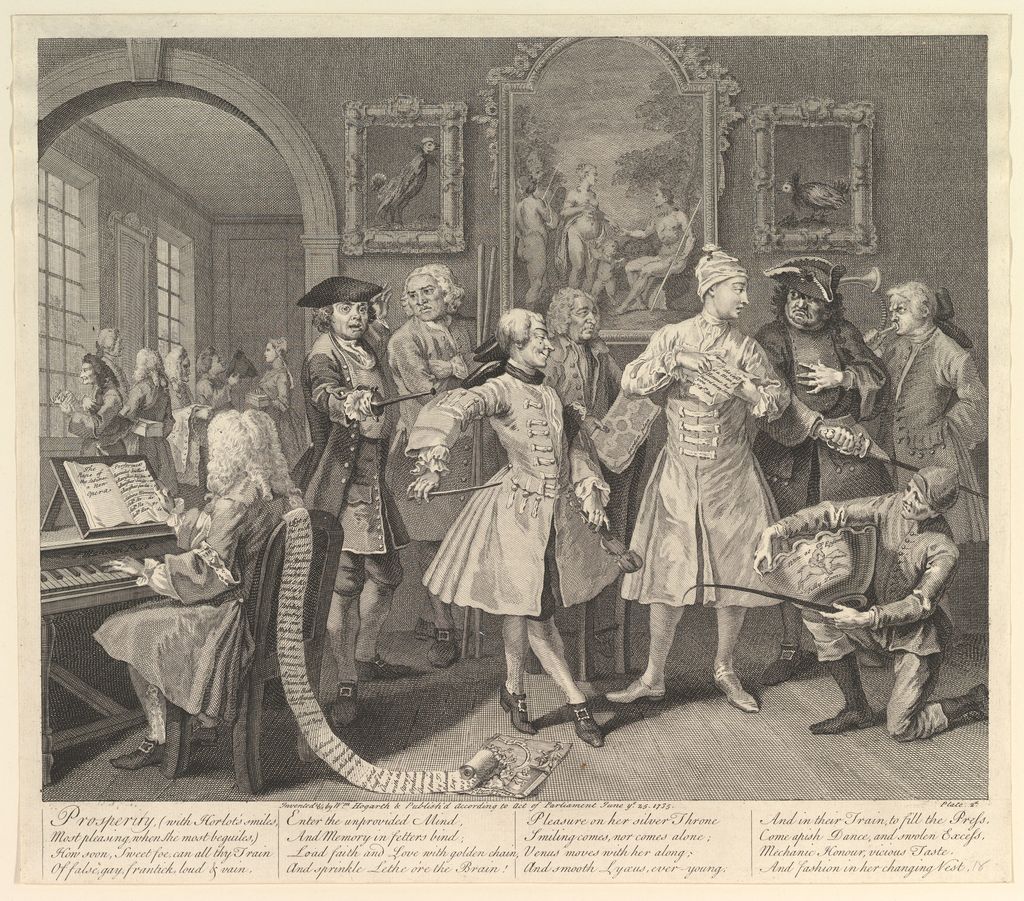
A Rake's Progress, Plate 2, William Hogarth and Gérard Jean-Baptiste Scotin, June 25, 1735. Etching and engraving; third state of four. 32.35(29). Harris Brisbane Dick Fund, 1932. Image source. CC0 / Public domain.
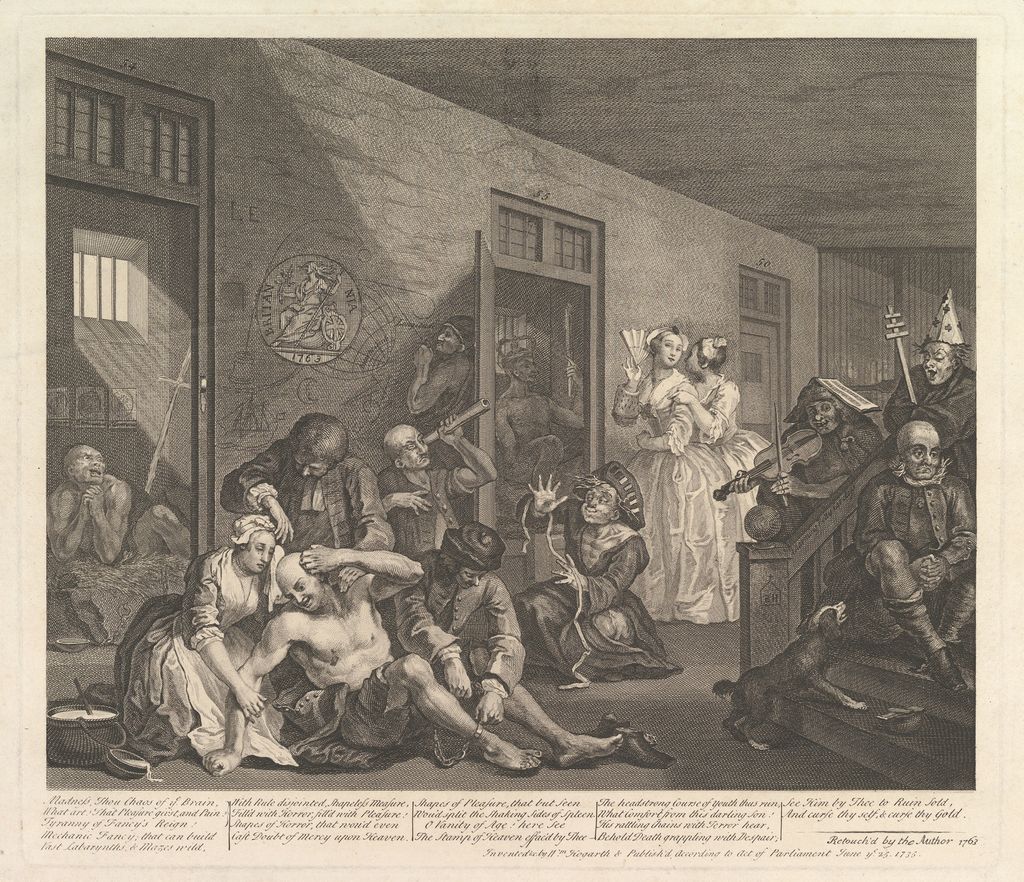
A Rake's Progress, Plate 8, William Hogarth, [June 25, 1735] reissued 1763. Etching and engraving; third state of three (retouched 1763). 91.1.90. Gift of Sarah Lazarus, 1891. Image source. CC0 / Public domain.
The prints in other hands
The copyright regime left room for types of reproduction approved by the proprietor. In 1735 the Fleet Street printseller Thomas Bakewell published a smaller version with Hogarth’s consent, marked in the inscription on the object. In Colonial Williamsburg’s example of Bakewell’s first print, the image is both reduced and reversed relative to Hogarth’s engraved plate. The difference gives two independent ways of identifying a copy whose story still begins with Tom taking possession of his father’s effects. Under the scene the title and the permission line belong to the printseller’s edition. For someone familiar with a painting or one of Hogarth’s own impressions, this version offered the same narrative in a different size and arrangement, at two shillings and sixpence against two guineas for Hogarth’s published set. [41] [42] [4]
The experiment suggests a more complex account of access than a simple contest between originals and frauds. A publisher could protect the value of one form of the work and also try to reach buyers who would spend less. The 1735 account reprinted by Nichols describes a promise to subscribers that Hogarth’s own prints would be kept at a higher price once they were issued. The reduction gave him another way to put the subject into circulation while keeping that promise. The plate from Hogarth’s set names his own role. Bakewell’s smaller sheet advertises its authorisation and its separate maker’s or seller’s place in the chain. [34] [41] [42] [3]
Another publisher could also change how a Hogarth design reached its audience. In 1768 Robert Sayer published a bound volume of Hogarth’s satires. Cristina S. Martinez identifies a reversed copy of the final Rake plate inside an ornamental border in that volume. Although the book appeared after the 1763 revisions, the copy retains a design without the Britannia coin. The book’s later publication date and the composition’s earlier form can coexist once a new plate is involved. In a bound volume, a reader also had a different physical way to proceed through the images from one who handled separately issued sheets. [43] [39]
The printed descriptions also opened up ways of telling the story at a greater distance from the designer. A 1735 poem published by J. Chettwood presents itself as a key to the eight prints and gives the episodes eight cantos. Princeton identifies Joseph Gay as the pen name associated with its copy of the second edition. The detailed synopsis on the title page of that edition, recorded by the Wellcome Collection, already supplies material a viewer would have to invent from the pictures. The sixth canto promises a verbal attack on gambling and the seventh an account of the condition of authors. Where Hogarth places a dismissive letter beside Tom’s rolled manuscript, the poem advertises the joke that the play is rejected because it is too good. The shift makes the commercial world of writing itself a subject of satire. [35] [44] [24]
Bakewell’s explanatory broadsheet is a separate publication. In the passage the Soane catalogue transcribes, it gives a cause for the physical restraint of Tom in Bethlem, referring to the wound indicated by a patch in early engraved evidence. It also reports the character’s later death. The canvas ends with Sarah, attendants and the patient still before us. The difference between those endings marks a choice familiar from reading a narrative in pictures. A painted gesture can be left open to the viewer for as long as the eye stays with it. A written key can tell the reader what occurred before it and what followed. In this case, the two bits of additional action change a hospital scene into an account of the end of a life. [2] [45]
Jean-André Rouquet wrote an explanation in French in 1746, in the form of letters to a friend in Paris. His second letter, also available in a German translation of 1754, begins by questioning how far ridicule could really reform a miser or a gambler. He nevertheless considers the form well suited to showing folly. His treatment of the first scene takes a reader through the heir, the distracted fitting and the claim that Sarah and her mother have come to press. Here an explanation helps a reader grasp who is doing what and what the etiquette of the room allows, while entertaining doubts about whether understanding the joke would make a viewer live differently. The letter is evidence of how someone explained the set across a linguistic boundary quite early in its circulation. [46] [47] [1]
Printed and painted afterlives could also run in the opposite direction to Hogarth’s initial production. The museum’s catalogue notes later versions of the tavern subject in oil, which it considers likely to derive from engravings. Changes of direction and differences in composition are important clues when distinguishing a print-based copy from the original painting the print followed. The subject was especially amenable to being encountered on its own. A dress, a candle, a watch and a room full of separate actions already give a viewer much to follow. A later copy could bring the tavern scene back to oil even when its maker had encountered the design as a print. [11] [48]
The eighteenth-century record even includes a change back from print to live speech and song, at least as an enterprise on paper. The anonymous Rake’s Progress manuscript edited by Mary F. Klinger, dated by her to about 1778–80, expands the eight scenes into a fifteen-scene drama with songs. Vice and Virtue appear as characters able to press their claims on the protagonist. Klinger connects its dating to the tunes specified in the manuscript. In the levée, a mixed company that we know in the painting through postures, papers and articles of trade can be staged by giving its hopeful suppliers language and music. The device also does some of the work that the early explanations do, assigning speakers and motives to events a viewer originally had to piece together from an image. [49] [6]
How the eight canvases came to Soane
The circulation of Hogarth’s prints helps explain why the pictures could already have a reputation when he put the canvases up for sale in February 1745. The printed entry ticket was itself a satire on the purchase and prestige of paintings. In the Royal Collection’s impression of The Battle of the Pictures, works attributed to the great traditions of old painting engage Hogarth’s modern subjects in a literal fight. One of his other painted series, Marriage A-la-Mode, appears among the combatants. The ticket is also evidence of the terms of access to the auction. Someone who knew Hogarth through his prints could come as a collector to buy a painting on which a print had been based. The conditions for owning an original had changed since the first studio visitors considered the subscription for paper impressions. [50] [1]
The Soane Museum records the eight Rake canvases going to William Beckford for £184 16s. The buyer was the elder Beckford, who became Lord Mayor of London and derived much of his wealth from Jamaican plantations worked by enslaved people. The paintings passed into a collection being formed at an estate bought in 1744. Their story about a City heir and inherited funds had no special relation to Beckford when Hogarth conceived it. The acquisition nonetheless places the set in a real history of how wealth, including colonial wealth, entered British country houses and gave owners the means to acquire paintings. The purchase sum is the price recorded for the whole painted series. It belongs to a different type of transaction from the initial price of its corresponding prints. [1] [51]
The Beckford family held works from another Hogarth series as well. A fire in 1755 damaged the earlier Fonthill house, which was replaced by the residence known as Fonthill Splendens. John Nichols’s early account places the loss of the Harlot’s Progress paintings in that fire and states that the Rake canvases escaped. The documented presence of all eight Rake paintings at the later Fonthill sale gives the two series separate histories at the estate. The story of the fire explains an important asymmetry in looking at the two works today. Hogarth’s own impressions can be consulted for both series. For the Rake they can also be followed alongside the complete painted sequence. [51] [34] [1] [52]
Soane’s connection to the pictures began before the sale. The younger William Beckford consulted him in the 1780s about converting an upstairs corridor at Fonthill Splendens into a picture gallery. The designs were unexecuted. When Soane visited the house in connection with the commission, he had an opportunity to see the collection in a setting that did not yet have the treatment he was proposing for it. The catalogue calls this a likely first encounter. By 1802 the Rake paintings were in the corridor that Soane had proposed remodelling. His relationship to the same eight pictures could thus proceed from consulting on a potential setting for them, through deciding what to bid for them, to choosing a setting in buildings of his own. [1] [53]
The younger Beckford’s paintings went on sale at Christie’s Great Room in Pall Mall on 27 February 1802. The auction catalogue identifies the collection as brought from the seller’s seat at Fonthill. The eight Hogarths formed lot 86. They sold for 570 guineas, or £598 10s. [54] In his diary the next day, the painter Joseph Farington records that Soane called on him and reported that his wife Eliza had done the bidding, with his authority to go as high as £1,000. Farington also records the buyer’s immediate intention to put them up at Ealing. Valuation here has two surviving figures before the set has even been hung, the sum that secured it and the much larger amount Soane was prepared to commit. [52] [1] [55]
The diary adds a third figure. On 2 March Farington recorded seeing the purchased series and receiving Sir George Beaumont’s request to offer Soane 600 guineas. Soane told him any sale would have to be at a high price. The subsequent home of the paintings confirms that he kept them. The entries reveal a sale followed within days by interest in a private purchase, as well as a role for Eliza that would disappear from an account bearing only her husband’s name. They also distinguish what the diarist records from what occurred in the saleroom. The bidding limit and the first destination come to us through the conversation that followed, while the later offer reached Farington as a request to make it on Beaumont’s behalf. [55] [1]
Soane hung the eight paintings at Pitzhanger Manor, his country house in Ealing. The museum’s research places them in the small drawing room, or retiring parlour, a room encountered early by a visitor. The route through the house gave access to a complete set that had been bought as one lot. After the sale of Pitzhanger in 1810, the paintings are securely documented in 1819 in the architect’s first Picture Room behind No. 12 Lincoln’s Inn Fields. Soane’s 1824 rearrangement gave the Rake canvases a place behind moving wooden panels in the new Picture Room. The historical sequence goes from a studio demonstration to a country collection, then to a room able to conceal and reveal the pictures in turn. [1] [56] [57]
The dimensions of the new room make the method plain. The museum describes a space about thirteen by twelve feet with room for 118 paintings thanks to the movable surfaces. Swinging a plane changes the pictures variously adjacent to and visible from one position. An encounter with the Rake paintings there has something in common with reading them in a portfolio. A set can be present and remain partly hidden until a person opens the surface that holds it. The analogy also has a limit. The hinges and other paintings occupy a continuous architectural space, so the act of showing Hogarth determines what other work becomes visible or disappears from view. [57] [1]
Soane took a particular interest in the effect of opening and closing those surfaces. In his 1835 account of the house and museum, cited in the modern catalogue, he defended the opportunity to cover some of the Rake scenes after giving them due attention. In his view the severity of the subject could make it hard to take in what surrounded it. More than a century after Hogarth showed the oils to visitors in his studio, the collector imagined another encounter in which viewers could be drawn close to the same story and then allowed time and distance from it. [1] [58]
What conservation changes about looking
The eight canvases preserve the materials of Hogarth’s paintings and traces of their revision. A reproduction can show the general play of light and colour, but the paint surface also carries uneven passages, small changes of mind and the physical history of the support. In the last scene, evidence from X-rays helps distinguish a concealed figure in the wall passage from surrounding paint as it now appears. Illuminating a surface or taking an image that registers what a brush covered can answer different questions from those a visitor brings to a finished composition. The works remain pictures of Tom’s changing circumstances at the same time as they bear physical evidence of how they were made. [2] [59]
The museum’s report for 2024–25 dates the beginning of its conservation of the series to April 2024 after a periodic check. It records small splits at the turnover edges of the canvas linings and raised or flaking paint on seven of the pictures. The Arrest, The Gaming House and The Madhouse formed the first treatment group. The work included reducing old discoloured varnish, securing areas of vulnerable paint and reinforcing the perimeter of the canvas with strips of lining material. The report also records a stage in 2025 at which paint losses were being addressed before final varnishing. Darkening from an old surface coating and darkness built up by the painter have different consequences for a viewer trying to follow figures at the back of the room. [59]
The investigation builds on technical imaging at Tate in 2021 and subsequent work with the National Gallery. Different forms of imaging make different parts of the evidence available, from changes beneath the surface to the distribution of elements registered by techniques such as X-ray fluorescence scanning. That helps place the history of the wall in the last picture within a wider effort to understand what is there before and during treatment. It also explains why a colour image made at a given date can be a record of an earlier condition as well as of a composition. The museum has used facsimiles in place of originals at periods of treatment, as dated notes for The Levee and The Orgy record. The Picture Room and the individual catalogue records can be consulted for how the works are shown. [6] [11] [2] [59] [60] [57]
The opera and David Hockney’s two encounters with the Rake
Igor Stravinsky’s opera The Rake’s Progress, with a libretto by W. H. Auden and Chester Kallman, premiered at La Fenice in Venice in September 1951. It takes the name of Tom Rakewell and some recognisable places and events from Hogarth, including the brothel and Bedlam. It gives the story a new way of locating responsibility. The promise of an inheritance comes from a stranger named Nick Shadow, and the source of the fortune is said to be an unknown uncle. Shadow promises to help Tom find his way and leaves the precise payment for his services to be settled a year and a day later. An eighteenth-century picture cycle in which different people have motives to exploit the heir becomes an opera in which one person can stay at his side and direct much of what happens. [61] [62] [63]
That person changes the nature of the wager. Hogarth puts the chaos of the gaming house in a room where merchants, gamblers and opportunists can all work at once. The opera sets a decisive card game in a churchyard and makes it a bargain over Tom’s soul. Other episodes similarly alter the economics. The bride is Baba the Turk, a performer with a career and an audience of her own. When creditors and inquisitive bidders arrive at the auction of Tom’s belongings, the stage offers Baba a chance to speak and return to her profession. And the scheme to turn stones into bread draws in investors and brings a financial collapse beyond the fortunes immediately available to Tom and his household. [63] [18] [12]
Anne Trulove has some of Sarah’s persistence, but the opera gives the relation a different history and a different kind of presence. Anne makes a decision to go after Tom. At Bedlam he mistakes her for Venus, and she sings him a lullaby. When the sound ends, the person who had imagined an answer to his distress eventually has to face her departure. Hogarth’s final canvas puts the care offered by Sarah into her proximity to Tom and the bowl nearby. The operatic ending makes an equivalent of that care audible and lets it last for an interval in real time. Auden and Kallman then give their characters a closing address to the audience. The original print has a comparable opportunity to change its mode of speaking in the verse beneath the image. [63] [2] [30]
David Hockney approached the engravings directly for his own A Rake’s Progress. The Museum of Modern Art connects the project to his first visit to New York in 1961. Its set, made in 1961–62 and published by Editions Alecto in association with the Royal College of Art in 1963, contains sixteen etchings and aquatints. The rake in this version is a young gay artist finding his way in a city new to him. The change of place matters, and so does his change of position from London heir with ready money to artist abroad. Hockney could use the structure of a progress to give acts of meeting, earning, spending and being seen a sequence of their own. [64]
The titles make clear how freely the earlier stages could be distributed across sixteen pages. The Arrival is plate 1, and Receiving the Inheritance is plate 1a. Viewing a Prison Scene is 5a, and The Wallet Begins to Empty is 6a. The verbal echoes are strong, but what Hogarth sets in one relation Hockney moves into another. The Englishman who begins with a given position in London has already become an American city’s recent arrival in the new set. Its eighth pair makes a further distinction between Meeting the Other People and Bedlam. Even without equating each plate to a single eighteenth-century antecedent, a reader can track how an inherited set of names operates in a new itinerary. [65] [64] [1] [24]
Hockney came back to Hogarth in a separate commission for the 1975 Glyndebourne production of Stravinsky’s opera. He designed sets and costumes for John Cox’s staging, as well as printed material for the production. Hockney used parallel lines and cross-hatching on the sets and costumes to extend the look of an engraving across the stage. Parallel strokes and cross-hatching changed with the distance from the viewer. Hockney recalled testing the size of hatch marks from the back of the theatre with binoculars, since marks readable at close range could merge into an unintended pattern at a distance. It was a practical response to an issue posed by Hogarth’s plates. The line that makes a garment or a room take shape depends on how sharply the audience can resolve its individual strokes. [62]
An art buyer could once visit a London studio, see the oils and leave with the prospect of eventually handling a set of sheets. In the theatre, the same graphic language became a surface that an actor could cross and that an audience could watch from the back of a room. Hogarth’s compositions leave tangible evidence of the labour involved in changing from one form to another, whether it is the portion of a copperplate reworked for a new impression, the hand that opened a picture plane in Soane’s museum, or the cross-hatching redrawn to work under stage lights. Each place offers a different opportunity to see Sarah, Tom and the people around them, and to decide where to look once the scene has been set in motion. [1] [39] [57] [62]
Browse Hogarth’s artworks
All 54 individual artworks and series stages in the approved English cluster
Frequently Asked Questions
Discussion
Look again at the images and ideas explored in A Rake’s Progress. These editorial prompts invite your observations.
Reader Insights
What changes between the first exchange of money between Tom and Sarah and their encounter in The Arrest?
Which doorway or boundary tells you most about the freedom Tom has lost?
Join the Conversation
Share a detail, comparison or question about A Rake’s Progress below.
References
- Sir John Soane’s Museum, William Hogarth, A Rake’s Progress, I, The Heir, P40, oil on canvas, 1734. View source.
- Sir John Soane’s Museum, William Hogarth, A Rake’s Progress, VIII, The Madhouse, P47, oil on canvas, 1734. View source.
- Bibliothèque nationale de France, William Hogarth, A Rake’s Progress, set record, with imprint and publication date. View source.
- National Gallery of Art, William Hogarth, A Rake’s Progress, plate I, 1944.5.27, first state. View source.
- Bibliothèque nationale de France, William Hogarth, A Rake’s Progress, plate I, The Heir, Paulson 132.3, third state (French catalogue record). View source.
- Sir John Soane’s Museum, William Hogarth, A Rake’s Progress, II, The Levee, P41, oil on canvas, 1734. View source.
- Yale Center for British Art, William Hogarth, A Rake’s Progress II, The Levee, Paul Mellon Collection, B1981.25.1412, in Art and Music in Britain. View source.
- Metropolitan Museum of Art, William Hogarth and Gérard Jean-Baptiste Scotin, A Rake’s Progress, plate II, 32.35(29), third state of four. View source.
- National Gallery of Art, William Hogarth, A Rake’s Progress, plate II, 1944.5.28, third state. View source.
- Bibliothèque nationale de France, William Hogarth, A Rake’s Progress, plate II, The Levee, Paulson 133.4, fourth state (French catalogue record). View source.
- Sir John Soane’s Museum, William Hogarth, A Rake’s Progress, III, The Orgy, P42, oil on canvas, 1734. View source.
- Sir John Soane’s Museum, William Hogarth, A Rake’s Progress, VI, The Gaming House, P45, oil on canvas, 1734. View source.
- Bibliothèque nationale de France, William Hogarth, A Rake’s Progress, plate III, The Orgy, Paulson 134.3, third state (French catalogue record). View source.
- National Gallery of Art, William Hogarth, A Rake’s Progress, plate III, 1944.5.29, first state. View source.
- Sir John Soane’s Museum, William Hogarth, A Rake’s Progress, IV, The Arrest, P43, oil on canvas, 1734. View source.
- Bibliothèque nationale de France, William Hogarth, A Rake’s Progress, plate IV, The Arrest, Paulson 135.3, third state (French catalogue record). View source.
- National Gallery of Art, William Hogarth, A Rake’s Progress, plate IV, 1944.5.30, first state. View source.
- Sir John Soane’s Museum, William Hogarth, A Rake’s Progress, V, The Marriage, P44, oil on canvas, 1734. View source.
- Joanne Bailey, “Favoured or Oppressed? Married Women, Property and ‘Coverture’ in England, 1660–1800,” Continuity and Change 17, no. 3, 2002, pp. 351–72. View source.
- Bibliothèque nationale de France, William Hogarth, A Rake’s Progress, plate V, The Marriage, Paulson 136.1, first state (French catalogue record). View source.
- Princeton University Art Museum, William Hogarth, A Rake’s Progress, plate V, x1988-34. View source.
- Museum of New Zealand Te Papa Tongarewa, William Hogarth, A Rake’s Progress, plate VI, Scene in a Gaming House, collection object 39134. View source.
- Bibliothèque nationale de France, William Hogarth, A Rake’s Progress, plate VI, The Gaming House, Paulson 137.2, second state (French catalogue record). View source.
- Sir John Soane’s Museum, William Hogarth, A Rake’s Progress, VII, The Prison, P46, oil on canvas, 1734. View source.
- House of Commons, A Report from the Committee Appointed to Enquire into the State of the Goals of this Kingdom, Relating to the Fleet Prison, 1729, in The Publications of James Edward Oglethorpe, University of Georgia Press. View source.
- Bibliothèque nationale de France, William Hogarth, A Rake’s Progress, plate VII, The Prison, Paulson 138.4, fourth state (French catalogue record). View source.
- Museum of New Zealand Te Papa Tongarewa, William Hogarth, A Rake’s Progress, plate VII, The Prison, collection object 40610. View source.
- Bethlem Museum of the Mind, “Visiting Bethlem,” public access, charitable donations and Cibber’s sculptures at Moorfields. View source.
- Bethlem Museum of the Mind, “In the Frame October 2014, Richard Newton’s A Visit to Bedlam,” quoting William Cowper’s account of a visit. View source.
- National Museum of Western Art, Tokyo, William Hogarth, A Rake’s Progress, plate VIII, G.1994-0011, Paulson 139 (2/3), with transcription of the engraved verse. View source.
- Bibliothèque nationale de France, William Hogarth, A Rake’s Progress, plate VIII, The Madhouse, Paulson 139.2, second state (French catalogue record). View source.
- Judy Egerton, Marriage A-la-Mode, National Gallery catalogue, the related Ashmolean oil sketch and Scotin’s earlier collaboration with Hogarth. View source.
- World Health Organization, “Gambling,” 2 December 2024, gambling-related harms and features of gambling disorder. View source.
- John Nichols, Biographical Anecdotes of William Hogarth, With a Catalogue of His Works, sections for 1733 and 1735, including the subscription and publication notices, and the account of the Beckford paintings. View source.
- Princeton University Library, Sin & the City, full exhibition checklist, including Southwark Fair, A Rake’s Progress and the 1735 Joseph Gay key. View source.
- Designers, engravers and etchers petitioning Parliament, The Case of Designers, Engravers, Etchers, &c., London, 1735, in Primary Sources on Copyright. View source.
- Parliament of Great Britain, Engravers’ Copyright Act, 8 Geo. II c. 13, § 1, facsimile in Primary Sources on Copyright. View source.
- Morgan Library & Museum, William Hogarth, A Rake’s Progress, plates bound in an album, with the imprint on plate I transcribed. View source.
- Metropolitan Museum of Art, William Hogarth, A Rake’s Progress, plate VIII, 91.1.90, third state of three, retouched 1763. View source.
- British Museum, William Hogarth, A Rake’s Progress, plate VIII, account of the 1763 coin design in the museum’s exhibition record at Google Arts & Culture. View source.
- Colonial Williamsburg Foundation, After William Hogarth, published by Thomas Bakewell, A Rake’s Progress, plate I, Taking Possession of His Father’s Effects, 1986-21,A, authorised reduction. View source.
- Colleen M. Terry, Presence in Print: William Hogarth in British North America, PhD dissertation, University of Delaware, 2014, pp. 68–69 and n. 118, Thomas Bakewell’s sales and prices. View source.
- Cristina S. Martinez, “Jane Hogarth: A Printseller’s Imprint on Copyright Law,” in Female Printmakers, Printsellers, and Print Publishers in the Eighteenth Century, pp. 189–206, discussion of Robert Sayer’s 1768 copy of plate VIII. View source.
- Wellcome Collection, The Rake’s Progress, or, The Humours of Drury-Lane, 2nd ed., London, J. Chettwood, 1735, title page and synopsis. View source.
- Colonial Williamsburg Foundation, After William Hogarth, published by Thomas Bakewell, A Rake’s Progress, plate VIII, Mad in Bedlam, authorised reduction. View source.
- Jean-André Rouquet, *Lettres de Monsieur ** à un de ses amis à Paris, pour lui expliquer les estampes de Monsieur Hogarth*, 1746, Wellcome Collection. View source.
- Jean-André Rouquet, Second letter in the 1754 German translation, pp. 99–101, transcribed in Margaret Daly Davis, Hogarth Explained for Foreign Markets, FONTES 54, pp. 16–18. View source.
- Reynolda House Museum of American Art, Attributed to William Hogarth, A Rake’s Progress: The Tavern Scene, collection object 361 and its discussion of the Soane composition. View source.
- Anonymous, The Rake’s Progress, British Library Add. MS 25997, dated about 1778–80 by Mary F. Klinger in her edition, Augustan Reprint Society 181, 1977. View source.
- Royal Collection Trust, William Hogarth, The Battle of the Pictures, RCIN 811767, printed entry ticket for the 1745 auction. View source.
- UCL Press, Fonthill Recovered: A Cultural History, ed. Caroline Dakers, account of Beckford’s acquisition of the estate and the 1755 fire. View source.
- Christie’s, A Catalogue of a Most Superb, Capital, and Valuable Collection of Italian, French, Flemish and Dutch Pictures, Fonthill sale, Pall Mall, 27 February 1802, Rijksmuseum library. View source.
- Bard Graduate Center, “Beckford, Soane, and Hope,” Soane’s 1787 visit, unexecuted gallery plans, and the location of the Rake series at Fonthill Splendens. View source.
- Sir John Soane’s Museum, General Description of Sir John Soane’s Museum, 1905, Picture Room, with the conversion of 570 guineas to £598 10s. View source.
- Joseph Farington, The Farington Diary, vol. I, ed. James Greig, pp. 340–41, entries of 28 February and 2 March 1802. View source.
- Pitzhanger Manor & Gallery, “William Hogarth at Pitzhanger,” the original hang at Soane’s country house. View source.
- Sir John Soane’s Museum, “The Picture Room,” room dimensions, movable picture planes and the Hogarth paintings. View source.
- John Soane, Description of the House and Museum on the North Side of Lincoln’s Inn Fields, 1835, p. 23, excerpted in the Soane Museum catalogue. View source.
- Sir John Soane’s Museum, Report and Accounts for the Year Ended 31 March 2025, HC 1547, pp. 13–14, examination and treatment of A Rake’s Progress. View source.
- Soane Foundation, “Rake’s Progress,” technical imaging and the conservation research collaboration. View source.
- Bibliothèque nationale de France, Igor Stravinsky, W. H. Auden and Chester Kallman, The Rake’s Progress, FRBNF39499341, first performance in Venice, 11 September 1951. View source.
- Glyndebourne, The Rake Progressed, exhibition account of David Hockney’s designs and John Cox’s 1975 production. View source.
- Glyndebourne, The Rake’s Progress, synopsis of the opera. View source.
- Museum of Modern Art, David Hockney, A Rake’s Progress, 521.1964.1–16, 1961–62, published 1963, with Judy Hecker’s account of the New York visit. View source.
- Museum of Modern Art, David Hockney, A Rake’s Progress, catalogue of the sixteen individual prints. View source.







