


 by Tom Gurney
Tom Gurney BSc (Hons) is an art history expert with over 20 years experience
Published on June 19, 2020 / Updated on October 14, 2023
Email: tomgurney1@gmail.com / Phone: +44 7429 011000
The Idle ’Prentice Turned Away and Sent to Sea: Introduction
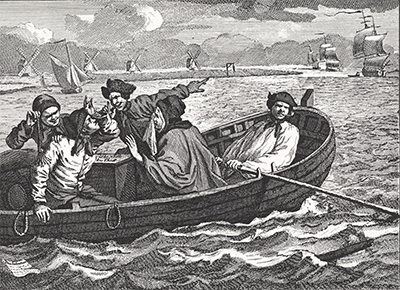
Thomas Idle sits in a rowing boat on the Thames, his chest beside him and his apprenticeship papers already in the water. A woman lifts a hand towards him as one of his companions points to a gibbet on the far bank. William Hogarth makes the moment of departure plate 5 of the twelve-print series Industry and Idleness. The Metropolitan Museum of Art’s impression, 91.1.13, is an etching and engraving catalogued as the second state of three and dated 30 September 1747. The departure takes up a single print, but the distance between the boat and the shore lets Hogarth put the things Idle is leaving and the dangers ahead into the same picture. [1] [2]
At a Glance
- Artist and seriesWilliam Hogarth, plate 5 of 12 in Industry and Idleness
- Met impressionEtching and engraving, second state of three, dated 30 September 1747, The Metropolitan Museum of Art, 91.1.13
- Boydell impressionThird state of three, inscribed 30 September 1747, National Gallery of Victoria, 1995.358.5
- Princeton paired sheetPlates 5 and 6, Princeton University Art Museum, x1988-58
- Later copyThomas Cook after William Hogarth, 1 December 1795, Wellcome Collection, 38371i
This work across William Hogarth’s career
Assembly at Wanstead House
1728–31The Heir
1734The Marriage Settlement
about 1743Gin Lane
1751Canvassing for Votes
1754–55Contents
- The people in the boat
- An indenture in the river
- The river and the gibbet
- The surviving impressions
- What happens between the plates
The people in the boat
The oar crosses the right side of the composition at an angle, carrying the eye from the seated oarsman into the water. The boat rides high enough for us to see its planks and the loops of rope hanging from its side. Hogarth makes the space inside it feel cramped by comparison. Idle braces a hand against the gunwale and tilts his face up towards the men leaning over him. His other hand is raised with two fingers extended. The woman opposite him holds a cloth to her face. Her open hand reaches into the space between them, where the lid of his chest catches the light. The Rijksmuseum identifies her as his mother, a reading encouraged by the proverb directly beneath the image. [1] [2]
The gestures offer several ways to read what the people in the boat are saying. One companion stretches an arm towards the far bank. Another holds up a short, frayed object that resembles a piece of rope. In the account published under John Trusler’s name in 1833, the rope stands for a cat-o’-nine-tails and the two fingers make horns in a joke about Cuckold’s Point. The same commentary reads the woman’s clothes as a possible sign of widowhood. The print gives those readings a foothold in objects and gestures while leaving the words of the exchange to the viewer. The frayed rope can evoke shipboard punishment without showing anyone receiving it. Idle’s raised fingers can turn a warning into a joke, even for a viewer unfamiliar with the place name. [1] [3]
Hogarth sets the mother’s open hand against the more emphatic gestures around it. The others direct attention away from the boat or make sport of the departure. She appeals to the person beside her. The cartouche quotes the second half of Proverbs 10:1, “A foolish son is the heaviness of his mother.” By choosing the mother’s half of the verse for this print, Hogarth gives the woman’s distress a place in the story equal to the title’s announcement of Idle’s dismissal. She can share the boat for this part of the journey, and her gesture measures how little that closeness lets her change. [1] [3]
An indenture in the river
Two pieces of lettering reward a closer look. The lid names the chest as Thomas Idle’s, and the little sheet on the water begins “This Indenture.” One object carries what he can take with him. The other records a place in a trade and a household that he is leaving behind. Hogarth sets the scrap close to the lower edge, where it can easily be missed among the waves. Trusler’s commentary supplies the action of Idle throwing it overboard. What the print shows is the aftermath, with the agreement floating just below the hand that grips the boat. [1] [3]
Surviving London records make that scrap more consequential. An apprenticeship indenture set out a term of service and the master’s obligation to teach a trade and provide for the apprentice. London Lives explains that there were normally two copies, one for the master and one kept by the parents or parish on the apprentice’s behalf. The matching cut could help show that they belonged to the same agreement. Idle’s discarded sheet is therefore a vivid sign of separation. The legal steps behind the words “turn’d away” stay outside the frame, along with any terms on which he might be going to sea. [1] [4]
Watch Hogarth’s paintings and prints
Five films on Hogarth’s painted stories, prints, drawing methods and work for the Foundling Hospital.
In 60 seconds: Hogarth's 'Gin Lane' & 'Beer Street'
A short introduction to the contrasting streets, the shops and the people in Hogarth’s paired prints.
Watch on YouTubeA boy could also go to sea under a new apprenticeship. The Foundling Museum records that Miles Cooke, admitted to the Foundling Hospital in December 1743, was later bound at eleven to a mariner. He was to serve until twenty-four and receive five pounds a year for the final three years. Those terms give a sense of what a documented placement could specify. In Idle’s case, the visible paper belongs to the apprenticeship he is leaving. The large ships in the picture suggest his next workplace, while his employer, destination and terms of service remain open. [1] [5]
The river and the gibbet
Windmills stand along the low bank, and sail fills the upper right, where the larger vessels dwarf the small boats nearer them. That change in scale gives the river depth and suggests how people could reach ships from shore. London Museum proposes that the land in the background is Millwall on the Isle of Dogs. The windmills and bend make the place persuasive as a working stretch of the Thames. They leave room for uncertainty about the exact viewpoint and the ship Idle is meant to board. [1] [2] [6]
The gibbet is little more than a dark upright with a hanging figure beside it. The thrust of the pointing arm makes that tiny detail hard to overlook. Royal Museums Greenwich documents the display of the bodies of some executed pirates at conspicuous points on the Thames, including near Greenwich Marsh, as a warning to people using the river. Hogarth’s print leaves the identity and offence of its hanging figure open. The warning works at the scale of the story too. By plate 11 it is Idle who is taken to the gallows, at Tyburn. Here the other man’s fate can still be waved away in a boat. [1] [7] [8]
The surviving impressions
The Met also holds a first-state impression, 32.35(41), with the same catalogue date as 91.1.13. The National Gallery of Victoria describes its impression, 1995.358.5, as the third of three states and identifies John Boydell as its publisher. The engraved publication date, 30 September 1747, appears on both the Boydell and the Met second-state impressions. They also share the Proverbs quotation beneath the scene. A plate number locates a scene in the story. A state records the condition of the printing surface, which could continue to carry the same dated line through later printings. Princeton University Art Museum identifies plate 5 as no. 172 in Ronald Paulson’s 1989 catalogue. [1] [9] [10] [11]
Princeton’s Graphic Arts Collection lists Hogarth’s plate 5 in its folio holdings and records a Thomas Cook version in a separate inventory. Wellcome Collection holds a copy engraved by Cook after Hogarth and dated 1 December 1795. The later print retains the floating indenture, the labelled chest and the proverb below the picture. Those details allow the small objects and the mother’s grief to keep their place even when a different engraver’s name appears in the lettering. [12] [13] [14]
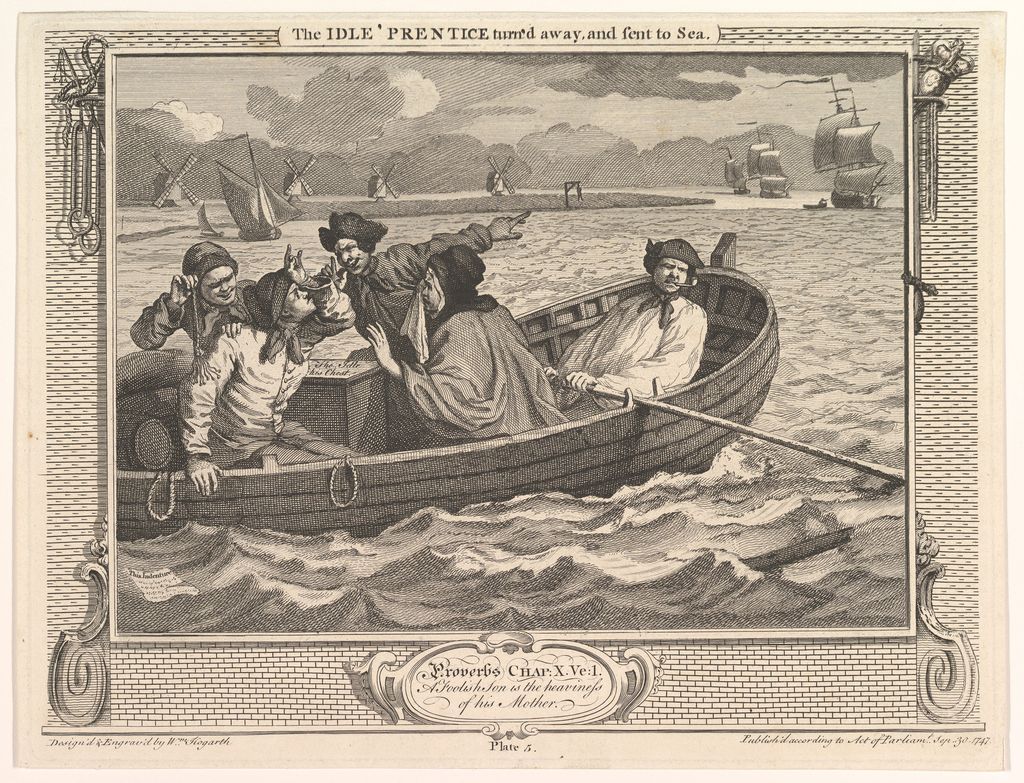
The Idle 'Prentice Turned Away and Sent to Sea (Industry and Idleness, plate 5), William Hogarth, September 30, 1747. Etching and engraving; second state of three. 91.1.13. Gift of Sarah Lazarus, 1891. Image source. CC0 / Public domain.
What happens between the plates
In plate 4, Goodchild earns his master’s trust while standing beside him in the shop. The next time Goodchild appears, in plate 6, he has completed his term and married his master’s daughter. Princeton University Art Museum’s sheet x1988-58 places plate 5 above plate 6. On that sheet a glance moves from the chest in a boat to the public celebration in the street. One apprentice’s changing place in his master’s household is visible to the neighbourhood. The other has been placed beyond the shop and the people who might have seen him there every day. [1] [11] [15]
Hogarth shows the boat journey and then skips over the voyage at sea. When he appears again in plate 7, the title says he has returned from sea and the image finds him already in a garret. That gap gives plate 5 its particular weight. This is the moment when the people around him can still address him directly, and when a sheet of paper, a gesture and a view of the shore can carry the consequences of leaving. [1] [16]
Browse Hogarth’s artworks
All 54 individual artworks and series stages in the approved English cluster
Frequently Asked Questions
They are already in the Thames by the time Idle is shown in the rowing boat. A companion points out a gibbet on the far bank. [1]
It is plate 5 of 12 in Industry and Idleness. Following the plate numbers keeps Goodchild’s and Idle’s episodes in the intended order. [1]
Discussion
Look again at the images and ideas explored in The Idle ’Prentice Turned Away and Sent to Sea. These editorial prompts invite your observations.
Reader Insights
How does the floating indenture change the meaning of the labelled chest inside the boat?
What happens to your reading of the scene when you follow the pointing hand to the gibbet on the far bank?
Join the Conversation
Share a detail, comparison or question about The Idle ’Prentice Turned Away and Sent to Sea below.
References
- The Metropolitan Museum of Art, William Hogarth, The Idle ’Prentice Turned Away and Sent to Sea (Industry and Idleness, plate 5), 91.1.13. View source.
- Rijksmuseum, William Hogarth, Tom Idle wordt in een roeiboot naar een schip op de Theems gevaren, RP-P-OB-18.783. View source.
- John Trusler, The Works of William Hogarth, London, Jones and Co., 1833, pp. 93–94, Industry and Idleness, plate V. View source.
- London Lives 1690–1800, Apprenticeship Indentures and Disciplinary Cases (IA), “Apprenticeship Indentures,” including St Botolph Aldgate, GLBAIA107000009. View source.
- The Foundling Museum, Tiny Traces, “Children’s Biographies,” no. 165, Miles Cooke. View source.
- London Museum, William Hogarth painted London behaving badly, “Sent to sea.”. View source.
- Royal Museums Greenwich, A Pirate hanged at Execution Dock, PAJ0887, catalogue commentary on Thames gibbets. View source.
- The Metropolitan Museum of Art, William Hogarth, The Idle ’Prentice Executed at Tyburn (Industry and Idleness, plate 11), 91.1.19. View source.
- The Metropolitan Museum of Art, William Hogarth, The Idle ’Prentice Turned Away and Sent to Sea: Industry and Idleness, plate 5, 32.35(41). View source.
- National Gallery of Victoria, William Hogarth, The idle ’prentice turn’d away and sent to sea, 1995.358.5. View source.
- Princeton University Art Museum, William Hogarth, Plates 5 & 6 from the series Industry and Idleness, x1988-58. View source.
- Princeton University Library, Vicki Principi, William Hogarth Collection, GC113, drawer 2, plate 5. View source.
- Princeton University Library, GC113 England 18th C. Prints William Hogarth, pp. 1–2, “Copies of Hogarth by Thomas Cook,” item 5. View source.
- Wellcome Collection, Thomas Cook after William Hogarth, The idle ’prentice turned away, and sent to sea, plate 5, 38371i. View source.
- The Metropolitan Museum of Art, William Hogarth, The Industrious ’Prentice a Favorite, and Entrusted by his Master: Industry and Idleness, plate 4, 32.35(40). View source.
- The Metropolitan Museum of Art, William Hogarth, The Idle ’Prentice Returned from Sea and in a Garret with a Common Prostitute (Industry and Idleness, plate 7), 91.1.15. View source.







