


 by Tom Gurney
Tom Gurney BSc (Hons) is an art history expert with over 20 years experience
Published on June 19, 2020 / Updated on October 14, 2023
Email: tomgurney1@gmail.com / Phone: +44 7429 011000
A Harlot’s Progress, Plate 3: Introduction
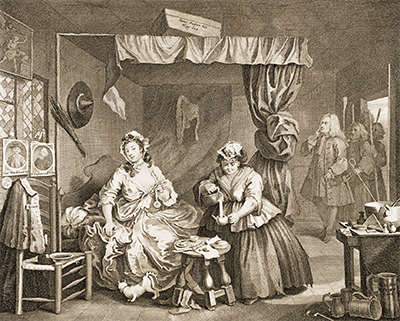
Moll Hackabout holds up a watch by its chain while a woman pours her breakfast drink. Behind them, a magistrate and his companions step into the room. William Hogarth gives us time to notice the men before either woman appears to see them. The watch, the falling stream of liquid and the first step through the doorway all belong to the same moment. The Metropolitan Museum of Art’s impression, 91.1.130, is an etching and engraving catalogued under April 1732. It depicts the third of six scenes in A Harlot’s Progress, published as a set of prints in 1732. [1] [2]
At a Glance
- ArtistWilliam Hogarth
- Series published1732
- MediumEtching and engraving
- First state in the Met catalogueThe Metropolitan Museum of Art, 32.35(4), catalogued before April 1732
- Third state in the Met catalogueThe Metropolitan Museum of Art, 91.1.130, catalogued under April 1732
This work across William Hogarth’s career
Assembly at Wanstead House
1728–31The Heir
1734The Marriage Settlement
about 1743Gin Lane
1751Canvassing for Votes
1754–55Contents
- Breakfast beside the bed
- Names among the possessions
- What changes between impressions
- The official at the door
Breakfast beside the bed
In Plate 2, Moll has enough space to overturn a tea table while another woman helps her lover slip away. Here the breakfast things are set out on a low table within easy reach of the bed. The change in lodgings tells us what has happened between scenes. Moll has lost the household her patron paid for and is now selling sex in cheaper quarters. The same patch of floor has to accommodate dressing, eating and receiving visitors. The attendant looks down at the cup she is filling. A cat moves past the edge of Moll’s skirt. Hogarth sets these ordinary movements close together in the foreground, while the men advance through a clear strip of floor at the right. [1] [3] [4]
The bed still has a canopy and an ample curtain. The fabric is gathered into a great knot beside the entering men, and finer folds in Moll’s dress catch the light across the front of the scene. There are still signs of an effort to dress and furnish the room well. The low ceiling and the belongings piled or hung around the bed show how little space there is for them. Even the top of the canopy serves as a shelf. The large pictures in the previous room had space on the wall. Here two small portraits are pinned beside the window, close to a hanging garment and the back of a chair. [1] [3]
The watch is small enough to disappear into a pocket and valuable enough to draw our attention when Moll holds it out. Colonial Williamsburg’s catalogue suggests two ways it could have reached her, as a client’s gift or as something stolen. The long chain makes the watch conspicuous. Its ownership remains a question for the viewer. Her expression and lifted hand make the gesture feel leisurely. A viewer who has already spotted the officials may read the same gesture as a danger to her. [1] [4]
Names among the possessions
The little portraits carry names of their own. The British Museum identifies them as Captain Macheath, the highwayman of The Beggar’s Opera, and Henry Sacheverell, the clergyman impeached in 1710. Above the canopy the museum identifies a box marked for James Dalton, a historical highwayman. The three names come from different parts of public life. A theatrical character sits alongside a controversial clergyman in the same cheap portrait format, while a name associated with robbery appears on a piece of luggage. They lend the room the familiarity of names a print buyer might know from the stage, news or other prints. The inscription on the box leaves its journey into the room to the viewer’s imagination. [1] [5]
A vessel on the floor provides a clue to the setting. The Allen Memorial Art Museum reads the words “in Drury Lane” on the tankard in its impression. Colonial Williamsburg finds the same location on the pewter measure in its sheet and marks its reading of the preceding surname as uncertain. The shared wording anchors the scene in the vicinity of Drury Lane. A tavern vessel can travel, and its inscription gives the viewer a neighbourhood without specifying Moll’s address. Likewise the bottles and the dark patches on her face carry a possible implication of venereal disease, as the Oberlin catalogue suggests. The image gives that reading its force by placing the signs of a toilette and possible treatment in the same small space. [1] [4] [6]
Watch Hogarth’s paintings and prints
Five films on Hogarth’s painted stories, prints, drawing methods and work for the Foundling Hospital.
In 60 seconds: Hogarth's 'Gin Lane' & 'Beer Street'
A short introduction to the contrasting streets, the shops and the people in Hogarth’s paired prints.
Watch on YouTubeWhat changes between impressions
The Metropolitan Museum catalogues its 32.35(4) as a first state, dated before April 1732, and its 91.1.130 as the third in its three-state count. A state records a change to the printing plate. It can help place impressions in order even when the day or year a particular sheet was printed remains unknown. Ronald Paulson’s third revised edition of Hogarth’s Graphic Works assigns this composition no. 123 and distinguishes four states, as the University of San Diego’s catalogue entry shows. The three-state labels here follow the Met’s records. [1] [7] [8]
The background objects make especially good points of comparison. The British Museum describes the two portraits by the window and Dalton’s box above the bed in its impression, details also visible in 91.1.130. At the right edge, a smaller object is reported to have changed. John Ireland and John Nichols’s catalogue describes a dish near the punch bowl in a first state and a bottle in its place in a later state. A dark bottle stands beside the bowl on the Met’s later impression, which also has a small cross in the lower margin. Ireland’s description gives us a place to look for revision without settling a modern catalogue number for the change. Set among bowls, papers and overturned drinking vessels, the bottle can escape notice on a first look, just as the little cross can go unseen beneath the image. [1] [5] [9]
A different comparison comes from a squared red chalk drawing at the British Museum, tentatively connected with the development of Plate 3. Its occupant attends to her own arm as another woman approaches with a leaking vessel. Implements crowd a table beside the bed, and washing hangs across the room. The print uses a similar conjunction of bed, attendant and vessels to give the women something to do as the men approach. In the drawing, the leaking jar and the bandage keep attention on the immediate needs of the two women. Hogarth’s print keeps that intimacy and gives us a view past it to a set of people with power over the room. The museum leaves the drawing’s precise date and purpose open. [1] [10]
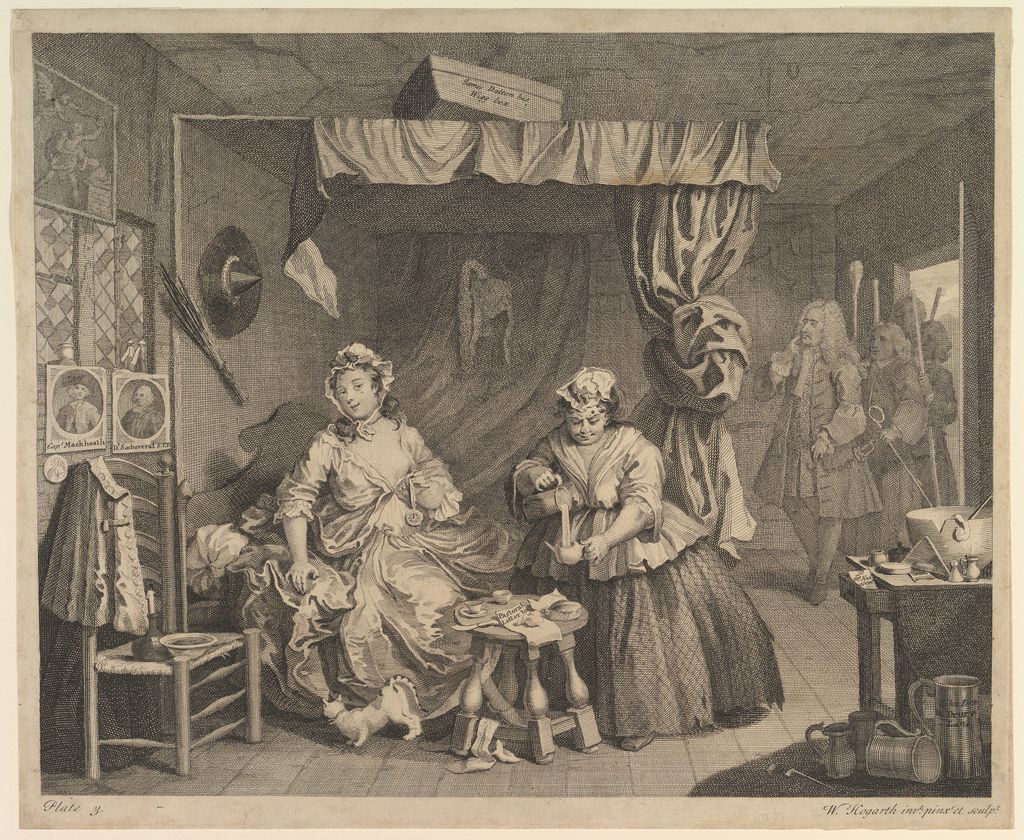
A Harlot's Progress, Plate 3, William Hogarth, before April 1732. Etching and engraving; first state of three. 32.35(4). Harris Brisbane Dick Fund, 1932. Image source. CC0 / Public domain.
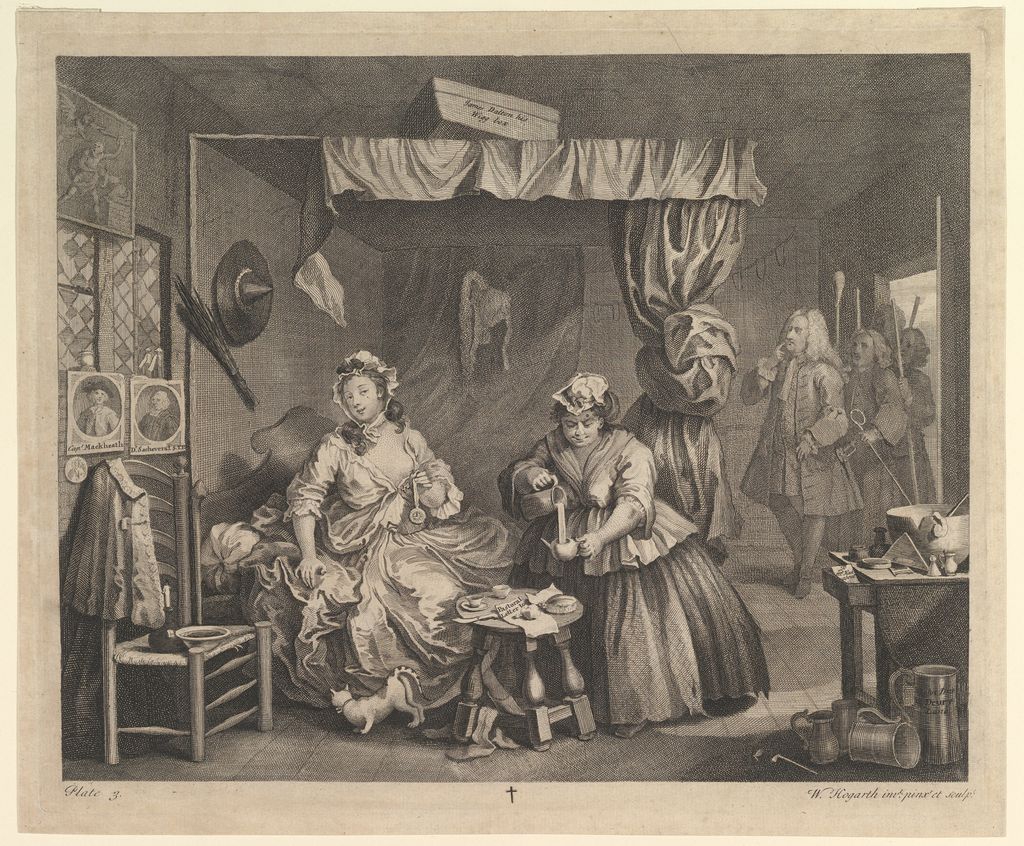
A Harlot's Progress, Plate 3, William Hogarth, April 1732. Etching and engraving; third state of three. 91.1.130. Gift of Sarah Lazarus, 1891. Image source. CC0 / Public domain.
The official at the door
The man commonly identified as Sir John Gonson is a step ahead of the others. He brings one hand up near his mouth as he looks into the room. The men behind him carry staves, visible against the opening. The identification gives the scene a topical reference. Gonson had served as a Middlesex magistrate since 1720 and supported the Society for the Reformation of Manners. A collection of his charges to grand juries, in its third edition by 1730, records addresses at quarter sessions for Westminster and the Tower jurisdiction in 1728 and 1729. The volume put his name and public role before readers who had never encountered him in person. [1] [4] [11] [12]
The printed charges and the enforcement campaign tell different parts of that history. Heather Shore’s research traces the crackdown on disorderly houses in 1730 to residents’ complaints and the responses of Westminster justices and constables. Petitions from St Martin-in-the-Fields and St Paul’s, Covent Garden, described neighbourhood disturbances that included fighting and robbery. Arrests took place in Drury Lane and some of the women apprehended in the campaign were sent to the Tothill Fields house of correction. Shore’s biography of Gonson qualifies how far his direct involvement in raids can be established. The historical record explains why a viewer might recognise the figure at the door, while the posture and timing of his entrance are Hogarth’s. [12] [13]
The cases Shore reconstructs could involve warrants, confinement, repeated accusations and disputed testimony. In the print the officials have only just arrived. The picture supplies neither a hearing nor a stated charge, and the watch alone cannot tell us why the men are there. By Plate 4, Moll is already beating hemp in a house of correction. Hogarth cuts from the moment before she sees the officials to the work imposed on her in custody. That cut gives the unbroken stream of liquid in Plate 3 a particular poignancy. Hogarth leaves her with the small interval in which a cup can be filled and a watch can still be shown off. [1] [13] [14]
Browse Hogarth’s artworks
All 54 individual artworks and series stages in the approved English cluster
Frequently Asked Questions
It is plate 3 of 6 in A Harlot’s Progress. The plate number identifies the design across impressions. [1]
Discussion
Look again at the images and ideas explored in A Harlot’s Progress, Plate 3. These editorial prompts invite your observations.
Reader Insights
How do the falling stream of liquid and the men at the doorway shape your sense of time in the print?
What does the Drury Lane inscription on the tankard tell you about the setting, and what does it leave open?
Join the Conversation
Share a detail, comparison or question about A Harlot’s Progress, Plate 3 below.
References
- The Metropolitan Museum of Art, William Hogarth, A Harlot’s Progress, Plate 3, 91.1.130. View source.
- Princeton University Library, Sin & the City: William Hogarth’s London, full exhibition checklist, A Harlot’s Progress entry. View source.
- The Metropolitan Museum of Art, William Hogarth, A Harlot’s Progress, Plate 2, 91.1.129. View source.
- The Colonial Williamsburg Foundation, William Hogarth, A Harlot’s Progress: Plate 3, 1951-86. View source.
- British Museum, William Hogarth, A Harlot’s Progress, Plate 3, 1858,0417.546, museum description reproduced with the object image. View source.
- Allen Memorial Art Museum, Oberlin College, William Hogarth, The Harlot’s Progress, Plate 3, 1975.197. View source.
- The Metropolitan Museum of Art, William Hogarth, A Harlot’s Progress, Plate 3, 32.35(4). View source.
- University of San Diego, University Galleries, William Hogarth, A Harlot’s Progress, Plate 3, PC2017.01.110, citing Ronald Paulson, Hogarth’s Graphic Works, third revised edition (1989), no. 123. View source.
- John Ireland and John Nichols, Hogarth’s Works, with Life and Anecdotal Descriptions of His Pictures, vol. 3, ch. V, p. 291, catalogue entry for Plate 3. View source.
- British Museum, Lindsay Stainton and Christopher White, commentary on William Hogarth, A harlot in her garret attended by her bunter, Z,1.3, reproduced with the museum’s object data. View source.
- Sir John Gonson, Five Charges to Several Grand Juries, third edition (London, 1730), Wellcome Collection catalogue. View source.
- Heather Shore, “Gonson, Sir John (1676/7–1765), magistrate,” Oxford Dictionary of National Biography (2012). View source.
- Heather Shore, “‘The Reckoning’: Disorderly Women, Informing Constables and the Westminster Justices, 1727–33,” Social History 34, no. 4 (2009), pp. 409–427, author manuscript, pp. 13–20. View source.
- Wellcome Collection, William Hogarth, A Harlot’s Progress, Plate 4, 38227i. View source.







