


 by Tom Gurney
Tom Gurney BSc (Hons) is an art history expert with over 20 years experience
Published on June 19, 2020 / Updated on October 14, 2023
Email: tomgurney1@gmail.com / Phone: +44 7429 011000
The Industrious ’Prentice Grown Rich and Sheriff of London: Introduction
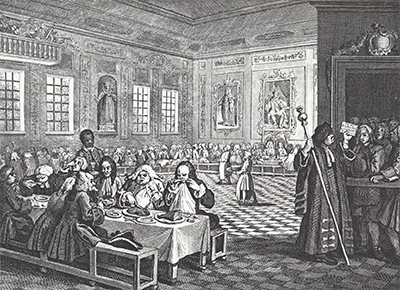
A man at the nearest table holds his napkin with both hands against his mouth. Across the hall, a staff-bearing official holds up a letter addressed to the sheriff. Between these actions, servers carry dishes across the chequered floor. This is William Hogarth’s eighth plate of twelve in Industry and Idleness, an etching and engraving that bears the date 30 September 1747. Francis Goodchild, the former apprentice, is the guest of honour with his wife. Hogarth makes the feast as much about the people who serve, eat and wait as about the couple seated at the far end. [1] [2]
At a Glance
- SeriesIndustry and Idleness, plate 8 of 12
- Engraved date30 September 1747
- MediumEtching and engraving
- Impression discussedMetropolitan Museum of Art, 91.1.16, second state of two
- Later engravingThomas Cook after William Hogarth, 1 February 1796, Wellcome Collection 38374i
This work across William Hogarth’s career
Assembly at Wanstead House
1728–31The Heir
1734The Marriage Settlement
about 1743Gin Lane
1751Canvassing for Votes
1754–55Contents
- A place at the feast
- The letter at the door
- A London hall and a London office
- Understanding and appetite
- Impressions and a later copy
A place at the feast
The room draws the eye towards the couple even as the diners keep interrupting the view. The high windows on the left and the receding squares on the floor establish a deep interior. The long tables run around the sides and across the far end, leaving room for servants in the middle. Goodchild and his wife sit beneath a large framed portrait, their high-backed chairs rising above the level of the other diners’ heads. The sword and mace beside them help pick out the seats of honour. From this distance, furniture and insignia tell us more about the new sheriff’s standing than his expression does. [1] [3] [4]
The foreground gives us a much closer view of the guests. A diner raises a glass and leans back. Another bends over his dish, keeping his face low above the table. Bent arms, tilted heads and the napkin pulled taut give several different rhythms to the act of eating. The dishes almost touch along the front of the cloth. At the near corner, the bench and its occupants cut across the path the eye might otherwise take towards the head of the table. Hogarth has reserved the most conspicuous seats for the couple and given the most conspicuous gestures to their guests. [1] [3]
Follow the movement of the servers through the gap between the tables. Two figures carry dishes in the open floor space, where the pattern of the tiles makes their progress easy to follow. A Black attendant stands behind the near diners, his upright figure visible above their wigs and shoulders. At the upper left, musicians look out from a gallery, above the service and eating on the floor. The hall supplies music as well as food, and the service is in full view. From the gallery to the bench, people have different work, different places and different views of the same celebration. [1] [3]
The letter at the door
At the right, figures crowd behind a barrier beneath a dark opening. The beadle, identifiable by his staff, turns towards them with the paper raised close to his face. The address names Francis Goodchild and gives his title as sheriff of London. The print makes that formal address readable in the same part of the picture where the would-be petitioners wait. The writing on the visible side gives the recipient and his office. The contents and outcome of the appeal remain open. Whoever brought the paper has reached an official who can receive it, with the man named on it still at a distance. [1] [3] [4]
The route taken by the paper throws the movement of the food into relief. Dishes cross an open floor towards people with assigned places. The figures by the doorway cluster around a single reader who stands between them and those tables. Hogarth puts the beadle and the waiting group on much the same scale as the diners in the foreground. The guests have the meal and the couple have the seats of honour, yet the figures at the barrier take up enough space to make their business hard to overlook. The beadle pauses to read while the people behind the barrier wait. Even this small act makes access to the sheriff depend on someone else’s attention. [1] [3] [4]
Watch Hogarth’s paintings and prints
Five films on Hogarth’s painted stories, prints, drawing methods and work for the Foundling Hospital.
In 60 seconds: Hogarth's 'Gin Lane' & 'Beer Street'
A short introduction to the contrasting streets, the shops and the people in Hogarth’s paired prints.
Watch on YouTubeA London hall and a London office
The statue between the windows is a clue to the setting. The print names Sir William Walworth, a fishmonger and twice Lord Mayor according to the Fishmongers’ Company. A historical photograph in Historic England’s archive documents a statue of Walworth at Fishmongers’ Hall. The Rijksmuseum identifies the room as Fishmongers’ Hall in its description of Thomas Cook’s later engraving after Hogarth. Colonial Williamsburg describes the feast as taking place at Guildhall. In the third revised edition of Hogarth’s Graphic Works (1989), as quoted by Wellcome, Ronald Paulson leaves Guildhall open as the intended setting and points to the Fishmongers’ Company as the home of the statue. That detail anchors the fiction in the City’s memory of one of its officeholders. The setting of the feast remains uncertain. [1] [2] [4] [5] [6] [7]
The office carried responsibilities well beyond the feast. The City of London’s historical account describes two annually elected sheriffs and records their duties in keeping prisoners at Newgate and delivering them for trial. Hogarth skips over the election and sets the new title in a social situation. We see how the office changes where Goodchild sits, how others address him and who stands between him and someone seeking his attention. The real duties give that title weight when the series returns to criminal justice. By plate X, Goodchild appears as an alderman, and Idle is brought before him. The banquet and the later hearing show different offices and different occasions on which others seek access to the same man. [1] [8] [9]
Understanding and appetite
In the lower cartouche of the Metropolitan Museum of Art impression, an extract from Proverbs 4:7–8 asks its reader to acquire understanding and promises honour to those who prize it. The title at the top announces that the apprentice has grown rich. The verse below asks the reader to consider what else a person should acquire. Goodchild’s seat gives the promise of honour a visible form, while the behaviour at the near table gives the eye ample reason to linger on a different kind of getting. The diners are intent on what they can eat and drink at this moment. The verse speaks of something worth seeking over the course of a life. [1] [2]
The two episodes on either side of the feast put it among very different interiors. In plate VII, Idle’s return from sea, bed, possessions and occupants are crowded together, and Idle reacts to a disturbance from the chimney. The banquet offers a wide floor, music and room for company. In plate IX, Idle’s betrayal in the night cellar, a woman at the entrance directs the attention of the men coming in. The doorway matters in both plates VIII and IX. At the feast it holds people seeking a way to reach the officeholder. In the cellar it gives those entering a way to reach the man they have come to take. [1] [3] [10] [11]
Impressions and a later copy
The Metropolitan Museum of Art catalogues 91.1.16, the impression discussed here, as the second of two states. Its other impression, 32.35(45), is catalogued as the first of two. Both are etchings and engravings, and both records use 30 September 1747. The publication date printed in the margin belongs to the design and could be carried forward on subsequently printed sheets. A state identifies a stage in the working life of the printing surface. The plate number identifies the scene’s place in the story in either state. The National Gallery of Victoria also catalogues its own impression, 1278.459-3, as second of two. Its transcription locates the biblical verse below the scene and the maker’s credit and date along the lower margin. [1] [12] [13]
Princeton University Library lists Hogarth’s plate VIII among the impressions of the series in its William Hogarth Collection. It separately records Thomas Cook’s version after Hogarth, dated 1 February 1796, in its British Prints Collection. Wellcome’s Cook impression retains the banquet, the petitioners and the Proverbs caption, but its lettering now credits the design to Hogarth and the engraving to Cook. That division of credit lets a reader distinguish a later engraving of the subject from a sheet printed from Hogarth’s plate. The letter at the door still names the sheriff. The line at the foot now tells us who made this version of his feast. [14] [15] [4]
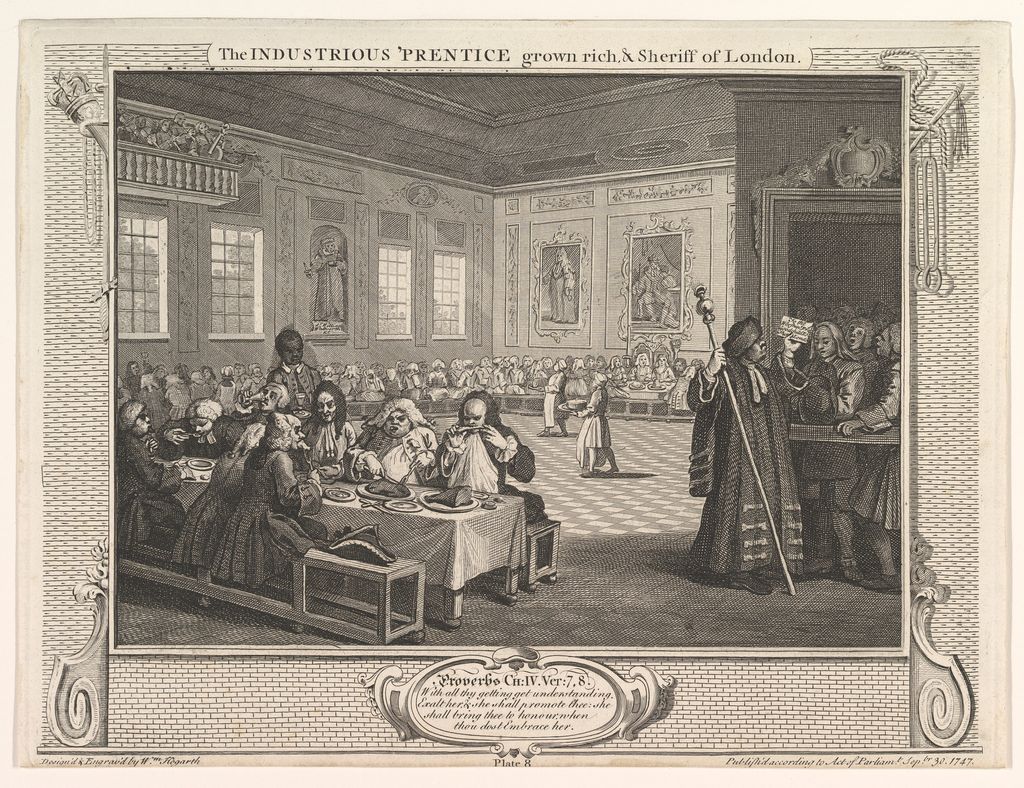
The Industrious 'Prentice Grown Rich and Sheriff of London (Industry and Idleness, plate 8), William Hogarth, September 30, 1747. Etching and engraving; second state of two. 91.1.16. Gift of Sarah Lazarus, 1891. Image source. CC0 / Public domain.
Browse Hogarth’s artworks
All 54 individual artworks and series stages in the approved English cluster
Frequently Asked Questions
It is plate 8 of 12 in Industry and Idleness. Following the plate numbers keeps Goodchild’s and Idle’s episodes in the intended order. [1]
Discussion
Look again at the images and ideas explored in The Industrious ’Prentice Grown Rich and Sheriff of London. These editorial prompts invite your observations.
Reader Insights
How do the high-backed chairs, sword and mace help you find Goodchild and his wife among the diners?
What does the beadle’s place at the barrier tell you about who can reach the sheriff during the feast?
Join the Conversation
Share a detail, comparison or question about The Industrious ’Prentice Grown Rich and Sheriff of London below.
References
- The Metropolitan Museum of Art, William Hogarth, The Industrious ’Prentice Grown Rich and Sheriff of London (Industry and Idleness, plate 8), 91.1.16. View source.
- Colonial Williamsburg Foundation, William Hogarth, The Industrious ’Prentice grown rich & Sheriff of London, plate VIII, 1947-485,A, label and inscriptions. View source.
- Andrew Stevens, Hogarth and the Shows of London, Elvehjem Museum of Art, 1996, p. 50, catalogue no. 41. View source.
- Wellcome Collection, Thomas Cook after William Hogarth, Francis Goodchild, now Sheriff of London, and his wife, framed by a sword and mace, preside over a grand banquet, 1796, 38374i, including Ronald Paulson, Hogarth’s Graphic Works, 3rd rev. ed., 1989, p. 134, as quoted in the object description. View source.
- The Fishmongers’ Company, Our History, Sir William Walworth and the company. View source.
- Historic England, Detail of Statue of Sir William Walworth, Fishmongers’ Hall, Royal Commission on the Historical Monuments of England Archive, BB97/01111. View source.
- Rijksmuseum, Thomas Cook after William Hogarth, De ijverige leerling is rijk geworden en benoemd tot Sheriff van Londen (plaat 8), RP-P-2020-131 (in Dutch). View source.
- City of London Corporation, An Historical Background of the Sheriffs, elections and duties at Newgate. View source.
- The Metropolitan Museum of Art, William Hogarth, The Industrious ’Prentice Alderman of London, The Idle One Brought Before Him and Impeached by his Accomplices (Industry and Idleness, plate 10), 91.1.18. View source.
- The Metropolitan Museum of Art, William Hogarth, The Idle ’Prentice Returned from Sea and in a Garret with a Common Prostitute (Industry and Idleness, plate 7), 91.1.15. View source.
- The Metropolitan Museum of Art, William Hogarth, The Idle ’Prentice Betrayed by his Whore and Taken in a Night Cellar with his Accomplice (Industry and Idleness, plate 9), 91.1.17. View source.
- The Metropolitan Museum of Art, William Hogarth, The Industrious ’Prentice Grown Rich and Sheriff of London: Industry and Idleness, plate 8, 32.35(45). View source.
- National Gallery of Victoria, William Hogarth, The industrious ’prentice grown rich, and sheriff of London, plate VIII, 1278.459-3, state and inscriptions. View source.
- Princeton University Library, Vicki Principi, William Hogarth Collection, GC113, drawer 2, plate VIII. View source.
- Princeton University Library, British Prints Collection, GC106, plate VIII engraved by Thomas Cook after William Hogarth, 1 February 1796. View source.







