



 by Tom Gurney
Tom Gurney BSc (Hons) is an art history expert with over 20 years experience
Published on June 19, 2020 / Updated on October 14, 2023
Email: tomgurney1@gmail.com / Phone: +44 7429 011000
The Tête à Tête: Introduction
A dog is the first to take an interest in what the Viscount has brought home. It noses a woman’s cap protruding from his coat pocket as he slumps by the fire, still wearing his hat. Across a small table, the Viscountess stretches with both arms raised. The steward is already on his way out with the household bills. William Hogarth painted this encounter in oil on canvas about 1743. It is the second of six scenes in Marriage A-la-Mode and measures 69.9 × 90.8 cm. The National Gallery in London acquired it in 1824 and catalogues it as NG114. [1]
At a Glance
- Artist and dateWilliam Hogarth, about 1743
- Medium and dimensionsOil on canvas, 69.9 × 90.8 cm
- CollectionNational Gallery, London, NG114
- Related printBernard Baron after William Hogarth, etching and engraving, fourth state of four, Metropolitan Museum of Art, 91.1.108
- Plate date and issueInscribed 1 April 1745, available to subscribers in early June 1745
This work across William Hogarth’s career
Assembly at Wanstead House
1728–31The Heir
1734The Marriage Settlement
about 1743The Tête à Tête (current article)
About 1743Gin Lane
1751Canvassing for Votes
1754–55Contents
- A household just after noon
- Cards, accounts and the view into the next room
- What Hogarth changed as he painted
- Bernard Baron’s Plate II
A household just after noon
In The Marriage Settlement, the fathers have money and documents laid out between them while the prospective spouses look elsewhere. A few months into the marriage, the young people have a room of their own and a table laid for one. The household accounts, which might have brought them into conversation, are leaving in the steward’s hand. The change is especially sharp if you follow the dogs. The two hounds chained together in the first scene anticipate the marriage. Here a single dog exposes a clue to the life the Viscount appears to lead away from it. [1] [2] [3]
The wall clock reads about twenty past twelve, which the National Gallery interprets as shortly after noon. The meal and the stretches suggest that the day is just starting for some of the household. For the Viscount, still in his outdoor hat and looking as though he might drop off, it seems to be the end of a long night. Jonathan Turner reads the placing of the clock above the Viscount as a suggestion of the authority he might exercise over domestic life. It is a suggestive reading because the two are so conspicuously out of step. The clock displays the time with precision while the man under it barely appears capable of attending to the business in front of him. [1] [2] [4]
His coat is still splendid, but his open waistcoat and loose cravat hang slack as he slides down in the chair. The sword on the carpet is broken inside its scabbard. A second cap appears wound round the hilt. The damage has been read as a joke about impotence, while the dark mark on his neck is what the National Gallery identifies as Hogarth’s sign for syphilis. Each clue works on a different scale. The broken line of the sword is easy to pick up among the things on the floor, whereas the mark requires a look at the face and neck of the man who has come home. [1] [2]
Judy Egerton compares his pose with the slumped reveller in Charles-Nicolas Cochin’s drawing A Party of Revellers, also called La Soirée, of about 1738 (Ashmolean Museum, WA1863.90). The design also circulated in a 1739 engraving by Claude Olivier Gallimard. In Cochin’s scene a woman with a mask watches the sleeping figure, and a mythological picture behind them supplies a second example of a woman regarding a sleeper. Hogarth uses the same opportunity to make a painting on the wall comment on the people beneath it. He makes the comparison harder to complete by leaving only a foot visible in the picture in the next room. [2] [5] [6]
Cards, accounts and the view into the next room
The Viscountess’s evening is pieced together from things left where they fell. Egerton identifies the book by her feet as Hoyle on whist. The scattered cards lie farther away, under the arch. In the foreground two fiddle cases lie one across the other by the overturned chair, one open enough to show part of its instrument. The book and cards could explain the presence of guests, while the arrangement of the fiddles invites a more intimate explanation for what happened after the games. There is also a small object in her raised right hand, generally read as a folding pocket mirror. She may be signalling to someone out of view. Egerton proposes the lawyer Silvertongue as a possible lover, though the composition gives that role to nobody we can see. [1] [2]
The arch gives the two rooms a shared view while keeping their activities apart. Deep blue columns interrupt the view of the adjoining room. Beyond them a footman raises a hand to his face, apparently yawning. The chairs in the distance still stand upright, in answer to the upholstered chair that lies across the carpet near us. Above them hang tall paintings of saints. Near the columns, a green curtain drawn across another frame leaves the bare foot exposed. The columns are close enough together to hide part of the scene behind them. From where we stand, the adjoining room is bigger than the portion we can see. [1] [2]
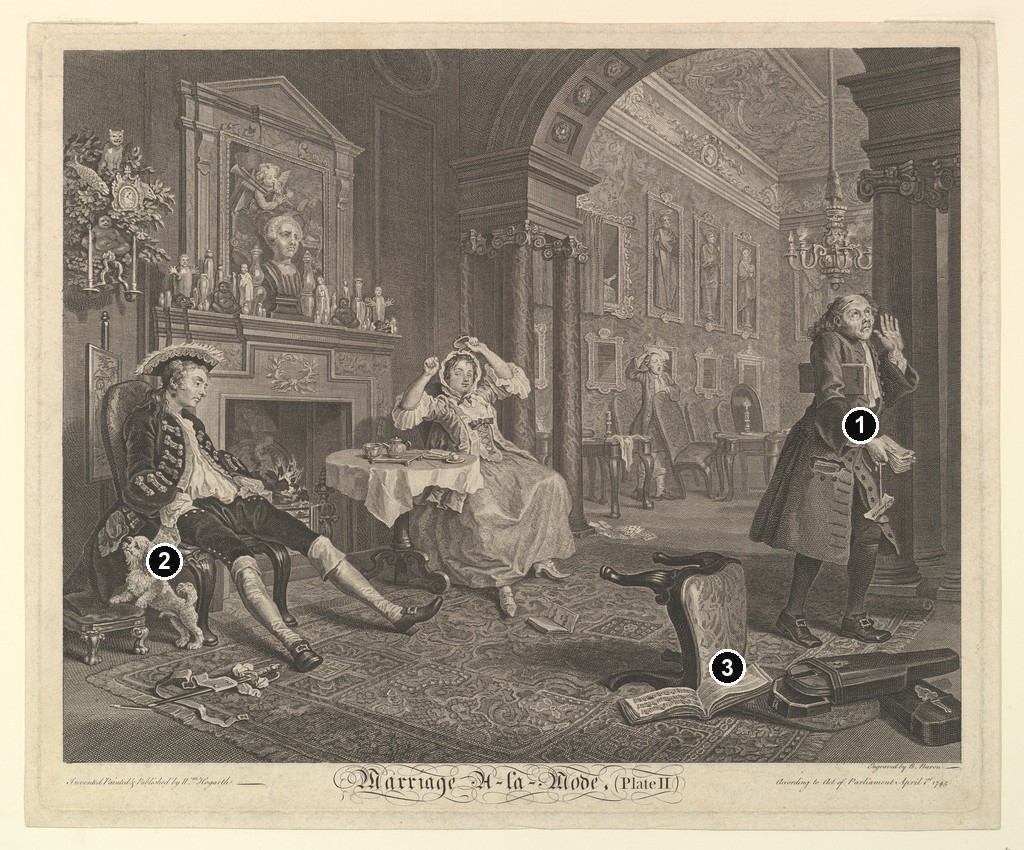
The steward carries three different kinds of financial evidence. There is a ledger under his arm, a bundle of bills in his hand and a single paper on a filing spike hanging from his finger. The ledger is the book in which the household could keep a running record. The bills are the immediate claims on it. The single receipted paper gives at least one transaction a date, which Egerton reads in the painting as 1743. The small tract in his pocket, labelled Regeneration, is a separate clue. Egerton connects its title to a sermon by the Methodist preacher George Whitefield. The lifted palm and upward glance suggest exasperation, and the tract lends the gesture a pious air. The steward has the papers in hand, but the couple leave him to carry them away. [1] [2]
Watch Hogarth’s paintings and prints
Five films on Hogarth’s painted stories, prints, drawing methods and work for the Foundling Hospital.
William Hogarth, Marriage A-la-Mode (including Tête à Tête)
A close look at Tête à Tête and how its figures and furnishings advance the story of the marriage.
Watch on YouTubeAbove the couple, the mantel offers another way of taking stock of the household. The chipped classical bust sits among little figures made in imitation of Chinese models. Their scale makes the bust resemble an outsized member of the collection. Up in the overmantel, a cherub plays the bagpipes, an instrument that gives the celestial figure an unexpectedly earthy occupation. Even the clock nearly disappears into foliage, animal shapes and twisted candleholders. Egerton reads it as a parody of elaborate French timepieces. The room contains plenty of things worth displaying, and Hogarth makes the way they are put together as revealing as the money spent on them. At the edge of the fireplace surround, beside the Viscountess’s cheek, there is a small male head. Its placement makes a third presence out of a furnishing where the title leads us to expect a conversation between two people. [1] [2]
What Hogarth changed as he painted
The raised hand acquired its importance as the painting developed. X-radiographs studied by David Bomford and Ashok Roy show that the Viscountess’s right arm was originally lower and probably held no mirror. They also found that the little table began without its cloth. The pieces of crockery were painted over the cloth, suggesting that the breakfast service came late in the design. The investigators were less certain about the direction of the woman’s earlier gaze. The evidence is clearest where it follows contours or the sequence of layers. The later setting gives her a meal she has yet to attend to, and her raised hand directs attention away from the table altogether. [2] [7]
The curtained picture proved harder to investigate. Its frame visibly continues behind the curtain, and the conservators tried to see whether the figure did too. The X-ray showed no underlying design in this area, and conventional infrared photography penetrated the green paint only to a degree. Infrared reflectography, using longer wavelengths than the film could record, disclosed an earlier Madonna and Child. A kneeling figure pointed to a possible Adoration. The exposed foot and ankle in the final design end at the curtain’s edge. The joke depends on the ease with which a viewer supplies the missing figure. Hogarth had first given the saints a plausible neighbour and then substituted a picture whose subject would be the one everyone wanted a better look at. [7]
Roy’s examination also gives a sense of how carefully Hogarth distributed colour. He found Prussian blue in the deep shadows of the columns and pale ultramarine in the ribbon of the cap by the Viscount’s dark coat. A sample from the grey-blue carpet pattern contained smalt, a cobalt-coloured glass, mixed with white. The blues perform distinct jobs. One marks the depth of the arch, another helps pick a small piece of fabric out of a dark costume, and a third belongs to the spread of ornament underfoot. The ease with which the eye finds the dog’s discovery owes something to that small colour contrast. [8]
Annotated Details from Tête à Tête
These details follow Baron’s engraved plate. Compare their position with the painted scene in the article. Marriage A-la-Mode, Plate II, Bernard Baron after William Hogarth. Metropolitan Museum of Art, New York, NY, 91.1.108. Collection record.
Details from TÊTE À TÊTE
Select a numbered point for a closer look.
Accounts in hand
The steward carries papers and raises a hand as he leaves. His upright pose contrasts with the relaxed figures who remain in the room.
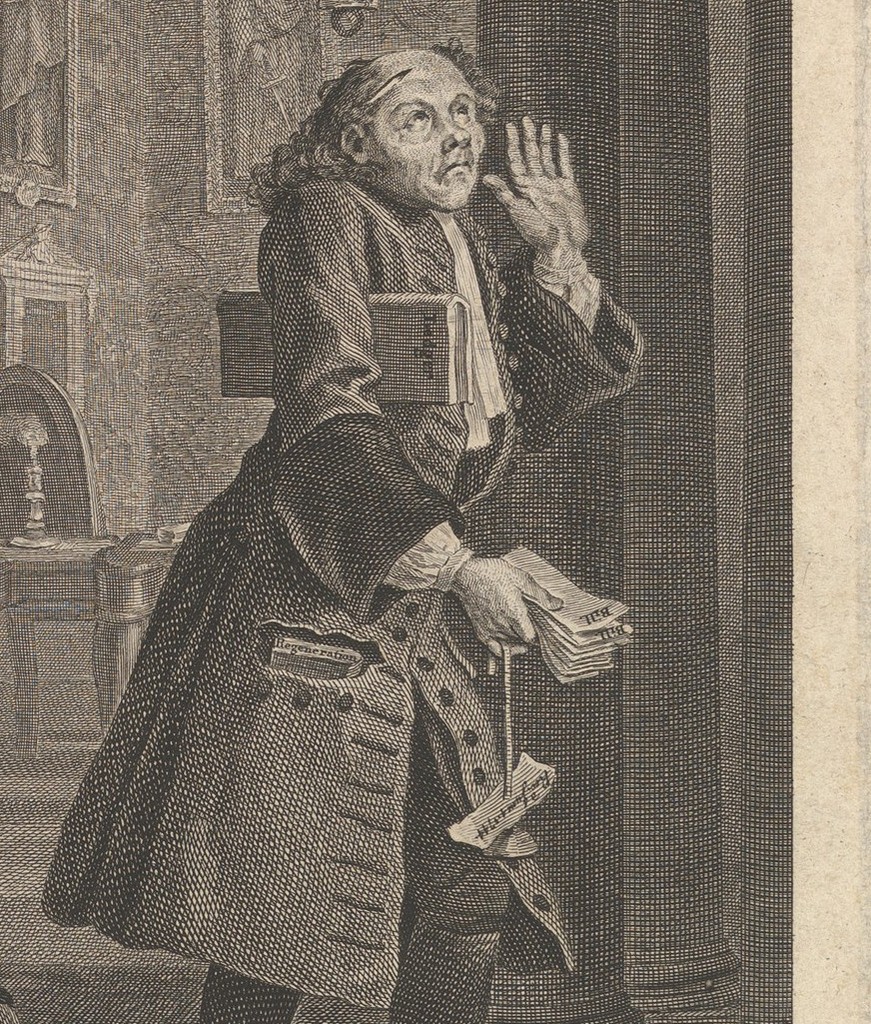
The dog at the Viscount’s side
The dog noses at a piece of fabric in the Viscount’s pocket. The animal’s attention directs yours to an object that a person in the room might choose to ignore.
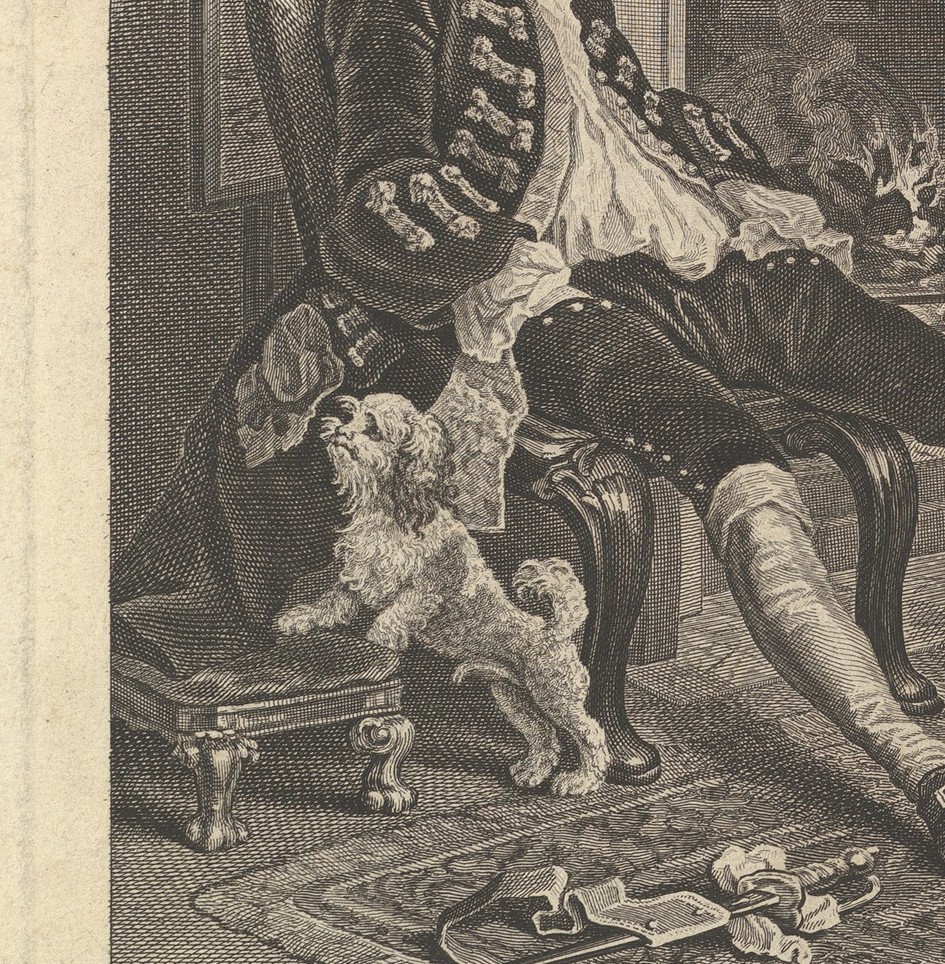
An overturned chair and music
An overturned chair and an open music book suggest activity in the room before the moment depicted. Compare their arrangement with the National Gallery’s painting.
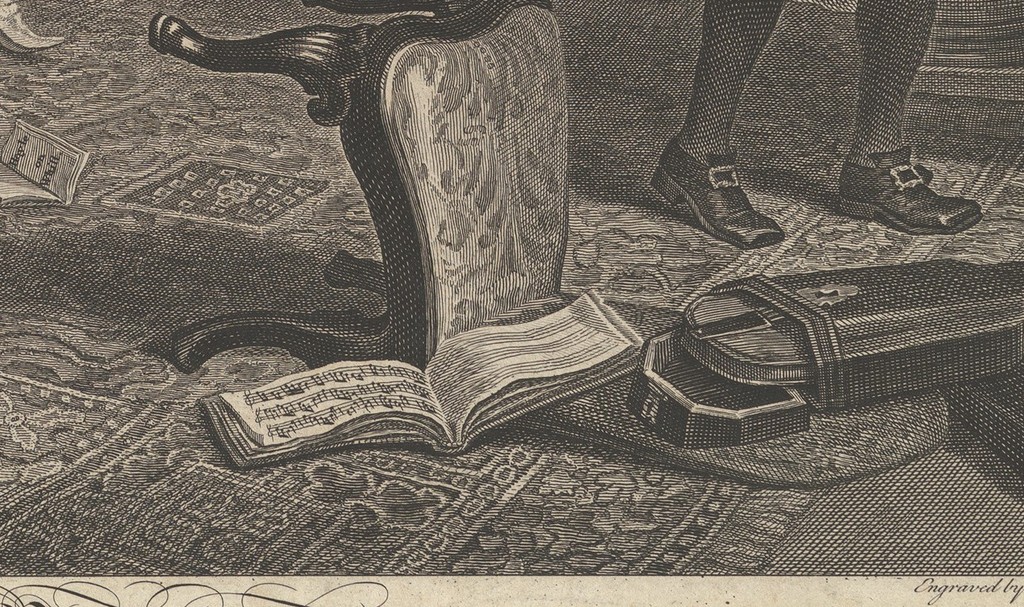
Bernard Baron’s Plate II
A drawing in the Royal Collection records one step between canvas and print. Egerton identifies it as Bernard Baron’s red-chalk rendering of scene two, catalogued by A. P. Oppé as no. 362. It measures 36 × 45.8 cm and is squared for engraving. A grid gives the engraver corresponding points for transferring a design whose original is almost twice as wide. The Metropolitan Museum of Art’s impression of Baron’s Marriage A-la-Mode, Plate II, accession 91.1.108, is an etching and engraving catalogued as the fourth state of four. Its plate measures 38.7 × 47 cm. [2] [9]
In the Met impression the Viscount and dog are on the left, and the steward walks towards the right edge. The reversal brings the viewer from the cap and broken sword across to the man with the bills if the scene is read from left to right. The main divisions of the large room carry over, including the arch that separates the little table from the footman. Smaller details change in legibility. Egerton notes that the head on the fireplace surround is less conspicuous in the engraving and that the notes on the open music book, which form a playable but unidentified tune in the painting, are jumbled in the print. The plate keeps the idea of music in the room, down to showing written notation on the page. [2] [9]
The paper on the spike has its own change. Egerton reads its date on the engraving as 4 June 1744, a more specific date in a later year than the one on the painted receipt. That date belongs to the household’s fiction. Lower down, outside the scene, the publication line gives 1 April 1745. Colonial Williamsburg transcribes that line on a third-state impression, 1967-567,2, where the lettering also credits Hogarth with the invention, painting and publication and Baron with the engraving. The National Gallery records that the prints were ready for subscribers in early June 1745. The receipt, the publication line and the notice of availability each date a different event. [2] [9] [10]
The Viscount next appears in The Inspection, where the mark on his neck connects the drawing-room scene to a visit to a practitioner. There he brandishes a cane, apparently dissatisfied with his treatment. Here his hat stays on and his hands remain in his pockets. Hogarth makes a whole scene out of that inertia. The dog, the steward and even the clock tell us more about the Viscount’s affairs than he appears willing or able to tell his wife. [1] [11]
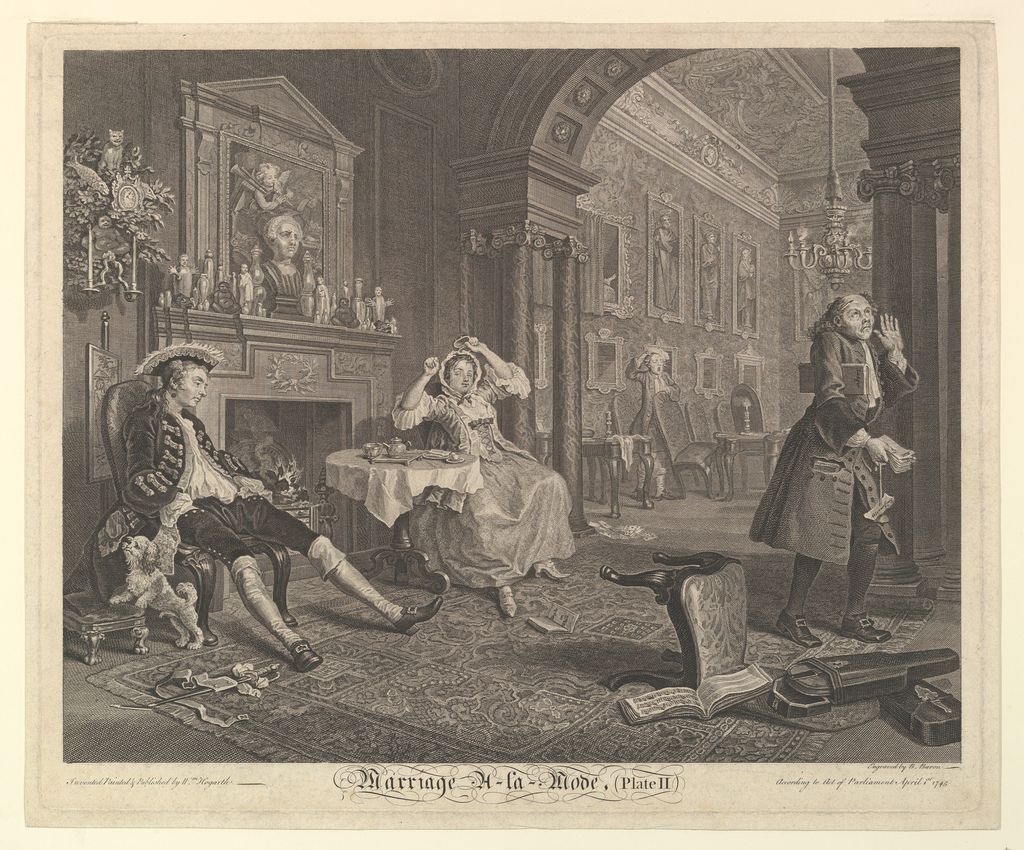
Marriage A-la-Mode, Plate II, Bernard Baron after William Hogarth, dated April 1745. Etching and engraving; fourth state of four. 91.1.108. Gift of Sarah Lazarus, 1891. Image source. CC0 / Public domain.
Browse Hogarth’s artworks
All 54 individual artworks and series stages in the approved English cluster
Frequently Asked Questions
The dog noses a woman’s cap protruding from the Viscount’s pocket while the steward leaves with the household bills. [1]
It is painting 2 of 6 in Marriage A-la-Mode. The National Gallery catalogues the original canvas under that number in the sequence. [1]
Discussion
Look again at the images and ideas explored in The Tête à Tête. These editorial prompts invite your observations.
Reader Insights
How does the clock above the Viscount change the way you read his slumped pose and the breakfast laid across from him?
How does seeing only a bare foot at the edge of the green curtain shape what you imagine about the adjoining room?
Join the Conversation
Share a detail, comparison or question about The Tête à Tête below.
References
- National Gallery, London, William Hogarth, Marriage A-la-Mode: 2, The Tête à Tête, NG114, about 1743. View source.
- Judy Egerton, “Marriage A-la-Mode”, National Gallery Catalogues: The British Paintings, 2000, “Engravings”, “Technical Notes”, Scene 2, pp. 159–162, fig. 6 and notes 108, 110 and 123. View source.
- National Gallery, London, William Hogarth, Marriage A-la-Mode: 1, The Marriage Settlement, NG113, about 1743. View source.
- Jonathan Turner, Telling Timepieces: Representations of the Timepiece within Literature and Visual Culture of the Eighteenth Century, University of Roehampton doctoral thesis, 2018, pp. 145–147. View source.
- Philadelphia Museum of Art, Claude Olivier Gallimard, La Soirée, 1739, collection record 188409. View source.
- Musée du Louvre, Claude Olivier Gallimard after Charles-Nicolas Cochin, La Soirée, L 75 LR/1077 Recto (in French). View source.
- David Bomford and Ashok Roy, “Hogarth’s ‘Marriage à la Mode’”, National Gallery Technical Bulletin 6, 1982, pp. 45–58, especially pp. 51–52 and figs. 6–10. View source.
- Ashok Roy, “Hogarth’s ‘Marriage à la Mode’ and Contemporary Painting Practice”, National Gallery Technical Bulletin 6, 1982, pp. 59–67, “Blue”. View source.
- Metropolitan Museum of Art, Bernard Baron after William Hogarth, Marriage A-la-Mode, Plate II, 91.1.108, fourth state of four. View source.
- Colonial Williamsburg Foundation, Bernard Baron after William Hogarth, Marriage A-la-Mode, Plate II (Early in the Morning or Tête à Tête), 1967-567,2, third state. View source.
- National Gallery, London, William Hogarth, Marriage A-la-Mode: 3, The Inspection, NG115, about 1743. View source.






