


 by Tom Gurney
Tom Gurney BSc (Hons) is an art history expert with over 20 years experience
Published on June 19, 2020 / Updated on October 14, 2023
Email: tomgurney1@gmail.com / Phone: +44 7429 011000
Moll Beats Hemp in Bridewell Prison: Introduction
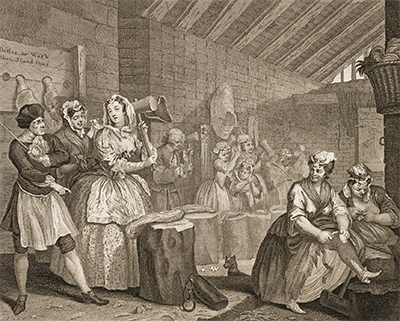
Moll Hackabout holds a mallet above a bundle of hemp. The keeper beside her raises a cane and points down. Behind them a prisoner has both wrists fastened high against a board. In the fourth plate of William Hogarth’s A Harlot’s Progress, a single corner of the room shows what Moll has to do, who can make her do it and what might happen if she stops. The National Galleries of Scotland records its impression, P 6724, as an etching and engraving on paper with a plate mark of 31.2 by 38.7 centimetres. The six-print series was published in 1732. [1] [2] [3]
At a Glance
- SeriesPlate 4 of 6 in A Harlot’s Progress
- First published1732
- MediumEtching and engraving on paper
- Scottish impressionNational Galleries of Scotland, P 6724
- Third-state impressionThe Metropolitan Museum of Art, 91.1.131
This work across William Hogarth’s career
Assembly at Wanstead House
1728–31The Heir
1734The Marriage Settlement
about 1743Gin Lane
1751Canvassing for Votes
1754–55Contents
- A row of beating blocks
- What the clothes still do
- What a house of correction did
- Who gets to write on the wall
- Reading the impressions
- Between the arrest and the sickroom
A row of beating blocks
Hogarth puts Moll near the left edge, where her dress and raised mallet make her easy to pick out. The line of heavy blocks draws the eye from her towards the back of the room. Hemp lies across the nearest block in a pale, twisted bundle, and loose fibres are scattered below. Beating the hemp prepared fibre for making rope. That practical purpose is visible in the way the material is laid out within reach of each worker. The repetition of blocks and mallets also makes clear what the keeper supervises. He can judge how each person is doing by watching the same movement performed down the row. [3] [4]
The man immediately beyond Moll is elaborately dressed, too. A torn playing card near the blocks is the clue that leads Wellcome to read him as a gambler. Hogarth introduces him through something he used outside the prison, then gives him the same implement as Moll. There are people of different ages farther down the row, and some faces are partly hidden by other workers and their tools. The print gives the gambler a readily legible clue to his past and leaves much of the company harder to account for. The common task gathers people whose reasons for being there may differ. [3] [4]
What the clothes still do
Moll’s lace and patterned skirt make her conspicuous in a room of rough masonry, timber and fibre. At her shoulder a woman holds out part of her finery. The Rijksmuseum reads the gesture on its impression as mockery. On the near right, another woman adjusts a garter and displays a pointed, decorated shoe. The older commentary collected under John Ireland and John Nichols identifies her as Moll’s former servant and supposes the shoes were a gift from better days. The shoe and garter can be seen clearly. Their ownership is a matter of interpretation. The composition does give the two incidents a connection. At either end of the row, a woman draws attention to a piece of dress while Moll has both hands occupied. [3] [5] [6]
The combination of rich clothes and hard labour also had a counterpart in print outside Hogarth’s story. Ireland and Nichols reproduce a newspaper item they attribute to the Grub Street Journal in September 1730. In their transcription, Mary Moffat was committed to hard labour at Tothill Fields Bridewell, brought before the Lord Chief Justice on a writ of habeas corpus and sent back when her commitment was found lawful. The item ends with the detail that she was beating hemp in a silver-laced gown. The detail was striking enough to end the newspaper item and, much later, to serve as evidence in a commentary on the print. The connection between Moffat’s case and Hogarth’s invention remains uncertain. [6]
What a house of correction did
The word Bridewell could refer to more than one institution. Wellcome and the Rijksmuseum place Hogarth’s scene at Tothill Fields in Westminster. The City of London had its own Bridewell in a former royal palace by the Fleet. London Lives records that the Westminster house was built in 1618 and enlarged in 1655. A tablet over its gateway advertised work for the poor of St Margaret’s parish and for people described as begging or living idly in Westminster. The gateway inscription belongs to the documented institution. The inscriptions inside Hogarth’s room are part of the image. Both make work a public statement about how the authorities understood their role. [4] [5] [7] [8]
Watch Hogarth’s paintings and prints
Five films on Hogarth’s painted stories, prints, drawing methods and work for the Foundling Hospital.
In 60 seconds: Hogarth's 'Gin Lane' & 'Beer Street'
A short introduction to the contrasting streets, the shops and the people in Hogarth’s paired prints.
Watch on YouTubeThe City Bridewell records give a separate example of what correction could entail. Governors determined punishments, which commonly included whipping or hard labour such as hemp beating. Whippings could take place before the governors and could be seen from a gallery. The same institution also housed boys apprenticed to masters who taught trades such as weaving or shoemaking. For apprentices, work could lead to the freedom of the City on completion of their service. For prisoners at the block, it fulfilled an immediate punishment. Those records help explain the different purposes work could serve in a single institution. They describe the City’s arrangements, while the room in the print has been associated with Westminster. [7] [8]
Who gets to write on the wall
“Better to work than stand thus” appears on the board where the prisoner’s wrists are held. The word “thus” directs the reader to look down from the lettering and see the body in that position. Ireland and Nichols also transcribe “The reward of idleness” on the upright post near the well-dressed man. That second phrase uses the language of reward for a place of punishment. A block with an iron attachment lies on the floor near Moll’s feet. By setting the restraints and their notices among the working tools, Hogarth makes it possible to see how a threat can keep the room at work even when the cane has yet to fall. [3] [4] [6]
The marks towards the back carry a different kind of message. Wellcome records a gallows figure with the letters “Sr JG”, conventionally read as a caricature of Sir John Gonson. The historical Gonson was a Westminster justice who pursued disorderly-house cases, including those associated with the tavern keeper Mary Harvey. The graffiti turns the threat of punishment back on a figure associated with enforcement. Hogarth supplies the little drawing and the letters within the scene, leaving the hand that made them unidentified. The maxims on the prison fittings speak for the people who can order a punishment. The gallows drawing makes one of those people its target. [3] [4] [6] [9]
Reading the impressions
The small cross below the image, near the centre of the lower margin, belongs to a different level of lettering from the signs that the prisoners could read. It appears on the Metropolitan Museum of Art’s 91.1.131, which the museum lists as the third of three states and dates April 1732. The same museum dates its first-state sheet, 32.35(5), before April 1732. A second-state impression in the Museum of Fine Arts, Houston, 2014.907.4, is catalogued with the plate number on the left and Hogarth’s signature on the right. The National Gallery of Victoria explicitly records the cross on its own third-state impression, 1995.354.4, listed as Paulson 124, and describes the plate as reworked in 1744. These dates are catalogue descriptions for particular objects or stages of the plate. The cross alone gives no exact printing date for an individual sheet. [3] [10] [11] [12]
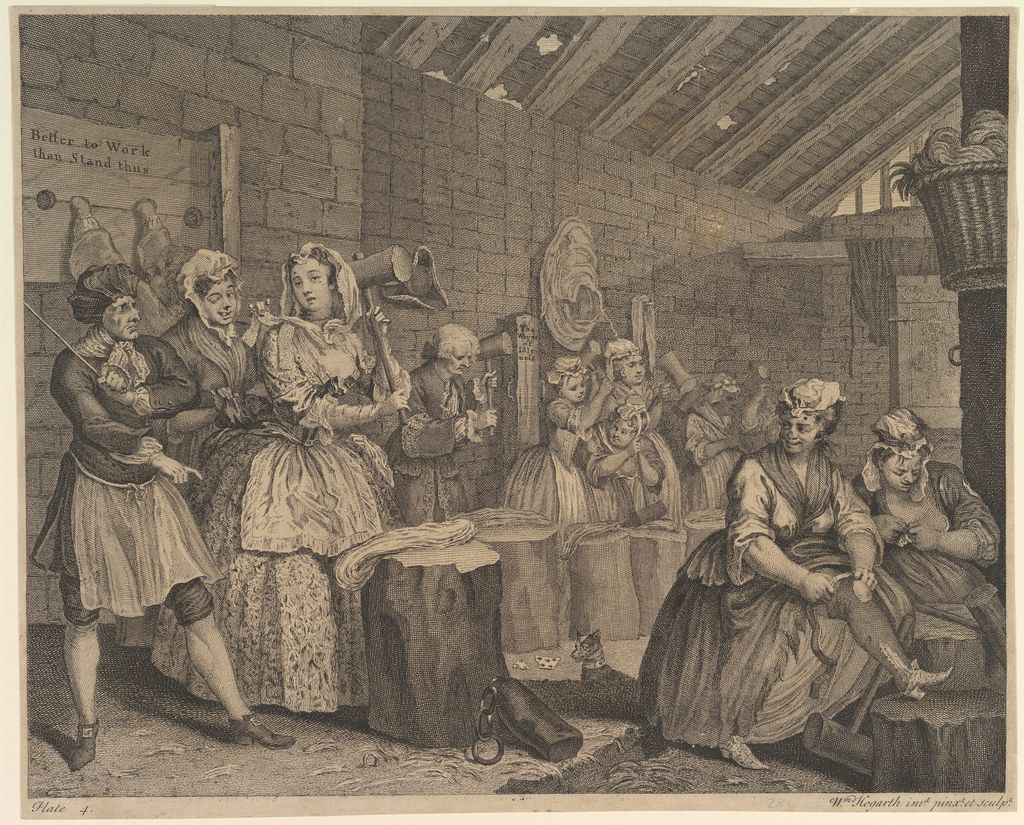
A Harlot's Progress, Plate 4, William Hogarth, before April 1732. Etching and engraving; first state of three. 32.35(5). Harris Brisbane Dick Fund, 1932. Image source. CC0 / Public domain.
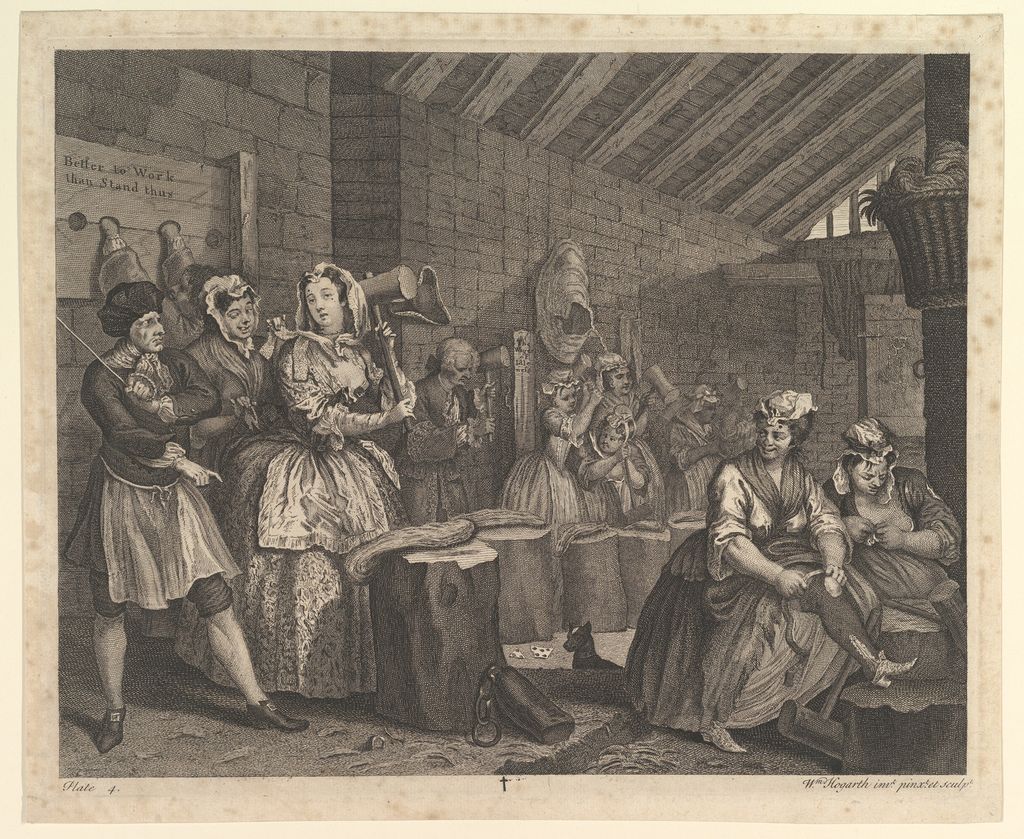
A Harlot's Progress, Plate 4, William Hogarth, April 1732. Etching and engraving; third state of three. 91.1.131. Gift of Sarah Lazarus, 1891. Image source. CC0 / Public domain.
Between the arrest and the sickroom
In Plate 3, Moll holds up a watch as the officers enter her lodging. Hogarth leaves the intervening legal steps out of the sequence. At Bridewell, another object in her hands measures out a different sort of time. Each blow is one in a repeated task, and the keeper is close enough to intervene. In Plate 5 she is back in a room with a bed, where an attendant supports her while the two doctors dispute. The jump from the beating block to the sickroom leaves the duration of her confinement and the circumstances of her release open. [3] [13] [14]
Within the prison scene, the nearest blow is still to come. The mallet gives Moll a task and the cane gives it urgency, while the women attending to garments and the little figure on the gallows pull the eye away from the keeper’s business. The row of blocks lets him impose the same work across the room. The torn card, the lace and the graffiti show how much of the world beyond the prison he has brought in with the people he supervises. [3] [4] [5]
Browse Hogarth’s artworks
All 54 individual artworks and series stages in the approved English cluster
Frequently Asked Questions
It is plate 4 of 6 in A Harlot’s Progress. The plate number identifies the design across impressions. [1]
Discussion
Look again at the images and ideas explored in Moll Beats Hemp in Bridewell Prison. These editorial prompts invite your observations.
Reader Insights
How does the position of the prisoner’s wrists change the way you read the words above them?
What does the gesture towards Moll’s lace add to a scene organised around the beating blocks?
Join the Conversation
Share a detail, comparison or question about Moll Beats Hemp in Bridewell Prison below.
References
- National Galleries of Scotland, A Harlot’s Progress, Plate 4, P 6724. View source.
- Princeton University Library, Sin & the City: William Hogarth’s London, full exhibition checklist, entry for the 1732 series, Paulson 121–126. View source.
- The Metropolitan Museum of Art, A Harlot’s Progress, Plate 4, third state of three, 91.1.131. View source.
- Wellcome Collection, Moll Hackabout, dressed in fine clothes, is beating hemp, 38227i, catalogue description and lettering. View source.
- Rijksmuseum, Moll Hackabout slaat hennep in Bridewell Prison, RP-P-OB-18.758 (in Dutch). View source.
- John Ireland and John Nichols, Hogarth’s Works, with Life and Anecdotal Descriptions of His Pictures, vol. I, Plate IV commentary, pp. 112–114 and note 58. View source.
- London Lives 1690 to 1800, Houses of Correction, sections on offences and punishments and Tothill Fields, Westminster. View source.
- London Lives 1690 to 1800, Bridewell Prison and Hospital, sections on government, apprentices, prisoners and conditions. View source.
- London Lives 1690 to 1800, Mary Harvey, fl. 1727–1733, section on the disorderly-house campaign. View source.
- The Metropolitan Museum of Art, A Harlot’s Progress, Plate 4, first state of three, 32.35(5). View source.
- The Museum of Fine Arts, Houston, A Harlot’s Progress, Plate IV, second state of three, Paulson 124, 2014.907.4. View source.
- National Gallery of Victoria, Scene in Bridewell, second edition, third state of three, Paulson 124 iii/iii, 1995.354.4. View source.
- The Metropolitan Museum of Art, A Harlot’s Progress, Plate 3, 91.1.130. View source.
- The Metropolitan Museum of Art, A Harlot’s Progress, Plate 5, first state of three, 32.35(6). View source.







