


 by Tom Gurney
Tom Gurney BSc (Hons) is an art history expert with over 20 years experience
Published on June 19, 2020 / Updated on October 14, 2023
Email: tomgurney1@gmail.com / Phone: +44 7429 011000
A Harlot’s Progress, Plate 5: Introduction
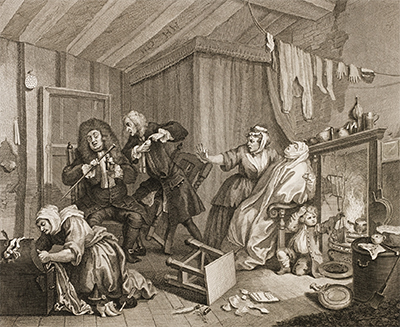
Moll Hackabout sits wrapped in blankets beside a fire while two practitioners quarrel a few feet away. Her head has fallen back and a woman beside her reaches out towards the men, as though asking them to stop and look. In the fifth plate of William Hogarth’s A Harlot’s Progress, Moll appears to be dying of an illness traditionally understood as syphilis. Hogarth gives the people around her competing tasks in a room where only one person appears to offer her immediate help. [1] [2] [3]
At a Glance
- ArtistWilliam Hogarth
- MediumEtching and engraving
- Series publication1732
- First-state impressionDated before April 1732, The Metropolitan Museum of Art, 32.35(6)
- Impression with a cross in the marginReworking dated 1744, National Gallery of Victoria, 1995.354.5
This work across William Hogarth’s career
Assembly at Wanstead House
1728–31The Heir
1734The Marriage Settlement
about 1743Gin Lane
1751Canvassing for Votes
1754–55Contents
- A sickroom around the hearth
- Richard Rock and Jean Misaubin
- The blankets and the remedies
- Reading the print’s lower margin
- From Bridewell to the wake
A sickroom around the hearth
The first-state impression at the Metropolitan Museum of Art sets Moll on the right of the room, upright in an armchair. The pale wrapping catches the eye against the dark bed curtains. Folds gather below her chin and descend almost to the floor, where they hide her feet. The men to the left have room to lean, turn and handle things. Moll’s stillness is clearest beside the movement of the woman who supports her. With her face close to Moll, the woman directs her open palm towards the argument. Her gesture makes it possible to read the two sides of the room together. [1]
At floor level, an overturned piece of furniture and scattered fragments interrupt the space between the chair and the doctors. A woman crouches over an open chest at the left and draws out cloth that trails across her lap. Wellcome and Colonial Williamsburg read her as a woman preparing grave clothes. The chest and the cloth are clear, while her exact business remains a matter of interpretation. If she is preparing for burial, the room is already making arrangements for Moll’s death while competing remedies are still under discussion. The chest holds the crouching woman’s attention even as the attendant stretches out her hand. The two men remain absorbed in their dispute. [1] [3] [4]
A child kneels below the chair arm, with one hand at his head and the other reaching towards the cooking at the fire. Wellcome describes him as probably Moll’s son. The picture leaves that relationship implicit, and the hand at his head gives little basis for a claim about his health. Above him, stockings and gloves hang on a line. Crockery and utensils crowd the hearth. The same fire that warms a dying woman is needed for a meal, and the child keeps up a domestic task in a room where the adults have almost no attention to spare. [1] [3]
Richard Rock and Jean Misaubin
The compact, seated figure is usually identified as Richard Rock and the leaner man standing beside him as Jean, or John, Misaubin. Their different builds make the argument easy to follow even before the viewer knows the proposed names. The seated man’s cane crosses his body on a diagonal, while his opponent bends towards him with his hands raised in front of his chest. Wellcome’s catalogue describes a slip bearing Rock’s name in its impression. There is independent evidence for the vendor’s trade. Wellcome cites a notice in The Craftsman of 24 February 1732/33 advertising his pill for venereal disease. In Hogarth’s 1738 print Morning, a vendor displays a bottle and a placard for Rock’s products in Covent Garden. In the sickroom, the association with a named remedy makes a dispute over treatment look like a contest between sellers. [1] [3] [4] [5]
Misaubin’s case brings a different kind of evidence. The medical historian Barry Hoffbrand traces his admission as a licentiate of the College of Physicians in 1719, after examinations in physiology, pathology and therapeutics. He also documents Misaubin’s trade in pills. Arthur Pond’s 1739 etching after Antoine Watteau gives the physician a long, lean figure and a repeated exhortation to take pills. Henry Fielding’s dedication to Misaubin in The Mock Doctor, a comedy performed in 1732, praises his little pill with the grand claim that it had done more good than Pandora’s box had done harm. The print and the dedication show how readily satirists could turn the product into shorthand for the man. His College licence shows how easily a formally qualified practitioner could become the model for a quack on paper. [6] [7] [8]
Watch Hogarth’s paintings and prints
Five films on Hogarth’s painted stories, prints, drawing methods and work for the Foundling Hospital.
In 60 seconds: Hogarth's 'Gin Lane' & 'Beer Street'
A short introduction to the contrasting streets, the shops and the people in Hogarth’s paired prints.
Watch on YouTubeThe blankets and the remedies
Princeton University Art Museum reads the scene as Moll dying of syphilis and identifies the scattered materials as popular remedies. Wellcome interprets the wrapping and the position by the fire as signs of a sweating treatment. It also identifies what it reads as teeth on the slip bearing Rock’s name in its own impression, and connects loose teeth with mercury, which was used to induce salivation in the treatment of venereal disease. In the image, the blanket is what first draws the eye to Moll. The signs of remedies, by comparison, take some searching amid the debris and household utensils. That difference in scale helps explain how the room can be read immediately as a scene of dying and more slowly as a satire on the means proposed to prevent it. [1] [2] [3]
Those clues support a reading of the illness within the story. The artist leaves the course of Moll’s illness between scenes, and the room gives no secure way to assign a particular medicine to either man’s gestures or to tell whether illness, attempted treatment or both have brought her to this point. The crowd of objects gives the impression that plenty has been tried. The disagreement shows how little of the practitioners’ attention is available to Moll as they argue. The support of the chair and the hand at her shoulder are two of the few things in the room whose use is immediately clear. [1] [2] [3]
Reading the print’s lower margin
Hogarth’s lower margin on the first-state sheet has the plate number at the left and a credit at the right that records him as designer, painter and engraver. Princeton University Library’s exhibition checklist dates the complete printed sequence to 1732. The Metropolitan Museum of Art dates its first-state etching and engraving, 32.35(6), to before April 1732. The museum separately lists 91.1.132 as the third of three states and dates it April 1732. Wellcome identifies the design as number 125 in the 1989 third edition of Ronald Paulson’s catalogue. A state describes a version of the printing plate. Individual impressions are the sheets printed from it. [1] [3] [9] [10]
The National Gallery of Victoria records a small cross in the lower centre of its impression, 1995.354.5. The same space is blank on the Met’s first state. A viewer comparing the sheets can find the difference by following the lower edge of the image from the plate number towards Hogarth’s credit. The Melbourne catalogue dates the reworking to 1744 and calls its impression the fourth of four states. State totals vary between these records, so the mark in the margin and the accession number are firmer guides to the sheets being compared. [1] [10] [11]
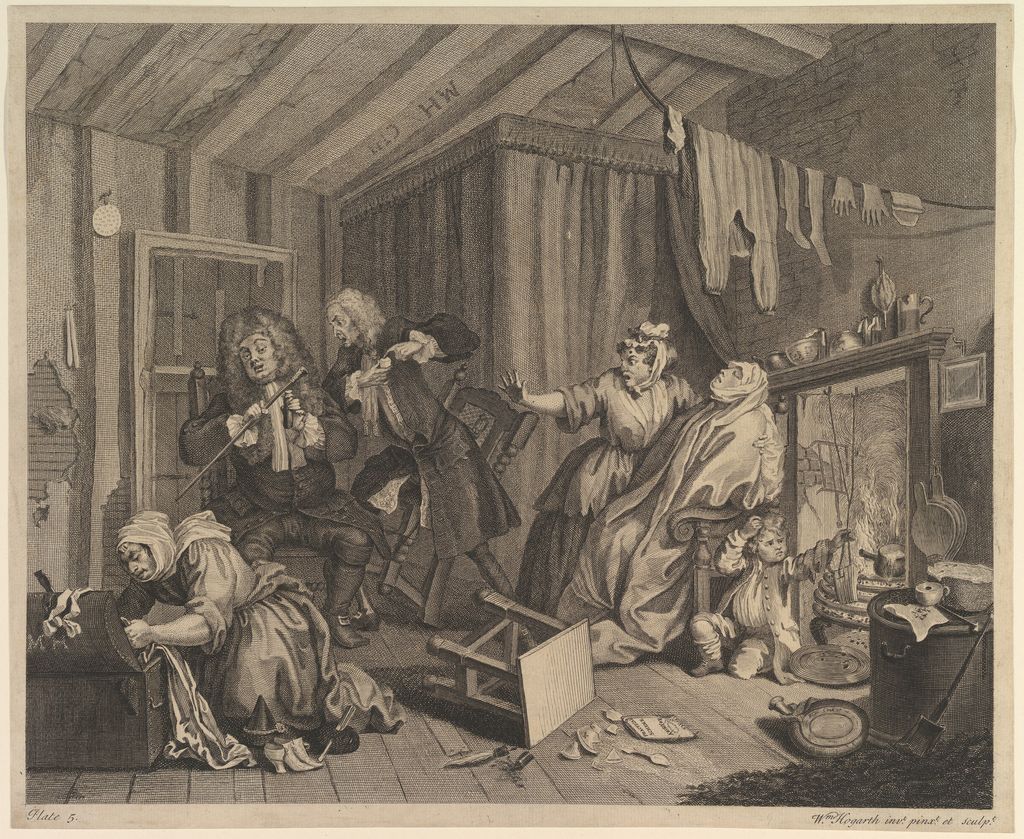
A Harlot's Progress, Plate 5, William Hogarth, before April 1732. Etching and engraving; first state of three. 32.35(6). Harris Brisbane Dick Fund, 1932. Image source. CC0 / Public domain.
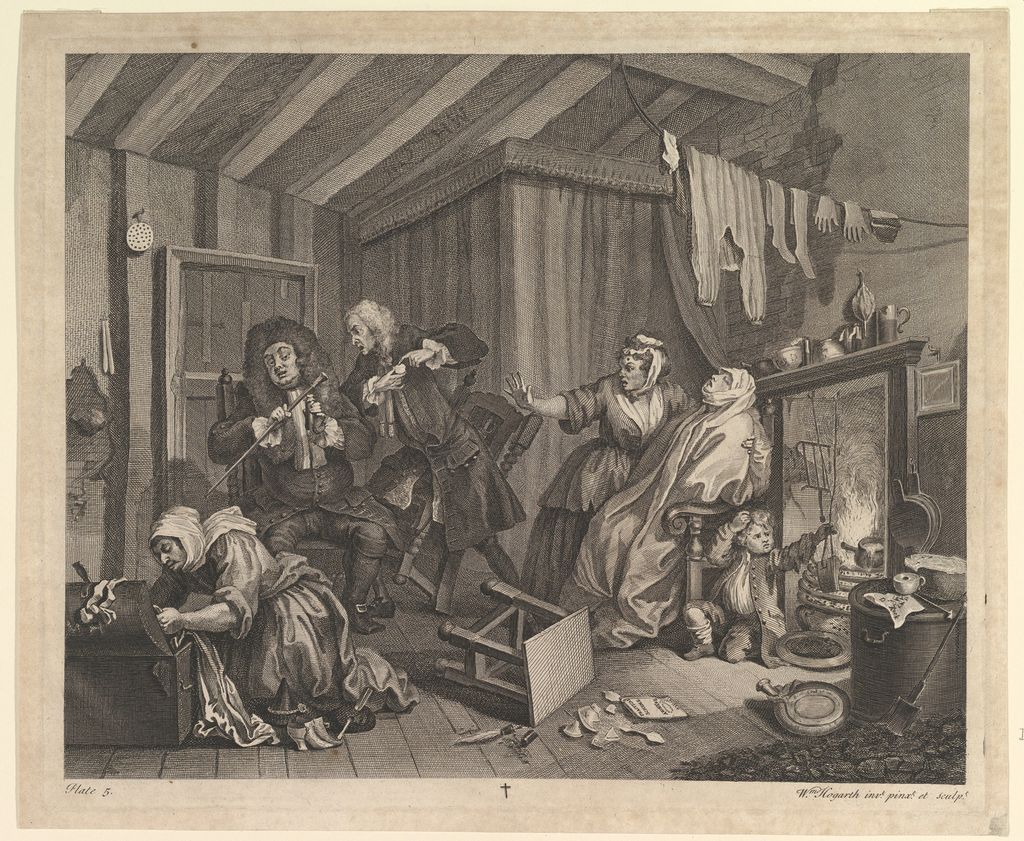
A Harlot's Progress, Plate 5, William Hogarth, April 1732. Etching and engraving; third state of three. 91.1.132. Gift of Sarah Lazarus, 1891. Image source. CC0 / Public domain.
From Bridewell to the wake
In Plate 4, at Bridewell, Moll stands at a block with a mallet while a keeper directs her to the work. Her dress distinguishes her from some of the people around her, though she is subject to the same demand for labour. The folds of her skirt spread beside the block. In Plate 5 she stays in the chair and the most forceful gestures belong to other people. In the sickroom heavy folds settle across her knees, while finer fabric passes through another woman’s hands. Hogarth makes the change in Moll’s circumstances legible through posture and the movement of fabric without filling in the time between prison and illness. [1] [4] [12]
In Plate 6, Moll’s wake, the coffin stretches across the centre of another crowded room, with a child close to it in the foreground. In the sickroom the child has the fire to attend to, and Moll’s attendant can still brace her body and raise a hand on her behalf. By the wake, the people near her coffin can turn their attention to drink, mourning clothes or each other. The sickroom already contains that dispersal of attention in the woman at the chest and the men engrossed in their dispute. What remains possible here is a simple, visible act of care, performed for as long as the woman can keep Moll upright. [1] [13]
Browse Hogarth’s artworks
All 54 individual artworks and series stages in the approved English cluster
Frequently Asked Questions
It is plate 5 of 6 in A Harlot’s Progress. The plate number identifies the design across impressions. [1]
Discussion
Look again at the images and ideas explored in A Harlot’s Progress, Plate 5. These editorial prompts invite your observations.
Reader Insights
How does the attendant’s outstretched hand change the way you read the doctors’ quarrel?
What can the small cross in the lower margin tell you about which impression you are looking at?
Join the Conversation
Share a detail, comparison or question about A Harlot’s Progress, Plate 5 below.
References
- The Metropolitan Museum of Art, William Hogarth, A Harlot’s Progress, Plate 5, 32.35(6), first state of three. View source.
- Princeton University Art Museum, William Hogarth, A Harlot’s Progress, Plate 5, x1988-25. View source.
- Wellcome Collection, William Hogarth, A Harlot’s Progress, Plate 5, 38228i, citing Ronald Paulson, Hogarth’s Graphic Works, 3rd ed., 1989, no. 125. View source.
- Colonial Williamsburg Foundation, William Hogarth, A Harlot’s Progress: Plate 5, 1951-84, catalogued as 1734. View source.
- Wellcome Collection, William Hogarth, The Four Times of the Day: Morning, 1738 engraving, Covent Garden detail, 20634i. View source.
- Barry Hoffbrand, “John Misaubin, Hogarth’s quack: a case for rehabilitation,” Journal of the Royal Society of Medicine 94, 2001, pp. 143–147, especially pp. 143–145. View source.
- Wellcome Collection, Arthur Pond after Antoine Watteau, John Misaubin, 1739, 6944i (lettering in French). View source.
- Henry Fielding, The Mock-Doctor, dedication to Dr John Misaubin, transcribed on Wikisource. View source.
- Princeton University Library, Sin & the City, full exhibition checklist, entry for A Harlot’s Progress, 1732. View source.
- The Metropolitan Museum of Art, William Hogarth, A Harlot’s Progress, Plate 5, 91.1.132, third state of three. View source.
- National Gallery of Victoria, William Hogarth, She expires, while the doctors are quarrelling, Plate 5, 1995.354.5. View source.
- The Metropolitan Museum of Art, William Hogarth, A Harlot’s Progress, Plate 4, 91.1.131. View source.
- The Metropolitan Museum of Art, William Hogarth, A Harlot’s Progress, Plate 6, 91.1.133. View source.







