



 by Tom Gurney
Tom Gurney BSc (Hons) is an art history expert with over 20 years experience
Published on June 19, 2020 / Updated on October 14, 2023
Email: tomgurney1@gmail.com / Phone: +44 7429 011000
Beer Street by William Hogarth: Introduction
In William Hogarth’s Beer Street, a man hoists a joint of meat as casually as he raises his tankard. Above him a sign painter balances on a ladder, and across the street workers haul a barrel to an upper storey. A different sort of lifting takes place at the house on the right. There a boy reaches up to pass a drink through a small opening in the pawnbroker’s door. The building is cracked, its upper window is boarded across, and a long timber props up the front. In this bustling neighbourhood, the business whose sign promises a loan is the one that looks closest to collapse. [1] [2]
Hogarth first issued this etched and engraved view of London in February 1751. The meat, the drink and the patched-up pawnshop all appear in the British Museum’s revised impression 1880,1113.4473 and in the Metropolitan Museum of Art’s impression 91.1.141. In an earlier impression a thin Frenchman hangs in the air where the joint would later appear. One change to the copperplate turned a joke at a stranger’s expense into a display of plentiful food and opened space for an embracing couple. The figures who carry goods, sell fish and work on buildings still give the street its rhythm. [1] [2] [3]
At a Glance
- ArtistWilliam Hogarth
- AdvertisedFebruary 1751
- MediumEtching and engraving
- CompanionGin Lane
This work across William Hogarth’s career
Assembly at Wanstead House
1728–31The Heir
1734The Marriage Settlement
about 1743Gin Lane
1751Canvassing for Votes
1754–55Contents
- Work at street level and above
- What the street reads
- The man who became a joint of meat
- When the prints appeared
Work at street level and above
Look past the crowd to the roof of the scaffolded building. Several men have gathered near the top of a ladder that runs up the roof. One raises a mug, another lifts a hat, and a flag flies near the steeple beyond them. In the attic opposite, tailors sit together around their work. A man at an open upper window attends to a hoist, with a barrel hanging below. The paving, the timber scaffolding and the rope on the hoist explain how the street is built and supplied. Beer marks the pause that these different trades can take in the course of doing their work. Tonkovich places the scene in the vicinity of St Martin-in-the-Fields. The flag and the roofers’ gestures have also been read as signs of a royal birthday celebration. John Trusler’s early account treats the birthday as a supposition based on the flag. [1] [2] [3] [4]
The same coordination carries through the middle distance. Two chairmen wait at the poles of a sedan chair, with a passenger visible through its opening. Nearby a paviour bends so low that his back nearly follows the angle of the street’s perspective. Hogarth shows how much work is required to move around this quarter. Its goods need hoisting, its paving needs hands at ground level, and a well-dressed passenger depends on the men at either end of the poles. The chair and the suspended barrel give conspicuous places to the exertion of people who might pass unnoticed in a grander view of the city. [1] [2]
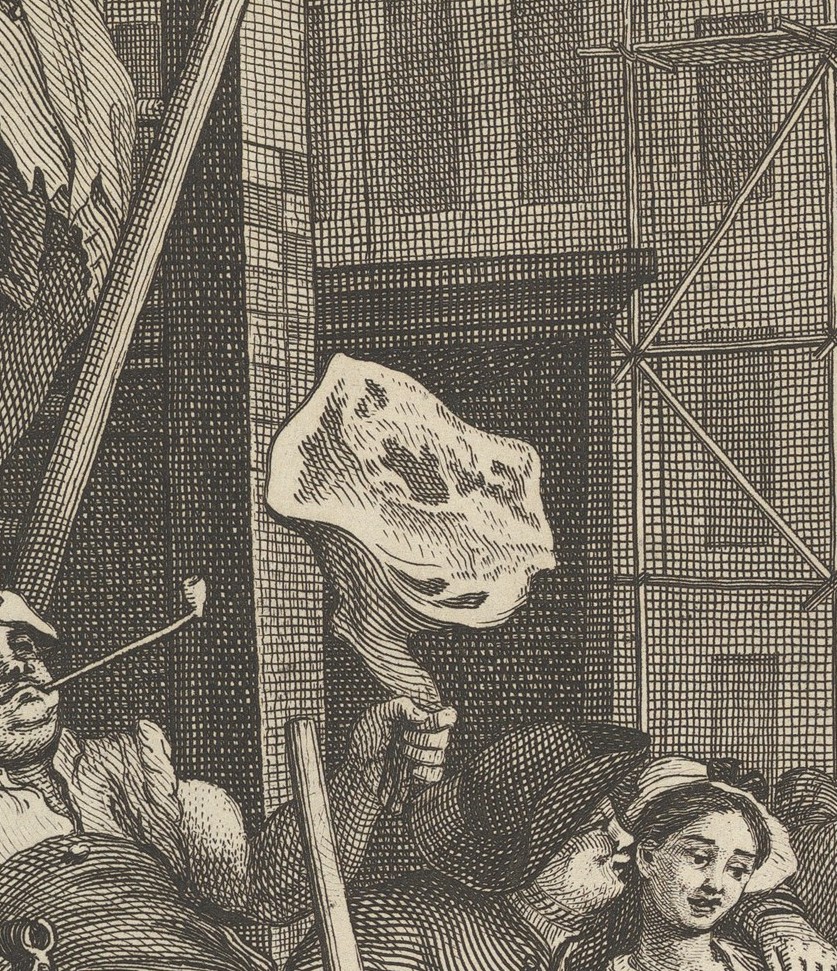
At the tavern table, that exertion gives way to the comic breadth of two well-fed men. The figure with the pipe lifts the joint while holding up his foaming drink. A pair of pincers hangs against his apron. Beside him, the reclining man rests his hand against his coat and has a tool suspended at his side. Tonkovich identifies the lifter in the earlier design as a blacksmith and his companion as a butcher. The British Museum describes a butcher lifting the meat in its revised impression. The pincers and the change in the thing being lifted help explain why the same figure has drawn more than one occupational label. His pose is the much clearer point of continuity. Hogarth made both versions depend on the ease with which he seems to manage something heavy. [1] [2] [3]
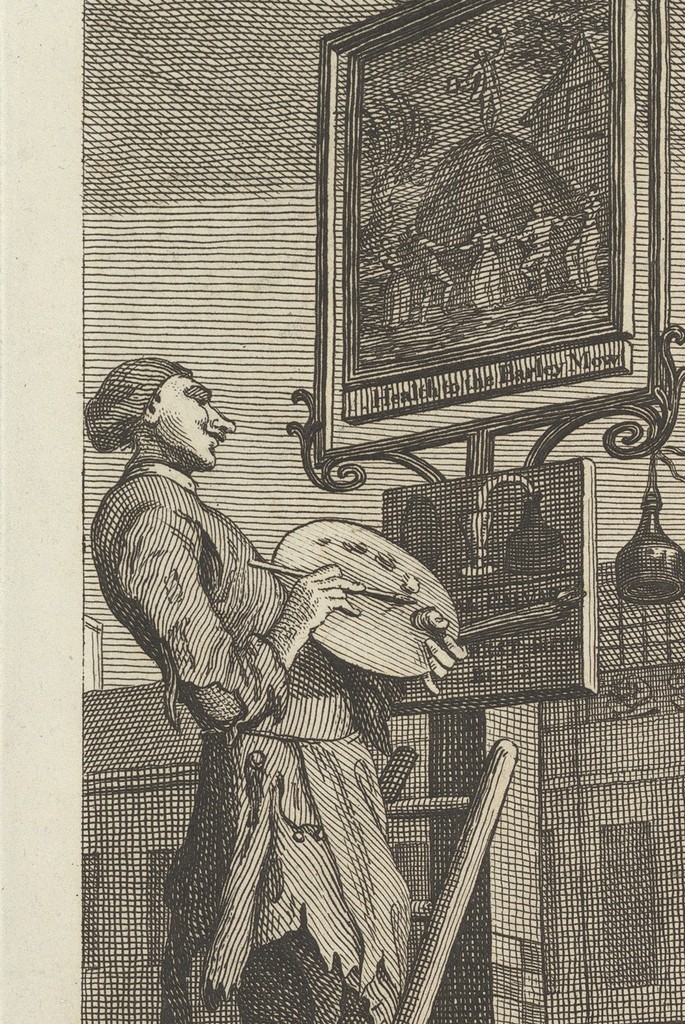
The sign painter makes that confidence more complicated. His clothes hang in strips, and his narrow frame rises above the drinkers’ rounded bodies. He holds a brush and palette beside a small sign with a bottle hanging close at hand, below the larger painted sign. The arrangement makes his task legible even at a glance. Someone has paid for an advertisement, and its maker looks as if he has little to spare. The tavern can afford his work and the street has a taste for his subject. His coat leaves room for a joke about what a painter earns from such a flourishing trade. [1] [2] [3] [4]
What the street reads
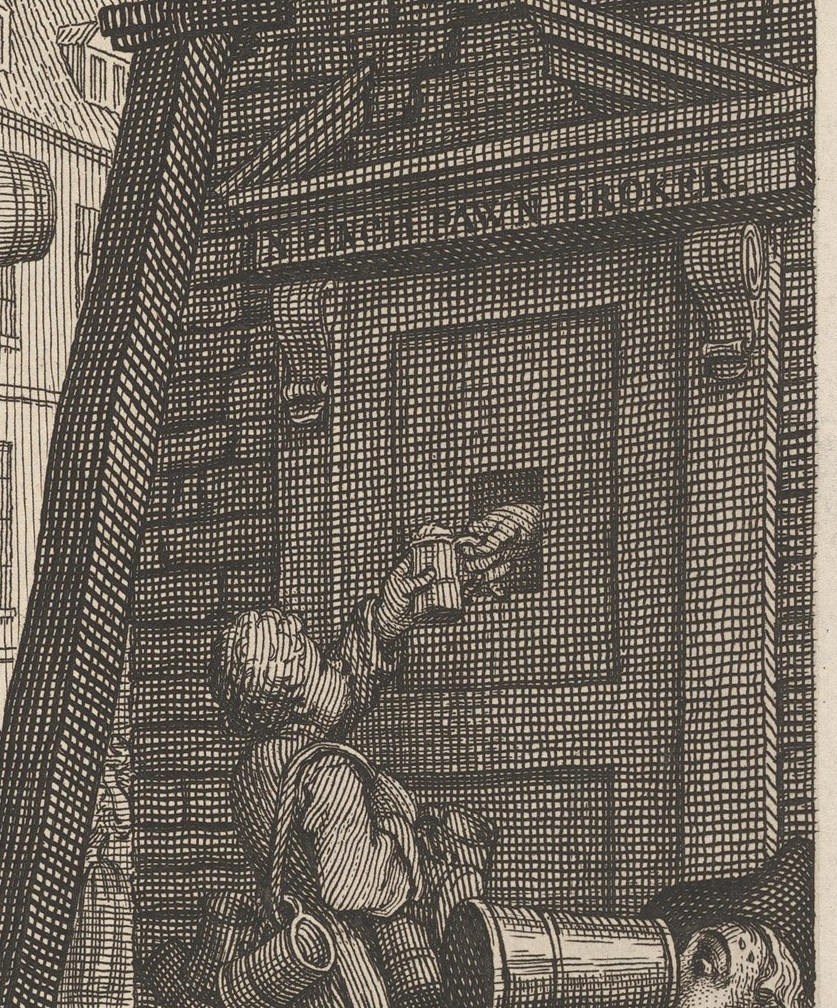
Above the painter is the invitation to drink to the Barley Mow, a stack of harvested barley. Opposite it, three suspended balls advertise the pawnbroker. His name, N. Pinch, is on the strip above the door. The traders can presumably recognise both types of business at a distance, before the lettering is legible. The print reader is free to approach more slowly. The pole of the pawnshop sign tilts over an entrance with no customers waiting. The boy carries mugs and reaches towards a hand at the wicket. The one exchange at the door is a drink being passed inside. The shop’s empty threshold answers the crowded space beneath the tavern signs. [1] [2] [5]
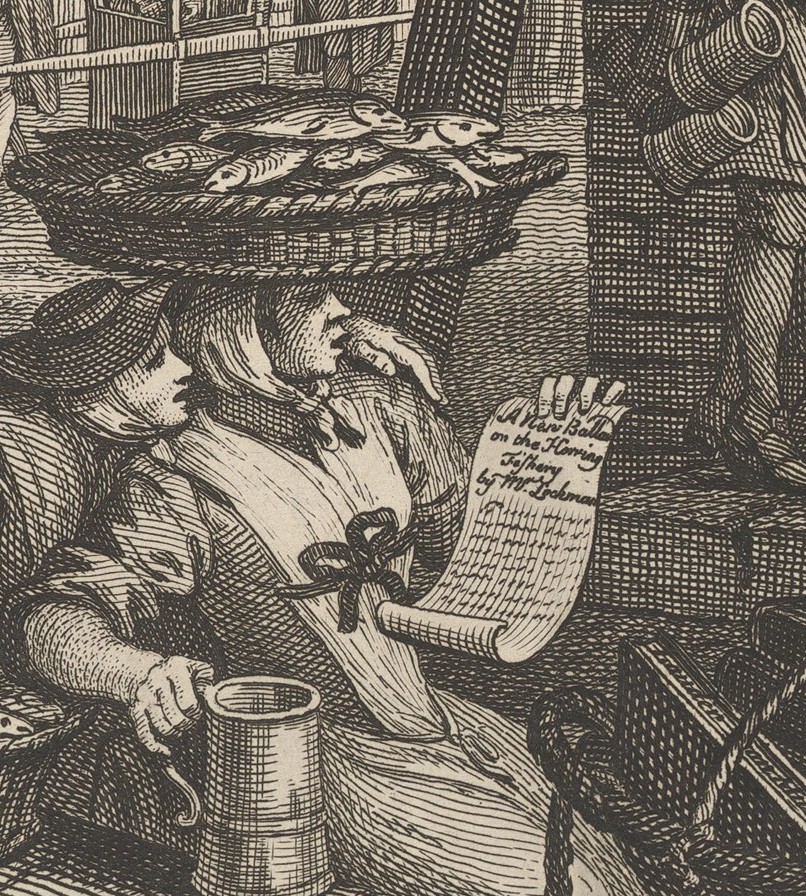
The foreground fish sellers make a different use of lettering. One has a wide basket balanced above her head and holds a printed ballad out in front of her. The other leans in to follow, with a second basket of fish close to hand. The page identifies the song as a new ballad on the herring fishery by Mr Lockman. John Lockman published a herring song in 1750 under the title Britannia’s Gold-Mine. Its title page names performances at Drapers’ Hall and Merchant Taylors’ Hall. That year George II granted a charter to the Society of the Free British Fishery, with powers to make rules for improving and regulating the industry. The fish sellers thus have reason to take an interest in the subject on their sheet. Hogarth puts a celebration of the trade in the hands of people who have brought its catch to market. [2] [5] [6] [7]
The papers at the men’s table include the Daily Advertiser and a speech by George II to both houses of Parliament dated 29 November 1748. The portion Hogarth makes legible calls for the advancement of commerce and the cultivation of peace. Its words have immediate counterparts in the barrels, fish, customers and work under way up the street. The date on the speech belongs to the paper lying on the table, while the publication line below the engraving belongs to the print. The speech has been brought into a scene in which commerce is visible from several stations at once, from the woman’s fish basket to the hoist over the warehouse window. [2] [4] [5]
A third bundle of print is strapped into the porter’s basket in the lower right. Spine titles include Modern Tragedies, a work on ancient painting associated with Turnbull, and Politicks in an absurd volume 9999. The tag directs the basket to a trunk maker in St Paul’s Churchyard. Trusler saw the books as waste paper destined for the tradesman. A fish seller can use a ballad, a public speech can be read over a drink, and a pile of weighty folios can find its next use in a workshop. Their titles make the consignment funny, but the address on the tag delivers the joke. The reader must look much closer than the drinkers do. [1] [2] [4] [5]
Watch Hogarth’s paintings and prints
Five films on Hogarth’s painted stories, prints, drawing methods and work for the Foundling Hospital.
In 60 seconds: Hogarth's 'Gin Lane' & 'Beer Street'
A short introduction to the contrasting streets, the shops and the people in Hogarth’s paired prints.
Watch on YouTubeThe lines below the scene, attributed to the Reverend James Townley, ask for a different kind of reading. They credit beer with restoring strength after labour, helping labour and art to advance, and cheering an English heart with liberty and love. The verse likens beer to the “Cup of Jove” and quips that the English will leave water to France. In the picture, the ragged painter and the solitary hand at the pawnshop have awkward places in this glowing account. A boy does a kindness to a man whose misfortune serves the print’s larger argument. The verse can praise a community in full voice while Hogarth keeps those small disparities in view. [2] [3] [8]
Annotated Details from Beer Street
Use the numbered points to explore this impression. Beer Street, William Hogarth. The Metropolitan Museum of Art, 91.1.141. Collection record.
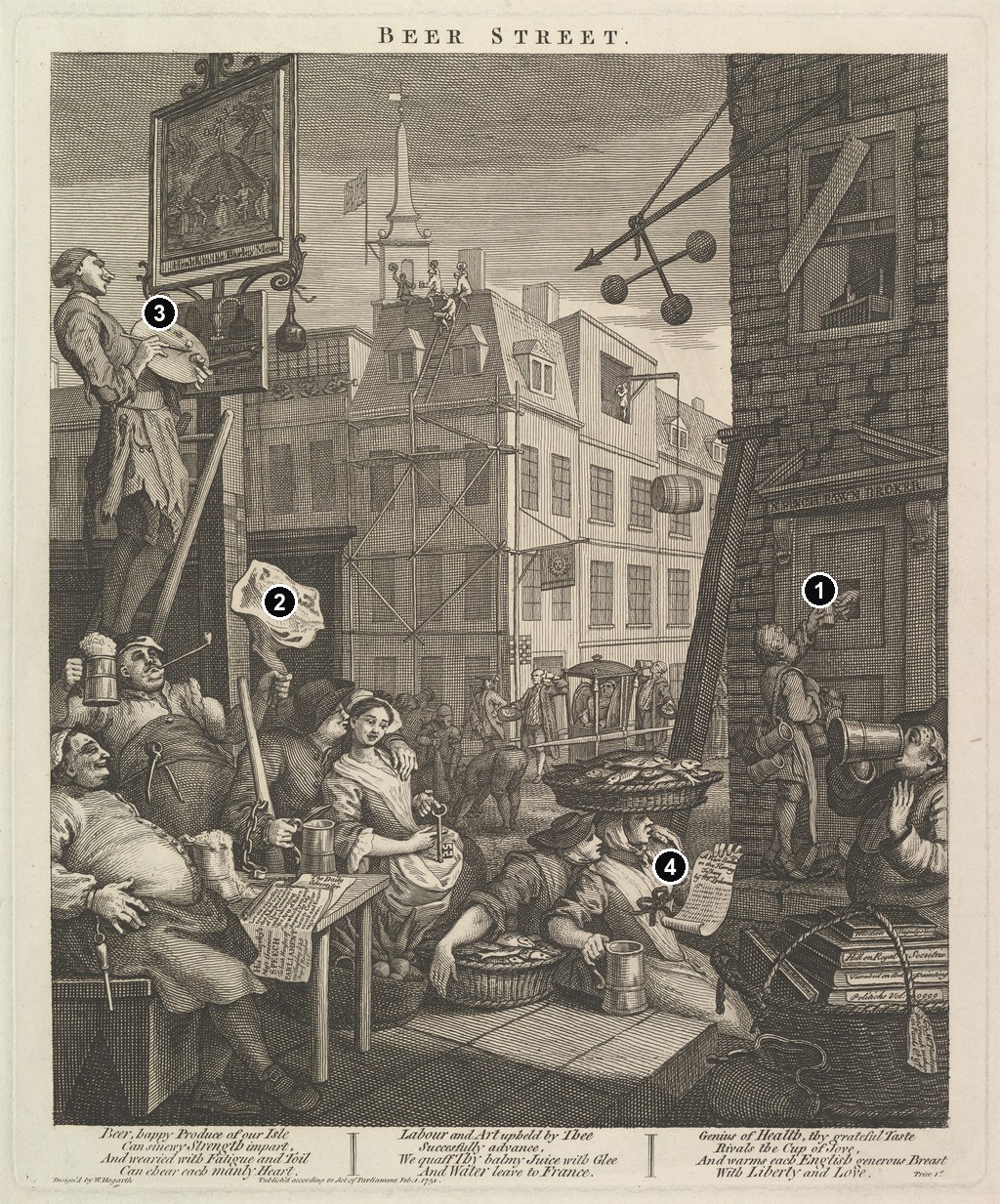
Details from BEER STREET
Select a numbered point for a closer look.
The pawnbroker’s door
A boy reaches toward a hand at the wicket. The pawnshop needs a timber prop, and the three-ball sign hangs over an empty entrance. Compare the people waiting to pawn goods in Gin Lane.
The raised joint
One of the drinkers lifts a joint of meat. In an earlier impression the same raised arm holds a small Frenchman. The figure and the meat belong to different versions of the copperplate.
The sign painter
The painter balances on a ladder beside the Barley Mow sign. His worn clothes and narrow frame stand out above the broad figures at the tavern table.
The herring ballad
The fish sellers read a ballad advertising the herring fishery. The sheet brings a national commercial project into contact with the women who carry its catch.
The man who became a joint of meat
The Morgan Library & Museum’s red-chalk drawing, III, 37, shows the pawnshop on the left and the tavern on the right. The painter lifts his hat, a cobbler sits beside a pile of shoes, and the main group at the tavern is occupied with pipes, beer and reading. Near the middle of the drawing, just above and to the right of the sedan chair, a hand seems to wave from empty space. There is a scrap of a bundle above it. Tonkovich connects these fragments with a now-missing paper overlay on which Hogarth drew the body of the Frenchman. Some strokes ran past the edge of the overlay and remained on the underlying sheet when the extra paper was removed. The fish seller’s lightly redrawn arm gives another indication of how the new figure encroached on its neighbours. [3] [9]
The Morgan records the drawing as incised with a stylus and rubbed with red chalk on the back. A point pressed along the drawn outlines could push pigment from the back onto another surface. Under light cast across the sheet at a shallow angle, Tonkovich and colleagues could see which passages had been traced and which stayed undisturbed beneath the missing paper. Traced lines around the isolated hand and the sun sign contrast with areas lacking those indentations. Tonkovich finds clues to a second overlay near the cobbler, where stray strokes and pinholes help explain the substitutions on the way to the print. The faint red-chalk sedan and its carriers were also strengthened in graphite, and that small passage preserves unusually clear evidence of chalk having transferred from the back. The marks show how Hogarth could revise a local group while keeping the surrounding buildings in place. [3] [9]
A surviving trial proof reproduced by Tonkovich already has the Frenchman but leaves details unresolved, including lettering on the papers and shading in his costume. In the British Museum’s published Frenchman impression, S,2.119, he wears a dark coat, has one hand flung open and dangles above the street with one foot near the table. His tied bundle angles across his shoulders. The sign painter has acquired his ragged coat, and the books have arrived in the basket beside the drinking porter where the cobbler sat in the mirrored drawing. Reading the drawing against the two printed stages reveals decisions about what to do with the spaces around the raised figure, as well as what to make of him. [3] [9] [10]
Compare S,2.119 with 1880,1113.4473. The bulky figure at the left still raises his drink and extends his other arm into the picture. The joint now takes up a much smaller patch of the street. Below it, the man in a dark cap slips an arm over the young woman’s shoulder and leans so close that his face nearly touches her cheek. She displays a large key above her lap. At their feet a basket of vegetables adds another kind of produce to the fish and meat around them. The brush, palette and rags of the sign painter persist in both impressions, while more of the space behind the foreground figures by the ladder is darkened and enclosed in the revised sheet. The woman’s key and her companion’s long implement have suggested a housemaid and a paviour. Their jobs are less certain than the posture of the couple, whose intimacy changes the tone of the joke in this corner. [1] [2] [3] [10] [11]
Making that change on copper took more than cutting fresh lines. The dark Frenchman and his bundle comprised deep, dense work that had to be burnished away. Examining Hogarth’s surviving copperplate, Tonkovich found the reworked area thinner and explains that the metal had to be worked from behind to raise the surface for engraving again. She also identifies the man’s bent sleeve and cuff as the basis for the shape of the new joint. The rest of the street could still be printed from the same plate. On the copper the pawnshop sits on the left and the title reads backwards. The Met’s paper impression puts the pawnshop on the right, as does the Rijksmuseum’s sheet RP-P-OB-18.791. On paper the tavern scene and its new couple therefore sit to the left. [1] [2] [3] [12] [13]
There is a precedent for the nationalist joke in Hogarth’s Gate of Calais, in which a great English joint of beef belongs to a scene of French appetite and deprivation. The precise kind of meat held up in Beer Street is disputed. The connection comes from the conspicuous abundance of the joint, and from a verse that still makes France the butt of a joke even after the Frenchman has gone. The revision makes the national contrast less explicit within the scene itself. Tonkovich links the changes tentatively with a notice for the pair in the Public Advertiser on 13 December 1759 and considers whether Anglo-French hostilities could have influenced the timing. The notice attests to renewed advertising, while the sheets and copper establish the change itself. [2] [3] [10] [11] [14]
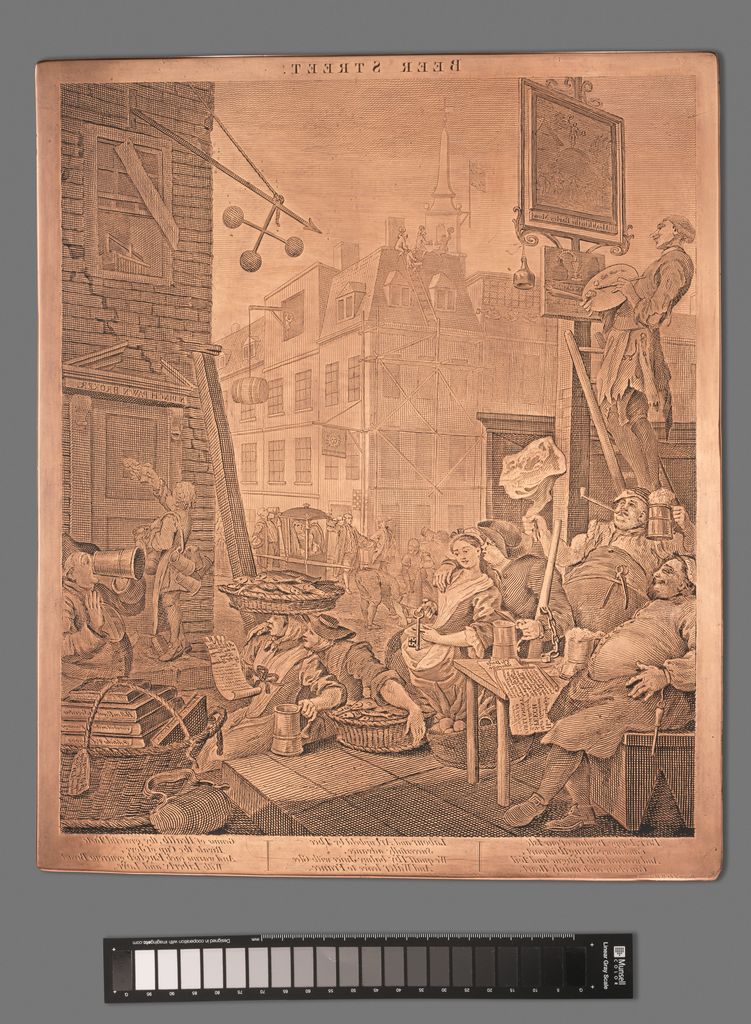
Beer Street, William Hogarth, 1751. Engraved copper plate. 21.55.2. Rogers Fund, 1921. Image source. CC0 / Public domain.
When the prints appeared
Below the verse, the Met impression names Hogarth as designer, carries a publication line dated 1 February 1751 and gives a price of one shilling. Hogarth announced both prints in the London Evening Post of 14–16 February at a shilling each, with a proposed better-printed issue at a shilling and sixpence. The catalogue for a later Morgan album records the same engraved publication date on its impression, although the museum dates the compilation to 1781 or later and associates the impressions with reissues by Hogarth’s widow. The dated line could travel with the picture long after its first sale. The figure at the tavern table provides a quicker way to recognise a major change in the design than the February date by itself. [2] [3] [8]
The companion print Gin Lane also brings a pawnshop close to the viewer. The guide to Beer Street and Gin Lane sets the two trades side by side and traces the public campaign in which Hogarth sold the sheets. The three-ball signs are easy landmarks when moving between the two sheets. [1] [15]
Browse Hogarth’s artworks
All 54 individual artworks and series stages in the approved English cluster
Frequently Asked Questions
Discussion
Look again at the images and ideas explored in Beer Street by William Hogarth. These editorial prompts invite your observations.
Reader Insights
Does the ragged sign painter change how prosperous the street looks to you?
What happens to the joke when the lifted Frenchman becomes a joint of meat?
Join the Conversation
Share a detail, comparison or question about Beer Street by William Hogarth below.
References
- British Museum, William Hogarth, Beer Street, etching and engraving, 1880,1113.4473, Paulson 185 IV. View source.
- Metropolitan Museum of Art, William Hogarth, Beer Street, etching and engraving, 91.1.141, catalogued as third state of three. View source.
- Jennifer Tonkovich, “Hogarth and the Making of Beer Street and Gin Lane,” Master Drawings 60, no. 2 (2022), pp. 201–218, especially pp. 202–204 and 206–213, figs. 3, 11–20 and nn. 23–29. View source.
- John Trusler, “Beer-Street and Gin-Lane,” Hogarth Moralized, first collected edition 1768, here in the London 1831 edition, pp. 146–149. View source.
- Hessen Kassel Heritage, William Hogarth, Beer Street, GS 20352, fol. 56, etched and engraved impression and transcription of lettering. View source.
- John Lockman, Britannia’s Gold-Mine, or, the Herring-Fishery for Ever, London, 1750, title page as catalogued by Wellcome Collection. View source.
- Society of the Free British Fishery, His Majesty’s Royal Charter, Granted on the Eleventh Day of October 1750, Edinburgh, 1751, title page as catalogued by Wellcome Collection. View source.
- Morgan Library & Museum, William Hogarth, Beer Street, PML 146852.20, impression in the Gordon N. Ray album, catalogue notes on the verse, publication line and reissue. View source.
- Morgan Library & Museum, William Hogarth, Beer Street, preparatory drawing, III, 37, 1750–51. View source.
- British Museum, William Hogarth, Beer Street, early Frenchman impression, S,2.119. View source.
- Peter Wagner, “‘Official Discourse’ in Hogarth’s Prints,” in Reading Iconotexts: From Swift to the French Revolution, Reaktion Books, 1995, pp. 101–137, discussion of the two Beer Street designs. View source.
- Metropolitan Museum of Art, William Hogarth, Beer Street, engraved copperplate, 21.55.2. View source.
- Rijksmuseum, William Hogarth, Beer Street, paper impression RP-P-OB-18.791. View source.
- Fitzwilliam Museum, William Hogarth and Charles Mosley, The Roast Beef of Old England &c. or The Gate of Calais, exhibition catalogue entry and illustrated print. View source.
- National Gallery of Art, William Hogarth, Gin Lane, etching and engraving, 1944.5.87. View source.






