


 by Tom Gurney
Tom Gurney BSc (Hons) is an art history expert with over 20 years experience
Published on June 19, 2020 / Updated on October 14, 2023
Email: tomgurney1@gmail.com / Phone: +44 7429 011000
Cruelty in Perfection: Introduction
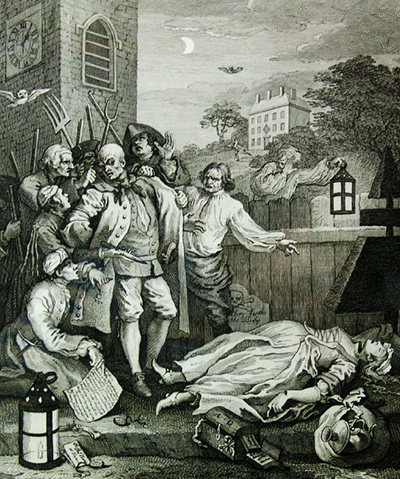
The killing has already happened when William Hogarth opens Cruelty in Perfection. Ann Gill lies in the foreground of a churchyard scene. A lantern lights the ground around her, and several people hold Tom Nero. Both are characters in Hogarth’s fictional story. To learn who Ann was and why she came, the viewer has to look past the struggling figures and read a letter within the picture. It records a meeting that she expected Nero to keep. The third print of The Four Stages of Cruelty turns on the distance between what she expected and what the people in the churchyard find. The Metropolitan Museum of Art’s impression, 91.1.138, is an etching and engraving. The plate bears the date 1 February 1751. [1] [2] [3]
At a Glance
- Place in the seriesThird of The Four Stages of Cruelty
- Etching and engravingWilliam Hogarth, dated 1 February 1751 on the plate, The Metropolitan Museum of Art, 91.1.138
- Preparatory drawingRed chalk with graphite, dated 1750–51 by The Morgan Library & Museum, III, 32d
- WoodcutJohn Bell after William Hogarth, Boydell and Co., dated 1790 by The Metropolitan Museum of Art, 21.72(2)
This work across William Hogarth’s career
Assembly at Wanstead House
1728–31The Heir
1734The Marriage Settlement
about 1743Gin Lane
1751Canvassing for Votes
1754–55Contents
- What the lantern reveals
- Ann Gill’s letter and the books beside her
- The drawing and the meeting place
- Bell’s woodcut and the changing letter
- From public discovery to punishment
What the lantern reveals
Hogarth brings most of the action to the front. Ann’s body lies low across the scene, while the people around Nero bunch together above her. Several hands reach towards Nero, while other gestures draw attention down towards the ground. The lantern at ground level catches Ann’s clothing and the things spilled around her. Higher up, faces turn in several directions. The light makes the foreground available to anyone who approaches, but each figure still has only a partial view. In the distance, people are still coming towards the scene. [1] [2]
The dark setting gives the scattered possessions unusual weight. The damaged body and the blade suggest what has just taken place, while the bundled goods and the letter point to what happened earlier. The difference is easy to miss in a scene that pulls the eye towards the arrest. Ann’s injuries make the encounter unmistakably violent. They could tell an onlooker very little about why she was there, what she meant to bring or what Nero had promised her. Hogarth puts the answers to some of those questions within reach of the reader, lower down on the sheet. [1] [2] [3]
Ann Gill’s letter and the books beside her
In the engraved version, the letter addresses Nero familiarly and ends with Ann Gill’s name. The Birmingham Museum of Art’s transcription records her gratitude to her mistress and the uneasiness she feels about wronging her. She nevertheless promises to bring what she can lay her hands on and asks Nero to meet her as he said he would. Read beside the bundle, her words suggest a servant taking property from her employer at Nero’s urging, possibly with the intention of leaving with him. The letter establishes the agreement within the story. It leaves Nero’s reasons for killing her unstated. [1] [2] [3]
It also lets Ann speak in a scene where everyone else is free to act around her. She has already considered the consequences of the theft for another person and tries to explain her decision in her own terms. Her closing pledge, “till Death”, carries the language of devotion into a picture where the reader has already seen its outcome. On a first look the body tells us that someone has died. The signature gives that person a name, and the letter shows that she arrived with a plan of her own, even as she was agreeing to do what Nero asked. [1] [3]
At the other side of the foreground are two books. Birmingham transcribes their lettering as Common Prayer and God’s Revenge against Murder. The angle of Ann’s injured hand leads the eye towards the second title. The gesture belongs to the design of the scene, giving the body a final claim on the viewer’s attention. The verse below the image makes a related claim when it declares that “Foul Murder cries aloud.” The verse gives a voice to the things the reader has just looked at. A body, a blade and a private letter have made the killing public. The last lines turn from the discovery to Nero’s fear of his own death. [1] [3]
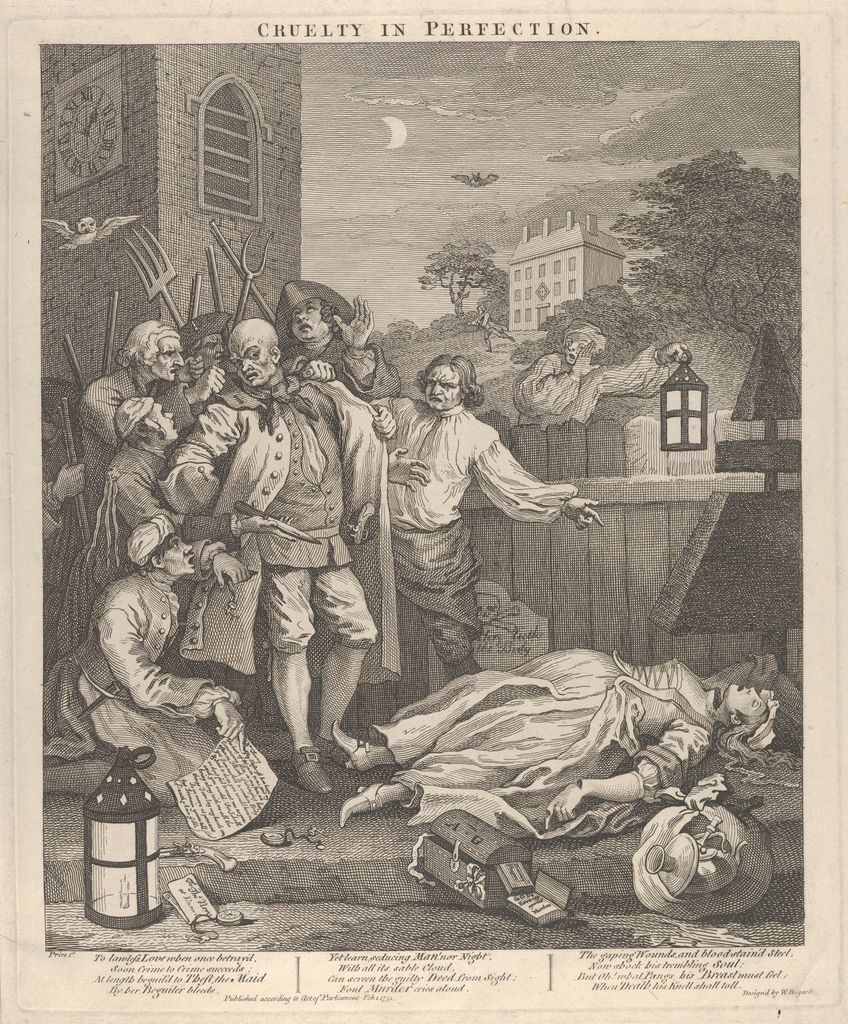
Cruelty in Perfection (The Four Stages of Cruelty), William Hogarth, February 1, 1751. Etching and engraving; only state. 91.1.138. Gift of Sarah Lazarus, 1891. Image source. CC0 / Public domain.
The drawing and the meeting place
The Morgan Library & Museum holds Hogarth’s working study, III, 32d, which its exhibition dated 1750–51. Tonkovich and Peterson date it about 1749–50. It is in red chalk with traces of graphite. A stylus has left incised lines, the reverse was rubbed with red chalk, and the front carries a graphite grid. Chalk on the back allows a drawn contour to be transferred when pressure is applied along it. The regular squares offer another means of carrying proportions from one surface to another. Tonkovich and Peterson observed that the squares, about two centimetres on each side, went on after the drawing was completed. They associate them with transfer and leave the precise destination unresolved. The study records the use of the drawing as a working object even where the next surface is unknown. [2] [4]
Watch Hogarth’s paintings and prints
Five films on Hogarth’s painted stories, prints, drawing methods and work for the Foundling Hospital.
Crafting Cruelty: Hogarth’s Innovative Drawing Methods
The Morgan examines Hogarth’s drawings for The Four Stages of Cruelty and the methods he used to work out his designs.
Watch on YouTubeThe finished engraving gives the setting a feature the Morgan study lacks. Above Ann is a conspicuously clipped tree, identified by Tonkovich and Peterson as a yew. They read it as a landmark for the meeting. The print brings a recognisable marker and the figure of the person who kept the appointment into the same part of the composition. The discovery thus takes place somewhere a character could have arranged to go and expected another person to find her. The addition makes the plot easier to reconstruct from the setting, even though the engraved letter refers to a previous agreement without giving directions. [1] [2] [3] [4]
Bell’s woodcut and the changing letter
John Bell cut a separate, larger version after Hogarth’s design. The Met’s woodcut, 21.72(2), is catalogued under Boydell and Co. and dated 1790. Its catalogued printing dimensions are 45 by 37.5 centimetres, compared with the engraved Met impression’s plate dimensions of 38.8 by 32.2 centimetres. The two prints preserve the same encounter on printing surfaces of different sizes and kinds. In a woodcut, raised surfaces carry the ink, so even a detail as small as the note can be made from a separate piece fitted into the block. [1] [2] [5]
The note gives readers a way to compare impressions. In early Lewis Walpole Library examples examined by Tonkovich and Peterson, its lines slope up to the right and were printed from type, probably set into a recess. The National Gallery of Art’s thick laid paper impression, 2012.2.1, has a note whose lines slope down to the right, closer to the layout of the engraving. The authors identify the letters as cut into an inserted piece of wood and date the change provisionally to around 1790. The enlarged, shortened note explicitly asks Nero to come to the churchyard. It leaves out Ann’s account of her mistress’s kindness and her own misgivings. That makes the place easier to identify and gives readers less of Ann’s reasoning than either the early woodcut or the engraving supplies. [2] [3] [6]
The date carried by the block presents a separate question. The Washington sheet still carries Bell’s signature, Hogarth’s credit for the design and publication, and the date 1 January 1750. The English civil year then began on 25 March. Reckoning the year from 1 January puts that January in 1751. The National Gallery of Art catalogues the sheet under 1750 and gives the reference 189/1 in Ronald Paulson’s third edition of 1989. Tonkovich and Peterson identify the same sheet as a second state from about 1790, pointing to its altered lettering and paper. Their account uses the revised order of the woodcut states, which Paulson had reversed in his first edition. The Met gives its own Boydell woodcut as first of two. The shape and direction of the letter’s lines offer a more immediate clue to what changed at the block. [2] [5] [6]
The Met catalogues the copperplate print in a single state. The National Museum of Western Art in Tokyo lists its engraved impression, G.1994-0014, as Paulson 189 (1/1), using the same 1989 edition. The state numbers for the cut and engraved surfaces describe separate sequences, even where the pictures and catalogue numbers are closely related. [1] [6] [7]
The Biblioteca Nacional de España records another Boydell example of Cruelty in Perfection, acquired in 2019 with Bell’s woodcut of the final scene. Its acquisition report gives the pair an edition date range of 1790–1810. The addition brought the woodcut and its companion into a collection that already held all four copperplate prints. [8]
From public discovery to punishment
In The Second Stage of Cruelty, a bystander takes down the number of Nero’s cab as Nero beats his horse. In the churchyard, people gather around an act they find after it has happened. The cab number offered a means of identifying a man for a complaint. Here the scattered objects and the private letter build an account of a relationship and an encounter. In The Reward of Cruelty, after the execution, Nero’s own body becomes the centre of a gathering. The churchyard is the point in the sequence where the consequences of his actions become visible to a crowd and where Hogarth gives the victim’s words a place in the story. [1] [2] [3]
Browse Hogarth’s artworks
All 54 individual artworks and series stages in the approved English cluster
Frequently Asked Questions
It is print 3 of 4 in The Four Stages of Cruelty. Use that position to follow the change in setting from one episode to the next. [1]
Discussion
Look again at the images and ideas explored in Cruelty in Perfection. These editorial prompts invite your observations.
Reader Insights
How does the lantern guide your eye between Ann Gill, the people holding Nero and the objects on the ground?
What changes in your understanding of Ann when the later woodcut keeps her request to meet but leaves out her misgivings about her mistress?
Join the Conversation
Share a detail, comparison or question about Cruelty in Perfection below.
References
- The Metropolitan Museum of Art, William Hogarth, Cruelty in Perfection (The Four Stages of Cruelty), etching and engraving, 91.1.138. View source.
- Jennifer Tonkovich and Laurel O. Peterson, “Hogarth and the Making of the Four Stages of Cruelty,” Master Drawings 62, no. 1 (2024), pp. 21–40, especially figs. 3, 6–10 and 16–20 and notes 11, 24 and 32. View source.
- Birmingham Museum of Art, William Hogarth, The Third Stage of Cruelty (Cruelty in Perfection), AFI.127.2014.3, inscriptions. View source.
- The Morgan Library & Museum, Hogarth: Cruelty and Humor, exhibition entry for William Hogarth’s Third Stage of Cruelty (Cruelty in Perfection), III, 32d. View source.
- The Metropolitan Museum of Art, John Bell after William Hogarth, Cruelty in Perfection, woodcut, 21.72(2). View source.
- National Gallery of Art, John Bell after William Hogarth, Cruelty in Perfection, woodcut on thick laid paper, 2012.2.1. View source.
- National Museum of Western Art, Tokyo, William Hogarth, Cruelty in Perfection, etching and engraving, G.1994-0014, Paulson 1989, no. 189 (1/1). View source.
- Biblioteca Nacional de España, Compra de fondo antiguo y especial 2019, “Estampas,” printed p. 9, acquisition entry for Estados de la crueldad (in Spanish). View source.







