


 by Tom Gurney
Tom Gurney BSc (Hons) is an art history expert with over 20 years experience
Published on June 19, 2020 / Updated on October 14, 2023
Email: tomgurney1@gmail.com / Phone: +44 7429 011000
William Hogarth’s Drawings: Introduction
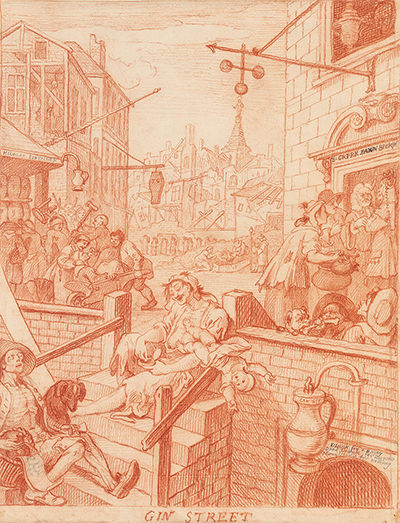
The drawing behind William Hogarth’s Gin Lane carries an earlier title, Gin Street. The title is written in red chalk beneath the steps where a child tumbles from a woman’s lap. The Morgan Library & Museum exhibited the sheet alongside other drawings for the prints Hogarth issued in 1751. What survives on paper includes choices that carried over into print, such as the steep flight of steps, and experiments he left behind, including the name of the street itself. [1]
At a Glance
- The Fellow ’Prentices at their Looms30 September 1747, etching and engraving, The Metropolitan Museum of Art, 91.1.9
- Plate X preparatory drawing1746–47, pen and brown ink with grey and brown wash over graphite, British Museum, 1896,0710.23
- Gin Street1750–51, red chalk with graphite and traces of black chalk, The Morgan Library & Museum, III, 36
- Second Stage of Cruelty1750–51 in the Morgan exhibition, red chalk with graphite, The Morgan Library & Museum, III, 32c
- Head of a Sleeping ChildAbout 1740–42, black and red chalk with white highlights on grey paper, British Museum, 1895,1214.1
Contents
- Two apprentices at their looms
- An alderman’s hearing in three drawings
- From Gin Street to Gin Lane
- A child’s likeness and a breakfast with friends
Two apprentices at their looms
Hogarth had already worked out much of Industry and Idleness on paper several years earlier. In the British Museum’s preliminary study for plate I, 1914,0613.30, he gave the two apprentices opposite sides of the workshop. Francis Goodchild is busy at his loom on the left, while Thomas Idle has fallen asleep on the right. The master raises a cane at the far left. Hogarth used pen and brown ink and grey wash on paper. The museum’s description tentatively identifies black chalk beneath them. At the margins he tried out the mace, the Lord Mayor’s chain and a halter. Before settling the border, he was already considering how it might foretell the apprentices’ very different futures. [2] [3]
The British Museum’s more finished drawing, 1896,0710.2, dates to 1746–47. The raised cane and paired looms are still there, alongside details that make the room more particular. There is now a lettered tankard that places the workshop in Spitalfields, a centre of London’s silk trade. Goodchild’s activity has a precise form. He passes the shuttle that carries the weft between the threads stretched across the loom. Idle’s sleep leaves his own machinery motionless. That contrast survives in the print even though the workshop is reversed. The Metropolitan Museum of Art dates its impression, 91.1.9, to 30 September 1747 and catalogues it as an etching and engraving in the second of two states. Above and below the workshop, lettering and emblems turn the trials in the sketch’s margins into part of the way the reader follows the story. [2] [4] [5]
One way to compare the three objects is to follow the cane. The British Museum identifies an earlier arrangement beneath the visible drawing, with the master in the middle raising his arm over Idle and a woman sitting at the spinning wheel. In the version drawn over it, the master is at the edge. Hogarth now has the width of the room between the raised cane and the sleeping boy. In the more finished design, the fine detail of the shop gives that same gesture a setting. In the impression it still points into the scene from the edge, now from the opposite side. The British Museum credits Hogarth with engraving this design. An inked plate leaves a mirror image on paper. Starting with a gesture that survives the reversal makes it easier to recognise the figures and then look for changes that go beyond the mechanics of printing. [2] [4] [5]
An alderman’s hearing in three drawings
The British Museum holds three studies for plate X, dated 1746–47 in Jennifer Tonkovich and Laurel O. Peterson’s study. Goodchild is now an alderman and Idle is brought before him. In the first sheet, 1896,0710.22, brown ink and grey wash over graphite establish the larger groups around the bar. A graphite drawing, 1981,1003.34, works out the place of the young apprentice in the foreground more clearly. In the near-final sheet, 1896,0710.23, pen and brown ink with grey and brown washes over graphite give the bodies and the room more definition. The clerk’s encounter with the woman at the bar is already worked into that drawing. In the print the woman slips a coin into his hand while the hearing goes on, an action easy to miss if the eye moves straight from the prisoner to the alderman. The Met’s impression, 91.1.18, is dated 30 September 1747. [6] [7]
Tonkovich and Peterson record indentations on both the graphite drawing and the near-final wash sheet, and chalk rubbed on the back of the latter. Tracing a contour with a pointed stylus could leave a groove in the sheet. The pressure could also deposit powdered chalk from the back onto a surface beneath. The wash made a group readable as a mass of light and shade. The stylus could pick out individual edges within it. Comparison with the print shows further revisions after the near-final drawing. Even where a print closely follows a drawing, a groove alone cannot tell us which surface lay beneath the sheet at the moment of tracing. [6]
Watch Hogarth’s paintings and prints
Five films on Hogarth’s painted stories, prints, drawing methods and work for the Foundling Hospital.
Crafting Cruelty: Hogarth’s Innovative Drawing Methods
The Morgan examines Hogarth’s drawings for The Four Stages of Cruelty and the methods he used to work out his designs.
Watch on YouTubeWatch the lecture at the Morgan Library & MuseumA different British Museum sheet, 1982,0227.1, shows how far Hogarth could develop an episode he eventually left out. On the front, Goodchild and his wife supervise a room where pictures are being hung and a carpet unrolled. The museum identifies this as an unused subject, probably a discarded proposal for plate VIII, which ultimately shows Goodchild as sheriff. The drawing already has ruled perspective and marks made for transfer. Turn the sheet over and there is a graphite sketch for plate VII, with Idle returned from sea. Even at the point of preparing one side for transfer, the subject of that plate could still change. The back, with its looser sketch, preserves an episode the series kept. [8]
From Gin Street to Gin Lane
The Morgan’s Gin Street, III, 36, is dated 1750–51. The exhibition record specifies red chalk with graphite and traces of black chalk in the left foreground. It also records stylus incisions and red chalk rubbed on the back. At the right edge of the sheet a small extension holds a separate study of the pawnbroker’s hand. On the extension, the fingers are distinct and the wrist bends down. In the published Gin Lane, the grip changes again. Tonkovich’s comparison with an unfinished proof at Windsor shows that Hogarth was still revising once he had begun working on copper. The procession in the middle distance comes to pass behind a broken wall, and the coffin is moved towards the pawnshop. The National Gallery of Art in Washington holds an impression of the 1751 etching and engraving, 1944.5.87, that carries the published title. [9] [10] [11]
An undated sheet at The Huntington, 64.15, is catalogued there as attributed to Hogarth. It includes details from the developed print, such as the woman giving gin to a baby, while using the same orientation as the Morgan drawing. Tonkovich reads the sheet as a copy after Hogarth and leaves its maker unidentified. Details introduced in the print give Tonkovich grounds for placing the Huntington sheet later in the history of the image. [10] [12]
Paper helps connect Gin Street with another project. The Morgan’s Second Stage of Cruelty, III, 32c, is drawn in red chalk with graphite, incised, and rubbed with red chalk on the back. The Morgan’s exhibition dates it to 1750–51, while Tonkovich and Peterson place it in 1750. Tonkovich reports that its watermark matches the marks on the sheets for Beer Street and Gin Street. The marks are evidence about the paper Hogarth had to hand across the projects. They leave the order in which he drew on the sheets open. [10] [13] [6]
A child’s likeness and a breakfast with friends
The National Gallery names Daniel Graham as the probable commissioner of Hogarth’s portrait of his four children. [14] A British Museum study traditionally called Head of a Sleeping Child, 1895,1214.1, records a very different task. A child lies sideways in a frilled bonnet. Hogarth worked in black and red chalk, with white highlights on grey paper. The museum dates the sheet to about 1740–42 and identifies the child as Thomas Graham, who died before Hogarth completed the family portrait. Judy Egerton considered a deathbed study likely while leaving open the possibility that the child was asleep. Look at the distance between that quiet head and Thomas in The Graham Children, the National Gallery’s oil on canvas of 1742, NG4756. There he sits upright in a gilded carriage and reaches towards cherries held by his sister. The paper could supply the baby’s features while the painter invented the action that gives him a place among his siblings. [15] [14]
Hogarth also used drawing to record an outing with friends. In the British Museum’s manuscript of the 1732 Five Days’ Peregrination, his drawing of breakfast at the Nag’s Head Inn in Stoke, Kent, uses pen and brown ink with watercolour. The travel account is collaborative, with illustrations by Hogarth and Samuel Scott. This particular sheet includes a figure identified in the manuscript as Hogarth himself making the drawing. The friends’ breakfast thus becomes a record of how it came to be pictured, with the act of drawing counted among the events of the trip. [16] [17]
Browse Hogarth’s artworks
All 54 individual artworks and series stages in the approved English cluster
Frequently Asked Questions
The chalk drawing at the Morgan Library & Museum is lettered Gin Street. Hogarth used Gin Lane for the published print. [9]
Yes. A British Museum sheet for Industry and Idleness includes a subject that Hogarth did not use alongside a study for plate seven. The sheet helps distinguish what he considered from what he ultimately published. [8]
Discussion
Look again at the images and ideas explored in William Hogarth’s Drawings. These editorial prompts invite your observations.
Reader Insights
How does moving the master to the edge of the workshop change the effect of his raised cane?
What does the separate sketch of the pawnbroker’s hand reveal when you compare it with his grip in Gin Lane?
Join the Conversation
Share a detail, comparison or question about William Hogarth’s Drawings below.
References
- The Morgan Library & Museum, Hogarth: Cruelty and Humor, online exhibition introduction. View source.
- British Museum, William Hogarth, preliminary drawing for The Fellow ’Prentices at their Looms, 1914,0613.30, collection description reproduced on Wikimedia Commons. View source.
- Art Fund, William Hogarth, Sketches for two Engravings from ‘Industry and Idleness’, 1914 acquisition record. View source.
- British Museum, William Hogarth, The Fellow ’Prentices at their Looms, drawing for plate I, 1896,0710.2, museum record on Google Arts & Culture. View source.
- The Metropolitan Museum of Art, William Hogarth, The Fellow ’Prentices at their Looms, plate I, 91.1.9. View source.
- Jennifer Tonkovich and Laurel O. Peterson, “Hogarth and the Making of the Four Stages of Cruelty,” Master Drawings 62, no. 1 (2024), figs. 2 and 11–14, pp. 28–29, nn. 6 and 15–18. View source.
- The Metropolitan Museum of Art, William Hogarth, The Industrious ’Prentice Alderman of London, The Idle One Brought Before Him and Impeached by his Accomplices, plate X, 91.1.18. View source.
- British Museum, William Hogarth, drawing for an unused subject and sketch for plate VII, 1982,0227.1. View source.
- The Morgan Library & Museum, William Hogarth, Gin Street, III, 36, exhibition entry and medium line. View source.
- Jennifer Tonkovich, “Hogarth and the Making of Beer Street and Gin Lane,” Master Drawings 60, no. 2 (2022), pp. 203–206, 213–216, figs. 4 and 22–23, nn. 2 and 8. View source.
- National Gallery of Art, William Hogarth, Gin Lane, 1944.5.87. View source.
- The Huntington Library, Art Museum, and Botanical Gardens, attributed to William Hogarth, Gin Lane, 64.15. View source.
- The Morgan Library & Museum, Hogarth: Cruelty and Humor, selected drawings, including William Hogarth, Second Stage of Cruelty, III, 32c. View source.
- The National Gallery, William Hogarth, The Graham Children, NG4756. View source.
- British Museum, William Hogarth, Head of a Sleeping Child, 1895,1214.1, collection description and catalogue commentary reproduced on Wikimedia Commons. View source.
- Yale University Library, “Peregrination,” William Hogarth’s Topographies, entry on Breakfast at the Nag’s Head Inn in Stoke, Kent. View source.
- John Kerslake, “Hogarth,” Early Georgian Portraits, National Portrait Gallery, iconography section. View source.







