


 by Tom Gurney
Tom Gurney BSc (Hons) is an art history expert with over 20 years experience
Published on June 19, 2020 / Updated on October 14, 2023
Email: tomgurney1@gmail.com / Phone: +44 7429 011000
The Levee: Introduction
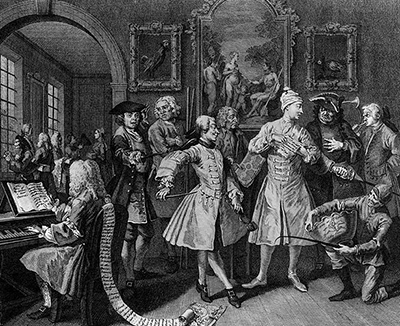
Tom Rakewell receives a roomful of callers in a pink silk morning coat and red slippers. A dancing master poses with a small violin, a jockey kneels with a silver trophy, and a man stands at Tom’s elbow with his hand on his sword. Each has something to show the newly wealthy host. In The Levee, the second of eight scenes in William Hogarth’s A Rake’s Progress, these competing demonstrations show how much work and money go into making a gentleman. The oil on canvas is dated 1734 by Sir John Soane’s Museum, which holds it as P41. It measures 63 × 75.5 cm. [1]
At a Glance
- Series positionScene 2 of 8 in A Rake’s Progress
- Painting1734, oil on canvas, Sir John Soane’s Museum, P41
- Plate II publication25 June 1735, London
- Washington impressionEtching and engraving, third state, National Gallery of Art, 1944.5.28
- Paris impressionEtching and engraving, fourth state, Bibliothèque nationale de France, FRBNF40262625
This work across William Hogarth’s career
Assembly at Wanstead House
1728–31The Heir
1734The Marriage Settlement
about 1743Gin Lane
1751Canvassing for Votes
1754–55Contents
- A court habit in a private house
- What the visitors bring
- The opera joke on paper
- The canvas and plate II
A court habit in a private house
The word levée comes from the French verb lever, meaning to rise. At the French court, the monarch’s morning routine provided an occasion to admit visitors, hear requests and do business. The aristocracy adapted the practice, receiving callers who sought patronage or offered their services. Tom borrows a ceremony that gives value to the host’s time, down to the moment when he gets dressed. His white house cap, worn before he puts on his wig, makes the hour part of the performance. Even the clothes he wears before he is ready to go out advertise what he can afford. When Lady Mary Wortley Montagu mocked the fashion in 1738, she singled out the crowds that people assembled to make themselves look important. Hogarth gives that pretension a visible measure in the number of callers who have to wait behind the arch. [1]
In The Heir, a tailor measures Tom in his late father’s house as Sarah Young comes to press her claim on him. At the levée, a tailor waits among the callers at the back, with a coat already over his arm. In the first scene Hogarth puts the labour of fitting Tom’s clothes at the centre of the room. Here, clothing is one of several services Tom can expect others to bring to him. The Soane catalogue takes the date 1727 on the painted punch bowl as a clue that seven years have passed in the story. The leap is visible in the height of the room and the number of people who have a reason to be there. [1] [2]
The arch makes room for a second group. The tailor, milliner and poet are part of the gathering even though they have yet to reach Tom. Their position gives the audience an order of access. Nearer the front, visitors can make a case with an instrument, a gesture or an object. To the rear, they must wait. The tall windows suggest the kind of house built on London’s fashionable new squares, as the Soane catalogue proposes. The room therefore shows the sort of address to which Tom aspires, while its size gives Hogarth space to show who gets near him. [1]
What the visitors bring
The dancing master stretches a foot into the foreground and holds a kit violin, small enough to carry to a lesson. Behind him a fencing master demonstrates his stance. Their offers have something in common. Both teach a pupil where to put his feet and how to carry himself in company. Beside the fencer, the sturdier man with a quarterstaff introduces another kind of training. The Soane catalogue identifies him as the prizefighter James Figg, who taught self-defence in Oxford Street, and suggests the fencer may be the French master Dubois. The man with the staff appears to look sidelong at the display. The three figures turn a morning appointment into a contest between different kinds of expertise. [1]
A garden designer holds out a plan. The Soane suggests Charles Bridgeman as a possible model. The historical Bridgeman worked at Stowe, where the National Trust records his design of an extensive sunken boundary, known as a ha-ha, in the early 1720s. His work gives a sense of the scale of the service Hogarth’s visitor is offering. In the picture, the regular shapes on the paper can be grasped in a glance. They promise a transformation that would take land, time and many hands to carry out. Tom is being invited to spend on the making of a setting as well as on his own appearance. [1] [3]
Watch Hogarth’s paintings and prints
Five films on Hogarth’s painted stories, prints, drawing methods and work for the Foundling Hospital.
The Sequel: Hogarth’s "A Rake’s Progress" (1734–5)
The Paul Mellon Centre revisits the eight-scene story of Tom Rakewell and its place in Hogarth’s work.
Watch on YouTubeAt the right, the jockey’s silver trophy and the horn at a caller’s lips link the room to racing and hunting. The Soane reads the trophy as a prize won by Tom’s horse, Silly Tom. The horse carries its owner’s name into public competition, and the kneeling jockey brings the result back to the house in a form that can be displayed. Above him, Captain Hackum stands close to Tom, with one hand at his heart and the other at his sword. The recommendation in Tom’s hand offers Hackum’s services and is signed W Stab, according to the museum’s transcription. The letter and the gesture have the air of a formal introduction. The signature gives the promise of service a more pointed meaning. [1]
Look above Tom’s shoulder and the question of judgment becomes the subject of a painting within the painting. The central picture shows Paris choosing Venus, whose promise of Helen sets in motion the events that lead to the Trojan War. The gamecocks in the smaller frames bring the eye back to the contests and wagers suggested below. Hung together, these subjects give the wall two registers of competition. A mythological choice with disastrous consequences occupies the place of honour, while the birds are recognisable emblems of a sporting appetite much closer to Tom’s own. [1]
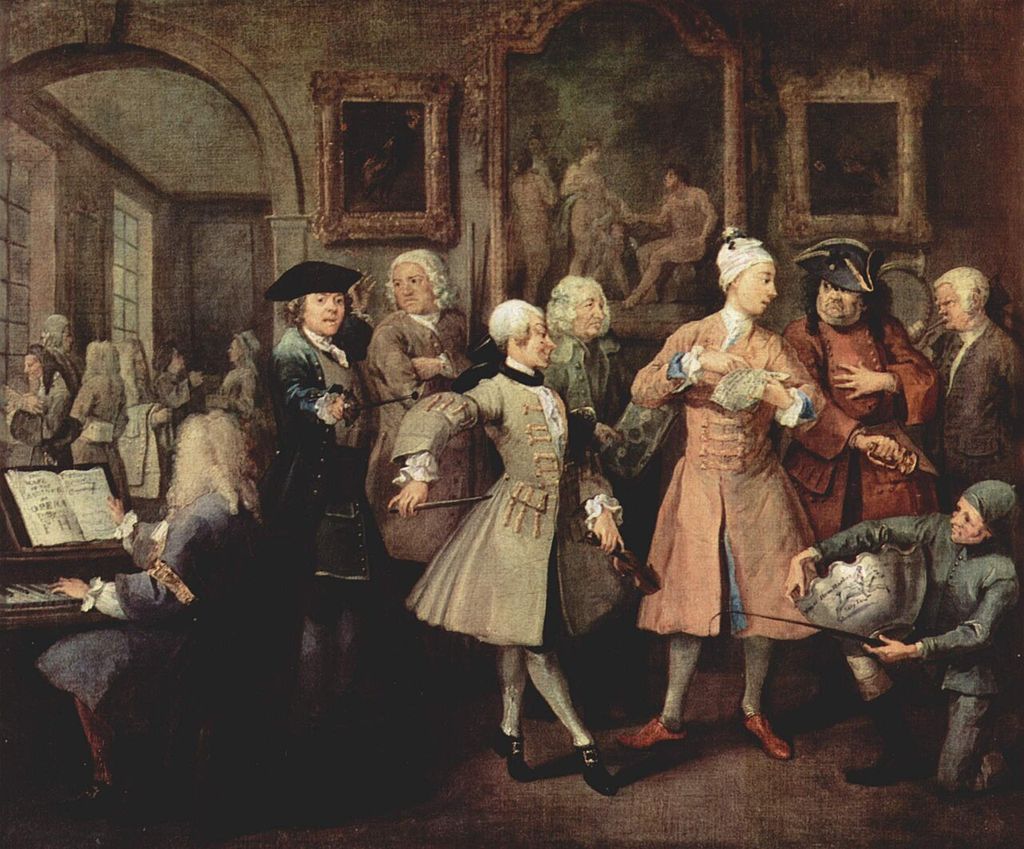
The Levée, William Hogarth, 1734. Oil on canvas. SM P41. The Yorck Project via Wikimedia Commons. Image source. Public domain.
The opera joke on paper
At the left, the harpsichordist’s turned head makes him hard to identify. In its account of the canvas, the Soane catalogue reads the title on the music book as The Rape of the Sabines and takes the initials F.H. as an allusion to George Frideric Handel. That association leaves the identity of the player open. In the Metropolitan Museum of Art’s third-state impression, a long scroll runs down the back of his chair and curves across the floor towards the centre of the room. The added detail pulls the reader from the player and his music towards the financial side of operatic celebrity. [1] [4]
Yale’s impression shows how the joke works. The fictional opera casts famous castrati as the ravishers in the Roman story. The scroll enumerates gifts to the singer Farinelli and ends at a small image of admirers offering him their hearts. It resembles a tribute to a ruler, with the singer raised on a pedestal. The Daily Advertiser reported Farinelli’s arrival in September 1734, when he had been engaged by the Opera of the Nobility, a rival of Handel’s company. He made his public London debut the following month. The print published in 1735 thus gave readers a joke about a current London celebrity within a story whose painted bowl suggests an earlier year. Farinelli’s admirers, like the people in Tom’s room, use objects to show what someone’s favour is worth. [4] [5] [6]
The canvas and plate II
The Bibliothèque nationale de France dates the London publication of plate II to 25 June 1735 and catalogues its etching and engraving as a fourth state. It gives a measurement for the printing element of 35.5 × 40.7 cm and a sheet measurement of 39 × 43.8 cm. The National Gallery of Art in Washington holds a separate third-state etching and engraving, accession 1944.5.28, with a sheet of 35.7 × 41.2 cm. Te Papa’s separate impression, registration 1965-0001-1/2-8, is catalogued as an engraving with image dimensions of 33.5 × 41.1 cm. Those figures describe different objects and different things being measured. The state describes a stage in the working of the plate, so two separate impressions can belong to the same state. The Met’s sheet measures 35.3 × 40.3 cm and, like the Washington impression, is catalogued as third state. The Met lists Scotin as engraver alongside Hogarth as artist and publisher, and National Gallery cataloguer Judy Egerton records that Scotin assisted Hogarth on this plate. [4] [7] [8] [9] [10]
At the Soane, the series belongs to the Picture Room, where hinged picture planes make room for more paintings than the walls alone can hold. As part of a conservation programme, the museum has used facsimiles when individual canvases are away for treatment. Its catalogue records a substitution for The Levee in July 2025. The oil, a facsimile of the oil and an impression on paper offer different kinds of evidence, especially where small inscriptions carry the joke. [1] [11]
In The Orgy, which follows the levée, Tom is again at the centre of a group. By then he is at the Rose Tavern and is too drunk to notice his watch being taken. Hogarth has changed the uses of the company around him. At the morning reception, Tom can still turn to the jockey’s prize or read the letter offering a swordsman’s services. At the tavern, the company can turn Tom’s inattention to its own advantage. The watch makes the cost of that change visible in a single object. [1] [12]
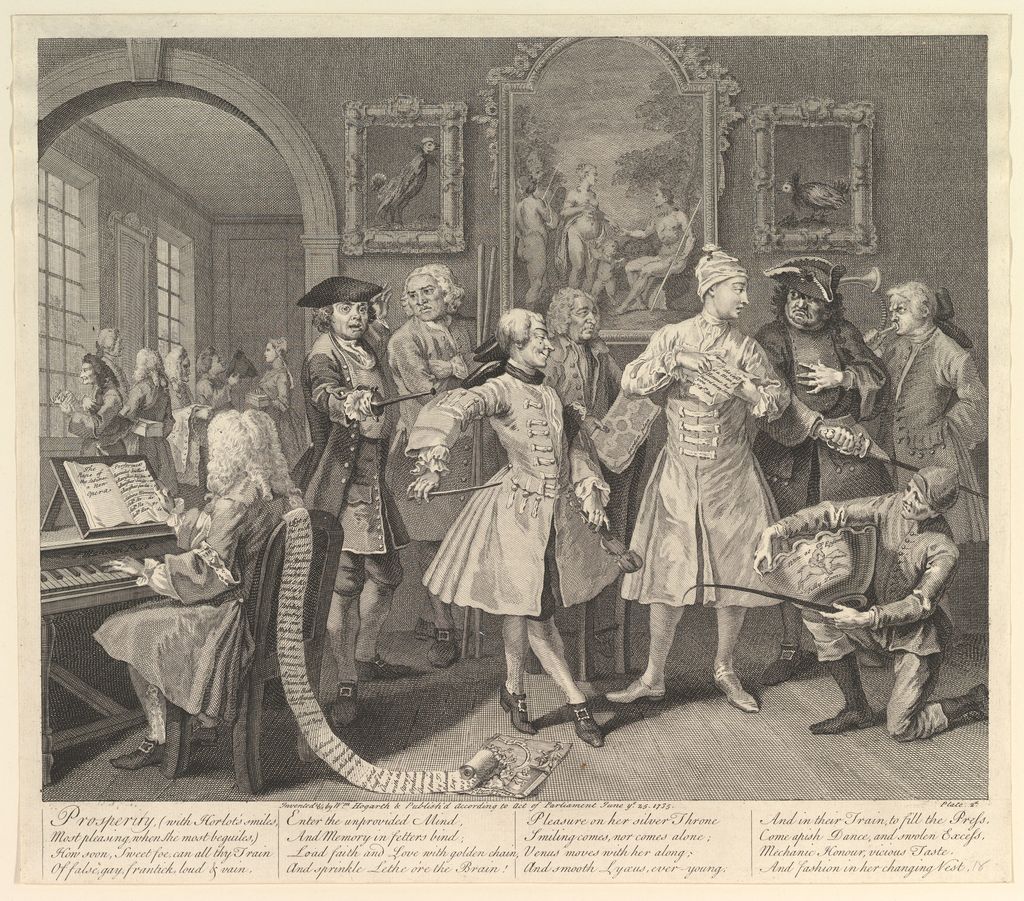
A Rake's Progress, Plate 2, William Hogarth and Gérard Jean-Baptiste Scotin, June 25, 1735. Etching and engraving; third state of four. 32.35(29). Harris Brisbane Dick Fund, 1932. Image source. CC0 / Public domain.
Browse Hogarth’s artworks
All 54 individual artworks and series stages in the approved English cluster
Frequently Asked Questions
His callers include a dancing master with a small violin and a jockey with a silver trophy. The gathering shows the services and diversions Tom can now pay for. [1]
It is scene 2 of 8 in A Rake’s Progress. Sir John Soane’s Museum uses the scene number for the original oil painting. [1]
Discussion
Look again at the images and ideas explored in The Levee. These editorial prompts invite your observations.
Reader Insights
What does the arch tell you about who gets close to Tom and who has to wait?
How does the scroll running from the harpsichordist’s chair to the floor change the joke about fashionable music?
Join the Conversation
Share a detail, comparison or question about The Levee below.
References
- Joanna Tinworth, Sir John Soane’s Museum, William Hogarth, A Rake’s Progress II: The Levee, P41, especially the scene commentary and notes 6–9. View source.
- Sir John Soane’s Museum, William Hogarth, A Rake’s Progress I: The Heir, P40. View source.
- National Trust Heritage Records, Ha Ha, Garden Boundary, Stowe Landscape Gardens, MNA129942. View source.
- The Metropolitan Museum of Art, William Hogarth and Gérard Jean-Baptiste Scotin, A Rake’s Progress, Plate 2, 32.35(29), third state of four. View source.
- Yale Center for British Art, William Hogarth, A Rake’s Progress II: The Levee, B1981.25.1412, in Art and Music in Britain: Four Encounters. View source.
- Donald Burrows, Helen Coffey, John Greenacombe and Anthony Hicks, editors, George Frideric Handel: Collected Documents, vol. 3, 1734–1742, p. 9, the Daily Advertiser of 26 September 1734 and editorial notes. View source.
- Bibliothèque nationale de France, William Hogarth, A Rake’s Progress: The Levee, plate II, FRBNF40262625, Paulson 133.4 (in French). View source.
- National Gallery of Art, Washington, William Hogarth, A Rake’s Progress: pl.2, 1944.5.28, Paulson 133, third state of four. View source.
- Museum of New Zealand Te Papa Tongarewa, William Hogarth, A rake’s progress. Plate 2. The Levée., 1965-0001-1/2-8, collection record 42692. View source.
- Judy Egerton, Marriage A-la-Mode, National Gallery catalogue, discussion of engraving and Scotin’s assistance on plate II of A Rake’s Progress. View source.
- Sir John Soane’s Museum, The Picture Room, picture planes and conservation of A Rake’s Progress. View source.
- Sir John Soane’s Museum, William Hogarth, A Rake’s Progress III: The Orgy, P42. View source.







