



 by Tom Gurney
Tom Gurney BSc (Hons) is an art history expert with over 20 years experience
Published on June 19, 2020 / Updated on October 14, 2023
Email: tomgurney1@gmail.com / Phone: +44 7429 011000
The Painter and his Pug: Introduction
In William Hogarth’s The Painter and his Pug, the dog sits on a ledge in front of an oval canvas that bears his owner’s likeness. His paws project forward, his head interrupts the edge of the oval, and his eyes have the same alertness as the painter’s. The whole arrangement is itself an oil painting on a rectangular canvas, 90 by 69.9 centimetres. Hogarth dated it 1745. Tate holds it as N00112, and the National Gallery in London lists the same painting under the loan number L1356. [1] [2]
At a Glance
- ArtistWilliam Hogarth
- Painting1745, oil on canvas, 90 × 69.9 cm, Tate, N00112
- National Gallery loan recordNational Gallery, London, L1356
- Printed self-portraitGulielmus Hogarth, 1748/1749, etching and engraving, National Gallery of Art, Washington, Rosenwald Collection, 1944.5.9
This work across William Hogarth’s career
Assembly at Wanstead House
1728–31The Heir
1734The Marriage Settlement
about 1743Gin Lane
1751Canvassing for Votes
1754–55Contents
- The painter within the painting
- The clothes Hogarth painted over
- The line on the palette
- The self-portrait in print
- From Angerstein’s collection to Tate
The painter within the painting
Hogarth shows himself in a dark cap and a loose red coat. The narrow band of white at his throat catches the light and draws attention towards his face. Follow the edge of the oval down from his shoulder and the image abruptly becomes an object with a weight of its own. Its lower edge rests on a pile of books. One can imagine lifting the portrait away and leaving the pug, the books and the palette on the ledge. The drapery helps keep the arrangement together, passing behind the dog and leading the eye back towards the painted figure. [1] [3]
Tate’s catalogue identifies the books as works by William Shakespeare, John Milton and Jonathan Swift. They physically support Hogarth’s likeness, making the choice of authors part of the portrait’s argument. Drama, epic poetry and satire are three kinds of invention to which a painter might claim kinship. Shakespeare suggests the scope of what can be done with gesture and character, Swift the use of wit to expose folly, and Milton the reach of an ambitious subject. The books suggest affinities across the arts without pointing to a particular scene or passage. The range of Hogarth’s paintings, from insistent likenesses to stories told across several canvases, gives those affinities substance. [1] [3]
The National Gallery identifies the dog as Trump, one of Hogarth’s own pugs. The Tate catalogue is more cautious and calls the identification probable. It also records the tradition that Hogarth remarked on the resemblance between himself and his dog. The painter and pug both command attention through their eyes and the set of their mouths, and their proximity invites the viewer to compare them. The dog’s compact body has a presence quite different from the painter’s composed upper half. The contrast is especially clear at the bottom of the picture, where the pug’s legs carry his weight and the artist’s likeness depends on a pile of books. The arrangement gives a joke about the resemblance between man and dog room to coexist with a serious claim for painting. [2] [3]
The clothes Hogarth painted over
The cap and coat belong to a revision. As Elizabeth Einberg and Judy Egerton report in Tate’s catalogue, X-rays made at the Courtauld Institute revealed a full wig, a flowing white cravat and a coat and waistcoat with gold buttons. The oval was once smaller and enclosed the head more tightly. The catalogue also describes a broad stroke, visible in light directed across the surface, where Hogarth tried to cover the former upper-right boundary. Enlarging the oval changed how the likeness fit into the still life. It gave the shoulder and sleeve more room and created a broader surface for the dog’s head to overlap. [3]
A small enamel on copper in the National Portrait Gallery offers an idea of how the earlier likeness may have looked. The museum attributes it to Jean André Rouquet, dates it to about 1740–45, and relates it closely to the first stage of the oil painting. Einberg and Egerton note that a second miniature has a case inscribed with the year 1735, although the inscription may have been made later. Together the miniatures and the X-rays make a start in the mid-1730s plausible. The canvas bears the date 1745, and the evidence leaves open when its first version was painted. [1] [3] [4]
The buried details also complicate the apparent simplicity of the foreground. The catalogue describes brushes once pushed through the thumbhole of the palette and a graving tool formerly lying across the books. In the finished oil, the thumbhole is clear and the marked palette has room to be read. The earlier tools would have advertised the painter’s skills directly. The revised design gives greater emphasis to a single line and its inscription, while the cap and coat carry the impression of a painter in his working clothes. [3]
Watch Hogarth’s paintings and prints
Five films on Hogarth’s painted stories, prints, drawing methods and work for the Foundling Hospital.
William Hogarth and the Foundling Hospital | HENI Talks
Caro Howell discusses Thomas Coram, Hogarth’s portrait of him and the artist’s work for the Foundling Hospital.
Watch on YouTubeThe line on the palette
At lower left, the long curve appears to rise from the palette and cast a shadow. Its slight suggestion of depth matters. The painted words following The Line of Beauty once included and Grace, which Einberg and Egerton describe as visible through the paint applied over them. In the 1753 Analysis of Beauty, Hogarth would distinguish a line that waves on a plane from a serpentine line that also winds in depth. The painted curve has the appearance of the latter. The painted-out words preserve a trace of the time when the two ideas still shared a label in Hogarth’s portrait. [3] [5]
The palette presents an idea in the same space as a dog with a wrinkled head and a coat that catches the light. Its neat curve can be followed from end to end, while the dog’s changing contours ask the eye to work its way around a body. The two kinds of looking belong together. By putting the line on a tool of his trade, Hogarth gives the viewer a small demonstration of how a curve can suggest volume on a flat surface. In the preface to his treatise, he recalls how the line on the printed frontispiece prompted painters and sculptors to ask him what it meant. His recollection gives the year as 1745, a date to distinguish from the lettering on the surviving impression in Washington. [3] [5] [6]
Annotated Details from The Painter and his Pug
Look at the framing devices in Hogarth’s engraved self-portrait. These details come from a paper impression referred to by its lettered title, Gulielmus Hogarth. Gulielmus Hogarth, William Hogarth. National Gallery of Art, Washington, 1944.5.9. Collection record.
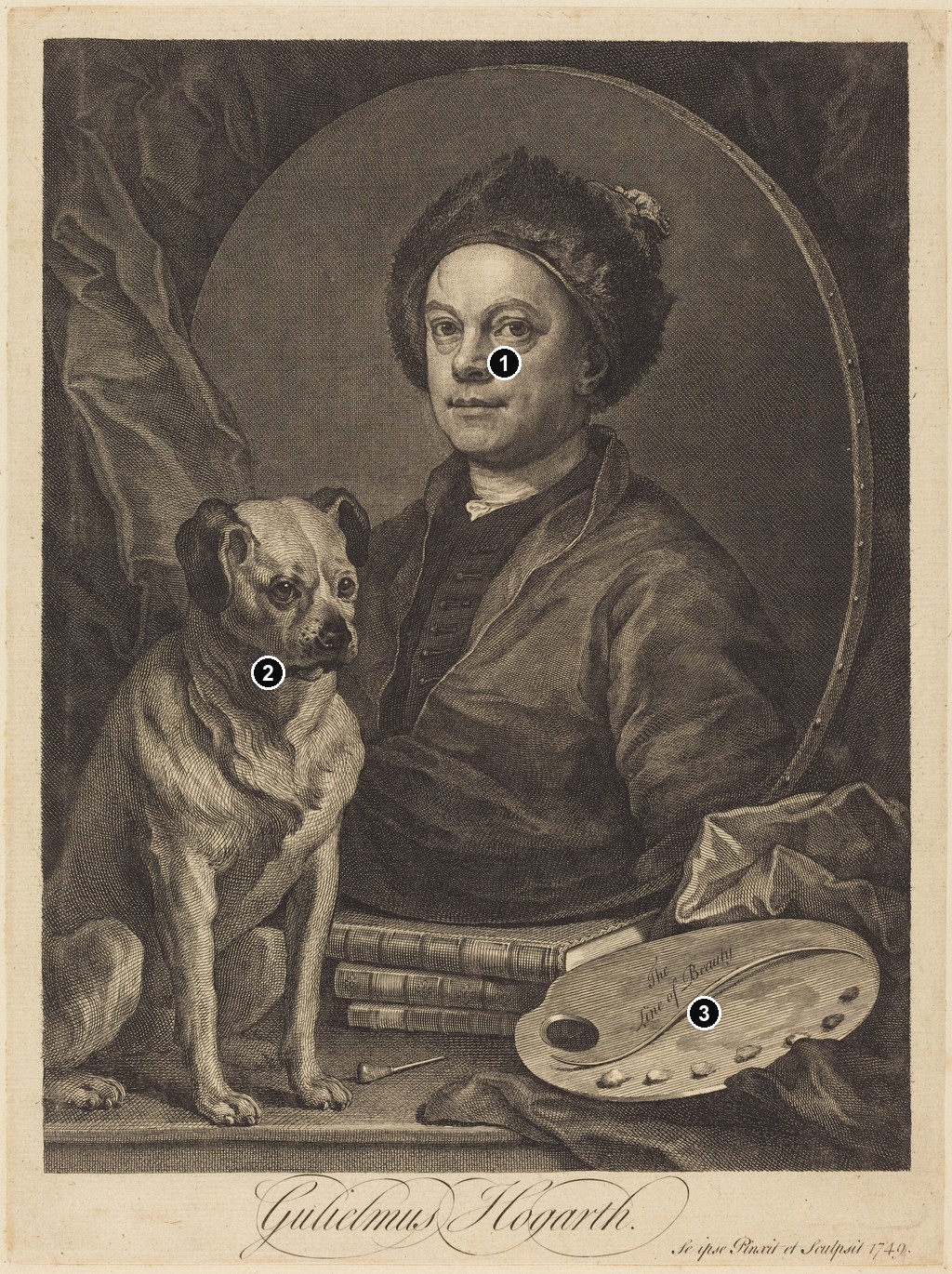
Details from THE PAINTER AND HIS PUG
Select a numbered point for a closer look.
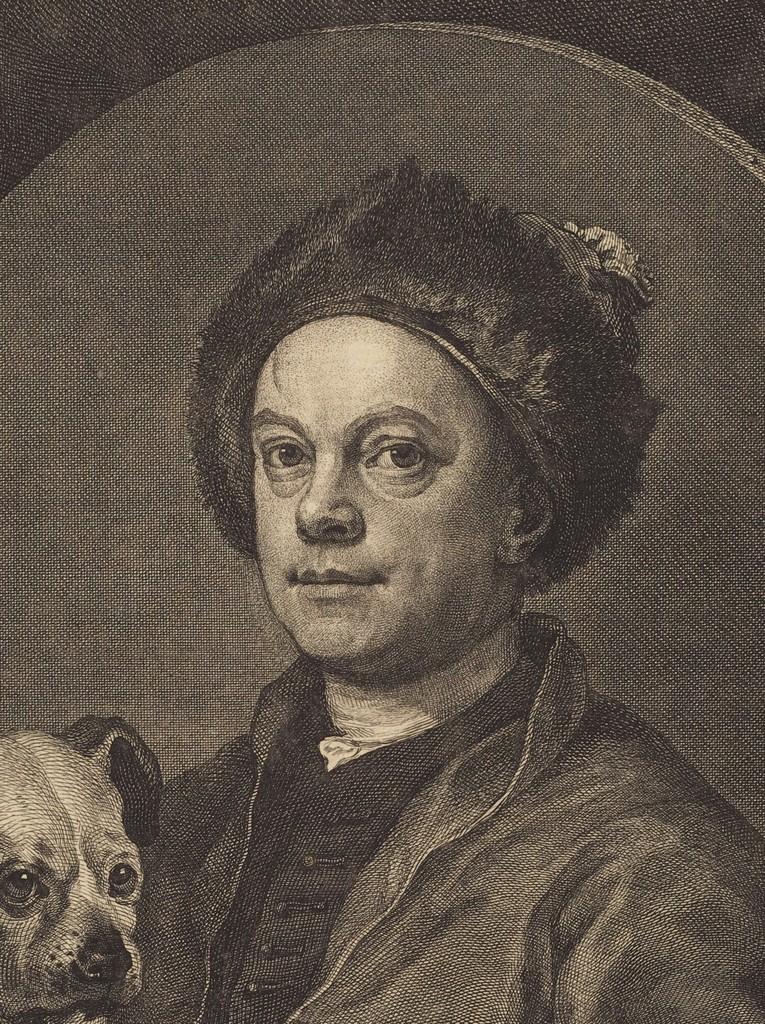
The painted likeness as an object
The man appears within an oval portrait. Look at the curved edge before deciding where the person, frame and objects are placed.
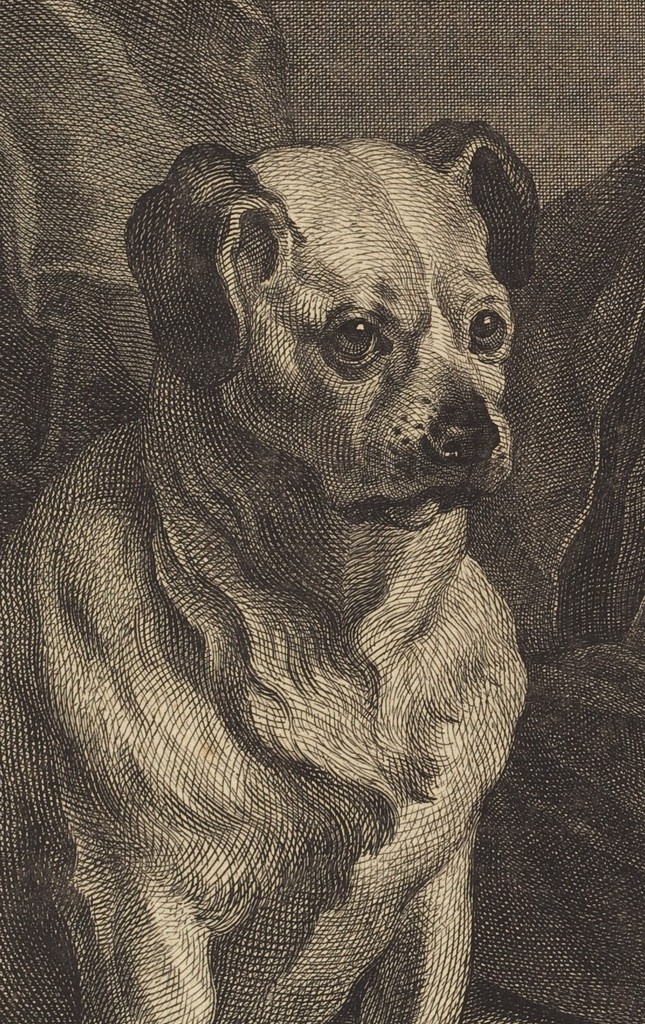
Trump outside the frame
The pug sits in front of the portrait. His body crosses one of its edges, which helps you see the difference between the framed likeness and the setting around it.
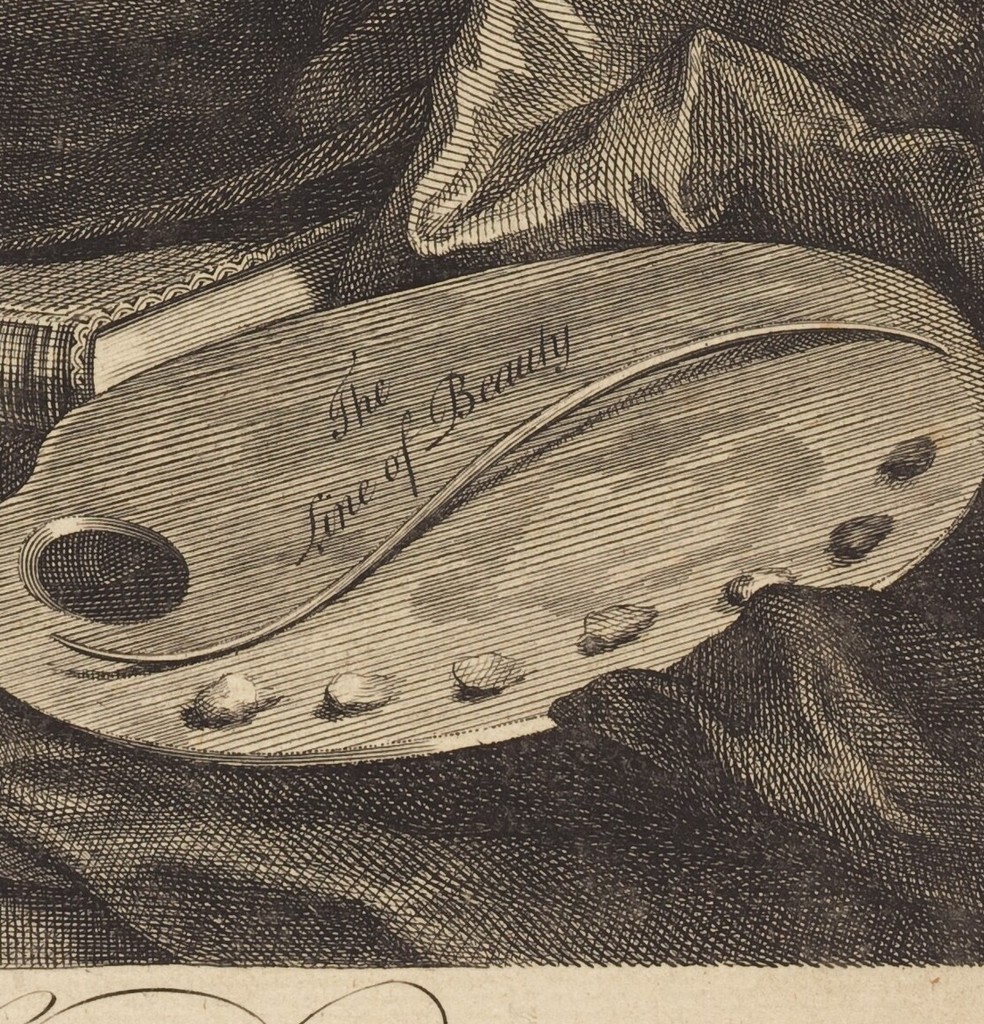
The marked palette
The curving mark runs across the palette while the books support the portrait. The line belongs to the things Hogarth arranges around his likeness.
The self-portrait in print
The National Gallery of Art in Washington catalogues Gulielmus Hogarth, from its Rosenwald Collection, as an etching and engraving dated 1748/1749. Its impression, 1944.5.9, is the fourth of four states under no. 181 in Ronald Paulson’s 1965 catalogue. The lettering below the image gives the year 1749 and credits Hogarth with painting and engraving his own likeness. He used the self-portrait as a frontispiece to his collected prints. The Washington record for the bound Collected Works lists the self-portrait among the 114 etchings and engravings originally contained in that volume. [3] [6] [7]
On paper, the dog moves to the left and the palette to the right. Hogarth has kept the scar over his own right eyebrow even as the composition reverses. The cap, cheek and dog’s coat are differentiated by marks whose density varies with the amount of shadow. Fine cross-hatching models the coat that Hogarth painted red. The palette catches the eye against the dark cloth. Around its lower edge, dabs of paint run from light to dark, a gradation without an apparent equivalent in the finished oil. Look beside the pug’s front paws for the short-handled engraving tool, or burin. It brings a detail concealed in the oil back into view, in a new position. In the frontispiece, the tool and the inscription below declare who made the print, while the palette still links it to the painter’s work. [3] [6]
Hogarth eventually used the same copperplate to make The Bruiser, his 1763 satire on the poet Charles Churchill. The Met’s impression, 91.1.57, preserves the oval, which now contains a bear with a club and a foaming tankard. The National Library of New Zealand’s record for another impression identifies the sheet under the pug as Churchill’s printed attack on Hogarth. The dog that once drew the viewer’s attention to a resemblance now takes part in the dispute. The surviving arrangement makes it possible to see how far Hogarth changed the subject without having to start a new plate. [8] [9]
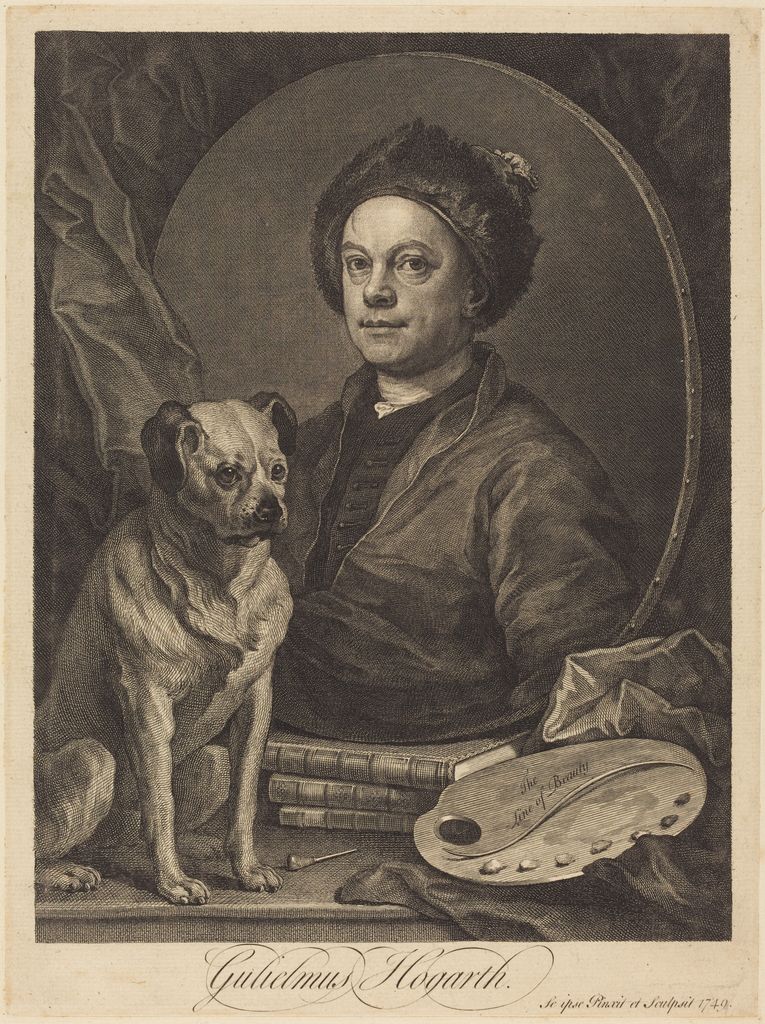
Gulielmus Hogarth, William Hogarth, 1748–49. Etching and engraving. 1944.5.9. Rosenwald Collection, National Gallery of Art, Washington. Image source. CC0 / Public domain.
From Angerstein’s collection to Tate
The oil entered the national collection in 1824 with the purchase of John Julius Angerstein’s pictures to found the National Gallery. The purchase also brought in Hogarth’s six paintings of Marriage A-la-Mode. The self-portrait later transferred to Tate, and Tate recorded lending it back to the National Gallery for the latter’s 2025–26 bicentenary year. [2] [10]
Tate exhibited the painting as The Painter and his Pug in Hogarth and Europe in 2021–22, alongside the Dutch painter Cornelis Troost’s Self-Portrait of 1739. Troost, too, places his likeness within an oval, with a curtain partly drawn across it. On the pedestal in front of him are his palette, brushes and a drawing on blue paper. The finery at his throat gives a sense of the kind of figure Hogarth’s earlier cravat and wig would have presented. The works make different use of the space in front of the oval. Troost supplies objects that show how he works, while Hogarth brings the dog close enough for the viewer to compare two faces. [3] [11] [12]
Browse Hogarth’s artworks
All 54 individual artworks and series stages in the approved English cluster
Frequently Asked Questions
Discussion
Look again at the images and ideas explored in The Painter and his Pug. These editorial prompts invite your observations.
Reader Insights
How does placing the pug outside the oval change the way you look at Hogarth’s face?
What does the burin beside the pug’s paws add to the printed self-portrait?
Join the Conversation
Share a detail, comparison or question about The Painter and his Pug below.
References
- Tate, William Hogarth, The Painter and his Pug, 1745, N00112, collection data. View source.
- The National Gallery, London, William Hogarth, The Painter and his Pug, 1745, L1356. View source.
- Elizabeth Einberg and Judy Egerton, The Age of Hogarth: British Painters Born 1675–1709, Tate Gallery Collections II (1988), entry for N00112, republished by Tate on Google Arts & Culture. View source.
- National Portrait Gallery, London, attributed to Jean André Rouquet, William Hogarth, circa 1740–45, NPG 5717. View source.
- William Hogarth, The Analysis of Beauty, London, printed by J. Reeves for the author, 1753, preface pp. x–xi and chapter VII pp. 37–39, Getty Research Institute, call number 78063. View source.
- National Gallery of Art, Washington, William Hogarth, Gulielmus Hogarth, 1748/1749, Rosenwald Collection, 1944.5.9, Paulson 1965, no. 181, state IV of IV. View source.
- National Gallery of Art, Washington, Collected Works of William Hogarth, Rosenwald Collection, 1944.5.9–122. View source.
- National Library of New Zealand, William Hogarth, The Bruiser, C Churchill (once the Revd!), D-020-101, catalogue note on the reworked copperplate. View source.
- The Metropolitan Museum of Art, William Hogarth, The Bruiser, 1763, etching and engraving, seventh state of seven, 91.1.57. View source.
- Tate, The Board of Trustees of the Tate Gallery Annual Report and Accounts 2024–25, p. 11, “Sharing the Collection”. View source.
- Josephina de Fouw, label for William Hogarth, The Painter and his Pug, N00112, in Tate Britain, Hogarth and Europe, large print exhibition guide, 2021–22, pp. 20–23. View source.
- Rijksmuseum, Cornelis Troost, Self-Portrait, 1739, SK-A-4225. View source.






