


 by Tom Gurney
Tom Gurney BSc (Hons) is an art history expert with over 20 years experience
Published on June 19, 2020 / Updated on October 14, 2023
Email: tomgurney1@gmail.com / Phone: +44 7429 011000
The Idle Apprentice Returns from Sea: Introduction
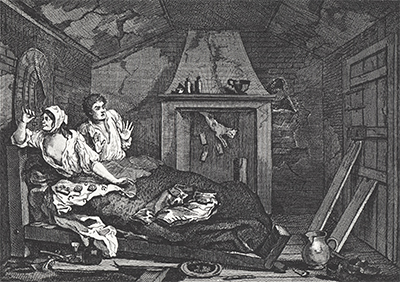
A cat tumbles down the chimney and Tom Idle jerks upright in bed. Beside him a woman holds a piece of jewellery up to her ear. The two share a bed whose foot has collapsed, but they scarcely seem to share the moment. This is where William Hogarth brings Idle back into Industry and Idleness. In plate seven, an etching and engraving bearing a publication date of 30 September 1747, Hogarth gives the returned apprentice a hiding place and shows how little reassurance it offers him. [1] [2]
At a Glance
- Artist and seriesWilliam Hogarth, Industry and Idleness, plate 7
- Publication inscription30 September 1747
- MediumEtching and engraving
- National Gallery of Victoria impression1995.358.7, second state of two (Paulson 174 ii/ii)
- Museum of Fine Arts Ghent impression1958-V-16-1, catalogued 1794–1812
This work across William Hogarth’s career
Assembly at Wanstead House
1728–31The Heir
1734The Marriage Settlement
about 1743Gin Lane
1751Canvassing for Votes
1754–55Contents
- The barricade and the chimney
- What the pair bring to the bed
- An attic room in London
- Between the wedding and the feast
- What the date on the print tells us
The barricade and the chimney
The planks wedged against the door are among the strongest diagonals in the print. They make the effort somebody has taken to shut the room legible from across it. Yet the disturbance comes through the chimney, an opening that belongs to the building as surely as the door does. The rat running across the floor gives the alarm another small consequence close to the ground. Idle’s abrupt movement makes sense once we follow the cat’s descent, but the barricade suggests that he was afraid of being found well before the cat arrived. Andrew Stevens’s exhibition catalogue reads that fear alongside the pistols and the apparent loot as evidence of the life Hogarth implies for Idle after his return. [1] [3]
The cartouche below the picture names Leviticus 26:36 and gives the line “The Sound of a Shaken Leaf shall Chace him.” In the King James Bible, the leaf sends survivors fleeing in enemy territory as if a sword were at their backs, though nobody pursues them. The printed caption narrows the verse from “them” to “him”, attaching the fear to one man. Hogarth gives the noise an everyday source and leaves the danger it seems to announce to Idle’s imagination. The picture lets us see the cat at the very moment the biblical line asks us to imagine what an ordinary sound can become to someone expecting a pursuer. [2] [4]
What the pair bring to the bed
The pistols are down beside the bed and the watches and jewellery are close to the woman. That division makes the objects tell different parts of the story. The pistols encourage the reader to imagine a threat used outside the room. The smaller valuables can be carried home, laid out and tried on. Ghent’s catalogue reads them as stolen, which fits the combination of weapons, display and concealment. The print leaves the circumstances of their acquisition offstage. Hogarth leaves the voyage itself between the departure in plate five and the announcement of the return in plate seven. Idle’s first appearance after that gap invites the reader to work backwards from the room to what he may have done. [1] [3] [5]
The print’s full title calls his companion a “common Prostitute”. The title supplies a social judgement before the reader has seen what she is doing. Goodchild’s bride in the preceding plate is identified by her relation to the master and by marriage. The woman here is unnamed and introduced by a category freighted with disapproval. Inside the garret she has a precise action of her own. The small movement of her hand towards her ear holds her attention as Idle’s whole body answers a noise. Her absorption can be read as interest in the ornament or in its value. Hogarth leaves her relationship with Idle, her share in acquiring the goods and any terms between them to inference. The hooped petticoat hanging nearby gives a further reminder of the difference between an appearance made up for others and the room where clothes are taken off. [1] [2] [6]
Watch Hogarth’s paintings and prints
Five films on Hogarth’s painted stories, prints, drawing methods and work for the Foundling Hospital.
In 60 seconds: Hogarth's 'Gin Lane' & 'Beer Street'
A short introduction to the contrasting streets, the shops and the people in Hogarth’s paired prints.
Watch on YouTubeAn attic room in London
A garret is a room immediately under the roof. Its position could make it a cheaper place to live. In John Styles’s study of London furnished lodgings reported in Old Bailey prosecutions, the cheaper single rooms tended to be garrets or back rooms, while more expensive single rooms were often larger rooms at the front. The 1750s cases also record feather beds, quilts, looking glasses and teakettles in modest lodgings. Those cases enter the record because furnishings were alleged to have been stolen, so they give a selective account of what a furnished room might contain. They help explain why a bed belongs at the centre of a scene about lodgings and why the broken one Hogarth chose could register as an especially poor example. [7]
Here, the bed has to serve as somewhere to sleep, somewhere to sit and a surface on which to inspect the valuables. The hooped petticoat hangs within sight of it and the weapons are at floor level. Hogarth puts the couple’s possessions and the evidence of disrepair within the same small field of view. A watch can be carried into the room and out again. The bed and the door determine what it is like to stay there. The print makes that difference visible through the contrast between things the figures can handle and things that fail to provide them with comfort or security. The kind of tenancy they have and the address of the garret remain outside the story. [1] [7]
An earlier bedchamber shows how differently Hogarth could use much the same arrangement. In plate three of A Harlot’s Progress, Moll Hackabout sits on a bed while men come in at the door to arrest her. The intrusion is visible in the room with her. In Idle’s garret the door is closed and the threatened arrival remains a possibility. Put the two plates side by side and the bed can make a figure exposed in two different ways. The men who enter Moll’s room already know where to find her. Idle’s reaction shows how much power the mere possibility of an arrest has over him. [1] [8]
Between the wedding and the feast
In the preceding plate, Goodchild marries his master’s daughter. The scene is seen from the street, with Goodchild at the window and his name on the business sign. Its openings allow news of a marriage and a place in the firm to travel. The garret turns that arrangement inward. The planked door keeps the pair out of public view, while the title tells readers what kind of room they have entered. In the next plate, Goodchild appears as Sheriff of London. A civic feast surrounds him with witnesses to his advancement. The sequence moves from a private room whose occupant dreads discovery to a public interior where recognition goes with office. Princeton’s set lists the three scenes consecutively under the same September 1747 date. The dates belong to the prints. The sequence leaves the time that passes between the wedding, the return and the feast to the reader. [1] [6] [9] [10]
What the date on the print tells us
The National Gallery of Victoria’s impression 1995.358.7 credits Hogarth in the lettering as designer and engraver and carries the September publication date. The gallery also lists John Boydell as publisher and calls the impression the second of two states. The University of Toronto’s finding aid, which takes its state descriptions from Ronald Paulson’s revised 1970 catalogue, likewise records its own plate seven as the final state of no. 174. A state describes a version of the printing plate, from which impressions could be pulled at different times. Ghent’s impression 1958-V-16-1 is catalogued with a date range of 1794–1812. Its broad dating places that sheet in the design’s later circulation. [1] [2] [11]
The design also circulated in newly engraved versions. The Wellcome Collection holds a smaller engraving with etching by Thomas Cook after Hogarth, published on 1 October 1795. Cook kept the plate number and the adapted line from Leviticus. He divided the credit in the margin between Hogarth as designer and himself as engraver. A reader of Cook’s version could therefore encounter the cat, the broken bed and the scriptural joke nearly half a century later, on a print that made both men’s roles legible. [2] [12]
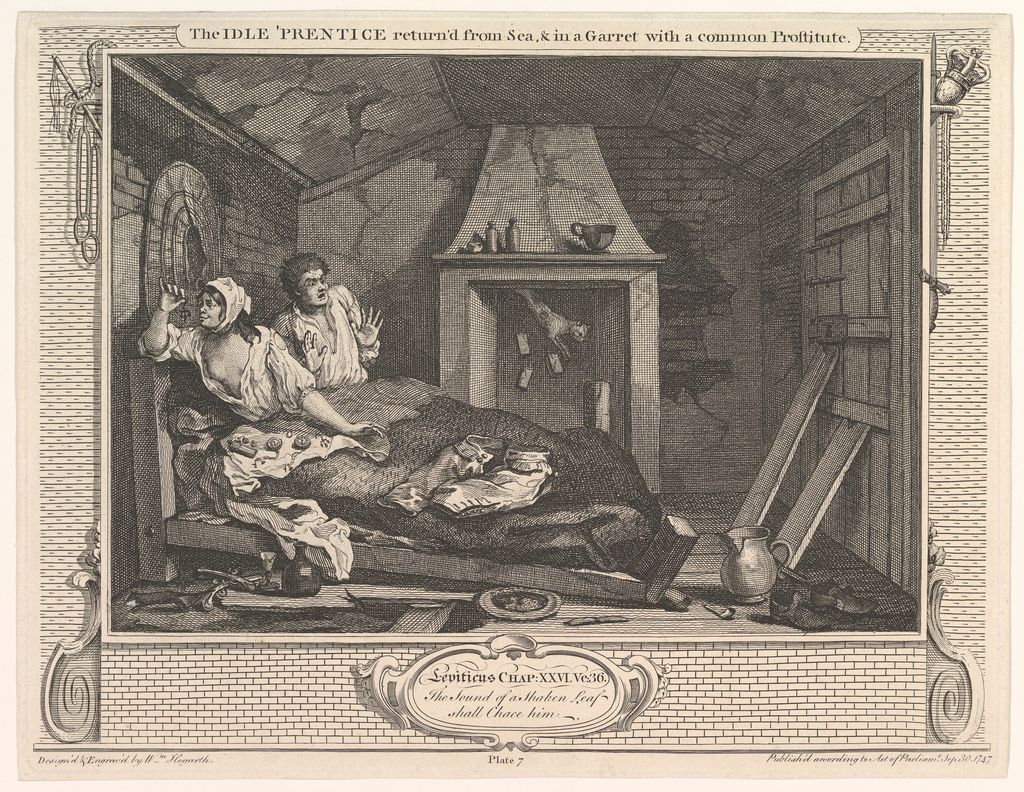
The Idle 'Prentice Returned from Sea and in a Garret with a Common Prostitute (Industry and Idleness, plate 7), William Hogarth, inscribed 30 September 1747. Etching and engraving; second state of two. 91.1.15. Gift of Sarah Lazarus, 1891. Image source. CC0 / Public domain.
Browse Hogarth’s artworks
All 54 individual artworks and series stages in the approved English cluster
Frequently Asked Questions
It is plate 7 of 12 in Industry and Idleness. Following the plate numbers keeps Goodchild’s and Idle’s episodes in the intended order. [1]
Discussion
Look again at the images and ideas explored in The Idle Apprentice Returns from Sea. These editorial prompts invite your observations.
Reader Insights
How do the planks against the door change the way you read Idle’s reaction to the cat?
What do you notice about the different ways Idle and his companion direct their attention?
Join the Conversation
Share a detail, comparison or question about The Idle Apprentice Returns from Sea below.
References
- Flemish Art Collection and Museum of Fine Arts Ghent, William Hogarth, The Idle ’Prentice return’d from Sea, & in a Garret with a common Prostitute, plate 7 from Industry and Idleness, 1958-V-16-1. View source.
- National Gallery of Victoria, William Hogarth, The Idle ’Prentice return’d from sea, and in a garret with a common prostitute, 1995.358.7, Paulson 174 ii/ii. View source.
- Andrew Stevens, Hogarth and the Shows of London, Elvehjem Museum of Art, 1996, pp. 48–49, catalogue no. 40, University of Wisconsin–Madison Libraries. View source.
- The Holy Bible, King James Version, Leviticus 26:36–37. View source.
- The Metropolitan Museum of Art, William Hogarth, The Idle ’Prentice Turned Away and Sent to Sea, plate 5 from Industry and Idleness, 91.1.13. View source.
- The Metropolitan Museum of Art, William Hogarth, The Industrious ’Prentice Out of his Time and Married to his Master’s Daughter, plate 6 from Industry and Idleness, 91.1.14. View source.
- John Styles, “Lodging at the Old Bailey: Lodgings and their Furnishing in Eighteenth-Century London”, in John Styles and Amanda Vickery, eds., Gender, Taste, and Material Culture in Britain and North America, 1700–1830, Yale University Press, 2006, pp. 66–80, author’s copy. View source.
- The Metropolitan Museum of Art, William Hogarth, A Harlot’s Progress, plate 3, 91.1.130. View source.
- The Metropolitan Museum of Art, William Hogarth, The Industrious ’Prentice Grown Rich and Sheriff of London, plate 8 from Industry and Idleness, 91.1.16. View source.
- Vicki Principi, Princeton University Library, William Hogarth Collection, GC113, 2005, drawer 2, plates 6–8. View source.
- University of Toronto Libraries, Hogarth, William, 1697–1764 [Collection of Prints], FO-1 00288, pp. 1 and 8, box 2, folder 8, citing Ronald Paulson, Hogarth’s Graphic Works, revised edition, Yale University Press, 1970, no. 174. View source.
- Wellcome Collection, Thomas Cook after William Hogarth, The Idle ’Prentice return’d from sea, & in a garret with a common prostitute, 1795, 38373i. View source.







