


 by Tom Gurney
Tom Gurney BSc (Hons) is an art history expert with over 20 years experience
Published on June 19, 2020 / Updated on October 14, 2023
Email: tomgurney1@gmail.com / Phone: +44 7429 011000
David Garrick as Richard III: Introduction
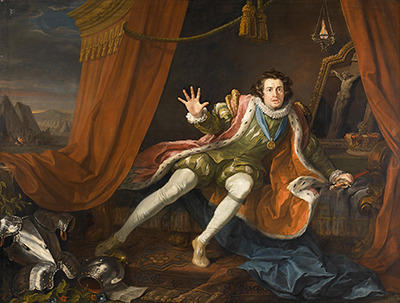
David Garrick throws up an open hand as Richard III wakes from a nightmare on the eve of the Battle of Bosworth. His feet are already off the couch, his body has twisted and his eyes are fixed on something beyond the picture. William Hogarth painted the actor in oils on canvas about 1745. The painting belongs to the Walker Art Gallery in Liverpool (WAG 634), which acquired it in 1956 with help from the Art Fund. The canvas measures 190.5 by 250.8 centimetres. Hogarth gives the actor room to play the shock of waking at life size, while the dark space around him lets the viewer imagine what could have provoked it. [1] [2]
At a Glance
- PaintingWilliam Hogarth, about 1745, oil on canvas, Walker Art Gallery, WAG 634
- London breakthrough19 October 1741, Goodman’s Fields, in Colley Cibber’s adaptation
- Published printWilliam Hogarth and Charles Grignion, 20 June 1746, etching and engraving, second state, Metropolitan Museum of Art, 32.35(238)
- Subscription ticketWilliam Hogarth, eighteenth century, etching, Metropolitan Museum of Art, 26.28.363
This work across William Hogarth’s career
Assembly at Wanstead House
1728–31The Heir
1734The Marriage Settlement
about 1743Gin Lane
1751Canvassing for Votes
1754–55Contents
- The king’s tent
- Shakespeare’s scene and Cibber’s stage
- A likeness worth £200
- The subscription and the published print
- Other portraits of Garrick
The king’s tent
A lifted curtain at the left opens onto a line of tents and watch fires. Inside, the deep folds and heavy gold fringe hang close to the picture’s front edge. They frame a man who seems to have moved faster than his clothes. The fur-lined cloak slips and bunches around his waist and legs, and a length of blue fabric trails across the carpet. The pale stockings make the sudden extension of his legs easy to follow. One hand stretches out with the fingers splayed, and the other braces him at the edge of the couch. The Walker Art Gallery picks out a serpentine line in the pose, an elongated S that can be traced from the lifted arm through the turning body and down the legs. Hogarth later discussed that kind of curve in The Analysis of Beauty (1753). Here it makes the body look poised to move again. [1]
Once the face and hand have caught the eye, the objects around them supply another account of the night. The armour lies in a heap in the foreground, out of use just when the king looks most in need of it. His crown sits behind him at the right, beneath a crucifix and near a hanging lamp. A crumpled sheet lies by the helmet. The paper could suggest a warning or bad news reaching the camp. Its position beside the armour makes the danger outside feel close even as Garrick’s expression draws attention to the danger his character has imagined. The amount of room Hogarth gives these objects invites a viewer to move between the king’s private fright and the obligations waiting for him at daybreak. [1]
Shakespeare’s scene and Cibber’s stage
Garrick made his London breakthrough as Richard on 19 October 1741 at Goodman’s Fields. He played Colley Cibber’s adaptation of Shakespeare’s Richard III, the version he continued to perform during his career. That distinction matters in the tent scene. In Act 5, scene 3 of Shakespeare’s play, the ghosts visit both Richard and his rival Richmond in their respective camps. They predict disaster for Richard and encourage Richmond. On waking, Richard questions whether he fears himself and imagines his conscience giving evidence against him. The two camps allow the audience to weigh Richard’s terror against the assurance given to the man who will defeat him. [3] [4]
As the art historian Robin Simon explains, Cibber’s staging of the nightmare concentrates on Richard and a single tent. The adapted waking speech carries Richard from cries for a fresh horse and help with his wounds to the physical sensations of sweat, cold and trembling. Simon also connects Hogarth’s distant watch fires with Cibber’s borrowing from the description of the camps before Agincourt in Shakespeare’s Henry V. The fires work at two distances. They locate the tent in a military camp at a glance, and their small scale measures the gap between the soldiers keeping watch and the shock that isolates the king. [5]
Hogarth places the burden of making the ghosts imaginable on Garrick’s body. The open palm looks capable of warding off an approach, though its spread fingers also suggest an involuntary start. Richard’s feet are pointed in different directions, while his eyes stay fixed. Someone watching Garrick in the theatre would have had the pace of the awakening and the sound of the voice to follow. In the painting, the opposed movements of eyes, hand and legs make it possible to recover something of that sequence from a single pose. The composition offers a painter’s interpretation of a stage performance whose exact gestures and scenery at Goodman’s Fields remain uncertain. [1] [3] [5]
A likeness worth £200
The Folger Shakespeare Library identifies Thomas Duncombe as the buyer of the painting for £200. Hogarth himself connected the price with the strength of the likeness. The Walker records the work passing down in the Duncombe family and then through Agnew’s Gallery before its purchase in 1956. The likeness had a material complication. The National Portrait Gallery and the Folger report that the face was painted on a separate piece of canvas inserted into the picture. Stories about Garrick deliberately changing his expression during sittings circulated later. The insertion is the more tangible evidence of the painter’s work on the face, where the sitter had to remain recognisable through the expression of terror. [1] [2] [6]
Watch Hogarth’s paintings and prints
Five films on Hogarth’s painted stories, prints, drawing methods and work for the Foundling Hospital.
William Hogarth and the Foundling Hospital | HENI Talks
Caro Howell discusses Thomas Coram, Hogarth’s portrait of him and the artist’s work for the Foundling Hospital.
Watch on YouTubeAt the 1868 National Portrait Exhibition at South Kensington, the Earl of Feversham lent the painting under the title David Garrick as “Richard III.” The catalogue described the raised hand and the king’s terror alongside the crown, armour and distant camp. That entry shows how the scene was read in a historical portrait exhibition. Garrick earned his place in the catalogue under his own name, and the chief means of recognising him was the action through which he made the role famous. [7]
Hogarth had already worked out a different relationship between actors and viewers in A Scene from The Beggar’s Opera, the oil of 1728/1729 at the National Gallery of Art in Washington (1983.1.42). There, Macheath stands in chains between two women who plead for him, and faces in the boxes watch the action. The painted spectators give the viewer a place in a recognisable theatre. Garrick’s tent also opens like a curtained stage, but the space beneath the lifted fabric leads to the camp. The theatrical scenes in the overview of Hogarth’s paintings show how he varied the setting to direct attention towards an ensemble or a single performer. [1] [8]
The subscription and the published print
Hogarth’s etched subscription ticket at the Metropolitan Museum of Art (26.28.363) makes a compact advertisement out of a theatrical mask and a painter’s palette. A cord passes through the mask and suspends it beside the tools of another craft. The wording entitles the bearer to a print of Garrick after a picture painted by Hogarth and gives the promised dimensions as twenty by fifteen and a half inches. The ticket describes the article a buyer could expect while presenting the painter and the actor together in its design. The Met dates this sheet broadly to the eighteenth century. [9]
The Met’s second-state impression of Mr. Garrick in the Character of Richard III (32.35(238)) is an etching and engraving published on 20 June 1746. It credits Hogarth as the painter and names him alongside Charles Grignion as engraver. The impression preserves the direction of the painted composition, with the camp at the left and the king’s outstretched hand against the dark interior. Fine intersecting lines create the depth of the curtain folds, while areas of lighter paper pick out the ruff, stockings and fingers. Even at the smaller scale, the print preserves enough of the distant camp to set the authority suggested by the royal furnishings against the exposure of the figure within them. [1] [10]
The line below the printed title identifies Act 5, scene 7. That caption gave buyers a place to situate Garrick’s pose within the play as it was known in the theatre. A reader of the Folger edition of Shakespeare will find the double visitation of the ghosts in Act 5, scene 3. In a bound collection of engravings at Sir John Soane’s Museum (B5637), David Garrick in the Character of Richard III is listed at number 30, between Southwark Fair and The Gate of Calais. An inscription in the volume records it as a gift from Hogarth to Dr Isaac Schomberg, who attended Garrick during his last illness. The gift note gives this impression a connection with the actor beyond the likeness itself. The binding also puts that likeness alongside crowded narrative pictures and extended sequences, showing the range of Hogarth’s engravings. [4] [10] [11]
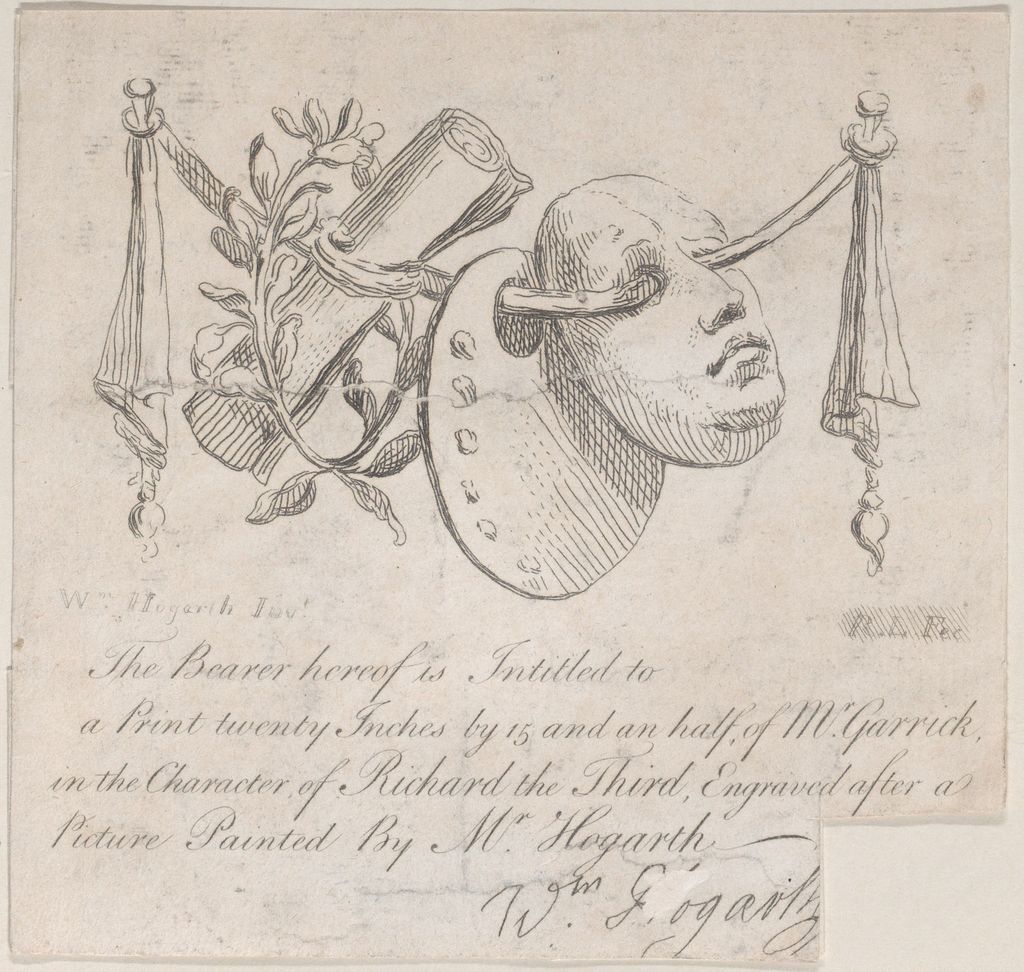
Subscription Ticket for "Garrick in the Character of Richard III", William Hogarth, 18th century. Etching. 26.28.363. Gift of Bella C. Landauer, 1926. Image source. CC0 / Public domain.
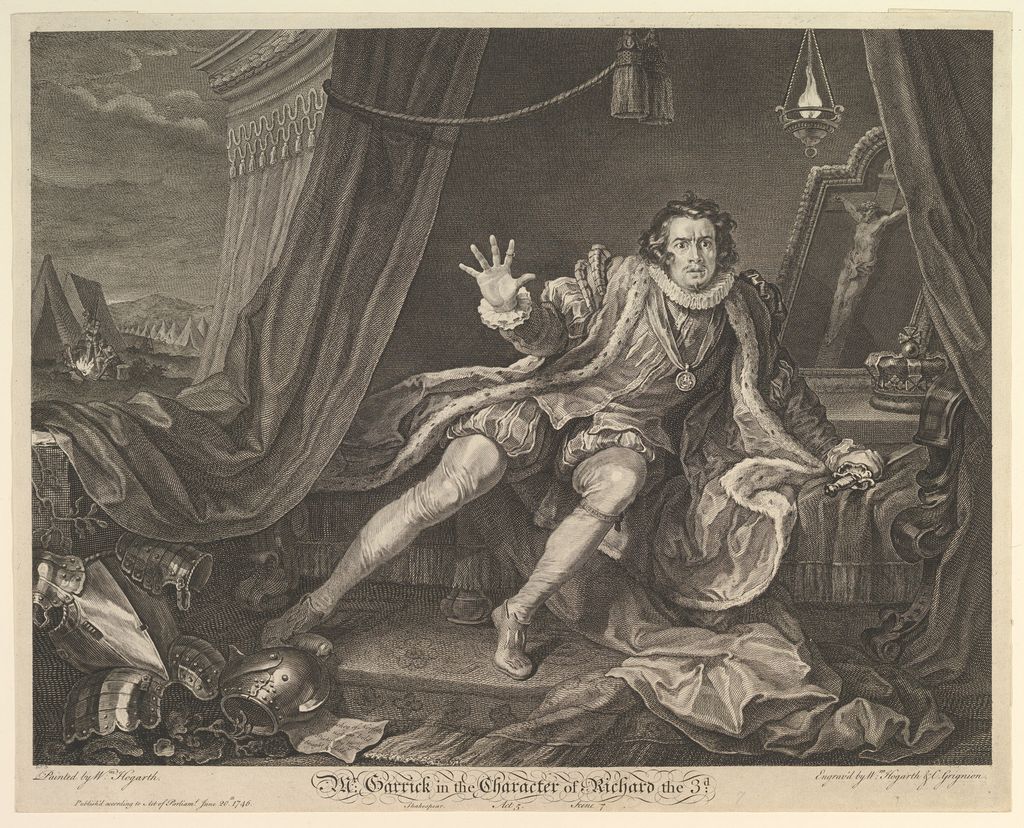
Mr. Garrick in the Character of Richard III, William Hogarth and Charles Grignion, June 20, 1746. Etching and engraving; second state of two. 32.35(238). Harris Brisbane Dick Fund, 1932. Image source. CC0 / Public domain.
Other portraits of Garrick
Nathaniel Dance-Holland’s 1771 painting of Garrick as Richard, held at the Town Hall in Stratford-upon-Avon, takes up the story after the nightmare. The difference is clear in John Dixon’s 1772 mezzotint after it, also at the Met (53.600.1843). Here Richard is unhorsed on the battlefield and brandishes his weapon. The upright format gives the armed figure nearly the whole height of the image. Both print titles name the actor and the king. The changing role of the raised arm tells the scenes apart. Dixon’s Richard lifts a weapon to confront a living enemy. Hogarth’s has only his bare hand between himself and whatever he sees. [2] [10] [12]
Hogarth also painted Garrick with his wife, the dancer Eva-Maria Veigel, in the double portrait now in the Royal Collection (RCIN 405682). In that painting, signed and dated 1757, Garrick sits at a writing table and his wife reaches for his pen. The action is domestic and playful, and the face belongs to an actor at work as a writer. In the Walker canvas the lifted hand and the stare into empty space carry an entire stage predicament. They are the details that the engraving could preserve most directly when the colour and scale of the painting gave way to ink on paper. [1] [10] [13]
Browse Hogarth’s artworks
All 54 individual artworks and series stages in the approved English cluster
Frequently Asked Questions
Discussion
Look again at the images and ideas explored in David Garrick as Richard III. These editorial prompts invite your observations.
Reader Insights
How do the splayed fingers and the hand braced against the couch suggest different movements in the same instant?
What does the theatrical mask beside the painter’s palette tell you about how Hogarth presented the print to subscribers?
Join the Conversation
Share a detail, comparison or question about David Garrick as Richard III below.
References
- Walker Art Gallery, National Museums Liverpool, William Hogarth, David Garrick as Richard III, about 1745, WAG 634, collection and provenance record. View source.
- National Portrait Gallery, “David Garrick,” extended iconography, entries for Hogarth’s Walker portrait and Nathaniel Dance’s 1771 painting. View source.
- Folger Shakespeare Library, David Garrick, 1717–1779: A Theatrical Life, “Garrick as Richard III,” including Cibber’s adaptation and the 1756 acting edition, PR2821 1756 copy 1 Sh.Col. View source.
- William Shakespeare, Richard III, Act 5, scene 3, edited by Barbara A. Mowat and Paul Werstine, Folger Shakespeare Library. View source.
- Robin Simon and William Chubb, “The little-ingenious Garrick and the ingenious little Hogarth,” Royal Collection Trust lecture, 23 April 2014, PDF pp. 4, 16–17. View source.
- Folger Shakespeare Library, “Garrick’s Image,” Garrickomania, sections on Garrick’s likeness and theatrical portraiture. View source.
- South Kensington Museum, Catalogue of the Third and Concluding Exhibition of National Portraits, 1868, no. 792, David Garrick as “Richard III.”. View source.
- National Gallery of Art, William Hogarth, A Scene from The Beggar’s Opera, 1728/1729, 1983.1.42. View source.
- The Metropolitan Museum of Art, William Hogarth, Subscription Ticket for “Garrick in the Character of Richard III”, 26.28.363. View source.
- The Metropolitan Museum of Art, William Hogarth and Charles Grignion, Mr. Garrick in the Character of Richard III, 20 June 1746, second state of two, 32.35(238). View source.
- Sir John Soane’s Museum, [Hogarth’s works.], B5637, item 30 (Paulson 165). View source.
- The Metropolitan Museum of Art, John Dixon after Nathaniel Dance-Holland, Mr. Garrick as Richard the Third, 18 April 1772, second state, 53.600.1843. View source.
- Royal Collection Trust, William Hogarth, David Garrick with his wife Eva-Maria Veigel, RCIN 405682, collection partner record. View source.







